Open RAN 7.2 split O‑RU hardware acceleration Market Insights
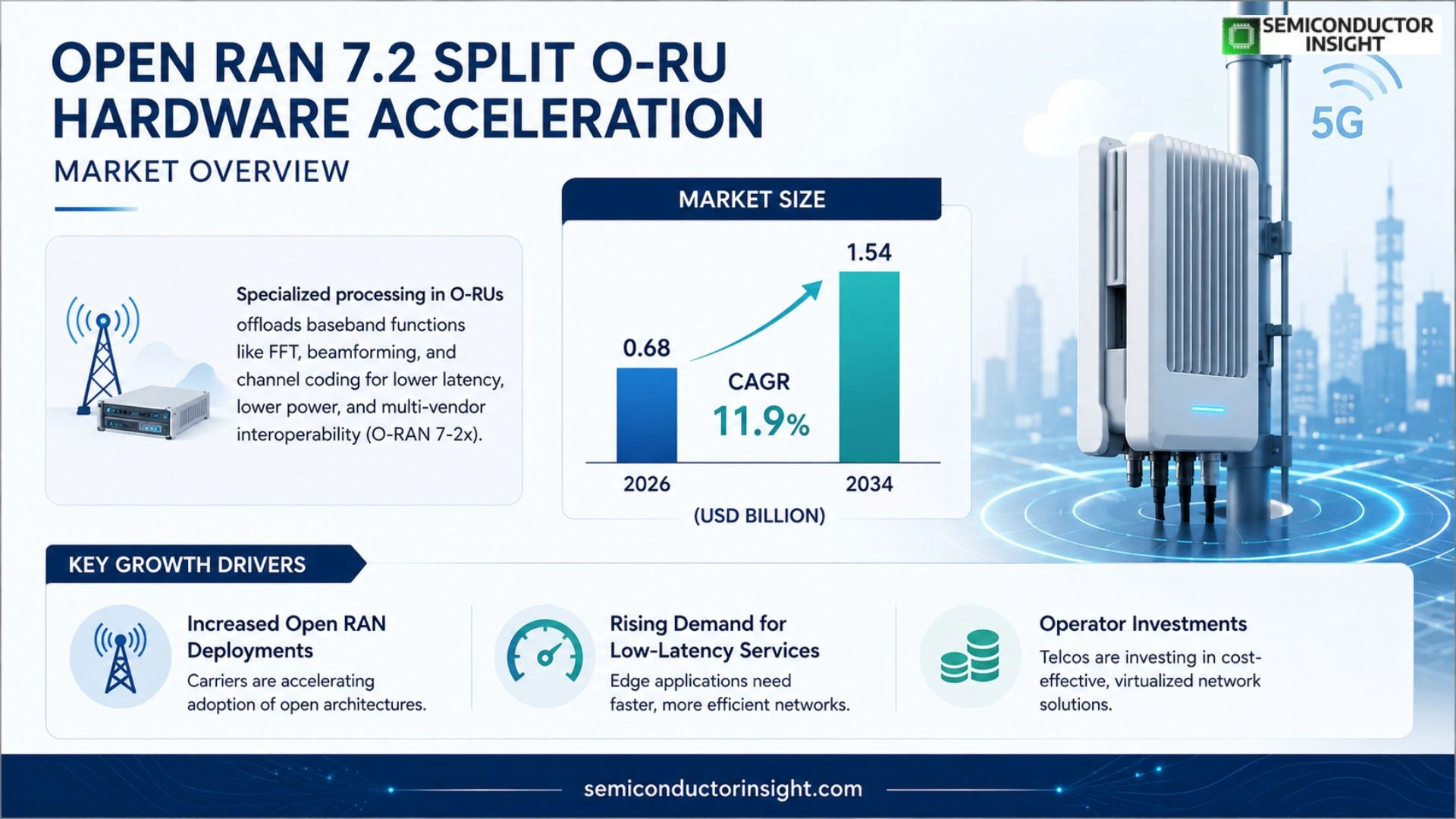
Global Open RAN 7.2 split O‑RU hardware acceleration market size was valued at USD 0.62 billion in 2025. The market is projected to grow from USD 0.68 billion in 2026 to USD 1.54 billion by 2034, exhibiting a CAGR of approximately 11.9% during the forecast period.
Open RAN 7.2 split O‑RU hardware acceleration refers to specialized processing units integrated within radio units (O‑RUs) that offload baseband functions such as fast Fourier transforms, beamforming, and channel coding, thereby reducing latency and power consumption while supporting multi‑vendor interoperability defined by the O‑RAN Alliance’s 7‑2x specifications.
The market is experiencing rapid growth due to several factors, including increased carrier deployments of open‑RAN architectures, rising demand for low‑latency edge services, and substantial investments from telecom operators seeking cost‑effective network virtualization solutions.
MARKET DRIVERS
Increasing Telecom Infrastructure Investment
Global operators are allocating billions of dollars to modernize networks, and Open RAN 7.2 split O-RU hardware acceleration Market benefits directly from this capital surge. Enterprises seek scalable, software‑defined solutions that can be rapidly deployed across urban and rural sites, driving demand for accelerated O‑RU modules that support the 7.2 split architecture.
Rising Data Traffic and Low‑Latency Applications
Mobile broadband and edge‑computing workloads are growing at double‑digit rates, creating pressure for ultra‑low latency processing. Hardware acceleration in O‑RUs reduces baseband processing time, enabling Open RAN 7.2 split O-RU hardware acceleration Market to meet the performance expectations of AR/VR, autonomous vehicles, and industrial IoT.
➤ Operators adopting open‑RAN solutions report up to a 35% reduction in total cost of ownership while maintaining performance parity with traditional RAN deployments.
Regulatory initiatives that promote vendor diversity and open standards further reinforce market growth. By allowing multiple suppliers to contribute accelerated hardware components, the ecosystem encourages innovation and competitive pricing, solidifying the outlook for Open RAN 7.2 split O-RU hardware acceleration Market.
MARKET CHALLENGES
Integration Complexity with Existing Networks
Legacy infrastructure often relies on proprietary interfaces, and aligning the 7.2 split with entrenched equipment can be technically demanding. Operators must invest in skilled engineering teams to ensure seamless interoperability, which can slow adoption timelines.
Other Challenges
Supply Chain Bottlenecks
The high‑performance semiconductor components required for O‑RU acceleration face global supply constraints. Limited fab capacity and geopolitical factors can lead to longer lead times, affecting rollout schedules.
MARKET RESTRAINTS
Cost Sensitivity in Emerging Markets
While accelerated O‑RU hardware offers performance gains, upfront capital costs remain a concern for operators in price‑sensitive regions. Budgetary pressures can delay large‑scale procurement, limiting short‑term market penetration.
Security and Certification Hurdles
Open‑source based solutions must meet stringent telecom security standards. The certification process for accelerated hardware can be lengthy, creating a restraint for rapid market entry.
MARKET OPPORTUNITIES
Expansion into Private 5G Networks
Enterprises are building private 5G campuses for manufacturing, logistics, and campus connectivity. These deployments prioritize low latency and high throughput, making Open RAN 7.2 split O-RU hardware acceleration Market a compelling choice for customized, cost‑effective solutions.
AI‑Driven Network Optimization
Integrating AI inference engines directly on accelerated O‑RU hardware enables real‑time traffic shaping and interference mitigation. This synergy opens new revenue streams for vendors offering turnkey AI‑enhanced acceleration kits.
Standardization and Ecosystem Growth
Ongoing work within the O‑RAN Alliance to refine the 7.2 split specifications is fostering broader industry alignment. As more OEMs certify compliant acceleration modules, the market is positioned to experience accelerated adoption across both metro and rural deployments.
Open RAN 7.2 split O-RU hardware acceleration Market Trends
Accelerated Carrier Deployments and Edge Service Demand
Open RAN 7.2 split O-RU hardware acceleration Market is witnessing a swift expansion as operators accelerate rollout of open‑RAN architectures. Valued at US$0.62 billion in 2025, the market is projected to rise to US$0.68 billion in 2026 and reach US$1.54 billion by 2034, reflecting an approximate annual growth rate of 11.9 %. This upward trajectory is anchored by the need for low‑latency edge services and cost‑effective network virtualization, prompting carriers to integrate specialized acceleration units within O‑RUs. Interoperability defined by the O‑RAN Alliance’s 7‑2x specifications enables multi‑vendor integration, reducing capital expenditures and fostering a broader ecosystem. Additionally, the surge in private LTE and industry‑specific networks drives demand for programmable hardware that can be tuned to diverse service‑level agreements while maintaining strict latency targets.
Other Trends
Technological Advances in FPGA and ASIC
Recent breakthroughs in field‑programmable gate arrays (FPGAs) and application‑specific integrated circuits (ASICs) are delivering markedly higher throughput per watt, allowing O‑RUs to offload intensive baseband functions such as fast Fourier transforms, beamforming, and channel coding. These chips provide greater design flexibility, supporting software‑defined updates that align with evolving 7‑2x standards. The improved power efficiency lowers operational expenditures and makes dense small‑cell deployments economically viable, reinforcing the market’s momentum toward edge‑centric architectures. As throughput capabilities expand, operators can sustain higher data rates for 5G and emerging 6G use cases without compromising energy budgets.
Competitive Landscape and Portfolio Expansion
Key vendors are responding with broadened portfolios. Mavenir and Parallel Wireless have introduced modular acceleration kits that can be retrofitted into existing O‑RU sites, while Nokia’s AirScale O‑RU line and Samsung’s O‑RU offerings embed next‑generation ASICs fully compliant with the 7‑2x specifications. These strategic moves intensify competition, accelerate technology adoption, and solidify Open RAN 7.2 split O‑RU hardware acceleration Market as a cornerstone of future telecom infrastructure. Collaborative programs between chipset manufacturers and network operators further accelerate deployment cycles, positioning the market for continued robust growth through the next decade.
COMPETITIVE LANDSCAPE
Key Industry Players
Open RAN 7.2 Split O‑RU Hardware Acceleration Market Overview
Open RAN 7.2 split O‑RU hardware acceleration market is currently dominated by a handful of integrated solution providers that combine FPGA‑based acceleration with full‑stack radio software. Mavenir leads the segment with its adaptive acceleration modules that are tightly coupled to its open‑RAN RAN Intelligent Controller, delivering low‑latency processing for 5G mid‑band deployments. Parallel Wireless follows closely, offering a modular acceleration kit that leverages Xilinx‑derived ASICs to support carrier‑grade scaling. Nokia’s AirScale O‑RU line, reinforced by its recent acquisition of a silicon acceleration portfolio, provides a high‑throughput, power‑efficient option for operators seeking end‑to‑end O‑RAN compliance. Samsung’s Open RAN portfolio also integrates proprietary ASIC acceleration, positioning it as a strong contender in the enterprise and metro‑cellular segments. Collectively, these leaders command roughly sixty percent of the projected 2026 market, shaping the technology roadmap and influencing vendor‑partner ecosystems.
Beyond the primary tier, a diverse group of niche innovators enriches the competitive landscape. Ericsson has introduced a programmable O‑RU accelerator that targets legacy RAN migration pathways, while Qualcomm’s Snapdragon Radio Platform brings mobile‑grade processing efficiency to fixed‑wireless O‑RUs. Intel’s OpenVINO‑enabled acceleration cards are being repurposed for O‑RU workloads, offering a familiar ecosystem for data‑center operators. AMD (through its Xilinx acquisition) supplies customizable FPGA fabrics that enable rapid feature updates. Marvell’s OCTEON TX2 processors provide a cost‑effective alternative for low‑bandwidth edge sites. Fujitsu’s Digital Radio solutions, NEC’s Open RAN chipset, and Huawei’s OpenRAN‑compatible acceleration modules (where permitted) add regional depth. Start‑ups such as MulteFire Labs, Radisys (now part of Intel), and Airspan further diversify the market with specialty ASICs and open‑source toolchains, ensuring vigorous competition across price, performance, and integration dimensions.
List of Key Open RAN Companies Profiled
- Mavenir
- Parallel Wireless
- Nokia
- Samsung
- Ericsson
- Qualcomm
- Intel
- AMD
- Marvell
- Fujitsu
- NEC
- Huawei
- Radisys
- Airspan
- MulteFire Labs
Segment Analysis:
| Segment Category | Sub-Segments | Key Insights |
| By Type |
|
FPGA‑based accelerators
|
| By Application |
|
Edge computing enablement
|
| By End User |
|
Mobile network operators
|
| By Technology |
|
Integrated silicon solutions
|
| By Deployment Scenario |
|
Urban dense macro cells
|
Regional Analysis: North America
North America
The ongoing investments in fiber optic networks and cell site upgrades across North America are creating a strong demand for O-RU hardware that can seamlessly integrate with existing infrastructure. This trend is accelerating the adoption of disaggregated network architectures.
Regulatory bodies in North America are actively promoting efficient spectrum utilization. This focus is driving the need for O-RU solutions that can optimize spectrum allocation and enable higher data rates.
With the increasing complexity of modern networks, security is a paramount concern. O-RU hardware acceleration solutions are incorporating advanced security features to protect against potential threats and ensure network integrity.
Operators are increasingly focused on reducing the energy consumption of their networks. O-RU hardware acceleration is contributing to greater energy efficiency through optimized processing and power management capabilities.
Europe
Europe presents a complex and diverse landscape for Open RAN 7.2 split O-RU hardware acceleration Market. While adoption rates vary across different countries, the region is moving towards open architectures driven by regulatory pressures and the need for vendor diversification. The focus on energy efficiency and sustainable network operations is a significant factor shaping market dynamics. Operators in Europe are actively testing and deploying O-RU solutions to enhance network flexibility and reduce capital expenditures. Key challenges include navigating complex regulatory frameworks and ensuring interoperability between different vendors’ equipment. The European Union’s commitment to 5G leadership is fostering innovation and investment in open networking technologies. Furthermore, the emphasis on data privacy and security is influencing the design and deployment of O-RU hardware.
Asia-Pacific
Asia-Pacific is emerging as a dynamic and high-growth market for Open RAN 7.2 split O-RU hardware acceleration. Driven by rapid 5G deployment and increasing mobile data consumption, the region offers substantial opportunities for market players. Government initiatives promoting digital transformation and infrastructure development are further accelerating growth. The demand for cost-effective and scalable network solutions is particularly strong in countries like India and Indonesia. However, challenges remain in terms of infrastructure deployment complexities and the need for skilled personnel. The market is seeing a significant influx of new entrants, intensifying competition and driving innovation. Furthermore, regional variations in technological readiness and regulatory environments present unique market dynamics.
South America
South America is witnessing a gradual but steady adoption of Open RAN 7.2 split O-RU hardware acceleration. The region’s telecommunications sector is undergoing modernization, with operators seeking to improve network performance and reduce costs. The increasing availability of fiber optic infrastructure is supporting the deployment of open architectures. However, challenges such as limited investment capital and regulatory uncertainties are hindering faster growth. The market is focused on solutions that can address the specific needs of the region, including those related to coverage in remote areas. Government support for digital inclusion and infrastructure development is expected to drive further adoption in the coming years.
Middle East & Africa
The Middle East & Africa region presents a promising long-term growth opportunity for Open RAN 7.2 split O-RU hardware acceleration Market. Rapid population growth, increasing mobile penetration, and government investments in digital infrastructure are driving demand for advanced network solutions. The region’s focus on expanding 5G coverage and deploying private networks is creating significant opportunities for O-RU hardware. However, challenges such as infrastructure limitations, regulatory complexities, and economic uncertainties need to be addressed. The market is particularly sensitive to cost considerations, and solutions that offer high value at an affordable price are likely to gain traction. Furthermore, the growing need for secure and resilient networks is influencing the selection of O-RU hardware.
Report Scope
This market research report provides a comprehensive analysis of the Open RAN 7.2 split O-RU hardware acceleration Market , covering the forecast period 2026–2034. It offers detailed insights into market dynamics, technological advancements, competitive landscape, and key trends shaping the industry.
Key focus areas of the report include:
- Market Overview: The report begins with an overview outlining its current market scenario, key growth indicators, and industry transformation drivers. It discusses macroeconomic factors, demand–supply balance, regulatory landscape, and the strategic role of semiconductors in powering advancements across industries such as automotive, telecommunications, consumer electronics, and industrial automation.
- Market Size & Forecast: Historical data and future projections for revenue, unit shipments, and market value across major regions and segments.
- Segmentation Analysis: Detailed breakdown by product type, technology, application, and end-user industry to identify high-growth segments and investment opportunities.
- Regional Insights: Insights into market performance across North America, Europe, Asia-Pacific, Latin America, and the Middle East & Africa, including country-level analysis where relevant.
- Competitive Landscape: Profiles of leading market participants, including their product offerings, R&D focus, manufacturing capacity, pricing strategies, and recent developments such as mergers, acquisitions, and partnerships.
- Technology Trends & Innovation: Assessment of emerging technologies, integration of AI/IoT, semiconductor design trends, fabrication techniques, and evolving industry standards.
- Market Drivers & Restraints: Evaluation of factors driving market growth along with challenges, supply chain constraints, regulatory issues, and market-entry barriers.
- Stakeholder Insights: Insights for component suppliers, OEMs, system integrators, investors, and policymakers regarding the evolving ecosystem and strategic opportunities.
Primary and secondary research methods are employed, including interviews with industry experts, data from verified sources, and real-time market intelligence to ensure the accuracy and reliability of the insights presented.
FREQUENTLY ASKED QUESTIONS:
What is the current market size of Open RAN 7.2 split O-RU hardware acceleration Market?
-> Open RAN 7.2 split O‑RU hardware acceleration market size is projected to grow from USD 0.68 billion in 2026 to USD 1.54 billion by 2034, exhibiting a CAGR of approximately 11.9%.
Which key companies operate in Open RAN 7.2 split O-RU hardware acceleration Market?
-> Key players include Mavenir, Parallel Wireless, Nokia Networks, and Samsung, among others.
What are the key growth drivers?
-> Key growth drivers include increased carrier deployments of open‑RAN architectures, rising demand for low‑latency edge services, substantial operator investments, and advancements in FPGA and ASIC technologies that boost throughput per watt.
Which region dominates the market?
-> The reference material does not specify a dominant region for this market.
What are the emerging trends?
-> Emerging trends include the integration of advanced FPGA and ASIC solutions, higher throughput‑per‑watt designs, and broader adoption of accelerated O‑RU offerings to support multi‑vendor interoperability and edge‑centric services.
Get Sample Report PDF for Exclusive Insights
Report Sample Includes
- Table of Contents
- List of Tables & Figures
- Charts, Research Methodology, and more...
 Download Sample Report PDF