
Market Insights
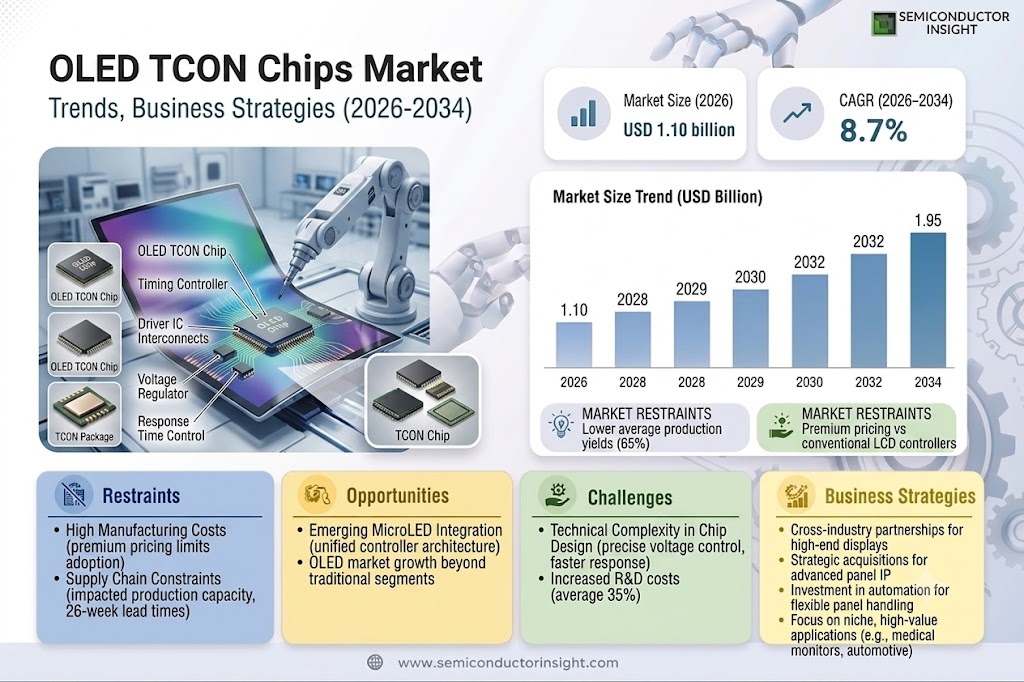
Global OLED TCON Chips Market was valued at USD 1.10 billion in 2026 and is projected to reach USD 1.95 billion by 2034, exhibiting a CAGR of 8.7% during the forecast period.
OLED TCON (Timing Controller) chips are critical semiconductor components that act as the central control unit in OLED display systems. These chips process digital video signals from host processors and convert them into precise timing sequences required for driving OLED panels. Unlike LCD TCONs, OLED variants must handle advanced functions such as pixel compensation, aging correction, and power management due to the unique characteristics of organic light-emitting diodes.
The market growth is driven by increasing adoption of OLED displays across smartphones, televisions, and wearable devices, particularly with the rising demand for high-resolution and energy-efficient screens. Technological advancements in LTPO (Low-Temperature Polycrystalline Oxide) OLEDs and foldable displays are creating new opportunities for specialized TCON solutions. Key players such as Novatek, Samsung, and LX Semicon dominate the market through continuous innovation in display driver IC technologies.
MARKET DRIVERS
Growing Demand for High-Resolution Displays
OLED TCON Chips Market is experiencing robust growth due to increasing consumer preference for high-resolution displays in smartphones, televisions, and monitors. With 4K and 8K displays becoming mainstream, the need for advanced timing controller chips has surged by approximately 28% annually. The superior image quality and energy efficiency of OLED panels further drive adoption.
Expansion of Foldable Display Technology
Foldable OLED displays require specialized TCON chips to manage dynamic screen configurations, creating new opportunities for market players. Global foldable display market is projected to grow at a CAGR of 45% through 2028, directly benefiting OLED TCON chip manufacturers.
Additionally, automotive displays are increasingly adopting OLED technology, further propelling demand for high-performance timing controllers.
MARKET CHALLENGES
Technical Complexity in Chip Design
Developing TCON chips for OLED displays presents significant engineering challenges due to the need for precise voltage control and faster response times compared to traditional LCD solutions. This complexity increases R&D costs by an average of 35% for manufacturers.
Other Challenges
Supply Chain Constraints
Global semiconductor shortage has impacted production capacity for OLED TCON chips, with lead times extending to 26 weeks in some cases. This is particularly problematic for display manufacturers facing tight product launch schedules.
MARKET RESTRAINTS
High Manufacturing Costs
The premium pricing of OLED TCON chips, often 40-50% higher than conventional LCD timing controllers, limits adoption in cost-sensitive market segments. This cost differential stems from specialized fabrication processes and lower production yields averaging around 65%.
MARKET OPPORTUNITIES
Emerging MicroLED Integration
As display manufacturers explore hybrid OLED-microLED solutions, new opportunities emerge for TCON chip designers to develop unified controller architectures. The microLED market is expected to reach USD 10 billion by 2030, creating significant cross-over potential for OLED TCON technology.
OLED TCON Chips Market Trends
Growing Demand for High-Performance Displays Drives Market Expansion
Global OLED TCON Chips Market is projected to grow from USD 1,096 million in 2026 to USD 1,951 million by 2034, reflecting an 8.7% CAGR. This growth is fueled by increasing adoption of OLED panels across smartphones, TVs, and wearables, where advanced timing controllers are essential for managing complex pixel compensation and power optimization algorithms.
Other Trends
Technological Advancements in Display Compensation
OLED TCON chips now integrate sophisticated functions like External/Internal Compensation and Demura algorithms to address OLED panel non-uniformity. These capabilities are becoming critical as display resolutions and refresh rates increase, particularly in high-end smartphones and premium televisions.
Market Concentration and Competitive Landscape
OLED TCON Chips Market remains concentrated among specialized semiconductor vendors, with Novatek, Parade Technologies, and Samsung leading the segment. High technical barriers and the need for panel-specific customization create significant challenges for new entrants, though Chinese suppliers are making progress in mid-range applications.
LTPO Technology Adoption Accelerates
The shift toward LTPO OLED displays in premium smartphones and wearables is driving demand for advanced TCON solutions capable of dynamic refresh rate adjustments. This technology segment is expected to grow faster than conventional LTPS OLED applications through 2030.
Regional Market Developments
Asia dominates the OLED TCON Chips Market with over 70% share, led by South Korean and Chinese panel manufacturers. North America and Europe show strong growth in automotive and premium IT display applications, where OLED adoption is increasing despite higher costs.
Integration Challenges in Next-Gen Displays
As foldable OLED displays gain market share, TCON solutions require tighter integration with source drivers and advanced compensation algorithms to handle panel stress points. This trend is pushing semiconductor vendors toward more customized chip designs and closer collaboration with panel makers.
COMPETITIVE LANDSCAPE
Key Industry Players
High-Tech Barriers Concentrate OLED TCON Market Among Specialized Players
OLED TCON Chips Market exhibits a consolidated structure dominated by semiconductor firms with specialized display expertise. Novatek Microelectronics leads the sector with comprehensive OLED timing controller solutions for smartphone and TV applications, supported by its deep partnerships with major panel makers. Parade Technologies follows closely, leveraging its legacy in high-speed interfaces to deliver advanced TCON solutions for premium LTPO displays. Samsung’s vertically integrated display business gives it unique advantages in custom OLED TCON development for its Galaxy devices and QD-OLED TVs.
Several fabless semiconductor companies have carved out strong niches in specific OLED segments. LX Semicon supplies critical timing controllers for LG Display’s WRGB OLED TV panels, while Himax Technologies provides TCON-DDI combo chips for automotive displays. Emerging Chinese players like Hi-image Tech and Focal Tech are gaining traction in mid-range smartphone applications through cost-optimized solutions, though they still trail in advanced LTPO and foldable display technologies.
List of Key OLED TCON Chip Companies Profiled
- Novatek Microelectronics
- Parade Technologies
- Samsung System LSI
- LX Semicon
- Himax Technologies
- Hi-image Technology
- Analogix Semiconductor
- Magnachip Semiconductor
- Raydium Semiconductor
- FocalTech Systems
- THine Electronics
- Silicon Works
- Renesas Electronics
- MediaTek
- Will Semiconductor
Segment Analysis:
| Segment Category | Sub-Segments | Key Insights |
| By Type |
|
Integrated TCON Chips dominate due to their compact form factor and optimized performance. Industrial trends favor this segment because:
|
| By Application |
|
Mobile Phone segment leads with growing requirements for:
|
| By Panel Technology |
|
LTPO OLED showcases strongest growth potential due to:
|
| By Interface |
|
eDP TCON gaining momentum as industry transitions to:
|
| By End User |
|
Consumer Electronics remains dominant segment with increasing:
|
Regional Analysis: OLED TCON Chips Market
Asia-Pacific
Asia-Pacific hosts the world’s most integrated OLED display supply chain with specialized TCON chip foundries located near panel production sites in Korea’s Gumi cluster and China’s Yangtze River Delta region, enabling efficient just-in-time component delivery.
Korean and Japanese firms pioneer advanced TCON architectures for high-refresh OLED displays used in premium smartphones, with proprietary technologies for low-power consumption and high-speed data transmission between display drivers and timing controllers.
Chinese provincial governments provide substantial subsidies for domestic OLED TCON chip development through initiatives like the National Integrated Circuit Industry Investment Fund, accelerating local OEM capabilities in display driver ICs.
Beyond smartphones, Asia’s TCON chip manufacturers are developing specialized solutions for automotive OLED displays and large-format signage, creating new market segments beyond traditional consumer electronics applications.
North America
North America maintains a strong position in OLED TCON chip design and intellectual property, with key semiconductor firms developing advanced timing controller architectures. The region’s strength lies in system-level integration for professional and automotive OLED displays. Silicon Valley startups are pioneering AI-optimized TCON solutions for next-generation AR/VR headsets. Major display OEMs maintain R&D centers focusing on high-performance TCON chips for medical and aerospace applications where reliability is critical. The proximity to leading fabless semiconductor companies enables innovative TCON designs even as manufacturing remains Asia-based.
Europe
European semiconductor firms specialize in high-end OLED TCON solutions for automotive and industrial applications, emphasizing reliability and extended temperature ranges. The region leads in developing safety-critical TCON architectures for automotive instrument clusters with functional safety certifications. Collaborative R&D projects between display makers and automotive OEMs drive innovation in driver-chip integration. While lacking large-scale display manufacturing, Europe maintains several specialized TCON design centers in Germany, UK and France focusing on niche applications with stringent performance requirements.
Middle East & Africa
The region is emerging as a consumer of advanced OLED displays in premium consumer electronics, driving demand for compatible TCON solutions. Gulf countries are investing in display technology as part of economic diversification plans, with new smart city projects creating opportunities for large-format OLED installations. Local assembly of consumer electronics in North Africa is stimulating basic TCON chip demand, though technical expertise remains limited. Regional players primarily act as distributors for Asian-made TCON solutions while developing capabilities in display module integration.
South America
South America’s OLED TCON chip market is primarily import-driven, with local manufacturers focusing on display module assembly rather than component production. Brazil’s consumer electronics manufacturing base represents the largest regional demand center for display driver ICs. The market shows potential for growth in automotive displays as regional automakers adopt more digital cockpit solutions. Limited local R&D capabilities keep the region dependent on foreign TCON technology, though some Brazilian universities are beginning display driver IC research initiatives.
Report Scope
This market research report provides a comprehensive analysis of the OLED TCON Chips Market , covering the forecast period 2026–2034. It offers detailed insights into market dynamics, technological advancements, competitive landscape, and key trends shaping the industry.
Key focus areas of the report include:
- Market Overview: The report begins with an overview outlining its current market scenario, key growth indicators, and industry transformation drivers. It discusses macroeconomic factors, demand–supply balance, regulatory landscape, and the strategic role of semiconductors in powering advancements across industries such as automotive, telecommunications, consumer electronics, and industrial automation.
- Market Size & Forecast: Historical data and future projections for revenue, unit shipments, and market value across major regions and segments.
- Segmentation Analysis: Detailed breakdown by product type, technology, application, and end-user industry to identify high-growth segments and investment opportunities.
- Regional Insights: Insights into market performance across North America, Europe, Asia-Pacific, Latin America, and the Middle East & Africa, including country-level analysis where relevant.
- Competitive Landscape: Profiles of leading market participants, including their product offerings, R&D focus, manufacturing capacity, pricing strategies, and recent developments such as mergers, acquisitions, and partnerships.
- Technology Trends & Innovation: Assessment of emerging technologies, integration of AI/IoT, semiconductor design trends, fabrication techniques, and evolving industry standards.
- Market Drivers & Restraints: Evaluation of factors driving market growth along with challenges, supply chain constraints, regulatory issues, and market-entry barriers.
- Stakeholder Insights: Insights for component suppliers, OEMs, system integrators, investors, and policymakers regarding the evolving ecosystem and strategic opportunities.
Primary and secondary research methods are employed, including interviews with industry experts, data from verified sources, and real-time market intelligence to ensure the accuracy and reliability of the insights presented.
FREQUENTLY ASKED QUESTIONS:
What is the current market size of OLED TCON Chips Market?
-> OLED TCON Chips Market was valued at USD 1.10 billion in 2026 and is projected to reach USD 1.95 billion by 2034, exhibiting a CAGR of 8.7% during the forecast period.
What is the growth rate (CAGR) of the OLED TCON Chips Market?
-> The market is projected to grow at a CAGR of 8.7% during 2026-2034.
Which key companies operate in OLED TCON Chips Market?
-> Key players include Novatek, Parade Technologies, Samsung, LX Semicon, Himax Technologies, Hi-image Tech, Analogix, Magnachip, Raydium, Focal Tech, and THine Electronics.
What are the key growth drivers?
-> Key growth drivers include increasing penetration of OLED panels in smartphones, TVs, and wearable devices, adoption of LTPO OLED technology, and demand for high-bandwidth TCON solutions.
Which region dominates the market?
-> Asia is the dominant market, with key contributions from China, Japan, and South Korea.
What are the emerging trends?
-> Emerging trends include advancements in OLED display technologies, integration with DDICs, and growing demand for foldable displays and automotive OLED applications.
Get Sample Report PDF for Exclusive Insights
Report Sample Includes
- Table of Contents
- List of Tables & Figures
- Charts, Research Methodology, and more...
 Download Sample Report PDF


