
MARKET INSIGHTS
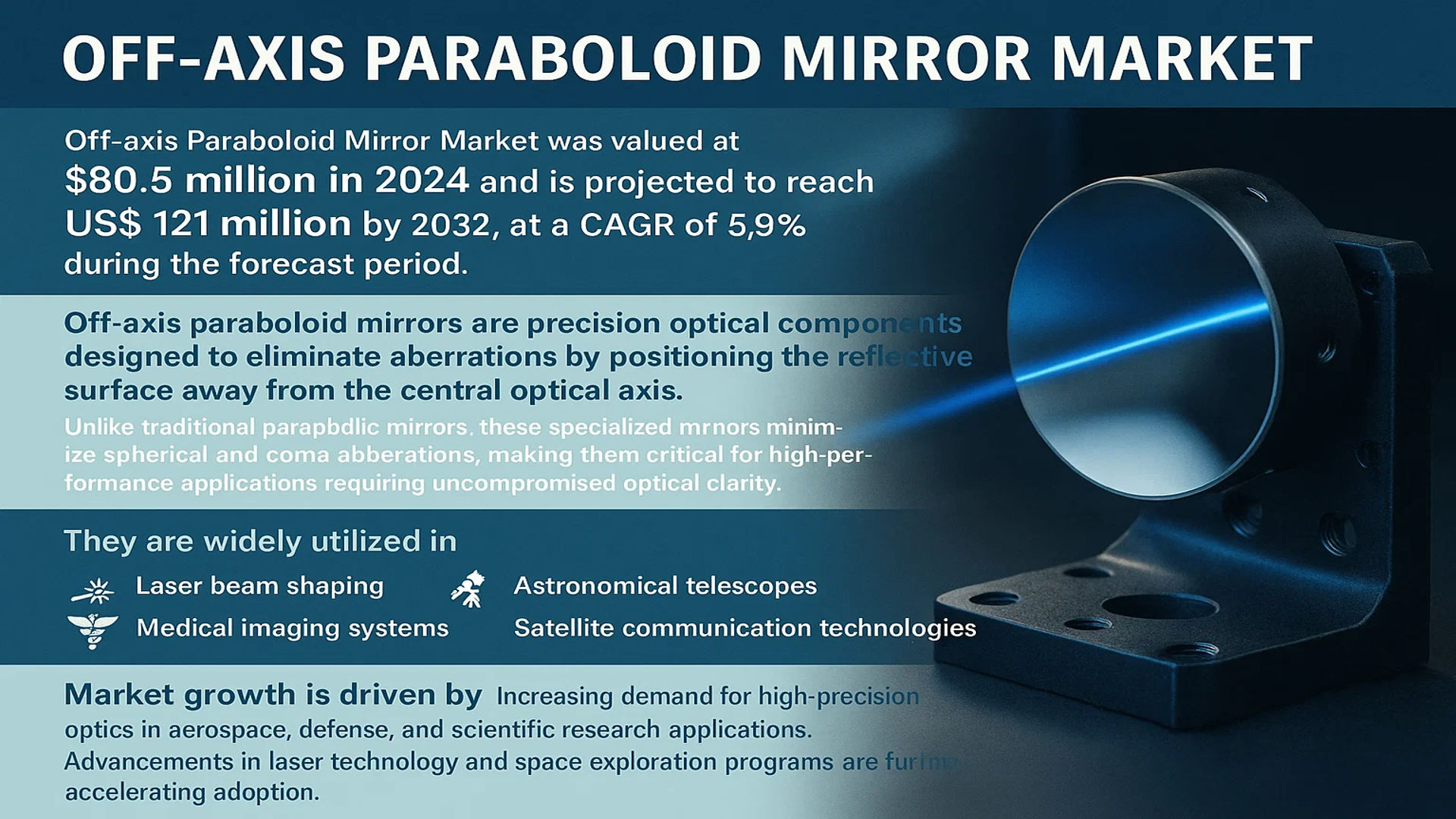
The global Off-axis Paraboloid Mirror Market was valued at 80.5 million in 2024 and is projected to reach US$ 121 million by 2032, at a CAGR of 5.9% during the forecast period.
Off-axis paraboloid mirrors are precision optical components designed to eliminate aberrations by positioning the reflective surface away from the central optical axis. Unlike traditional parabolic mirrors, these specialized mirrors minimize spherical and coma aberrations, making them critical for high-performance applications requiring uncompromised optical clarity. They are widely utilized in laser beam shaping, astronomical telescopes, medical imaging systems, and satellite communication technologies.
The market growth is driven by increasing demand for high-precision optics in aerospace, defense, and scientific research applications. Advancements in laser technology and space exploration programs are further accelerating adoption. Key industry players such as Edmund Optics, Newport Corporation, and Thorlabs dominate the market with extensive product portfolios. The uncoated segment holds significant market share, while gold and aluminum substrates are gaining traction for specialized applications requiring enhanced reflectivity and durability.
MARKET DYNAMICS
MARKET DRIVERS
Expanding Applications in Laser Technology Driving Market Growth
The off-axis paraboloid mirror market is experiencing significant growth due to increasing adoption in laser systems across industries. These specialized mirrors provide superior beam shaping and collimation compared to traditional optics, making them indispensable in high-power laser applications. The global laser technology market has demonstrated consistent expansion, creating substantial demand for precision optical components. Off-axis parabolic mirrors are particularly valued in fiber lasers, which accounted for over 40% of industrial laser system sales in recent years. Their ability to minimize spherical aberrations enables more efficient laser processing in material cutting, welding, and additive manufacturing applications.
Space and Defense Sector Investments Fueling Demand
Growing government expenditures in space exploration and defense technologies are creating robust demand for high-performance optical systems. Off-axis parabolic mirrors play critical roles in satellite communication systems, reconnaissance equipment, and astronomical observation instruments. The space sector alone has seen investments exceeding $400 billion globally, with optical components representing a significant portion of satellite payload budgets. These mirrors enable compact, high-resolution imaging systems while eliminating central obscurations that degrade optical performance. The trend toward miniaturization in space optics further enhances their value proposition compared to traditional parabolic mirrors.
Moreover, recent advancements in infrared imaging systems for defense applications are creating new opportunities. The exceptional performance of off-axis parabolic mirrors in mid-wave infrared (MWIR) and long-wave infrared (LWIR) bands makes them ideal for thermal imaging and targeting systems. Their off-axis design provides unobstructed light paths essential for high-sensitivity detection in security and surveillance equipment.
MARKET CHALLENGES
Precision Manufacturing Requirements Pose Production Challenges
The fabrication of off-axis paraboloid mirrors presents significant technical hurdles that constrain market expansion. These optical components require sub-micron surface accuracy and nanometer-level surface roughness, necessitating specialized manufacturing capabilities. The production process involves high-precision diamond turning followed by time-consuming polishing and metrology procedures. A single mirror can require weeks of skilled labor to achieve the stringent specifications demanded by applications in astronomy and laser systems.
Other Challenges
Thermal and Mechanical Stability Concerns
Maintaining optical performance across operational environments remains a persistent challenge. Thermal expansion and mechanical deformation can induce wavefront errors that degrade mirror performance. While advanced materials like silicon carbide and ultra-low expansion glasses help mitigate these effects, they substantially increase production costs and lead times.
Alignment and Mounting Complexities
The off-axis configuration creates unique alignment challenges during system integration. Precise angular orientation and positional adjustment require specialized mounts and alignment procedures, often adding significant time and cost to optical system assembly. These complexities can deter adoption in price-sensitive applications.
MARKET RESTRAINTS
High Costs Limiting Adoption in Commercial Applications
Premium pricing remains a significant barrier to broader market penetration. Finished off-axis parabolic mirrors can cost 3-5 times more than conventional spherical or parabolic optics with comparable diameters. This cost differential stems from the complex manufacturing process, low production yields, and extensive quality assurance requirements. While acceptable for defense and research applications, these prices make the technology prohibitive for many commercial uses where cost sensitivity is paramount.
Additionally, the long lead times associated with custom mirror production (often exceeding 12 weeks) present operational challenges for system integrators. The lack of standard catalog items forces most customers into made-to-order purchasing patterns that disrupt project timelines. This contrasts sharply with the availability of conventional optics that often feature immediate shipment from distributor inventories.
MARKET OPPORTUNITIES
Emerging Applications in Quantum Technologies Creating New Demand
The rapid development of quantum computing and communication systems is opening new avenues for off-axis parabolic mirrors. These applications require extreme optical performance for manipulating single photons and trapped ions, creating demand for ultra-precision mirror surfaces. The quantum technology market is projected to grow at over 30% annually, representing a significant growth opportunity for specialized optical component suppliers.
Furthermore, advances in free-space optical communication systems are driving innovation in compact optical assembly designs. The ability of off-axis mirrors to provide unobstructed optical paths while maintaining beam quality makes them ideal for next-generation laser communication terminals. As the technology transitions from experimental to operational systems in both terrestrial and space applications, the demand for reliable, high-performance mirrors will accelerate.
The photonics industry is responding to these opportunities through strategic collaborations and technology investments. Several leading manufacturers have recently expanded their fabrication capabilities for large-aperture off-axis mirrors, recognizing the growing requirements of astronomical and defense applications. These developments are expected to gradually reduce production costs through economies of scale and process optimization.
OFF-AXIS PARABOLOID MIRROR MARKET TRENDS
Increasing Demand in High-Precision Optical Systems to Drive Market Growth
The global off-axis paraboloid mirror market, valued at $80.5 million in 2024, is witnessing robust growth due to rising adoption in high-precision optical applications. Off-axis parabolic mirrors are increasingly preferred in fields such as laser beam shaping, satellite communications, and astronomical telescopes because they minimize optical aberrations like coma and spherical distortion. Their ability to precisely focus light without obstructing the optical path makes them indispensable in industries demanding ultra-high accuracy. Furthermore, advancements in coating technologies, such as gold, silver, and aluminum substrates, are enhancing reflectivity and durability, further fueling market expansion.
Other Trends
Rapid Growth in Aerospace and Defense Applications
The aerospace and defense sectors are emerging as significant consumers of off-axis paraboloid mirrors, accounting for a substantial share of market revenue. These mirrors are critical in applications like infrared imaging, target tracking, and directed energy weapons, where precision optics are non-negotiable. The increasing defense budgets of major economies and ongoing advancements in space exploration programs are contributing to higher demand. Notably, the U.S. and China are leading regional markets, collectively holding over 45% of the global revenue share in 2024, driven by their heavy investments in military and space technologies.
Technological Advancements in Manufacturing Processes
The off-axis paraboloid mirror market is benefiting from innovations in diamond turning and computer-controlled polishing, which enable the production of mirrors with nanometer-level surface accuracy. Manufacturers are also adopting automated alignment techniques to reduce production costs while maintaining stringent quality standards. Additionally, the uncoated segment, expected to expand at a CAGR of 6.2% through 2032, is gaining traction in cost-sensitive applications where anti-reflective coatings are unnecessary. This technological evolution is positioning the market to reach an estimated value of $121 million by 2032, with laser applications contributing significantly due to their widespread use in industrial and medical systems.
COMPETITIVE LANDSCAPE
Key Industry Players
Global Leaders Drive Innovation in High-Precision Optical Solutions
The global off-axis paraboloid mirror market exhibits a moderately competitive landscape with established optical technology providers dominating revenue share while smaller niche players cater to specialized applications. Edmund Optics maintains a leadership position, accounting for an estimated 18% market share in 2024, driven by its comprehensive catalog of precision optics and strong distribution networks across North America, Europe, and Asia-Pacific.
Newport Corporation and Thorlabs follow closely, collectively representing 22% of the 2024 market value. Their growth stems from vertically integrated manufacturing capabilities and strong R&D focus on laser and astronomy applications. Recent expansions in Asia have further strengthened their competitive positioning in emerging markets.
The market witnesses intensified competition as companies diversify their substrate offerings – with gold-coated mirrors gaining traction in infrared applications while aluminum variants dominate visible spectrum uses. Coherent recently expanded its ultra-precision mirror line, reflecting the industry trend toward application-specific solutions.
Emerging players like Avantier and Hyperion Optics challenge incumbents through technological differentiation, particularly in compact mirror designs for portable medical devices. Meanwhile, Japanese firm Shimadzu leverages its materials science expertise to develop durable coatings that extend product lifespan in harsh environments.
List of Key Off-axis Paraboloid Mirror Manufacturers
- Edmund Optics (U.S.)
- Newport Corporation (U.S.)
- Thorlabs (U.S.)
- Shimadzu Corporation (Japan)
- Coherent (U.S.)
- OptoSigma (Japan)
- Photonics Industries (U.S.)
- Avantier (U.S.)
- Hyperion Optics (U.S.)
- Optical Surfaces Ltd (UK)
- Shanghai Optics (China)
- TYDEX (Russia)
Segment Analysis:
By Type
Uncoated Off-axis Paraboloid Mirrors Hold Significant Demand Due to General-Purpose Optical Applications
The market is segmented based on type into:
- Uncoated
- Gold Substrates
- Aluminum Substrates
- Silver Plated Substrates
- Others (Copper Substrates, etc.)
By Application
Laser Applications Drive Market Growth Due to Increasing Industrial and Scientific Usage
The market is segmented based on application into:
- Medical
- Laser
- Astronomy
- Others
By Substrate Material
Aluminum Substrates Gain Traction Owing to Cost-Effectiveness and Durability
The market is segmented based on substrate material into:
- Glass
- Metal
- Ceramic
By Coating Type
Dielectric Coatings Witness Growth for Enhanced Reflectance Properties
The market is segmented based on coating type into:
- Dielectric
- Enhanced Aluminum
- Protected Silver
- Others
Regional Analysis: Off-axis Paraboloid Mirror Market
North America
The North American market for off-axis paraboloid mirrors is characterized by high investment in research and development, driven by strong demand from aerospace, defense, and laser technology sectors. The region benefits from the presence of key manufacturers like Edmund Optics, Newport Corporation, and Thorlabs, who prioritize precision optics. Additionally, government-led initiatives, such as the U.S. Department of Defense’s funding for optical technology advancements, further propel the market. The medical and astronomy applications are also significant contributors, with North America expected to maintain its dominant position due to continuous innovation and technological leadership.
Europe
Europe remains a critical region for off-axis paraboloid mirror adoption, largely due to its advanced industrial and scientific infrastructure. Countries like Germany and the U.K. lead in optics manufacturing, supported by strong academic and corporate collaboration. Stringent quality and environmental standards ensure high-performance mirror production, catering to industries such as semiconductor manufacturing and space exploration. The European Space Agency (ESA) frequently sources such mirrors for satellite systems, reinforcing the market’s robustness. Although cost sensitivity exists among smaller enterprises, larger corporations continue to drive demand for high-precision optical components.
Asia-Pacific
Asia-Pacific is the fastest-growing market, led by China, Japan, and South Korea. The region benefits from large-scale semiconductor and electronics manufacturing, which relies on high-performance optical components. China’s investment in space and defense programs has notably increased demand for off-axis parabolic mirrors, with companies like Shanghai Optics and Yudi Optics playing pivotal roles. However, while cost competitiveness drives market penetration, inconsistent quality standards in some areas pose challenges. The rise of domestic suppliers is gradually reshaping market dynamics, making Asia-Pacific a vital expansion focus for global players.
South America
South America’s market is emerging but remains constrained by limited local manufacturing capabilities and economic instability. Brazil and Argentina exhibit sporadic demand in academic research and medical imaging applications, relying heavily on imports. Despite potential in telescope and laser system applications, infrastructure gaps and funding limitations hinder large-scale adoption. However, as industries modernize, opportunities exist for suppliers willing to navigate regional complexities. Foreign manufacturers dominate the landscape, but local partnerships could accelerate market development.
Middle East & Africa
The Middle East & Africa market is nascent, with limited but growing interest in optical technologies. Countries like Israel and Saudi Arabia are investing in defense and space programs, generating demand for high-precision mirrors. The UAE’s focus on scientific research, exemplified by projects like the Al Yah Satellite Company, is gradually uplifting regional demand. However, economic constraints and a lack of specialized manufacturers restrict rapid growth. Nevertheless, the market holds potential, particularly in nations prioritizing technological and infrastructural advancements.
Report Scope
This market research report provides a comprehensive analysis of the global and regional Off-axis Paraboloid Mirror markets, covering the forecast period 2024–2032. It offers detailed insights into market dynamics, technological advancements, competitive landscape, and key trends shaping the industry.
Key focus areas of the report include:
- Market Size & Forecast: Historical data and future projections for revenue, unit shipments, and market value across major regions and segments. The global Off-axis Paraboloid Mirror market was valued at USD 80.5 million in 2024 and is projected to reach USD 121 million by 2032, growing at a CAGR of 5.9%.
- Segmentation Analysis: Detailed breakdown by product type (Uncoated, Gold Substrates, Aluminum Substrates, Silver Plated Substrates, Others), application (Medical, Laser, Astronomy, Others), and end-user industry to identify high-growth segments.
- Regional Outlook: Insights into market performance across North America, Europe, Asia-Pacific, Latin America, and the Middle East & Africa. The U.S. market size is estimated at USD million in 2024, while China is projected to reach USD million.
- Competitive Landscape: Profiles of leading market participants including Edmund Optics, Newport Corporation, Thorlabs, Shimadzu, Coherent, and others, covering their product offerings, R&D focus, and recent developments.
- Technology Trends & Innovation: Assessment of emerging optical technologies, precision manufacturing techniques, and evolving industry standards in high-performance mirror applications.
- Market Drivers & Restraints: Evaluation of factors driving market growth such as increasing demand for high-precision optical systems, along with challenges like complex manufacturing processes.
- Stakeholder Analysis: Insights for optical component suppliers, OEMs, system integrators, and investors regarding the evolving ecosystem and strategic opportunities.
Primary and secondary research methods are employed, including interviews with industry experts and data from verified sources, to ensure the accuracy and reliability of the insights presented.
FREQUENTLY ASKED QUESTIONS:
What is the current market size of Global Off-axis Paraboloid Mirror Market?
-> Off-axis Paraboloid Mirror Market was valued at 80.5 million in 2024 and is projected to reach US$ 121 million by 2032, at a CAGR of 5.9% during the forecast period.
Which key companies operate in Global Off-axis Paraboloid Mirror Market?
-> Key players include Edmund Optics, Newport Corporation, Thorlabs, Shimadzu, Coherent, Laser Focus World, OptoSigma, Standa Photonics, Photonics Industries, and Avantier, among others.
What are the key growth drivers?
-> Key growth drivers include increasing demand for high-precision optical systems in aerospace, medical imaging, and laser applications, along with technological advancements in mirror manufacturing.
Which region dominates the market?
-> North America currently leads the market, while Asia-Pacific is expected to show the highest growth rate during the forecast period.
What are the emerging trends?
-> Emerging trends include development of ultra-precise mirror surfaces, integration with advanced optical systems, and increasing applications in space exploration technologies.

Get Sample Report PDF for Exclusive Insights
Report Sample Includes
- Table of Contents
- List of Tables & Figures
- Charts, Research Methodology, and more...
 Download Sample Report PDF

