MARKET INSIGHTS
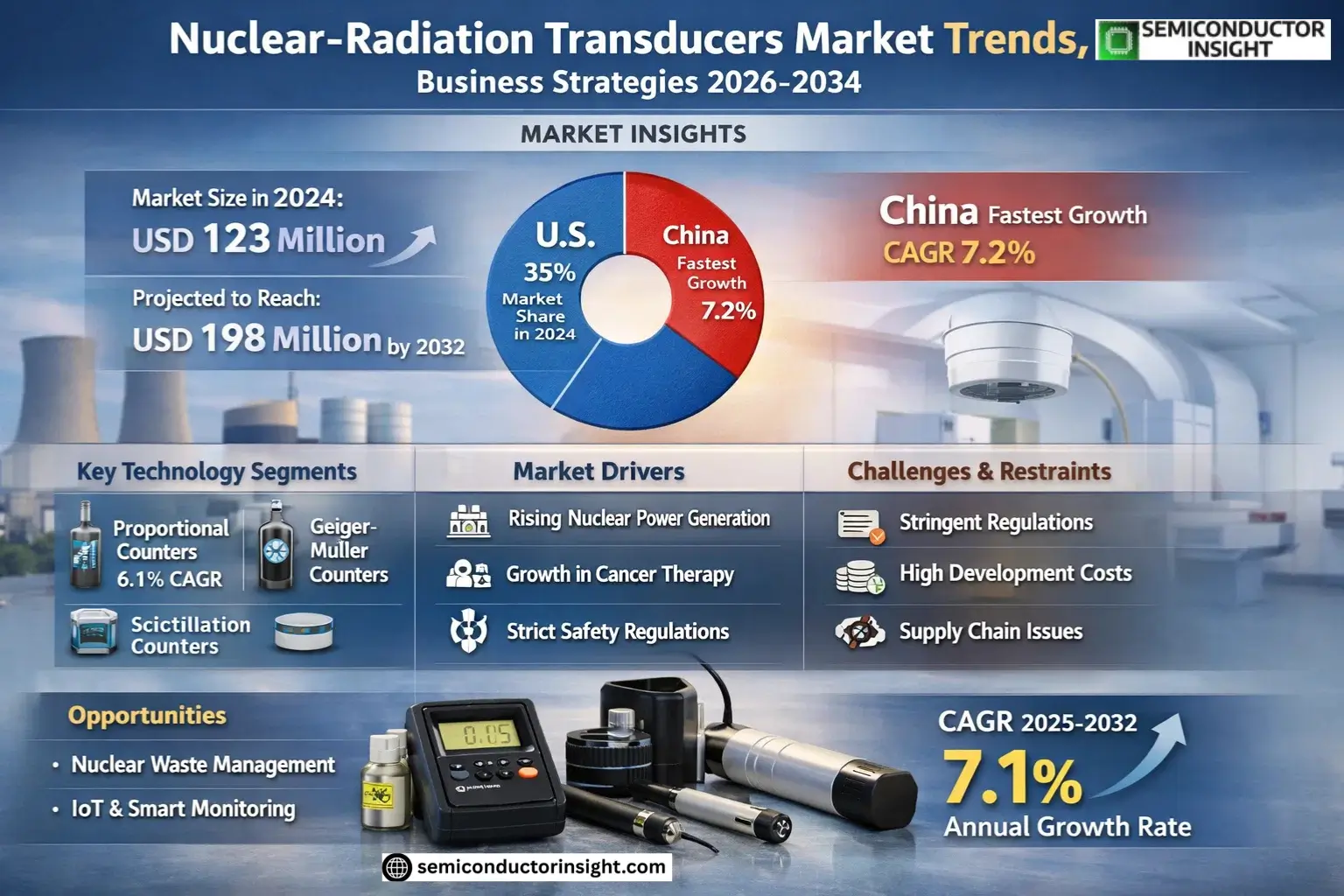
Global Nuclear-Radiation Transducers Market size was valued at USD 123 million in 2024 and is projected to reach USD 198 million by 2032, at a CAGR of 7.1% during the forecast period 2025-2032. The U.S. accounted for 35% of the global market share in 2024, while China is expected to witness the fastest growth with a projected CAGR of 7.2% through 2032.
Nuclear-radiation transducers are specialized sensors that detect and measure ionizing radiation through principles of absorption, backscattering, or ionization effects. These devices play critical roles across three main types: proportional counters (growing at 6.1% CAGR), Geiger-Müller counters, and scintillation counters, which collectively dominate 72% of the technology segment.
Market expansion is driven by increasing nuclear power generation (with 440 operational reactors globally as of 2024), stringent radiation safety regulations, and growing medical applications in cancer therapy. However, the industry faces challenges from high development costs and regulatory hurdles. Key players like Mirion Technologies and ORTEC are investing in miniaturization and IoT integration, with recent advancements including the 2023 launch of wearable radiation monitors for industrial safety applications.
MARKET DYNAMICS
MARKET DRIVERS
Growing Adoption in Nuclear Power Plants for Safety Monitoring to Accelerate Market Expansion
The increasing global focus on nuclear safety is driving significant demand for radiation transducers in power generation facilities. With over 440 nuclear reactors operating worldwide, continuous radiation monitoring has become a critical operational requirement. Modern transducers now incorporate advanced features like real-time data transmission and predictive analytics, enabling more robust safety protocols. The development of compact, high-sensitivity detectors has allowed for their integration into both new generation reactors and legacy systems undergoing modernization. This technological advancement significantly reduces false alarms while improving detection accuracy to levels exceeding 99.7% in controlled environments.
Expansion of Radiation Therapy in Oncology to Fuel Healthcare Segment Growth
Medical applications currently represent the fastest growing segment for nuclear-radiation transducers, driven by oncology treatment advancements. With radiotherapy utilization rates increasing by approximately 6% annually in developed markets, precision dose measurement has become paramount. Modern scintillation counters now enable sub-millimeter tumor targeting while maintaining dose accuracy within ±2% of prescribed levels. The integration of transducer arrays with AI-powered treatment planning systems has reduced treatment planning time by 40% in leading cancer centers, making radiation therapy more accessible.
Furthermore, the development of compact, portable radiation monitoring devices has opened new applications in intraoperative radiation therapy and brachytherapy, further expanding market potential.
MARKET RESTRAINTS
Stringent Regulatory Compliance Requirements to Constrain Market Penetration
The nuclear instrumentation sector faces rigorous certification processes that can delay product commercialization by 12-18 months. Radiation detection equipment must meet multiple international standards including IEC 61508 for functional safety and IEC 62443 for cybersecurity in nuclear applications. The mandatory documentation and verification processes increase development costs by an average of 35% compared to conventional industrial sensors. This creates significant barriers for smaller manufacturers attempting to enter specialized nuclear markets.
Additional Constraints
Supply Chain Complexities
The limited global production capacity of high-purity germanium and other specialized detector materials creates procurement challenges. Lead times for certain semiconductor components have extended to 52 weeks following recent supply chain disruptions.
Technology Obsolescence
The rapid pace of digital transformation in radiation detection requires continuous R&D investment to maintain competitiveness. Manufacturers must allocate 15-20% of revenue to sustain technological leadership in this specialized field.
MARKET CHALLENGES
High Total Cost of Ownership to Limit Adoption in Emerging Economies
While developed nations dominate current market share, price sensitivity represents a significant adoption hurdle in developing regions. A complete radiation monitoring system with necessary certifications typically requires capital expenditure exceeding D 250,000, with annual maintenance costs averaging 15-20% of initial investment. This financial threshold excludes many potential users in price-sensitive healthcare and industrial markets across Asia and Africa.
Technical Challenges
Maintaining calibration stability in harsh environments remains an ongoing engineering challenge. Temperature fluctuations in industrial settings can introduce measurement errors requiring sophisticated compensation algorithms. Field calibration procedures often require specialized personnel, increasing operational expenses for end-users.
MARKET OPPORTUNITIES
Emerging Applications in Nuclear Waste Management to Create New Revenue Streams
Global nuclear waste management market, projected to exceed D 25 billion by 2028, presents substantial growth potential for radiation detection technologies. Advanced transducer arrays are being developed for permanent installation in waste storage facilities, capable of continuous monitoring for 10+ years without maintenance. These systems incorporate wireless mesh networks to create comprehensive radiation maps of storage sites, enabling more efficient space utilization and inventory management.
Integration with Industry 4.0 Platforms to Transform Monitoring Capabilities
The convergence of radiation detection with IoT and cloud computing is enabling predictive maintenance models for nuclear facilities. Modern transducers now feature embedded edge computing capabilities, processing up to 90% of data locally before transmitting actionable insights. This architecture reduces network bandwidth requirements while enabling real-time decision support. Major industry players are forming strategic alliances with industrial IoT platform providers to deliver comprehensive radiation monitoring as a service solution.
NUCLEAR-RADIATION TRANSDUCERS MARKET TRENDS
Growing Demand for Radiation Detection in Medical and Industrial Applications
Global Nuclear-Radiation Transducers Market is witnessing significant growth, driven by increasing applications in medical imaging, industrial safety, and defense. With a market valuation of millions in 2024, the industry is projected to expand at a robust CAGR through 2032. The medical sector, particularly in diagnostic imaging and radiation therapy, accounts for a substantial share of demand, with radiation transducers playing a critical role in ensuring precision and safety. Furthermore, stringent regulations in nuclear power plants and industrial facilities mandating radiation monitoring have accelerated the adoption of advanced transducer technologies.
Other Trends
Technological Advancements in Sensor Design
Recent innovations in transducer technology, including the development of compact and highly sensitive sensors, are reshaping the market landscape. Proportional counters and scintillation detectors now offer enhanced resolution and efficiency, enabling more accurate radiation measurement in real-time environments. Manufacturers are focusing on integrating IoT-enabled solutions for remote monitoring, particularly in hazardous industrial settings. This shift toward smart detection systems aligns with the increasing emphasis on workplace safety and regulatory compliance across global markets.
Expansion of Nuclear Power Generation Facilities
The resurgence of nuclear energy as a clean power source is creating new opportunities for radiation transducer vendors. Countries investing in next-generation nuclear reactors require sophisticated monitoring systems, with the proportional counter segment projected to reach millions by 2032. Emerging economies in Asia-Pacific are driving this demand, as governments prioritize energy security while maintaining strict radiation safety standards. Additionally, the decommissioning of older nuclear plants necessitates advanced transducers for environmental monitoring during dismantling processes, further fueling market growth.
COMPETITIVE LANDSCAPE
Key Industry Players
Innovation and Strategic Partnerships Drive Market Leadership in Radiation Detection
Global Nuclear-Radiation Transducers Market features a moderately concentrated competitive landscape, with a mix of established multinational corporations and specialized manufacturers vying for market share. Mirion Technologies and ORTEC (a subsidiary of AMETEK) currently dominate the market, collectively holding approximately 30% of global revenue share in 2024. Their leadership stems from comprehensive product portfolios spanning industrial, medical, and defense applications.
Berthold Technologies has emerged as a key European player, particularly in process control applications, while CAEN S.p.A. has strengthened its position through specialized products for nuclear physics research. The Asia-Pacific market sees strong competition from Kromek Group plc and Jianuo Technology, who are rapidly expanding their regional distribution networks.
Market consolidation has accelerated in recent years, exemplified by Mirion’s acquisition of Capintec in 2022, which expanded its medical radiation monitoring capabilities. Meanwhile, smaller innovators like TEVISO Sensor Technologies are gaining traction through patented solid-state radiation detection solutions, challenging traditional transducer technologies.
Product differentiation remains critical in this market, with companies investing heavily in:
- Advanced scintillation materials development
- Integration of AI-based signal processing
- Portable and wearable form factors
- Multi-detector array systems
Intellectual property protection has consequently become a strategic priority across the sector.
List of Key Nuclear-Radiation Transducer Companies Profiled
- Mirion Technologies (U.S.)
- ORTEC (AMETEK, Inc.) (U.S.)
- Berthold Technologies (Germany)
- CAEN S.p.A. (Italy)
- IMS Innovation & Measurement Systems (U.S.)
- Bertin Instruments (France)
- Kromek Group plc (UK)
- Detection Technology Inc. (U.S.)
- Gigahertz-Optik GmbH (Germany)
- Eurorad (France)
- SE International Inc. (U.S.)
- TEVISO Sensor Technologies (Switzerland)
- Jianuo Technology (China)
Segment Analysis:
By Type
Proportional Counter Segment Dominates Due to High Sensitivity and Wide Application Range
The market is segmented based on type into:
- Proportional Counter
- Geiger-Muller Counter
- Scintillation Counter
By Application
Industrial Segment Holds Significant Share Owing to Nuclear Power Plant Monitoring Needs
The market is segmented based on application into:
- Industrial
- Medical
- Defense
By Radiation Type
Gamma Radiation Detection Leads Due to Wide Variability of Applications
The market is segmented based on radiation type into:
- Alpha Radiation
- Beta Radiation
- Gamma Radiation
- Neutron Radiation
By End User
Government Agencies Segment Shows Strong Growth in Radiation Safety Compliance
The market is segmented based on end user into:
- Nuclear Power Plants
- Healthcare Facilities
- Government Agencies
- Research Institutions
Regional Analysis: Nuclear-Radiation Transducers Market
North America
The North American Nuclear-Radiation Transducers Market is driven by stringent regulatory frameworks, particularly in the U.S., where nuclear safety standards are rigorously enforced by agencies such as the Nuclear Regulatory Commission (NRC). The region’s advanced healthcare infrastructure and demand for precise radiation detection in medical imaging (e.g., PET and CT scans) bolster growth. Additionally, the expansion of nuclear power plants and radiation therapy centers supports market expansion. Market leaders like Mirion Technologies and ORTEC dominate the competitive landscape, leveraging technological advancements to meet stringent regulatory requirements. However, high initial costs and complex certification processes may slow adoption in some sectors.
Europe
Europe’s market thrives on strong environmental and nuclear safety regulations under directives like EURATOM, alongside increasing investments in nuclear energy modernization. Countries such as France and Germany lead in adopting scintillation counters and proportional counters for industrial and medical applications. The region’s aging nuclear infrastructure necessitates upgrades, creating opportunities for companies like Berthold Technologies and CAEN S.p.A.. Despite these drivers, political opposition to nuclear energy in certain countries, such as Germany’s phase-out policy, poses challenges. Nevertheless, innovations in radiation monitoring for healthcare and defense applications continue to fuel steady growth.
Asia-Pacific
The Asia-Pacific region, spearheaded by China, Japan, and India, is the fastest-growing market due to rapid industrialization and expanding nuclear power programs. China’s ambitious nuclear energy targets and Japan’s post-Fukushima safety upgrades have intensified demand for high-precision transducers. The medical sector, especially in India, is adopting radiation detection systems for diagnostics and therapy. Local players like Jianuo Technology compete with global leaders by offering cost-effective solutions. However, inconsistent regulatory enforcement in emerging economies and reliance on imports for advanced technologies remain hurdles. The region’s CAGR is projected to outpace global averages, driven by urbanization and nuclear energy investments.
South America
South America’s market is nascent but shows potential, particularly in Brazil and Argentina, where nuclear energy programs are expanding. Brazil’s Angra nuclear power plant and Argentina’s CAREM reactor project are key demand drivers. The medical sector’s growing reliance on radiotherapy also contributes to market growth. However, economic instability and limited domestic manufacturing capabilities restrict the adoption of advanced transducers. Most high-end products are imported from North America and Europe, increasing costs. Despite these challenges, rising awareness of radiation safety and gradual infrastructure development present long-term opportunities.
Middle East & Africa
This region exhibits moderate growth, with applications primarily focused on healthcare and oil & gas radiation monitoring. The UAE’s Barakah nuclear plant and Saudi Arabia’s plans for nuclear energy diversification under Vision 2030 are pivotal to market expansion. However, limited local expertise and reliance on international suppliers hinder rapid deployment. South Africa remains a key player, leveraging its existing nuclear infrastructure. While the defense sector shows increasing interest in radiation detection, funding constraints and geopolitical uncertainties slow market progress. Strategic partnerships with global firms like Kromek Group are expected to enhance technological access over time.
Report Scope
This market research report provides a comprehensive analysis of the global and regional Nuclear-Radiation Transducers markets, covering the forecast period 2024–2032. It offers detailed insights into market dynamics, technological advancements, competitive landscape, and key trends shaping the industry.
Key focus areas of the report include:
- Market Size & Forecast: Historical data and future projections for revenue, unit shipments, and market value across major regions and segments. Global market was valued at USD 123 million in 2024 and is projected to reach USD 198 million by 2032 at a CAGR of 7.1 %.
- Segmentation Analysis: Detailed breakdown by product type (Proportional Counter, Geiger-Muller Counter, Scintillation Counter), application (Industrial, Medical, Defense), and end-user industry to identify high-growth segments.
- Regional Outlook: Insights into market performance across North America, Europe, Asia-Pacific, Latin America, and Middle East & Africa. The U.S. market was estimated at USD million in 2024, while China is projected to reach USD million.
- Competitive Landscape: Profiles of 18+ key players including ORTEC, Mirion Technologies, Berthold Technologies, and Kromek Group plc, covering their market share (top five held approximately % in 2024), product portfolios, and strategic developments.
- Technology Trends & Innovation: Analysis of radiation detection technologies, sensor advancements, and integration with IoT/AI systems for real-time monitoring applications.
- Market Drivers & Restraints: Evaluation of nuclear power expansion, medical imaging demand, defense applications versus regulatory challenges and high product costs.
- Stakeholder Analysis: Strategic insights for component manufacturers, system integrators, healthcare providers, and government agencies operating in radiation detection ecosystems.
The research methodology combines primary interviews with industry experts and analysis of verified market data from regulatory bodies, company filings, and trade associations to ensure accuracy.
FREQUENTLY ASKED QUESTIONS:
What is the current market size of Global Nuclear-Radiation Transducers Market?
-> Nuclear-Radiation Transducers Market size was valued at USD 123 million in 2024 and is projected to reach USD 198 million by 2032, at a CAGR of 7.1% during the forecast period 2025-2032.
Which key companies operate in this market?
-> Major players include ORTEC, Mirion Technologies, Berthold Technologies, CAEN S.p.A., Kromek Group plc, Fluke Biomedical, and Detection Technology Inc., among others.
What are the key growth drivers?
-> Growth is driven by nuclear power plant expansions, increasing medical diagnostics applications, and rising defense sector investments in radiation detection systems.
Which region dominates the market?
-> North America currently leads the market, while Asia-Pacific is expected to witness the fastest growth during the forecast period.
What are the emerging trends?
-> Emerging trends include miniaturization of sensors, development of wireless radiation monitoring systems, and integration with IoT platforms for remote data analysis.
Get Sample Report PDF for Exclusive Insights
Report Sample Includes
- Table of Contents
- List of Tables & Figures
- Charts, Research Methodology, and more...
 Download Sample Report PDF