North America AI Data Center Processor Market Insights
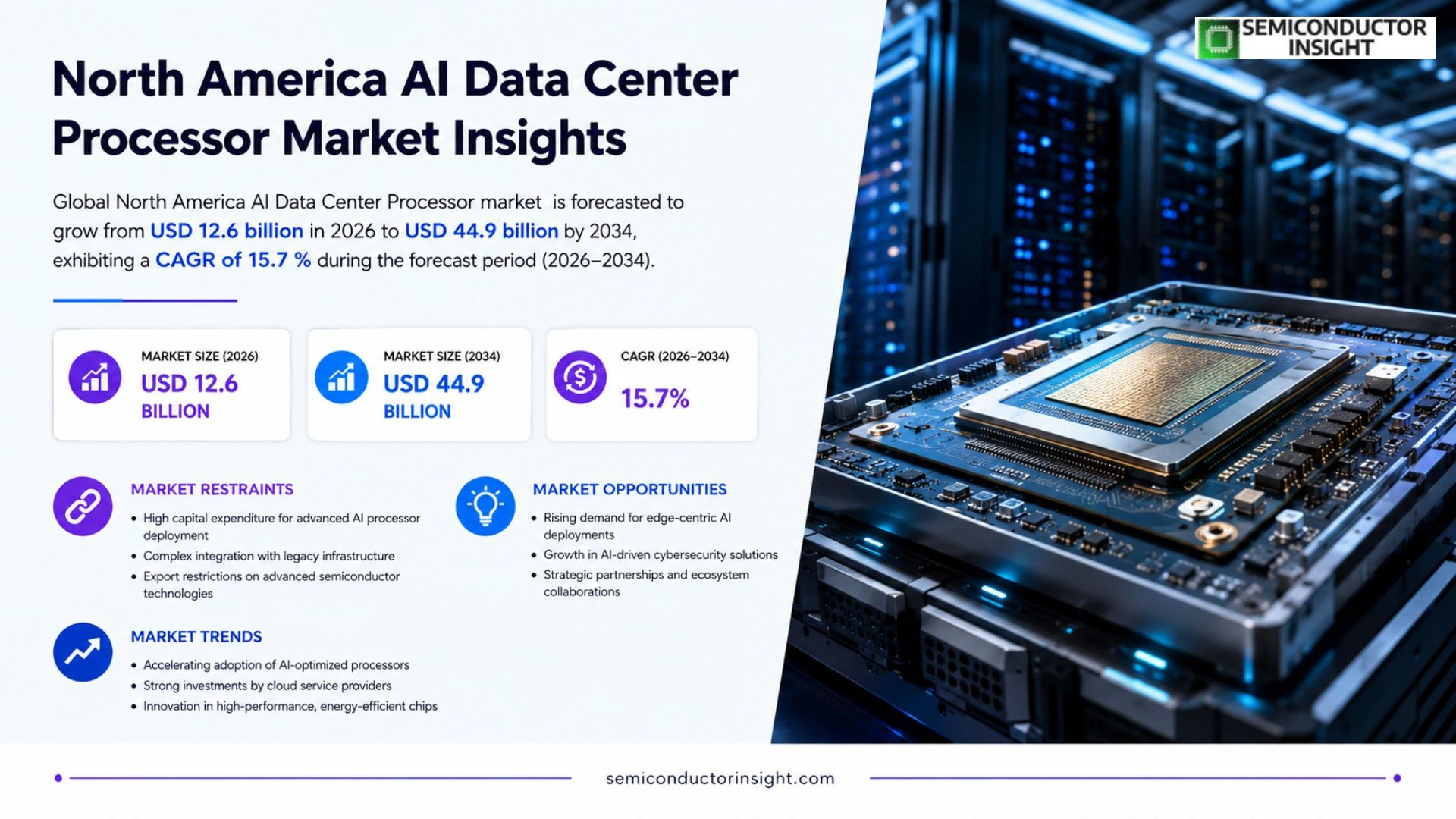
Global North America AI Data Center Processor market size was valued at USD 11.8 billion in 2025. The market is forecasted to grow from USD 12.6 billion in 2026 to USD 44.9 billion by 2034, exhibiting a CAGR of 15.7 % during the forecast period.
AI‑optimized processors include CPUs, GPUs and dedicated accelerators that are purpose‑built for large‑scale neural‑network training and inference inside data centers. These chips feature high‑bandwidth memory links, tensor cores and support heterogeneous software stacks that accelerate model execution.
The expansion is fueled by rising cloud‑service demand for generative‑AI offerings, growing enterprise investment in edge‑to‑cloud analytics, and continued capital spending on hyperscale infrastructure upgrades across the United States and Canada. Recent actions such as Nvidia’s introduction of the Grace Hopper Superchip in early 2024 and Intel’s incorporation of Habana Gaudi accelerators into its Xeon portfolio demonstrate how leading vendors are reshaping the processor ecosystem to satisfy escalating performance requirements.
MARKET DRIVERS
Escalating AI Workload Requirements
Enterprises across finance, healthcare and autonomous systems are feeding ever‑larger neural networks with terabytes of data. This surge forces North America AI Data Center Processor Market to prioritize chips that deliver higher FLOPS per watt, prompting vendors to accelerate silicon‑on‑foundry cycles and integrate specialized tensor cores.
Cloud Provider Capital Investment
Leading hyperscale operators have earmarked billions for next‑generation compute farms, targeting latency‑critical inference as a differentiator. Their procurement strategies tilt toward processors that support flexible scaling, thereby expanding the addressable market for high‑performance units.
➤ “Processing efficiency now determines competitive advantage more than raw capacity.”
Regulatory incentives for energy‑efficient data centers further reinforce this trajectory. Facilities that adopt processors with superior power‑performance ratios qualify for tax credits, driving early adoption among mid‑size players who otherwise would defer upgrades.
MARKET CHALLENGES
Supply Chain Volatility
Foundry capacity constraints, coupled with geopolitical tensions, have introduced lead‑time extensions that compress project timelines. Clients are compelled to re‑evaluate inventory policies, often opting for lower‑margin, readily available silicon over cutting‑edge designs.
Other Challenges
Talent Shortage
The scarcity of engineers proficient in low‑level AI accelerator programming inflates development costs. Companies resort to external consulting firms, which adds a layer of expense and can delay time‑to‑market for customized solutions.
Moreover, the rapid pace of algorithmic innovation outpaces the ability of hardware roadmaps to keep up, leaving some deployments stranded on legacy processors that lack support for newer precision formats.
MARKET RESTRAINTS
High Capital Expenditure Thresholds
Deploying state‑of‑the‑art AI processors often demands datacenter retrofits,upgraded cooling, power distribution and rack density adjustments. The upfront spend deters smaller firms, limiting market penetration beyond the largest cloud operators.
In addition, legacy workloads that dominate many enterprise environments still run on general‑purpose CPUs. Migration paths are complex, and the perceived ROI for upgrading to specialized AI processors remains uncertain for cost‑conscious IT managers.
Finally, stringent export controls on advanced semiconductor technologies restrict cross‑border collaborations, curbing the ability of North American firms to source certain high‑end components at competitive prices.
MARKET OPPORTUNITIES
Edge‑Centric AI Deployments
As 5G rollout accelerates, demand for low‑latency inference at the edge is creating a niche for compact, power‑efficient processors. Companies that can ship modular AI chips optimized for micro‑datacenters stand to capture a growing slice of North America AI Data Center Processor Market.
The rise of AI‑driven cybersecurity solutions also opens a pathway for processors that embed on‑chip encryption and anomaly detection. Vendors offering built‑in security features may command premium pricing while addressing the heightened risk profile of modern networks.
Lastly, strategic partnerships between silicon designers and software ecosystems,particularly those that standardize model compilation across heterogeneous hardware,can reduce integration friction. Such alliances are likely to spur a wave of accelerated product launches, expanding the overall market envelope.
North America AI Data Center Processor Market Trends
Accelerating Adoption of AI‑Optimized Processors
North America AI Data Center Processor market registered a valuation of approximately $11.8 billion in 2025 and is projected to approach $44.9 billion by 2034. This expansion is anchored in two converging forces: the relentless demand from cloud service providers to host generative‑AI models and a wave of enterprise spending on advanced analytics that span edge to core data‑center environments. Recent product launches,including Nvidia’s Grace Hopper Superchip and Intel’s integration of Habana Gaudi accelerators into its Xeon line,illustrate how manufacturers are re‑engineering silicon architectures to embed high‑bandwidth memory, tensor‑core compute blocks, and heterogeneous software stacks. The resulting performance uplift shortens training cycles, reduces inference latency, and creates a tangible business advantage for organizations that can deploy AI services at scale.
Other Trends
Edge‑to‑Cloud Analytics Integration
Organizations are extending AI inference workloads beyond centralized facilities to regional edge nodes, driven by the need for sub‑second response times in applications such as autonomous guidance and real‑time video analytics. This migration compels data‑center operators to adopt processors that balance raw throughput with power efficiency, prompting a more diversified server mix that pairs traditional GPUs with specialized accelerators. In the United States and Canada, hyperscalers are reshaping procurement strategies, allocating larger portions of their capital budget to platforms that can seamlessly manage heterogeneous workloads across disparate locations, thereby reinforcing the overall robustness of North America AI Data Center Processor ecosystem.
Capital Expenditure on Hyperscale Infrastructure
Spending by the world’s largest hyperscale operators has accelerated as they replace legacy server fleets with AI‑ready silicon. The infusion of higher‑density compute resources drives down the cost per operation, which in turn encourages deeper model training and more ambitious AI product roadmaps. This virtuous cycle fuels a competitive imperative: operators that refresh more rapidly can offer differentiated AI services, attract premium customers, and capture greater market share. Processor vendors are responding with bundled hardware‑software solutions that simplify integration, shorten deployment timelines, and reduce total cost of ownership, thereby reinforcing the feedback loop of investment and innovation across the region.
COMPETITIVE LANDSCAPE
Key Industry Players
North America AI Data Center Processor Market – Competitive Overview
North American arena is dominated by a handful of vendors whose product portfolios span GPUs, CPUs and purpose‑built accelerators. Nvidia retains the front‑row seat, leveraging its CUDA ecosystem and the recent Grace Hopper Superchip to address both training and inference workloads. The chip’s integration of high‑bandwidth memory and tensor‑core clusters forces rivals to accelerate their own roadmap. AMD’s acquisition of Xilinx has broadened its offering, allowing a seamless blend of programmable logic with Radeon Instinct GPUs for heterogeneous workloads. Intel, capitalising on its Xeon lineage, embeds Habana Gaudi accelerators to capture a slice of the hyperscale segment that seeks higher throughput per watt. These three firms command the bulk of revenue, influence software stack alignment and steer pricing dynamics across the United States and Canada.
Beyond the incumbents, a constellation of niche players adds depth to the competitive set. Qualcomm’s AI‑engine chips, while originally mobile‑focused, are being re‑engineered for data‑center density constraints. Broadcom and Marvell supply networking‑aware silicon that couples compute with fabric optimisation, a critical attribute for edge‑to‑cloud pipelines. Google’s Tensor Processing Units, accessed through the cloud, represent a vertically integrated model that bypasses traditional OEM channels. Amazon Web Services’ Graviton series introduces ARM‑based alternatives that appeal to cost‑sensitive workloads. Meanwhile, specialist firms such as Graphcore, Cerebras and the original Habana Labs (now under Intel) chase performance niches with massively parallel architectures, reinforcing a fragmented yet innovative ecosystem that pressures the leaders to diversify their IP portfolios.
List of Key AI Data Center Processor Companies Profiled
- Nvidia Corporation
- Advanced Micro Devices (AMD)
- Intel Corporation
- Qualcomm Technologies, Inc.
- Broadcom Inc.
- Marvell Technology Group Ltd.
- Google (Alphabet Inc.) – Tensor Processing Unit
- Amazon Web Services – Graviton
- Microsoft Azure – custom AI silicon
- Graphcore Ltd.
- Cerebras Systems
- Habana Labs (Intel subsidiary)
Segment Analysis:
| Segment Category | Sub-Segments | Key Insights |
| By Type |
|
GPUs
|
| By Application |
|
Model Training
|
| By End User |
|
Cloud Service Providers
|
| By Architecture |
|
Dataflow
|
| By Deployment Model |
|
Hybrid Cloud Environments
|
Regional Analysis: North America AI Data Center Processor Market
Cloud providers are expanding AI workloads to meet client demand for real‑time analytics, prompting sizable capital commitments to AI‑tuned processors. Simultaneously, the surge in autonomous vehicle simulations and biotech modeling fuels the need for chips that balance throughput with energy efficiency, compelling data‑center operators to prioritize next‑gen silicon.
Legacy CPU makers are confronting aggressive entrants that specialize in matrix multiplication cores. Partnerships between semiconductor firms and software vendors are blurring traditional boundaries, fostering ecosystems where hardware performance is co‑designed with AI frameworks, reshaping market share dynamics.
Federal tax credits for energy‑conserving data centers encourage the adoption of processors with superior performance‑per‑watt ratios. Privacy regulations also drive investments in on‑premise AI hardware, as firms seek to keep sensitive model training within national borders.
Chip designers are integrating programmable logic alongside AI accelerators, enabling customers to tailor hardware to niche inference patterns. This flexibility, combined with advances in 3‑D packaging, is shortening time‑to‑market for specialized AI processors.
Europe
European data‑center operators are channeling investments toward sovereign AI chips to mitigate reliance on non‑EU supply chains. Coupled with the EU’s emphasis on green IT, manufacturers are showcasing processors that achieve high compute density while adhering to stringent energy standards, prompting a regional shift toward balanced performance and sustainability.
Asia‑Pacific
In the Asia‑Pacific, rapid digitalization across manufacturing and fintech sectors drives demand for AI‑ready processors. Governments are bolstering local semiconductor ecosystems through subsidies, which encourages multinational vendors to establish design hubs, thereby accelerating technology transfer and regional market maturation.
South America
South American markets are experiencing incremental adoption of AI workloads, primarily in telecom and natural resources analytics. Limited data‑center capacity has led operators to favor modular, AI‑optimized processors that can be deployed in compact footprints, aligning with the region’s cost‑sensitive investment approach.
Middle East & Africa
The Middle East & Africa region is leveraging AI processors to support burgeoning cloud services and sovereign cloud initiatives. Energy‑rich locales are experimenting with AI chips that integrate power‑management features, positioning the region as a testbed for high‑efficiency, AI‑centric compute solutions.
Report Scope
This market research report provides a comprehensive analysis of the North America AI Data Center Processor Market , covering the forecast period 2026–2034. It offers detailed insights into market dynamics, technological advancements, competitive landscape, and key trends shaping the industry.
Key focus areas of the report include:
- Market Overview: The report begins with an overview outlining its current market scenario, key growth indicators, and industry transformation drivers. It discusses macroeconomic factors, demand–supply balance, regulatory landscape, and the strategic role of semiconductors in powering advancements across industries such as automotive, telecommunications, consumer electronics, and industrial automation.
- Market Size & Forecast: Historical data and future projections for revenue, unit shipments, and market value across major regions and segments.
- Segmentation Analysis: Detailed breakdown by product type, technology, application, and end-user industry to identify high-growth segments and investment opportunities.
- Regional Insights: Insights into market performance across North America, Europe, Asia-Pacific, Latin America, and the Middle East & Africa, including country-level analysis where relevant.
- Competitive Landscape: Profiles of leading market participants, including their product offerings, R&D focus, manufacturing capacity, pricing strategies, and recent developments such as mergers, acquisitions, and partnerships.
- Technology Trends & Innovation: Assessment of emerging technologies, integration of AI/IoT, semiconductor design trends, fabrication techniques, and evolving industry standards.
- Market Drivers & Restraints: Evaluation of factors driving market growth along with challenges, supply chain constraints, regulatory issues, and market-entry barriers.
- Stakeholder Insights: Insights for component suppliers, OEMs, system integrators, investors, and policymakers regarding the evolving ecosystem and strategic opportunities.
Primary and secondary research methods are employed, including interviews with industry experts, data from verified sources, and real-time market intelligence to ensure the accuracy and reliability of the insights presented.
FREQUENTLY ASKED QUESTIONS:
What is the current market size of North America AI Data Center Processor Market?
-> North America AI Data Center Processor market is forecasted to grow from USD 12.6 billion in 2026 to USD 44.9 billion by 2034.
Which key companies operate in North America AI Data Center Processor Market?
-> Key players include Nvidia, Intel, AMD, Google (Alphabet), Qualcomm, and Apple, among others.
What are the key growth drivers?
-> Key growth drivers include rising cloud-service demand for generative AI, expanding edge‑to‑cloud analytics, and substantial capital spending on hyperscale infrastructure upgrades across the United States and Canada.
Which region dominates the market?
-> North America dominates the market, with the United States being the leading contributor.
What are the emerging trends?
-> Emerging trends include AI‑optimized processors featuring high‑bandwidth memory, tensor cores, and dedicated accelerators; increasing integration of CPUs, GPUs, and custom ASICs; and the development of heterogeneous software stacks to accelerate neural‑network training and inference.
Get Sample Report PDF for Exclusive Insights
Report Sample Includes
- Table of Contents
- List of Tables & Figures
- Charts, Research Methodology, and more...
 Download Sample Report PDF