Niobium pentoxide capacitor for medical implantable device Market Insights
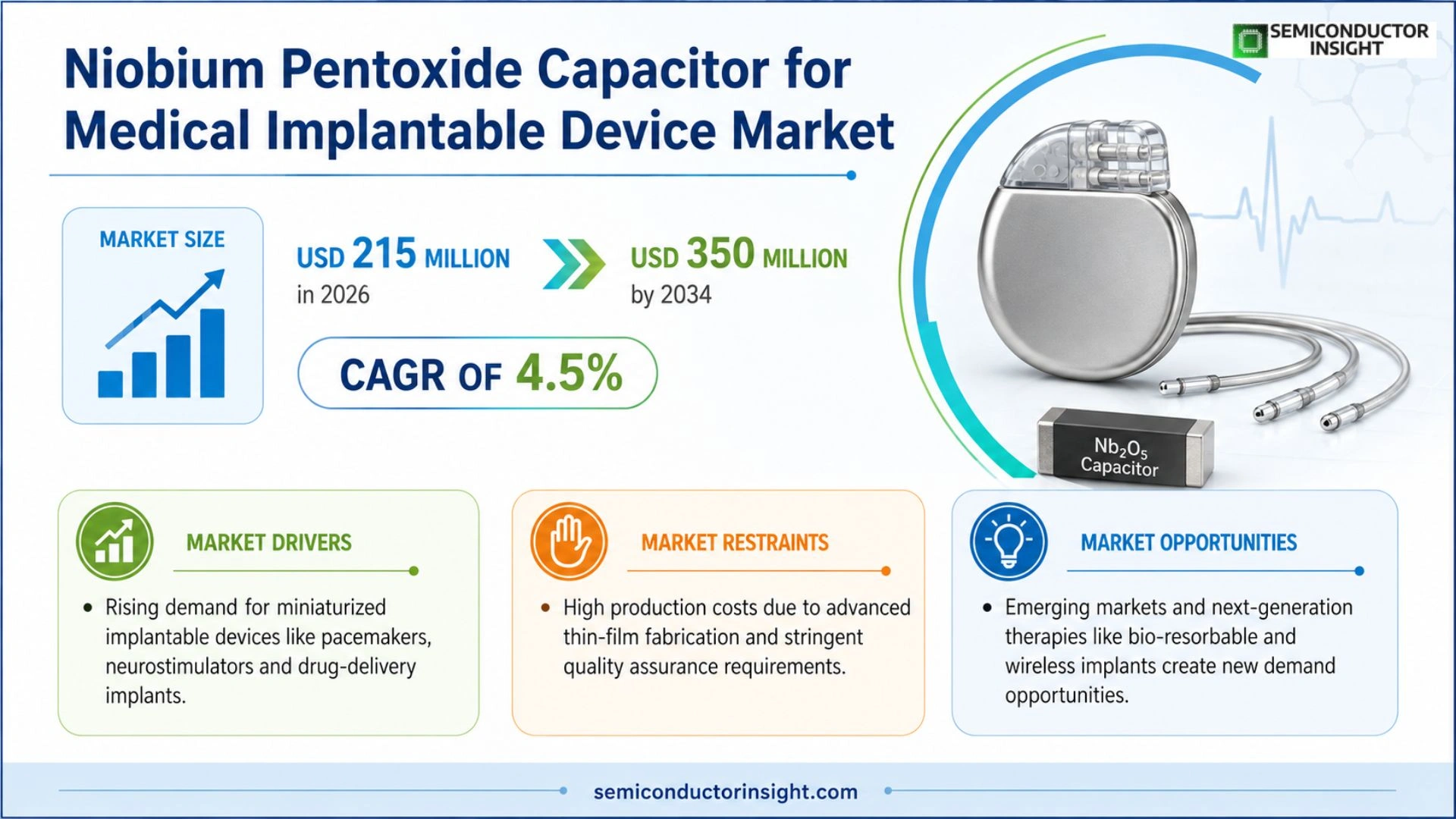
Global Niobium pentoxide capacitor for medical implantable device market size was valued at USD 210 million in 2025. The market is projected to grow from USD 215 million in 2026 to USD 350 million by 2034, exhibiting a CAGR of 4.5% during the forecast period.
Niobium pentoxide capacitors are high‑reliability passive components that store electrical energy using a niobium oxide dielectric layer. Their biocompatible surface and stable capacitance under physiological conditions make them ideal for implantable cardiac pacemakers, neurostimulators, and drug‑delivery systems where long‑term performance and safety are paramount.
The market is experiencing rapid growth because the demand for miniaturized yet robust power‑management solutions in medical implantable devices is rising sharply. Furthermore, advances in thin‑film deposition techniques have lowered production costs, encouraging wider adoption. Key players such as KEMET Corporation (AVX), Vishay Intertechnology, TDK Corporation, and Panasonic Healthcare are expanding their portfolios through strategic R&D investments and collaborations with leading med‑tech firms.
MARKET DRIVERS
Rising Demand for Miniaturized Implantable Devices
Niobium pentoxide capacitor for medical implantable device Market is being propelled by a sharp increase in demand for compact, high‑performance power supplies in cardiac pacemakers, neurostimulators and drug‑delivery implants. Device manufacturers seek capacitors that occupy minimal board space while delivering stable voltage, and niobium pentoxide’s high dielectric constant meets these design constraints.
Enhanced Reliability and Biocompatibility
Clinical data confirm that niobium pentoxide exhibits excellent biocompatibility, reducing the risk of inflammatory responses. This reliability translates into longer device lifespans, which is a critical factor for physicians and end‑users who prioritize safety and reduced replacement surgeries.
➤ Niobium pentoxide’s superior dielectric strength enables capacitors to operate reliably for over a decade inside the human body.
Overall, the convergence of device miniaturization, stringent safety requirements, and proven material performance are key drivers shaping the growth trajectory of Niobium pentoxide capacitor for medical implantable device Market.
MARKET CHALLENGES
Regulatory Hurdles and Certification
Achieving FDA and CE approval for new capacitor designs remains a significant challenge. The certification process demands extensive biocompatibility testing, long‑term reliability studies, and documentation, which can extend time‑to‑market and increase development costs.
Other Challenges
Manufacturing Complexity
Producing high‑purity niobium pentoxide layers requires specialized deposition equipment and tight process control, leading to higher unit costs compared with conventional ceramic capacitors.
MARKET RESTRAINTS
High Production Costs
The need for advanced thin‑film fabrication and rigorous quality assurance drives up production expenses, making cost‑sensitive manufacturers hesitant to adopt niobium pentoxide capacitors without clear price‑performance justification.
MARKET OPPORTUNITIES
Emerging Markets and Next‑Generation Therapies
Growth in emerging economies, combined with the development of bio‑resorbable and wireless implantable therapies, creates new demand pockets. These applications benefit from niobium pentoxide’s stable performance and can justify the premium cost, offering a significant opportunity for market expansion.
Niobium pentoxide capacitor for medical implantable device Market Trends
Increasing Demand for Miniaturized Power Solutions
The market for Niobium pentoxide capacitor for medical implantable device applications is being driven by a clear shift toward smaller, yet highly reliable, power‑management components. Clinicians and device manufacturers prioritize long‑term stability under physiological conditions, and niobium pentoxide capacitors meet these requirements through a biocompatible dielectric surface and minimal leakage currents. Recent product launches have emphasized ultra‑low profile form factors that enable next‑generation cardiac pacemakers and neurostimulators to achieve longer battery life while reducing overall device volume. This trend is reinforced by regulatory guidance encouraging the use of materials with proven long‑term safety records, further cementing the role of niobium‑based capacitors in the implantable device ecosystem.
Other Trends
Advances in Thin‑Film Deposition Techniques
Thin‑film deposition processes have evolved to deliver consistent layer thicknesses at scale, effectively lowering production costs for niobium pentoxide capacitors. By improving uniformity of the niobium oxide dielectric, manufacturers achieve tighter tolerance on capacitance values, which is critical for precise dosing in drug‑delivery implants. In parallel, the adoption of atomic‑layer deposition (ALD) has reduced defect densities, enhancing reliability metrics that exceed 10 years of continuous operation. These technical gains are reflected in the growing preference of device designers for niobium‑based solutions over traditional aluminum or tantalum alternatives, particularly in applications where size constraints and long‑term performance intersect.
Strategic Expansion by Key Players
Major component suppliers are consolidating their positions through targeted R&D investments and collaborations with leading med‑tech firms. Partnerships focus on integrating niobium pentoxide capacitors into emerging closed‑loop therapeutic systems, where precise energy delivery is essential. Companies are also expanding their global supply chains to ensure consistent material quality, a response to the heightened scrutiny of implantable device components by health authorities. This strategic activity not only broadens the product portfolio but also accelerates the diffusion of niobium‑based capacitors across a wider range of implantable therapies, reinforcing the market’s upward trajectory.
COMPETITIVE LANDSCAPE
Key Industry Players
Niobium Pentoxide Capacitors in Implantable Medical Devices: A Competitive Overview
The market is dominated by a few large capacitor manufacturers that have leveraged their thin‑film expertise to produce biocompatible niobium pentoxide devices. KEMET Corporation (AVX) leads the segment with a broad portfolio of high‑reliability capacitors specifically qualified for cardiac pacemakers and neurostimulators. Vishay Intertechnology and TDK Corporation follow closely, both investing heavily in R&D to improve dielectric stability and reduce form‑factor footprints. These incumbents benefit from established supply chains, extensive regulatory approvals, and strategic collaborations with major med‑tech OEMs, which together shape a market structure characterized by high entry barriers and concentration among the top three players.
Niche but technically sophisticated firms are expanding the competitive landscape. Panasonic Healthcare has introduced specialty-grade capacitors optimized for drug‑delivery implant platforms, while Murata Manufacturing focuses on ultra‑miniature modules for wearable‑implant hybrids. Smaller innovators such as Taiyo Yuden, ROHM Semiconductor, NXP Semiconductors, Samsung Electro‑Mechanics, and Hitachi Chemical are differentiating through proprietary deposition processes that lower cost and enable higher capacitance density. These players collectively increase choice for device designers and drive incremental performance improvements across the market.
List of Key Niobium Pentoxide Capacitor Companies Profiled
- KEMET Corporation (AVX)
- Vishay Intertechnology
- TDK Corporation
- Panasonic Healthcare
- Murata Manufacturing Co., Ltd.
- NXP Semiconductors
- Taiyo Yuden
- ROHM Semiconductor
- Hitachi Chemical
- Samsung Electro‑Mechanics
- AVX Corp.
- Ricoh Electronics
- MaxLinear Inc.
- Qualcomm Technologies
- Analog Devices, Inc.
Segment Analysis:
| Segment Category | Sub-Segments | Key Insights |
| By Type |
|
Thin‑film Niobium Pentoxide Capacitors
|
| By Application |
|
Neurostimulators
|
| By End User |
|
Medical Device Manufacturers
|
| By Device Class |
|
Cardiac Rhythm Management Devices
|
| By Regulatory Focus |
|
ISO 10993 Biocompatibility Compliance
|
Regional Analysis: Niobium pentoxide capacitor for medical implantable device Market
North America
The FDA’s guidance on biocompatible electronic components encourages early engagement, enabling manufacturers to streamline approval pathways for Niobium pentoxide capacitors used in implantable devices. State‑level incentives further reduce time‑to‑market for compliant technologies.
Leading firms such as Johnson Controls, Texas Instruments, and emerging startups collaborate with biotech firms to integrate Niobium pentoxide capacitors, leveraging advanced fabrication techniques to enhance reliability.
Research clusters in Boston and Silicon Valley focus on nano‑structuring Niobium pentoxide, improving energy density while maintaining low leakage,critical for long‑term implant performance.
Europe
European nations benefit from coordinated regulatory frameworks under the European Medicines Agency, which streamline cross‑border approvals for medical devices incorporating Niobium pentoxide capacitors. Strong public‑private partnerships in Germany and France nurture joint research programs that focus on material safety and miniaturization. Additionally, the region’s emphasis on sustainable manufacturing practices encourages the development of eco‑friendly production lines for high‑performance capacitors. Healthcare systems in Scandinavia prioritize cost‑effectiveness, prompting manufacturers to optimize capacitor design for both performance and affordability, thereby expanding the market reach across a diverse set of clinical applications.
Asia‑Pacific
The Asia‑Pacific market is driven by rapid expansion of healthcare infrastructure in China, India, and Japan. Government incentives for advanced medical device manufacturing catalyze investment in Niobium pentoxide capacitor technology, especially for emerging implantable neuro‑devices. Local firms increasingly collaborate with Western research institutions, adopting cutting‑edge fabrication methods to meet rigorous performance criteria. Rising patient awareness and a growing middle‑class population create demand for sophisticated implant solutions, positioning the region as a fast‑growing segment in the overall market landscape.
South America
South America’s market growth is anchored by Brazil’s expanding biomedical sector and Argentina’s focus on renewable manufacturing practices. Regional health ministries are updating standards to align with international guidelines, facilitating the introduction of Niobium pentoxide capacitors into implantable devices. Collaborative initiatives between universities and multinational corporations aim to enhance local expertise in material science, gradually reducing reliance on imports and fostering a nascent ecosystem for high‑reliability capacitor production.
Middle East & Africa
In the Middle East & Africa, burgeoning healthcare investments in the United Arab Emirates, Saudi Arabia, and South Africa drive interest in advanced implantable technologies. Strategic partnerships with global device manufacturers bring Niobium pentoxide capacitor expertise to local markets, while regulatory harmonization efforts improve market entry efficiency. Although the region remains in an early adoption phase, targeted government programs and increasing clinical trial activity signal a steady upward trajectory for Niobium pentoxide capacitor for medical implantable device Market in this geography.
Report Scope
This market research report provides a comprehensive analysis of the Niobium pentoxide capacitor for medical implantable device Market , covering the forecast period 2026–2034. It offers detailed insights into market dynamics, technological advancements, competitive landscape, and key trends shaping the industry.
Key focus areas of the report include:
- Market Overview: The report begins with an overview outlining its current market scenario, key growth indicators, and industry transformation drivers. It discusses macroeconomic factors, demand–supply balance, regulatory landscape, and the strategic role of semiconductors in powering advancements across industries such as automotive, telecommunications, consumer electronics, and industrial automation.
- Market Size & Forecast: Historical data and future projections for revenue, unit shipments, and market value across major regions and segments.
- Segmentation Analysis: Detailed breakdown by product type, technology, application, and end-user industry to identify high-growth segments and investment opportunities.
- Regional Insights: Insights into market performance across North America, Europe, Asia-Pacific, Latin America, and the Middle East & Africa, including country-level analysis where relevant.
- Competitive Landscape: Profiles of leading market participants, including their product offerings, R&D focus, manufacturing capacity, pricing strategies, and recent developments such as mergers, acquisitions, and partnerships.
- Technology Trends & Innovation: Assessment of emerging technologies, integration of AI/IoT, semiconductor design trends, fabrication techniques, and evolving industry standards.
- Market Drivers & Restraints: Evaluation of factors driving market growth along with challenges, supply chain constraints, regulatory issues, and market-entry barriers.
- Stakeholder Insights: Insights for component suppliers, OEMs, system integrators, investors, and policymakers regarding the evolving ecosystem and strategic opportunities.
Primary and secondary research methods are employed, including interviews with industry experts, data from verified sources, and real-time market intelligence to ensure the accuracy and reliability of the insights presented.
FREQUENTLY ASKED QUESTIONS:
What is the current market size of Niobium pentoxide capacitor for medical implantable device Market?
-> Niobium pentoxide capacitor for medical implantable device market size is projected to grow from USD 215 million in 2026 to USD 350 million by 2034.
Which key companies operate in Niobium pentoxide capacitor for medical implantable device Market?
-> Key players include KEMET Corporation (AVX), Vishay Intertechnology, TDK Corporation, Panasonic Healthcare.
What are the key growth drivers?
-> Key growth drivers include rising demand for miniaturized yet robust power‑management solutions in medical implantable devices and cost reductions from advances in thin‑film deposition techniques.
Which region dominates the market?
-> The source does not specify a single dominant region; the market is considered global with significant activity across North America, Europe and Asia‑Pacific.
What are the emerging trends?
-> Emerging trends include development of thinner‑film capacitors, integration of biocompatible materials, and collaborative R&D initiatives between capacitor manufacturers and med‑tech firms.
Get Sample Report PDF for Exclusive Insights
Report Sample Includes
- Table of Contents
- List of Tables & Figures
- Charts, Research Methodology, and more...