MARKET INSIGHTS
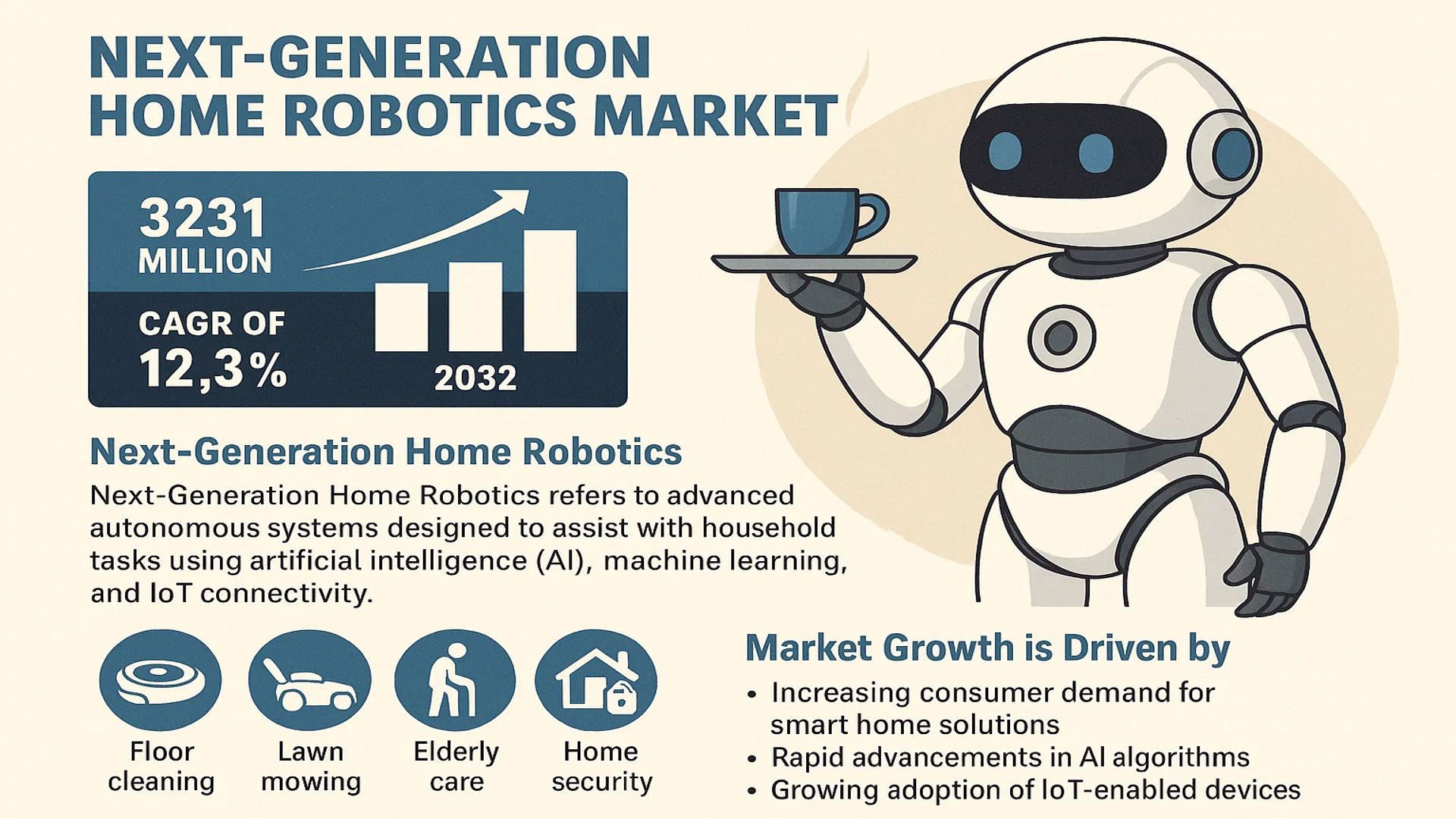
The global Next-Generation Home Robotics Market was valued at 3231 million in 2024 and is projected to reach US$ 7103 million by 2032, at a CAGR of 12.3% during the forecast period.
Next-Generation Home Robotics refers to advanced autonomous systems designed to assist with household tasks using artificial intelligence (AI), machine learning, and IoT connectivity. These robots integrate sophisticated sensors, computer vision, and voice recognition technologies to perform functions ranging from floor cleaning and lawn mowing to elderly care and home security. Unlike conventional robotic appliances, next-generation models demonstrate adaptive learning capabilities, enabling them to improve performance over time based on user behavior and environmental changes.
The market growth is driven by increasing consumer demand for smart home solutions, rapid advancements in AI algorithms, and growing adoption of IoT-enabled devices. North America currently leads market adoption with major players like iRobot and Neato Robotics, while Asia-Pacific shows the highest growth potential due to rising disposable incomes and tech-savvy populations. Recent developments include Samsung’s 2023 launch of AI-powered home assistant robots and iRobot’s strategic partnership with Amazon to enhance smart home integration capabilities.
MARKET DYNAMICS
MARKET DRIVERS
Growing Demand for Smart Home Integration Fuels Adoption of Next-Gen Robotics
The rapid expansion of smart home ecosystems is significantly driving the adoption of next-generation home robotics. With over 300 million smart homes globally as of 2024, consumers increasingly seek seamless automation solutions that integrate with existing smart devices. Home robots equipped with AI and IoT capabilities can now communicate with smart speakers, security systems, and appliances, creating a unified home management experience. For instance, leading vacuum robots now sync with voice assistants for hands-free operation and can trigger smart air purifiers when detecting increased dust levels. This interoperability is transforming home robotics from standalone devices into integral components of intelligent home networks.
Aging Populations and Labor Shortages Create Demand for Assistive Robotics
Demographic shifts across developed nations are accelerating demand for robotic home assistants. Countries like Japan, where over 28% of the population is aged 65+, and Germany with similar aging trends are witnessing surging interest in elder-care robots. These sophisticated systems can monitor vital signs, dispense medication, and provide mobility support – addressing critical caregiver shortages while maintaining patient dignity. The global market for robotic caregivers is projected to grow at 18% CAGR through 2030 as healthcare systems embrace these cost-effective alternatives to human care. Recent advancements in emotional AI enable these robots to better understand and respond to human needs, significantly improving user acceptance.
Advancements in AI and Computer Vision Revolutionize Home Robotics
Breakthroughs in machine learning algorithms and sensor technologies are enabling home robots to perform increasingly complex tasks with human-like perception. Modern robotic vacuums now achieve 99% navigation accuracy using AI-powered simultaneous localization and mapping (SLAM) technology, while kitchen robots can identify over 1,000 ingredients through advanced computer vision. The integration of large language models allows for more natural voice interactions, with some models processing over 100 language variations. These technological leaps are expanding robotics beyond simple chores into sophisticated home management roles, with recent product launches demonstrating capabilities like recipe adaptation based on available ingredients and predictive maintenance of home systems.
MARKET RESTRAINTS
High Development Costs and Pricing Barriers Limit Mass Adoption
While technological capabilities advance rapidly, the premium pricing of advanced home robotics remains a significant barrier to widespread adoption. Development costs for AI-powered robots often exceed traditional appliance budgets by 300-500%, with sophisticated models requiring investments in specialized sensors, processors, and R&D. This translates to retail prices that remain prohibitive for mainstream consumers, with high-end robotic chefs currently priced comparably to luxury vehicles. Even in developed markets, only 12-15% of households can justify such expenditures for non-essential automation, creating a challenge for manufacturers seeking to expand beyond early adopters and tech enthusiasts.
Data Privacy Concerns Hinder Consumer Trust in Connected Robotics
The always-connected nature of next-gen home robots raises legitimate security concerns that impact market growth. With devices containing multiple cameras, microphones, and access to home networks, consumers fear vulnerabilities to hacking and data misuse. Recent incidents involving unauthorized data collection have led to increased scrutiny, with regulatory bodies imposing stricter requirements on device manufacturers. Compliance with evolving data protection laws adds development complexity and costs, while consumer surveys show 63% of potential buyers delay purchases until privacy safeguards improve. Manufacturers must balance advanced functionality with robust encryption and transparent data policies to overcome this restraint.
MARKET CHALLENGES
Technical Limitations in Unstructured Home Environments
Despite impressive advancements, home robots still struggle with the unpredictability of residential environments. Unlike controlled industrial settings, households present endless variables – from playful pets to rearranged furniture – that challenge robotic perception systems. Current technology achieves only 75-85% accuracy in complex tasks like laundry folding or navigating cluttered spaces. These limitations require constant human oversight, reducing the value proposition for many consumers. Developing algorithms capable of handling infinite real-world scenarios without frequent intervention remains a key challenge for engineers, with some estimates suggesting another 3-5 years of development needed for truly autonomous operation.
Regulatory Uncertainties Slow Innovation Pace
The lack of standardized regulations governing home robotics creates uncertainties that impede market growth. Jurisdictions vary widely in their approaches to safety certifications, data collection policies, and liability frameworks for autonomous devices. This patchwork of requirements forces manufacturers to develop multiple device variants, increasing costs and delaying launches. Recent debates about robot ethics and appropriate levels of automation in domestic settings further complicate the landscape. Industry leaders call for harmonized international standards to provide clarity while ensuring consumer protection – a balance that regulatory bodies continue to struggle with as technology outpaces policy development.
MARKET OPPORTUNITIES
Emerging Markets Offer Significant Growth Potential
Developing economies present substantial untapped opportunities as rising disposable incomes and urbanization drive smart home adoption. Regions like Southeast Asia and the Middle East show accelerating interest in home automation, with robotics adoption rates growing at 23% annually compared to 9% in mature markets. Localized product adaptations addressing smaller living spaces and cultural preferences could unlock this potential. Manufacturers investing in region-specific solutions – such as compact robotic cooks for apartment kitchens or multi-language support for diverse households – stand to gain first-mover advantages in these burgeoning markets.
Subscription and Robotics-as-a-Service Models Create New Revenue Streams
Innovative business models are emerging to overcome affordability barriers while ensuring recurring revenue for manufacturers. Robotics-as-a-Service (RaaS) offerings, where users pay monthly fees instead of outright purchases, are gaining traction – particularly for high-end models. These plans often include automatic software updates, hardware upgrades, and premium support, increasing long-term customer value while making advanced robotics accessible. Several leading brands report subscription adoption rates exceeding 30% for newer models, with customers valuing the predictable costs and continuous improvements. This shift toward service-oriented models is reshaping industry economics and customer relationships in the home robotics sector.
NEXT-GENERATION HOME ROBOTICS MARKET TRENDS
Artificial Intelligence and Machine Learning Driving Market Innovation
The integration of Artificial Intelligence (AI) and Machine Learning (ML) in next-generation home robotics has transformed how domestic tasks are automated. These technologies enable robots to learn from their environment, recognize patterns, and adapt to user preferences. For example, leading robotic vacuum cleaners now utilize AI-driven navigation systems, improving efficiency by 30-40% compared to traditional models. Additionally, advancements in natural language processing have enhanced voice interaction capabilities, making personal assistant robots more intuitive and user-friendly. Over 60% of new models launched in 2024 feature some form of AI-powered automation, signaling robust market adoption.
Other Trends
Expansion of Smart Home Ecosystems
The rapid growth of smart home technology is accelerating demand for interconnected robotic systems. With global smart home device shipments surpassing 1.2 billion units annually, home robotics are increasingly being designed to seamlessly integrate with existing smart home ecosystems. Autonomous security robots, for instance, now leverage IoT connectivity to sync with smart locks and surveillance cameras, providing enhanced home protection. This trend is further supported by the rising consumer preference for unified smart home solutions, where robotic assistants act as central control hubs.
Rising Demand for Robotic Elderly and Healthcare Assistance
An aging population and increasing healthcare costs are propelling demand for robotic caregivers and healthcare monitoring systems. By 2032, nearly 22% of the global population will be over 60 years old, creating significant opportunities for assistive robotics. Recent models include fall detection sensors, medication reminders, and companion functionalities to address loneliness—a growing concern in elderly care. Furthermore, hospitals and home care providers are piloting robotic solutions to assist with patient monitoring, reducing workforce strain while improving care quality. The healthcare robotics segment is projected to grow at a CAGR of 15.8% through 2032, outpacing other home robotics categories.
COMPETITIVE LANDSCAPE
Key Industry Players
Technological Innovation and Strategic Expansion Drive Market Leadership
The global Next-Generation Home Robotics market displays a dynamic competitive landscape where established technology giants compete with specialized robotics firms. iRobot, the pioneer behind the Roomba series, maintains a dominant position with approximately 67% market share in robotic vacuum cleaners as of 2024. Their success stems from continuous AI advancements and strategic partnerships with smart home ecosystems. However, competitors like Ecovacs Robotics and Roborock are rapidly gaining ground through superior lidar-based navigation and mopping functionalities.
Asian manufacturers are demonstrating particularly strong growth, with LG Electronics and Samsung leveraging their home appliance expertise to develop multi-functional robotic systems. LG’s recent Cloi Chefbot, which integrates recipe databases with precise cooking automation, exemplifies this trend. Meanwhile, Miso Robotics has carved a niche in kitchen robotics through its Flippy robotic fry station, demonstrating how specialized applications can create new market segments.
The industry is witnessing increasing vertical integration as players like KUKA Robotics (owned by Chinese appliance giant Midea) combine industrial robotics expertise with home automation. Recent acquisitions in computer vision startups by several major players indicate growing emphasis on spatial awareness capabilities. Furthermore, companies are expanding their service models beyond hardware sales, with SoftBank Robotics pioneering robotics-as-a-service subscriptions for eldercare applications.
List of Key Next-Generation Home Robotics Companies
- iRobot Corporation (U.S.)
- Ecovacs Robotics (China)
- Roborock Technology (China)
- Neato Robotics (U.S.)
- Miso Robotics (U.S.)
- Samsung Electronics (South Korea)
- LG Electronics (South Korea)
- Aibo (Sony Corporation) (Japan)
- SoftBank Robotics (Japan)
- KUKA Robotics (Germany)
Segment Analysis:
By Technology
Computer Vision Drives Innovation in Home Robotics Due to Advanced Object Recognition Capabilities
The market is segmented based on technology into:
- Computer Vision
- LiDAR
- Voice Recognition
- Sensors
- Subtypes: Infrared sensors, proximity sensors, force sensors, and others
- Others
By Application
Autonomous Vacuum Cleaners Lead the Market Owing to High Consumer Adoption for Household Cleaning
The market is segmented based on application into:
- Autonomous Vacuum Cleaners
- Robotic Lawn Mowers
- Home Security Robots
- Robotic Kitchen Assistants
- Robotic Caregivers
- Window-Cleaning Robots
- Others
By End User
Residential Sector Dominates Due to Increasing Demand for Smart Home Automation
The market is segmented based on end user into:
- Residential
- Commercial
- Subtypes: Hospitality, healthcare facilities, and others
- Industrial
By Functionality
Cleaning Robots Maintain Market Leadership with Growing Focus on Household Convenience
The market is segmented based on functionality into:
- Cleaning Robots
- Companion Robots
- Security Robots
- Healthcare Assistants
- Others
Regional Analysis: Next-Generation Home Robotics Market
North America
The North American market leads in adoption due to high consumer awareness, robust technological infrastructure, and strong purchasing power. The U.S. dominates with key players like iRobot and Mayfield Robotics driving innovation in vacuum cleaning, lawn care, and security applications. AI-powered home assistants and elder-care robots are gaining traction, supported by an aging population. Despite premium pricing, demand remains steady due to smart home integration trends and convenience-driven lifestyles. Privacy concerns around data collection for intelligent robotics pose a notable challenge for manufacturers. The region’s early adoption of IoT and 5G networks further accelerates market growth.
Europe
Europe maintains strong growth potential due to stringent regulations favoring energy-efficient robotics and growing acceptance of automated domestic solutions. Countries like Germany and the U.K. are at the forefront, with KUKA Robotics and Ecovacs Robotics expanding their smart home portfolios. Robotic vacuum cleaners and window cleaners are widespread, while kitchen assistant robots experience growing interest. Privacy laws like GDPR slightly hinder data-intensive robotics applications, but the market adapts with localized processing solutions. Northern European countries show particular interest in robotic lawn mowers and snow-clearing robots due to harsh seasonal conditions.
Asia-Pacific
As the fastest-growing market, Asia-Pacific benefits from massive manufacturing capabilities and expanding middle-class populations. China’s Ubtech Robotics and Roborock lead in cost-competitive yet advanced robotics, with Japan’s Sony Aibo dominating robotic pets. Domestic helper robots see heavy adoption in South Korea and Singapore, while India shows nascent growth in security and monitoring robots. High population density in urban centers drives demand for space-saving automated solutions. However, fragmented regulations and intellectual property concerns occasionally disrupt supply chains, while local players increasingly challenge established global brands.
South America
Market growth here is moderate but accelerating, with Brazil and Argentina as primary adopters. Economic constraints limit penetration to middle-upper income households, favoring multi-functional robots over single-task devices. Vacuum robots lead sales, while security monitoring robots gain popularity in gated communities. Local startups are emerging in the service robotics space, though imports still dominate. Infrastructure limitations in rural areas and inconsistent technical support networks hinder broader adoption. The market shows potential for growth in elderly-assist robotics as demographic shifts occur.
Middle East & Africa
This emerging market shows promise, particularly in Gulf Cooperation Council countries where smart home investments are rising. High-net-worth individuals drive demand for luxury robotic solutions like automated pool cleaners and interactive social robots. The UAE leads in adoption due to tech-savvy consumers and government smart city initiatives. However, high costs and lack of localized service centers restrict widespread adoption in other regions. Africa sees gradual uptake in South Africa and Nigeria, primarily for security robots and basic cleaning devices, though power reliability issues present operational challenges in some areas.
Report Scope
This market research report provides a comprehensive analysis of the Global Next-Generation Home Robotics Market, covering the forecast period 2024–2032. It offers detailed insights into market dynamics, technological advancements, competitive landscape, and key trends shaping the industry.
Key focus areas of the report include:
- Market Size & Forecast: Historical data and future projections for revenue, unit shipments, and market value across major regions and segments. The global market was valued at USD 3,231 million in 2024 and is projected to reach USD 7,103 million by 2032, growing at a CAGR of 12.3%.
- Segmentation Analysis: Detailed breakdown by technology (Computer Vision, LiDAR, Voice Recognition, Sensors, Others) and application (Autonomous Vacuum Cleaners, Robotic Lawn Mowers, Home Security Robots, etc.) to identify high-growth segments.
- Regional Outlook: Insights into market performance across North America, Europe, Asia-Pacific, Latin America, and Middle East & Africa. The U.S. and China are key markets with significant growth potential.
- Competitive Landscape: Profiles of leading market participants including iRobot, Neato Robotics, Ecovacs Robotics, Samsung, LG, and KUKA Robotics, covering their product portfolios, market share, and strategic initiatives.
- Technology Trends & Innovation: Assessment of AI integration, advanced sensor technologies, human-robot interaction, and smart home connectivity in next-gen home robotics.
- Market Drivers & Restraints: Analysis of factors such as rising smart home adoption, aging populations, labor cost increases, alongside challenges like high costs and privacy concerns.
- Stakeholder Analysis: Strategic insights for robotics manufacturers, technology providers, investors, and policymakers to navigate the evolving market landscape.
The report employs primary and secondary research methodologies, including interviews with industry experts and analysis of verified market data, to ensure accuracy and reliability.
FREQUENTLY ASKED QUESTIONS:
What is the current market size of Global Next-Generation Home Robotics Market?
-> Next-Generation Home Robotics Market was valued at 3231 million in 2024 and is projected to reach US$ 7103 million by 2032, at a CAGR of 12.3% during the forecast period 2032.
Which key companies operate in Global Next-Generation Home Robotics Market?
-> Key players include iRobot, Neato Robotics, Ecovacs Robotics, Samsung, LG, KUKA Robotics, SoftBank Robotics, and Roborock, among others.
What are the key growth drivers?
-> Key growth drivers include rising smart home adoption, increasing labor costs, aging populations requiring assistance, and advancements in AI/robotics technologies.
Which region dominates the market?
-> North America currently leads in adoption, while Asia-Pacific is expected to be the fastest-growing region due to increasing disposable incomes and smart home penetration.
What are the emerging trends?
-> Emerging trends include AI-powered personalization, multi-functional robots, cloud-connected robotics, and integration with smart home ecosystems.

Get Sample Report PDF for Exclusive Insights
Report Sample Includes
- Table of Contents
- List of Tables & Figures
- Charts, Research Methodology, and more...
 Download Sample Report PDF