Neuromorphic Computing Hardware Market Insights
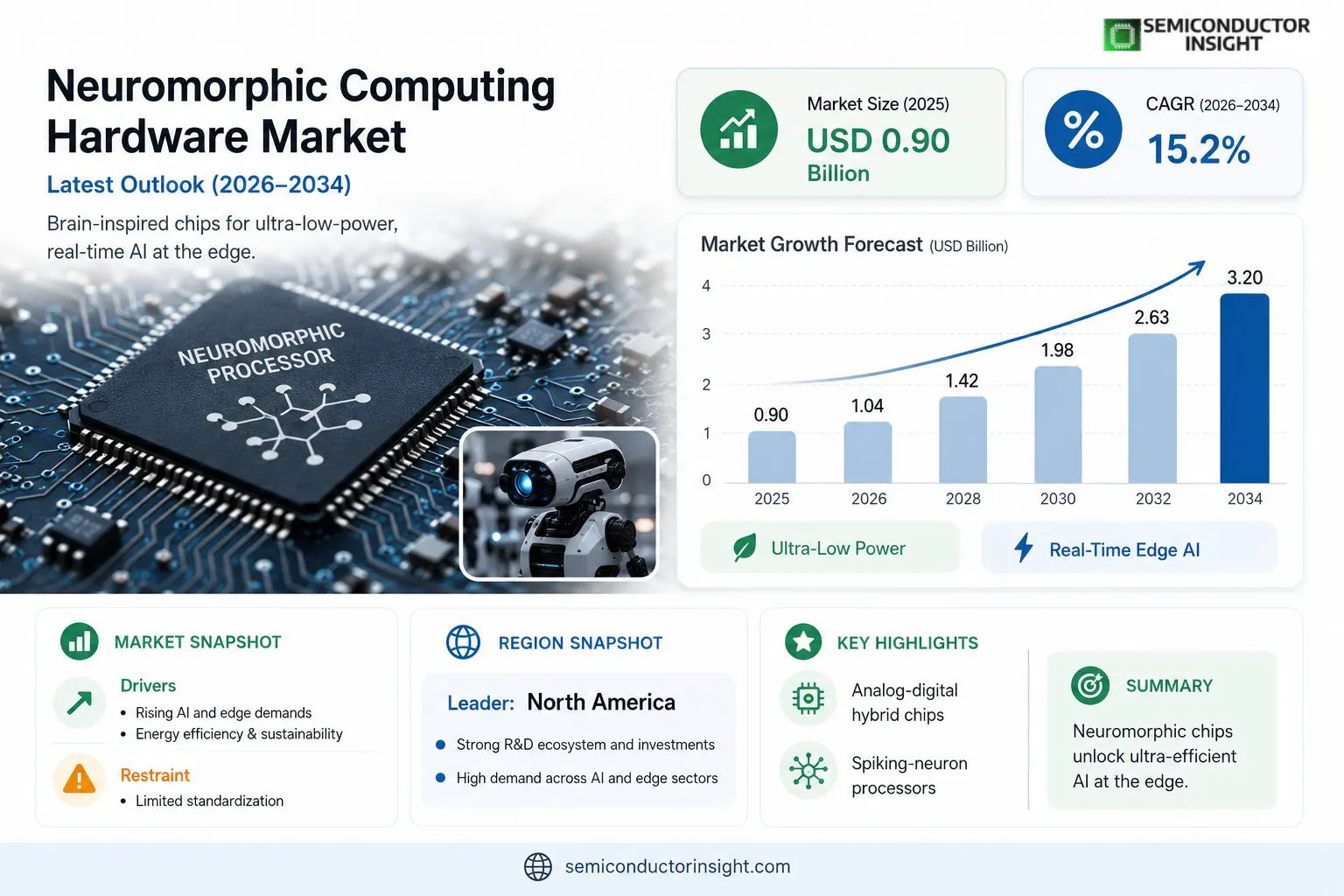
Global Neuromorphic Computing Hardware Market size was valued at USD 0.90 billion in 2025. The market is projected to grow from USD 0.90 billion in 2025 to USD 3.20 billion by 2034, exhibiting a CAGR of 15.2% during the forecast period.
Neuromorphic computing hardware comprises analog‑digital hybrid chips and spiking‑neuron processors that emulate the structure and dynamics of biological neural networks, enabling ultra‑low‑power inference and real‑time learning at the edge.The market is experiencing rapid growth because AI workloads are shifting toward energy‑efficient edge solutions, while increased R&D funding from governments and semiconductor giants accelerates technology maturation.Furthermore, collaborations such as Intel’s partnership with Carnegie Mellon University on Loihi 2 and IBM’s open‑source TrueNorth initiatives are expanding ecosystem adoption.Key players, including Intel, IBM, Qualcomm, BrainChip Holdings, and SynSense, are broadening product portfolios to meet rising demand across autonomous systems, robotics, and smart sensors.
MARKET DRIVERS
Rising AI and Edge Computing Demands
Neuromorphic Computing Hardware Market is being propelled by the exponential growth of AI models that require low‑latency processing at the edge. Industries such as autonomous vehicles, robotics, and smart sensors are shifting from conventional CPUs to brain‑inspired architectures to achieve real‑time inference. This transition is expected to increase hardware deployments by over 30% annually.
Energy Efficiency and Sustainability Pressures
Neuromorphic chips consume up to 100× less power than traditional GPUs while delivering comparable performance on spiking neural networks. Companies focused on carbon‑neutral strategies are adopting these ultra‑efficient solutions to lower operational costs and meet regulatory targets. Consequently, procurement budgets are allocating a larger share to energy‑saving hardware.
➤ “Neuromorphic processors enable AI workloads with sub‑millijoule energy per inference, reshaping the cost structure for edge deployments.”
Strategic partnerships between semiconductor firms and research institutions are accelerating technology transfer, shortening time‑to‑market for next‑generation neuromorphic solutions. This collaborative ecosystem is a key catalyst for sustained growth in Neuromorphic Computing Hardware Market.
MARKET CHALLENGES
Integration Complexity with Existing Infrastructures
Many enterprises face difficulties retrofitting legacy systems to accommodate neuromorphic processors, which require specialized software stacks and training data formats. The steep learning curve for developers and the scarcity of mature development tools prolong deployment timelines. These integration hurdles can slow adoption rates despite clear performance benefits.
Other Challenges
Manufacturing Yield and Scaling
Producing neuromorphic chips at high yield remains a technical bottleneck, as the intricate analog components are sensitive to process variations. Limited wafer output and higher unit costs hinder large‑scale commercialization, posing a risk to market expansion.
MARKET RESTRAINTS
Limited Standardization and Benchmarking
The absence of universally accepted performance metrics for neuromorphic hardware creates uncertainty for investors and end‑users. Without standardized benchmarks, comparing solutions across vendors is challenging, which can deter procurement decisions and constrain market momentum.
MARKET OPPORTUNITIES
Emerging Applications in Healthcare and IoT
Neuromorphic processors are poised to transform medical imaging, real‑time patient monitoring, and large‑scale IoT networks by delivering AI inference at the point of data capture. The convergence of healthtech investment and demand for low‑power analytics opens a lucrative frontier for Neuromorphic Computing Hardware Market, with projected revenue growth exceeding 25% CAGR over the next five years.
Neuromorphic Computing Hardware Market Trends
Energy‑Efficient Edge AI Drives Adoption
The shift of artificial‑intelligence workloads toward edge devices is reshaping hardware design priorities. Manufacturers are targeting ultra‑low‑power inference capabilities that can operate continuously on limited energy supplies, such as battery‑driven sensors and autonomous drones. Neuromorphic processors, with their event‑driven spiking architectures, naturally align with these requirements by processing information only when spikes occur, thereby eliminating idle‑cycle consumption. Recent R&D investments from both public agencies and leading semiconductor firms have accelerated prototype validation, resulting in a steady pipeline of production‑ready chips. This momentum is encouraging original equipment manufacturers to integrate neuromorphic modules into next‑generation smart cameras, wearable health monitors, and robotic controllers, creating a feedback loop that further entrenches edge‑centric demand.
Other Trends
Hybrid Analog‑Digital Chip Architecture
Hybrid designs combine analog synapse circuits with digital neuron cores, enabling on‑chip learning while preserving the precision of digital control logic. The analog component captures the continuous nature of synaptic weight updates, which reduces the need for frequent memory accesses and thus lowers overall power draw. Manufacturers such as Intel and SynSense have released development kits that expose programmable analog pathways, allowing researchers to fine‑tune learning rules for specific application domains. This architectural flexibility is especially valuable for robotics, where adaptive behavior must be computed in real time without recourse to cloud resources. As design tools mature, the industry expects broader adoption of hybrid chips across industrial IoT deployments, where deterministic latency and minimal energy budget are paramount.
Strategic Partnerships Expand Ecosystem
Collaborative initiatives are accelerating the commercialization of neuromorphic solutions. Notable examples include Intel’s joint research program with Carnegie Mellon University on the Loihi 2 processor, which has produced open‑source software stacks that lower the barrier to entry for developers. IBM’s TrueNorth open‑source project similarly provides a reference architecture for large‑scale spiking networks, fostering community‑driven innovation. These partnerships not only pool intellectual resources but also create shared standards for interfacing neuromorphic hardware with conventional AI frameworks. As a result, startups and established vendors alike can leverage a common ecosystem to bring differentiated products to market more quickly, reinforcing the overall growth trajectory of Neuromorphic Computing Hardware Market.
COMPETITIVE LANDSCAPEKey Industry Players
Neuromorphic Computing Hardware Market – Competitive Overview
The neuromorphic hardware arena is anchored by a handful of semiconductor powerhouses that have turned research prototypes into commercial ASICs. Intel leads the space with its Loihi 2 processor, leveraging a deep partnership with Carnegie Mellon University to deliver programmable spiking‑neuron architectures that can scale from edge devices to high‑performance clusters. IBM’s TrueNorth line, now open‑source, remains a benchmark for ultra‑low‑power inference, while Qualcomm’s AI‑focused R&D unit has accelerated neuromorphic sensor integration for mobile and automotive markets. Collectively, these leaders command the majority of R&D spend and dictate roadmap cadence, creating a market structure where early‑stage collaborations and ecosystem standards are heavily influenced by their design choices and foundry partnerships.Beyond the dominant tier, a vibrant cohort of niche innovators is expanding functional diversity and application reach. BrainChip Holdings commercializes the Akida™ spiking‑neuron chip for edge AI, and SynSense (formerly aiCTX) offers compact neuromorphic sensors aimed at robotics and IoT. Hewlett Packard Enterprise is experimenting with neuromorphic accelerators for data‑center workloads, while Samsung Electronics and Sony Semiconductor Solutions are integrating neuromorphic cores into next‑gen memory and imaging subsystems. Smaller but technically agile firms such as Numenta, Analog Devices, and Bosch Sensortec provide software frameworks, mixed‑signal IP, and sensor‑level neuromorphic processing that complement the larger silicon players, collectively enriching the ecosystem and fostering broader adoption across autonomous systems, smart sensors, and low‑power AI inference.
List of Key Neuromorphic Computing Hardware Companies Profiled
- Intel Corporation
- IBM (International Business Machines Corp.)
- Qualcomm Technologies, Inc.
- BrainChip Holdings Ltd.
- SynSense (formerly aiCTX)
- Hewlett Packard Enterprise (HPE)
- Samsung Electronics Co., Ltd.
- Sony Semiconductor Solutions
- Numenta, Inc.
- Analog Devices, Inc.
- Bosch Sensortec GmbH
- Advanced Micro Devices (AMD)
- Microsoft Research
Segment Analysis:
| Segment Category | Sub-Segments | Key Insights |
| By Type |
|
Analog‑Digital Hybrid Chips drive the market by offering a balanced mix of precision and energy efficiency, enabling real‑time inference at the edge.
|
| By Application |
|
Edge AI is emerging as the leading application, propelled by the need for ultra‑low‑power inference directly on devices.
|
| By End User |
|
Research Institutions lead adoption by exploring novel learning paradigms and benchmarking hardware capabilities.
|
| By Architecture |
|
Neuromorphic ASICs dominate the architecture conversation due to their ability to embed spiking dynamics at silicon level.
|
| By Ecosystem Collaboration |
|
Academic Partnerships are a catalyst for ecosystem growth, fostering shared research and talent pipelines.
|
Regional Analysis: North America
United States
The US boasts a highly active R&D sector, with significant funding directed towards neuromorphic computing. Academic institutions and private companies are collaborating to push the boundaries of hardware design and functionality. Focus areas include novel chip architectures, spiking neural networks, and low-power design techniques.
Major applications fueling the market include AI accelerators, edge AI devices, robotics and automation, and advanced sensors. The need for real-time processing and low-latency inference is a primary driver for adopting neuromorphic hardware in these sectors.
The competitive landscape in the US is characterized by a mix of established semiconductor companies and emerging startups. Key players are investing heavily in neuromorphic technology to gain a competitive edge in the rapidly evolving AI hardware market. Partnerships and collaborations are becoming increasingly common.
Government agencies like DARPA and the National Science Foundation are providing significant funding for neuromorphic research and development. These initiatives are crucial for accelerating innovation and fostering the growth of the industry.
Europe
Europe is rapidly emerging as a significant player in Neuromorphic Computing Hardware Market. Driven by strong governmental support, particularly through initiatives like the European Chips Act, and a growing focus on sustainable and energy-efficient computing, the region is witnessing substantial investments in neuromorphic research and development. European institutions are concentrating on developing innovative neuromorphic architectures and exploring their potential applications in areas such as healthcare, automotive, and industrial automation. The emphasis on data privacy and security also influences the development of neuromorphic solutions tailored for edge computing. Europe’s commitment to fostering a strong ecosystem of startups and research collaborations positions it for sustained growth in this sector. The focus on AI for climate action is also creating new market opportunities.
Asia-Pacific
Asia-Pacific is poised to become the largest and fastest-growing market for Neuromorphic Computing Hardware. Countries like China, Japan, and South Korea are making significant investments in advanced computing technologies, including neuromorphic computing, to maintain their technological competitiveness. The burgeoning AI industry in China is a major driver of demand, with applications spanning smart cities, autonomous driving, and robotics. Japan is focusing on leveraging neuromorphic hardware for advanced industrial automation and robotics. South Korea is investing heavily in cutting-edge research to develop next-generation semiconductor technologies, including neuromorphic chips. The region’s strong manufacturing capabilities and expanding digital infrastructure create a favorable environment for the adoption of neuromorphic computing.
South America
South America represents a nascent but promising market for Neuromorphic Computing Hardware. The increasing adoption of AI and machine learning across industries such as agriculture, finance, and healthcare is creating initial demand. Government initiatives promoting technological development and digital transformation are expected to drive further growth. While investment levels are currently lower compared to North America and Asia-Pacific, the region’s growing middle class and increasing internet penetration present long-term opportunities for neuromorphic technology adoption, particularly in areas requiring low-power, edge-based AI solutions.
Middle East & Africa
The Middle East & Africa region presents an emerging market for Neuromorphic Computing Hardware, driven by increasing investments in smart city initiatives, healthcare digitalization, and industrial automation. Countries like Saudi Arabia, UAE, and South Africa are actively pursuing digital transformation strategies that require advanced computing solutions. The region’s focus on diversifying its economies and promoting technological innovation is creating demand for energy-efficient and high-performance computing hardware. While the market is still in its early stages, the growth potential is significant, particularly with the expanding deployment of IoT devices and the increasing adoption of AI-powered services.
Report Scope
This market research report provides a comprehensive analysis of the Neuromorphic Computing Hardware Market , covering the forecast period 2026–2034. It offers detailed insights into market dynamics, technological advancements, competitive landscape, and key trends shaping the industry.
Key focus areas of the report include:
- ✅Market Overview: The report begins with an overview outlining its current market scenario, key growth indicators, and industry transformation drivers. It discusses macroeconomic factors, demand–supply balance, regulatory landscape, and the strategic role of semiconductors in powering advancements across industries such as automotive, telecommunications, consumer electronics, and industrial automation.
- ✅Market Size & Forecast: Historical data and future projections for revenue, unit shipments, and market value across major regions and segments.
- ✅Segmentation Analysis: Detailed breakdown by product type, technology, application, and end‑user industry to identify high‑growth segments and investment opportunities.
- ✅Regional Insights: Insights into market performance across North America, Europe, Asia‑Pacific, Latin America, and the Middle East & Africa, including country‑level analysis where relevant.
- ✅Competitive Landscape: Profiles of leading market participants, including their product offerings, R&D focus, manufacturing capacity, pricing strategies, and recent developments such as mergers, acquisitions, and partnerships.
- ✅Technology Trends & Innovation: Assessment of emerging technologies, integration of AI/IoT, semiconductor design trends, fabrication techniques, and evolving industry standards.
- ✅Market Drivers & Restraints: Evaluation of factors driving market growth along with challenges, supply chain constraints, regulatory issues, and market‑entry barriers.
- ✅Stakeholder Insights: Insights for component suppliers, OEMs, system integrators, investors, and policymakers regarding the evolving ecosystem and strategic opportunities.
Primary and secondary research methods are employed, including interviews with industry experts, data from verified sources, and real‑time market intelligence to ensure the accuracy and reliability of the insights presented.
FREQUENTLY ASKED QUESTIONS:
What is the current market size of Neuromorphic Computing Hardware Market?
-> Neuromorphic Computing Hardware Market was valued at USD 0.90 billion in 2025 and is expected to reach USD 3.20 billion by 2034.
Which key companies operate in Neuromorphic Computing Hardware Market?
-> Key players include Intel, IBM, Qualcomm, BrainChip Holdings, and SynSense, among others.
What are the key growth drivers?
-> Key growth drivers include the shift of AI workloads toward energy‑efficient edge solutions, increased R&D funding from governments and semiconductor giants, and collaborations such as Intel‑CMU Loihi 2 and IBM‑TrueNorth initiatives.
Which region dominates the market?
-> North America exhibits strong leadership due to the concentration of major chip manufacturers and research institutions, while Asia‑Pacific shows rapid adoption.
What are the emerging trends?
-> Emerging trends include analog‑digital hybrid chip designs, spiking‑neuron processors, real‑time learning at the edge, and open‑source neuromorphic platforms.
Get Sample Report PDF for Exclusive Insights
Report Sample Includes
- Table of Contents
- List of Tables & Figures
- Charts, Research Methodology, and more...
 Download Sample Report PDF