MARKET INSIGHTS
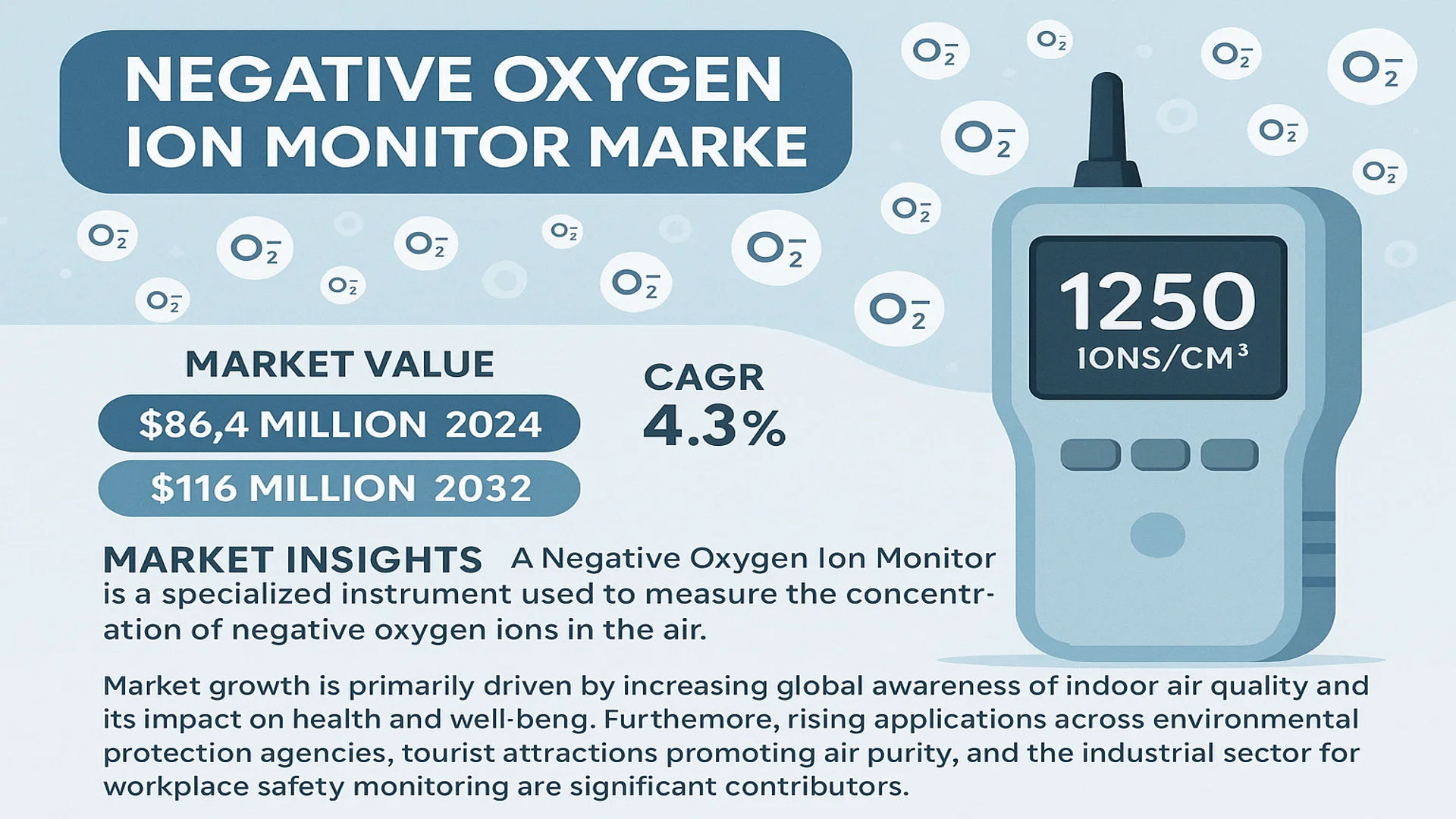
The global Negative Oxygen Ion Monitor Market was valued at 86.4 million in 2024 and is projected to reach US$ 116 million by 2032, at a CAGR of 4.3% during the forecast period.
A Negative Oxygen Ion Monitor is a specialized instrument used to measure the concentration of negative oxygen ions in the air. These devices detect the number of negatively charged oxygen molecules (O₂⁻) or negative ion groups in the environment in real time through advanced sensor technology, typically displaying data in units of ions per cubic centimeter (ions/cm³).
The market growth is primarily driven by increasing global awareness of indoor air quality and its impact on health and well-being. Furthermore, rising applications across environmental protection agencies, tourist attractions promoting air purity, and the industrial sector for workplace safety monitoring are significant contributors. Key players such as Aeroqual, Honeywell, and TSI Incorporated lead the market with innovative product developments, focusing on enhanced accuracy and portability to meet diverse consumer needs.
MARKET DYNAMICS
MARKET DRIVERS
Rising Global Air Quality Awareness to Accelerate Market Adoption
Increasing global awareness about air pollution’s health impacts is driving substantial demand for negative oxygen ion monitors. With urban air quality deteriorating in major metropolitan areas worldwide, consumers and regulatory bodies are seeking reliable methods to measure environmental health indicators. Negative oxygen ions are recognized for their potential benefits in improving respiratory function, enhancing mood, and reducing airborne pollutants. Recent studies indicate that indoor environments typically contain 100-500 ions/cm³, while natural settings like forests and waterfalls can reach 5,000-50,000 ions/cm³. This significant variation has created demand for accurate monitoring devices across residential, commercial, and industrial sectors. The market is further propelled by growing scientific research validating the correlation between negative ion concentration and human wellbeing, prompting healthcare facilities, wellness centers, and smart building developers to integrate these monitoring systems into their environmental management strategies.
Expansion of Smart City Infrastructure to Fuel Market Growth
The global smart city initiative is creating robust opportunities for negative oxygen ion monitor integration into urban environmental monitoring networks. Municipal governments worldwide are implementing comprehensive air quality management systems that require real-time monitoring of multiple parameters, including negative ion concentrations. These systems help urban planners assess environmental health, identify pollution hotspots, and evaluate the effectiveness of green infrastructure projects. Major metropolitan areas across Asia and Europe have allocated substantial portions of their environmental budgets to deploying advanced monitoring technologies. The integration of negative oxygen ion monitors with IoT platforms enables continuous data collection and analysis, providing valuable insights for public health initiatives and environmental policy development. This technological convergence is driving innovation in sensor accuracy, data transmission reliability, and system interoperability, making these monitors essential components of modern urban environmental management ecosystems.
Growing Wellness Tourism Sector to Boost Market Expansion
The rapidly expanding wellness tourism industry represents a significant growth driver for negative oxygen ion monitors. Destination resorts, spa facilities, and health retreats are increasingly promoting their natural environments’ air quality as a key attraction feature. Establishments located in mountainous regions, coastal areas, and forest retreats utilize these monitors to demonstrate their superior air quality metrics to health-conscious consumers. The global wellness tourism market’s consistent growth pattern has created sustained demand for environmental validation tools that can provide measurable data to support marketing claims. Luxury hospitality brands particularly value these monitoring systems as differentiation tools in competitive markets, often integrating real-time air quality displays into guest rooms and common areas. This trend is further amplified by increasing consumer awareness about environmental health factors and willingness to pay premium prices for destinations offering verified air quality benefits.
MARKET RESTRAINTS
High Product Costs and Technical Complexity to Limit Market Penetration
The negative oxygen ion monitor market faces significant growth constraints due to relatively high product costs and technical complexity. Advanced monitoring systems incorporating precision sensors and sophisticated data processing capabilities command premium pricing, creating adoption barriers in price-sensitive markets and developing regions. The manufacturing process requires specialized components and calibration equipment, contributing to elevated production expenses that ultimately transfer to end-users. Technical complexity presents additional challenges, as proper operation and maintenance demand specialized knowledge that may not be readily available among potential users. Calibration procedures require controlled environments and reference standards, while interpretation of monitoring data necessitates understanding of environmental science principles. These factors collectively restrict market expansion among smaller enterprises and individual consumers who might benefit from air quality monitoring but lack the technical resources or budget for advanced systems.
Limited Consumer Awareness and Education to Hinder Market Development
Market growth is considerably restrained by limited consumer understanding of negative oxygen ions’ significance and monitor functionality. Despite growing air quality awareness, most consumers lack specific knowledge about negative ion benefits and measurement methodologies. This knowledge gap reduces perceived value and adoption motivation, particularly in consumer markets where purchase decisions are heavily influenced by immediate tangible benefits. The scientific community continues researching negative ions’ health impacts, but conclusive evidence remains somewhat limited, creating uncertainty among potential users. Educational initiatives face challenges in communicating complex environmental science concepts to general audiences, while competing air quality monitoring technologies often offer simpler value propositions. This awareness deficit affects both consumer and commercial markets, as decision-makers may prioritize more established environmental parameters over negative ion concentration when allocating monitoring budgets.
Regulatory Standardization Challenges to Impede Market Consistency
The absence of universally accepted measurement standards and calibration protocols creates significant market restraints for negative oxygen ion monitors. Different manufacturers employ varying measurement methodologies and technical specifications, resulting in data inconsistency that undermines user confidence and cross-comparison capabilities. Regulatory bodies worldwide have been slow to establish comprehensive certification requirements and performance standards specifically for negative ion monitoring devices. This standardization gap allows product quality variations that can confuse consumers and complicate procurement decisions for institutional buyers. The lack of clear regulatory frameworks also hinders integration with established air quality monitoring networks, as data compatibility issues arise when combining readings from different manufacturer systems. These challenges are particularly pronounced in international markets where regulatory approaches differ significantly between regions, creating additional complications for manufacturers seeking global distribution.
MARKET CHALLENGES
Sensor Accuracy and Environmental Interference to Challenge Measurement Reliability
Negative oxygen ion monitors face significant technical challenges related to measurement accuracy and environmental interference. These devices must detect extremely small electrical charges carried by negative ions, making them susceptible to various interference factors that can compromise reading reliability. Humidity fluctuations, temperature variations, and airborne particulate matter all affect measurement precision, requiring sophisticated compensation algorithms that increase system complexity and cost. Different sensor technologies exhibit varying performance characteristics under identical conditions, creating consistency issues across the market. The fundamental physics of negative ion measurement presents inherent challenges, as ions are transient and easily disrupted by environmental factors. Manufacturers must invest substantially in research and development to improve sensor stability and reduce measurement drift, but these advancements typically increase production costs. These technical hurdles represent ongoing challenges for industry participants seeking to deliver reliable, affordable monitoring solutions across diverse application environments.
Other Challenges
Market Fragmentation and Intense Competition
The negative oxygen ion monitor market experiences considerable fragmentation with numerous manufacturers offering products across different quality tiers and price points. This competitive landscape creates challenges for established brands maintaining market share while newer entrants struggle to differentiate their offerings. Price competition often intensifies as companies attempt to gain market position, potentially compromising product quality and features. The absence of dominant industry standards allows technological approaches to vary significantly between manufacturers, complicating comparison shopping and potentially confusing consumers. This fragmentation also affects after-sales support and service consistency, as different companies provide varying levels of technical assistance and warranty coverage.
Technical Support and Maintenance Requirements
Advanced negative oxygen ion monitors require regular calibration and technical maintenance to ensure measurement accuracy, creating operational challenges for end-users. Many organizations lack in-house expertise for proper device maintenance, necessitating manufacturer support that may not be readily available in all geographic markets. Calibration procedures typically require specialized equipment and controlled environments, adding operational complexity and cost for monitoring system operators. These maintenance requirements particularly challenge continuous monitoring applications where system downtime affects data continuity and reliability. The technical sophistication of these systems also creates training challenges for operators who must understand both the monitoring technology and underlying environmental science principles to effectively utilize collected data.
MARKET OPPORTUNITIES
Integration with Building Automation Systems to Create New Application Areas
The growing adoption of smart building technologies presents substantial opportunities for negative oxygen ion monitor integration into comprehensive environmental management systems. Modern building automation platforms increasingly incorporate air quality monitoring as a standard feature, creating natural synergy opportunities for negative ion detection capabilities. Building managers and facilities engineers recognize the value of monitoring multiple air quality parameters to optimize ventilation systems, energy efficiency, and occupant comfort. Integration with existing building management infrastructure allows negative ion monitors to leverage established data networks and control systems, reducing implementation costs and complexity. This convergence opportunity is particularly relevant in commercial real estate, healthcare facilities, and educational institutions where environmental quality significantly impacts occupant health and productivity. The trend toward healthier building certifications and green construction standards further drives demand for comprehensive air quality monitoring solutions that include negative ion measurement.
Technological Advancements in Sensor Design to Enable New Market Segments
Ongoing innovations in sensor technology and miniaturization are creating opportunities for negative oxygen ion monitors to expand into new application areas and consumer segments. Recent advancements in semiconductor manufacturing and materials science have enabled development of more compact, energy-efficient sensors suitable for integration into portable devices and wearable technology. These technological improvements reduce power requirements and physical size while maintaining measurement accuracy, opening opportunities in consumer electronics, mobile applications, and personal air quality monitoring. The convergence of environmental sensing with smartphone technology represents a particularly promising opportunity, as mobile device integration dramatically increases accessibility and user engagement. Miniaturization also enables deployment in previously impractical locations, including vehicles, aircraft, and temporary monitoring scenarios. These technological advancements collectively create pathways for market expansion beyond traditional stationary monitoring applications into dynamic, mobile, and personal use cases.
Growing Corporate Wellness Programs to Drive Commercial Adoption
The expanding corporate wellness industry presents significant growth opportunities for negative oxygen ion monitor adoption in workplace environments. Companies increasingly recognize the connection between indoor environmental quality and employee health, productivity, and satisfaction. Corporate wellness initiatives now frequently include air quality monitoring as a component of comprehensive workplace health strategies. Office buildings, manufacturing facilities, and corporate campuses represent substantial addressable markets for environmental monitoring systems that can demonstrate tangible benefits through improved employee wellbeing and reduced absenteeism. The trend toward healthy building certifications and green workplace standards further encourages investment in advanced air quality monitoring technologies. These corporate applications often involve larger-scale deployments and recurring revenue opportunities through monitoring services, data analysis, and system maintenance. The commercial sector’s growing emphasis on environmental, social, and governance criteria creates additional impetus for investments in workplace air quality monitoring and improvement initiatives.
NEGATIVE OXYGEN ION MONITOR MARKET TRENDS
Heightened Focus on Indoor Air Quality and Wellness to Emerge as a Dominant Trend
The global negative oxygen ion monitor market is experiencing significant growth, largely driven by an increased global focus on indoor air quality and wellness. Negative oxygen ions, often referred to as “air vitamins,” are recognized for their potential benefits, including mood enhancement, improved sleep, and reduction of airborne pollutants. This has led to a surge in demand for accurate monitoring devices across residential, commercial, and institutional settings. The market’s expansion is further supported by a growing body of research linking high negative ion concentrations to improved cognitive function and overall well-being. While the market was valued at 86.4 million in 2024, it is projected to reach 116 million by 2032, growing at a compound annual growth rate of 4.3%. This steady growth is a direct reflection of consumers and businesses becoming more proactive about managing their environmental health, moving beyond traditional particulate matter sensors to more comprehensive air quality assessment tools.
Other Trends
Technological Integration and Smart Building Ecosystems
Another powerful trend shaping the market is the seamless integration of negative oxygen ion monitors into smart building and home automation ecosystems. Modern devices are increasingly equipped with IoT connectivity, allowing for real-time data streaming to mobile applications and centralized building management systems. This enables automated responses, such as triggering air purification systems or adjusting ventilation when ion levels drop below a certain threshold. The portable monitor segment, in particular, is witnessing rapid innovation, with manufacturers focusing on user-friendly interfaces, longer battery life, and enhanced data accuracy. The shift towards smart cities and green building certifications, which often include air quality metrics, is creating substantial new demand for these integrated monitoring solutions, making them a standard feature in new construction and retrofitting projects.
Expansion into Niche Application Segments
Beyond traditional environmental monitoring, the application scope for negative oxygen ion monitors is broadening into specialized niches. The tourism and hospitality sector, for instance, is leveraging this technology as a marketing tool, promoting high negative ion concentrations in natural tourist attractions like waterfalls, forests, and coastal areas to attract health-conscious travelers. Similarly, the industrial field is adopting these monitors to ensure optimal working conditions in facilities where air ionization is used for processes like static control or contamination reduction. The fixed monitor segment is expected to see robust growth in these industrial and commercial applications due to the need for continuous, stationary monitoring. This diversification of use cases is a key factor driving innovation and competition among established players and new entrants in the market.
COMPETITIVE LANDSCAPE
Key Industry Players
Companies Strive to Strengthen their Product Portfolio to Sustain Competition
The global Negative Oxygen Ion Monitor market exhibits a fragmented competitive structure, characterized by the presence of numerous international and regional players vying for market share. This dynamic is driven by increasing global awareness of air quality and the health benefits associated with negative ion concentration monitoring. Aeroqual (New Zealand) and Honeywell (U.S.) are recognized as frontrunners, leveraging their extensive distribution networks and robust technological heritage in environmental monitoring solutions. Their dominance is particularly evident in North American and European markets, where regulatory standards and consumer awareness are high.
Meanwhile, specialized firms like TSI Incorporated (U.S.) and GrayWolf Sensing Solutions (U.S.) have carved out significant niches, especially within the industrial and occupational health sectors. Their growth is largely attributed to providing highly accurate, durable monitors that meet stringent industry requirements. These companies continuously invest in R&D to enhance sensor sensitivity and data reliability, which are critical factors for professional end-users.
The competitive intensity is further amplified by the strategic activities of established players. Recent developments include Testo (Germany) expanding its portable monitor line with enhanced connectivity features, catering to the growing demand for IoT-integrated environmental devices. Similarly, PCE Instruments (Germany) has been active in broadening its application reach into the tourist attraction segment, capitalizing on the wellness tourism trend. These moves are not just about product innovation; they represent strategic efforts to capture emerging application segments before they mature.
Asia-Pacific represents a fiercely contested and high-growth region, with local players like Lutron Electronic Enterprise (Taiwan) and several Chinese manufacturers such as Shandong Tianhe Environmental Technology and Xiamen Xinyangbang Technology competing aggressively on price and localization. These companies benefit from strong domestic supply chains and a deep understanding of regional market needs, allowing them to hold substantial market share within Asia. However, they are increasingly focusing on improving product quality and obtaining international certifications to compete on a global scale, indicating a market-wide shift towards higher standards.
Looking forward, the competitive landscape is expected to witness consolidation through mergers and acquisitions as larger entities seek to acquire innovative technologies and access new geographical markets. Partnerships between sensor technology firms and software companies are also becoming more common, aiming to offer comprehensive air quality management solutions rather than standalone monitoring devices.
List of Key Negative Oxygen Ion Monitor Companies Profiled
- Aeroqual (New Zealand)
- Honeywell International Inc. (U.S.)
- Acoem (France)
- TSI Incorporated (U.S.)
- GrayWolf Sensing Solutions (U.S.)
- PCE Instruments (Germany)
- E Instruments International (U.S.)
- Lutron Electronic Enterprise Co., Ltd. (Taiwan)
- KIMO Instruments (France)
- Testo SE & Co. KGaA (Germany)
- Shandong Tianhe Environmental Technology Co., Ltd. (China)
- Shandong Tianwei Environmental Technology Co., Ltd. (China)
- Xiamen Xinyangbang Technology Co., Ltd. (China)
Segment Analysis:
By Type
Portable Segment Leads the Market Due to Rising Demand for On-the-Go Air Quality Monitoring
The market is segmented based on type into:
- Fixed
- Portable
By Application
Environmental Protection Segment Dominates Owing to Increased Regulatory Focus on Air Quality Standards
The market is segmented based on application into:
- Environmental Protection
- Tourist Attractions
- Industrial Field
- Other
By End User
Government & Regulatory Bodies Hold Significant Share Driven by Mandatory Air Quality Index Monitoring Initiatives
The market is segmented based on end user into:
- Government & Regulatory Bodies
- Research Institutions
- Industrial Facilities
- Tourism & Hospitality Sector
- Others
By Technology
Electrostatic Collection Technology Prevails Due to its High Accuracy and Reliability in Ion Detection
The market is segmented based on technology into:
- Electrostatic Collection
- Light Scattering
- Others
Regional Analysis: Negative Oxygen Ion Monitor Market
Asia-Pacific
The Asia-Pacific region is the dominant force in the global Negative Oxygen Ion Monitor market, driven by severe air quality challenges and proactive government responses. China, in particular, is the largest market, fueled by its national ecological civilization construction strategy and the widespread installation of air quality monitoring stations in major cities like Beijing and Shanghai. The country’s 14th Five-Year Plan emphasizes environmental protection, creating substantial demand for precise monitoring equipment. India follows closely, with its National Clean Air Programme (NCAP) targeting a 20-30% reduction in particulate matter concentration by 2024, spurring procurement of monitoring devices. Japan and South Korea also represent mature markets with high adoption rates in public spaces and smart city infrastructure. The region’s growth is further accelerated by rising health consciousness among the urban population and the tourism sector’s use of negative ion concentration as a wellness marketing tool.
North America
North America holds a significant share of the market, characterized by stringent regulatory standards and high consumer awareness regarding indoor air quality (IAQ). In the United States, the Environmental Protection Agency (EPA) guidelines and standards, alongside green building certifications like LEED, drive the adoption of advanced air quality monitors in commercial and residential sectors. The presence of major market players, including Honeywell and TSI Incorporated, fosters innovation and technological advancement. Canada shows similar trends, with a strong focus on environmental health research and monitoring in public institutions. The market here is primarily driven by the industrial and environmental protection sectors, with a growing niche demand from health and wellness industries.
Europe
Europe’s market is propelled by rigorous EU air quality directives and a deeply ingrained culture of environmental sustainability. Countries like Germany, France, and the U.K. are at the forefront, integrating negative ion monitoring into broader environmental monitoring networks. The EU’s Ambient Air Quality Directives mandate member states to monitor and report on a range of pollutants, creating a stable, regulation-driven demand. There is also a notable trend in the hospitality and tourism sectors, particularly in countries with natural attractions like Switzerland and Austria, where high negative ion levels are promoted. The market is mature, with a preference for high-accuracy, certified equipment, and strong competition among established international and regional suppliers.
South America
The market in South America is emerging, with growth potential tied to increasing urbanization and rising awareness of environmental issues. Brazil and Argentina are the primary markets, where industrial expansion and urban air quality concerns are beginning to drive demand. However, market penetration is hindered by economic volatility and less stringent regulatory frameworks compared to North America or Europe. Investment in environmental monitoring infrastructure is sporadic and often dependent on regional government initiatives or international funding. The adoption is currently strongest in specific industrial applications and academic research, with slower uptake in consumer or commercial segments.
Middle East & Africa
This region represents a nascent but promising market for Negative Oxygen Ion Monitors. Development is largely concentrated in wealthier Gulf Cooperation Council (GCC) nations, such as the UAE and Saudi Arabia, where smart city projects and a focus on environmental sustainability are creating opportunities. For instance, monitoring air quality is a component of Saudi Arabia’s Vision 2030. However, across most of Africa, market growth is constrained by limited funding, weaker regulatory enforcement, and more pressing infrastructure priorities. The demand that exists is primarily driven by international environmental projects, mining operations requiring air quality checks, and a small but growing wellness tourism sector in select countries.
Report Scope
This market research report provides a comprehensive analysis of the global and regional Negative Oxygen Ion Monitor markets, covering the forecast period 2024–2032. It offers detailed insights into market dynamics, technological advancements, competitive landscape, and key trends shaping the industry.
Key focus areas of the report include:
- Market Size & Forecast: Historical data and future projections for revenue, unit shipments, and market value across major regions and segments.
- Segmentation Analysis: Detailed breakdown by product type, technology, application, and end-user industry to identify high-growth segments and investment opportunities.
- Regional Outlook: Insights into market performance across North America, Europe, Asia-Pacific, Latin America, and the Middle East & Africa, including country-level analysis where relevant.
- Competitive Landscape: Profiles of leading market participants, including their product offerings, R&D focus, manufacturing capacity, pricing strategies, and recent developments such as mergers, acquisitions, and partnerships.
- Technology Trends & Innovation: Assessment of emerging technologies, integration of IoT and smart sensors, evolving industry standards, and advancements in detection accuracy.
- Market Drivers & Restraints: Evaluation of factors driving market growth along with challenges, supply chain constraints, regulatory issues, and market-entry barriers.
- Stakeholder Analysis: Insights for component suppliers, OEMs, system integrators, investors, and policymakers regarding the evolving ecosystem and strategic opportunities.
Primary and secondary research methods are employed, including interviews with industry experts, data from verified sources, and real-time market intelligence to ensure the accuracy and reliability of the insights presented.
FREQUENTLY ASKED QUESTIONS:
What is the current market size of Global Negative Oxygen Ion Monitor Market?
-> Negative Oxygen Ion Monitor Market was valued at 86.4 million in 2024 and is projected to reach US$ 116 million by 2032, at a CAGR of 4.3% during the forecast period.
Which key companies operate in Global Negative Oxygen Ion Monitor Market?
-> Key players include Aeroqual, Honeywell, Acoem, TSI Incorporated, GrayWolf Sensing Solutions, PCE Instruments, E Instruments International, Lutron Electronic Enterprise, KIMO Instruments, and Testo, among others.
What are the key growth drivers?
-> Key growth drivers include increasing awareness of air quality, rising health consciousness, government environmental monitoring initiatives, and growing tourism sector demand.
Which region dominates the market?
-> Asia-Pacific is the fastest-growing region, while North America remains a significant market.
What are the emerging trends?
-> Emerging trends include integration with IoT platforms, development of portable handheld devices, increased adoption in smart city projects, and enhanced sensor accuracy.

Get Sample Report PDF for Exclusive Insights
Report Sample Includes
- Table of Contents
- List of Tables & Figures
- Charts, Research Methodology, and more...