Multilayer Inductor Market, Emerging Trends, Technological Advancements, and Business Strategies 2025-2032

Multilayer Inductor Market was valued at USD 1.55 billion in 2024 and is projected to reach USD 2.66 billion by 2032, exhibiting a CAGR of 8.1% during the forecast period

PDF Icon Download Sample Report PDF
  • Quick Dispatch

    All Orders

  • Secure Payment

    100% Secure Payment

Price range: $1,500.00 through $4,250.00

Clear

MARKET INSIGHTS

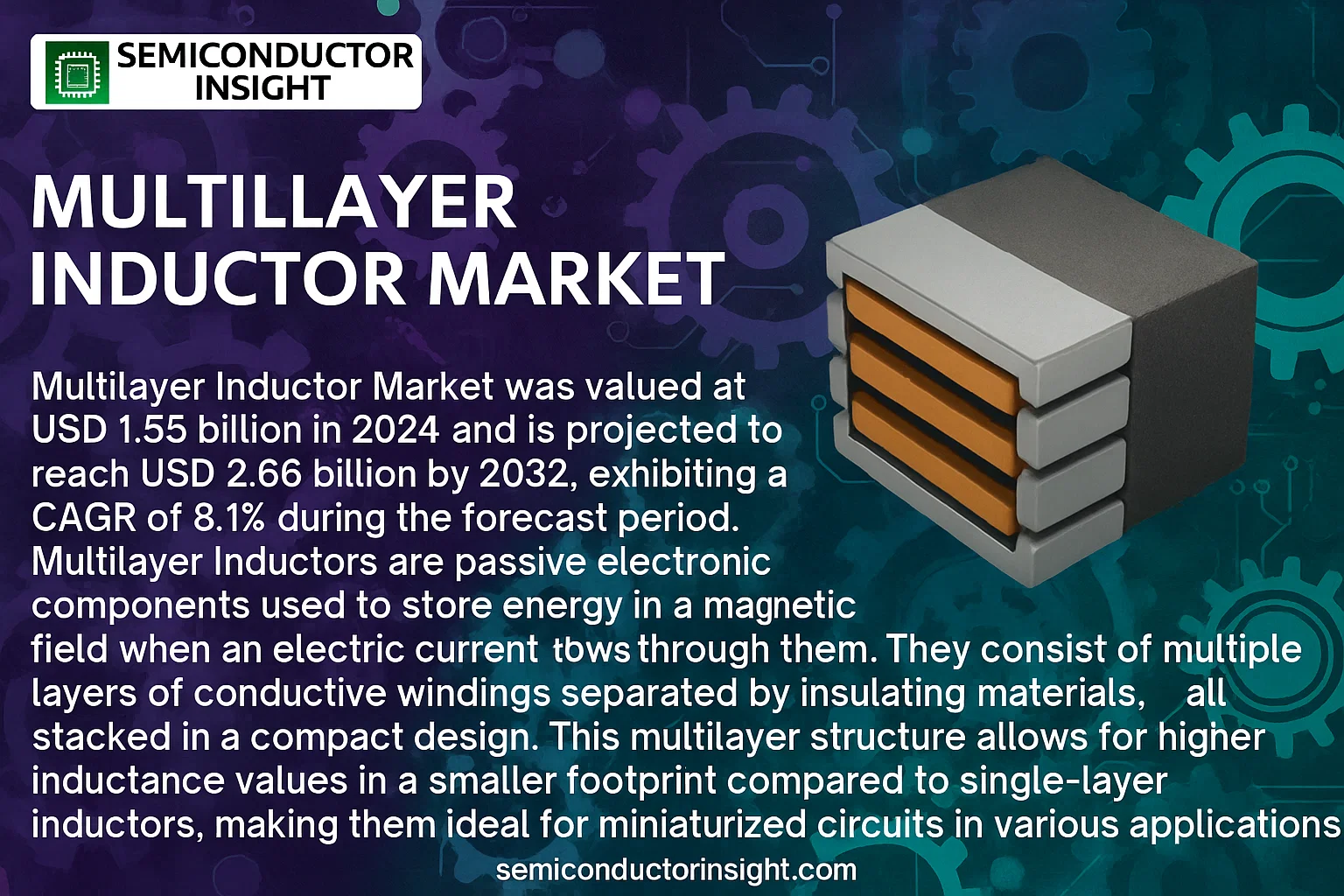
Global Multilayer Inductor Market was valued at USD 1.55 billion in 2024 and is projected to reach USD 2.66 billion by 2032, exhibiting a CAGR of 8.1% during the forecast period. Multilayer Inductors are passive electronic components used to store energy in a magnetic field when an electric current flows through them. They consist of multiple layers of conductive windings separated by insulating materials, all stacked in a compact design. This multilayer structure allows for higher inductance values in a smaller footprint compared to single-layer inductors, making them ideal for miniaturized circuits in various applications.

The market is experiencing rapid growth due to several factors, including increased demand from the consumer electronics sector, where multilayer inductors are used in smartphones, tablets, and wearables for signal filtering and power management. The automotive industry’s shift towards electric vehicles (EVs) and advanced driver-assistance systems (ADAS) also drives demand, as these systems require efficient power management and noise suppression components. Additionally, the growth of 5G infrastructure and Internet of Things (IoT) devices necessitates high-performance passive components like multilayer inductors. However, the market faces challenges from raw material price volatility, particularly for ferrite and ceramics, and supply chain disruptions that affect production costs and pricing.

Regionally, Asia Pacific dominates the market due to high electronics manufacturing activity in China, Japan, and South Korea. North America and Europe also hold significant shares due to technological advancements and presence of key manufacturers. Key players include TDK Corporation, Murata Manufacturing Co., Ltd., Vishay Intertechnology, Inc., and Taiyo Yuden Co., Ltd., who are focusing on product innovation and strategic partnerships to strengthen their market position.
Multilayer Inductor Market

MARKET DRIVERS


Proliferation of 5G Technology and High-Frequency Applications

The global rollout of 5G infrastructure is a primary driver for the multilayer inductor market. These components are essential in 5G smartphones, base stations, and network equipment due to their ability to function effectively at high frequencies, miniaturized size, and high reliability. The demand for faster data rates and lower latency necessitates advanced passive components, directly boosting the adoption of multilayer chip inductors.

Expansion of Automotive Electronics and Electrification

The automotive industry’s rapid transition toward electric vehicles (EVs) and advanced driver-assistance systems (ADAS) is fueling demand. Multilayer inductors are critical in power management units, infotainment systems, battery management systems (BMS), and various sensors. The trend towards vehicle electrification and autonomy requires robust, high-performance inductors that can withstand harsh automotive environments, driving market growth.

The miniaturization of electronic devices remains a relentless trend, pushing for smaller component footprints without compromising performance.

Furthermore, the continuous miniaturization of consumer electronics, including wearables, ultra-thin laptops, and IoT devices, demands compact, high-density passive components. Multilayer inductors, with their small size and surface-mount technology (SMT) compatibility, are perfectly suited for these applications, ensuring sustained market expansion.

MARKET CHALLENGES


Complex Manufacturing and Raw Material Price Volatility

The production of multilayer inductors involves sophisticated processes like co-firing ceramic and internal conductor materials, which require precise control to avoid defects. This complexity leads to higher manufacturing costs. Additionally, the market is sensitive to fluctuations in the prices of key raw materials such as silver and nickel, which can squeeze profit margins for manufacturers.

Other Challenges

Intense Price Competition
The market is highly competitive, particularly from manufacturers in the Asia-Pacific region. This results in significant price pressure, making it challenging for companies to maintain profitability while investing in research and development for next-generation products.

Thermal Management at High Currents
As electronic devices demand more power in smaller packages, managing heat dissipation in multilayer inductors under high-current conditions becomes a significant technical challenge. Excessive heat can degrade performance and reliability, requiring advanced materials and design innovations.

MARKET RESTRAINTS


Maturation of Key End-Use Segments

While growth in smartphones and personal computers continues, these core markets are showing signs of saturation in terms of unit shipments. This maturity can temper the growth rate of the multilayer inductor market, as these devices represent a massive volume application. Manufacturers must increasingly rely on premiumization and new features within these segments to drive component demand.

Design Complexity and Standardization Issues

The push for customization to meet specific application requirements increases design complexity and time-to-market. Furthermore, the lack of global standardization for certain high-frequency or high-power inductors can create interoperability issues and limit their plug-and-play adoption across different platforms and regions, acting as a restraint on market growth.

MARKET OPPORTUNITIES


Growth in Internet of Things (IoT) and Edge Computing

The explosive growth of the IoT ecosystem, encompassing smart home devices, industrial sensors, and edge computing nodes, presents a substantial opportunity. These applications require vast quantities of small, efficient, and reliable passive components for power regulation and signal filtering, creating a high-volume market for multilayer inductors.

Advancements in Renewable Energy and Industrial Automation

The global shift toward renewable energy sources like solar and wind power involves sophisticated power conversion systems that utilize inverters and converters. Similarly, Industry 4.0 and industrial automation rely on robust control systems. Multilayer inductors are key components in these high-power, high-reliability applications, opening new avenues for market expansion.

Development of Ultra-High-Frequency Inductors for 6G and Beyond

Research and development into next-generation communication technologies, such as 6G, which will operate at terahertz frequencies, is underway. This frontier creates an opportunity for innovators to develop new multilayer inductor materials and architectures capable of meeting the extreme performance demands of future wireless systems.

Multilayer Inductor Market Trends
Sustained Growth Driven by Miniaturization and Advanced Electronics

The global Multilayer Inductor market is on a robust growth trajectory, with its value projected to rise from US$1551 million in 2024 to US$2658 million by 2032, representing a compound annual growth rate (CAGR) of 8.1%. A primary catalyst for this expansion is the relentless demand for miniaturization across the consumer electronics sector. Multilayer inductors, with their compact design of multiple conductive windings stacked with insulating materials, deliver high inductance values in a small footprint, making them indispensable for smartphones, tablets, and wearable devices where space is at a premium. This trend is further amplified by the automotive industry’s rapid transition to electric and hybrid vehicles, which rely on advanced electronic systems for power management, safety, and connectivity, all of which require high-performance components like multilayer inductors.

Other Trends

Raw Material Price Volatility and Supply Chain Challenges

A significant trend impacting the market is the volatility in the cost of raw materials, which has led to price increases averaging around 4.65% in recent years. The prices of essential inputs such as ferrite and ceramic components are highly susceptible to global supply chain disruptions. This volatility poses a persistent challenge for manufacturers, influencing production costs and profitability. The market must navigate these fluctuations while maintaining the supply needed to meet the growing demand from key sectors.

Future Opportunities in IoT, 5G, and Renewable Energy

Looking ahead, the multilayer inductor market is poised for significant opportunities driven by the proliferation of emerging technologies. The expansion of the Internet of Things (IoT), the global rollout of 5G telecommunications networks, and advancements in artificial intelligence (AI) are creating a substantial demand for electronic components that can operate at higher frequencies with greater energy efficiency. Multilayer inductors are perfectly suited for these applications. Furthermore, the global emphasis on renewable energy and energy-efficient systems is expected to increase the adoption of multilayer inductors in power supplies and grid infrastructure, cementing their role in the future of electronics. Market analysis segments the industry by materials like ferrite and ceramic, and by key applications including consumer electronics, automotive, industrial, and telecommunications, with Asia currently leading in both production and consumption.

COMPETITIVE LANDSCAPE

Key Industry Players

An Oligopolistic Market Led by Global Component Giants

The global multilayer inductor market is characterized by a concentrated competitive environment, with a handful of major Japanese and multinational corporations holding significant market share. TDK Corporation and Murata Manufacturing dominate the landscape, leveraging their extensive product portfolios, advanced R&D capabilities, and strong global supply chains. This market structure has led to a competitive dynamic focused on technological innovation, product miniaturization, and cost efficiency to cater to the demanding consumer electronics and automotive sectors. Recent strategies have involved significant investments in expanding production capacity for high-frequency components required for 5G and automotive applications, along with navigating the challenges of raw material price volatility and supply chain constraints.

Beyond the dominant leaders, a tier of highly specialized and geographically focused players has carved out significant niches. Companies like Taiyo Yuden are renowned for their high-performance components for smartphones, while Vishay Intertechnology offers a broad range of inductors for industrial and automotive applications. Chinese manufacturers, such as Sunlord Electronics and Fenghua Advanced Technology, have grown their market presence substantially by offering cost-effective solutions and capturing a large share of the domestic and regional supply chains. Other notable players like Chilisin Electronics (part of YAGEO) and INPAQ Technology compete by focusing on specific applications like power supplies and IoT devices, contributing to a diverse and dynamic competitive field.

List of Key Multilayer Inductor Companies Profiled

Segment Analysis:

Segment Category Sub-Segments Key Insights
By Type
  • Ferrite
  • Ceramic
  • Others
Ferrite inductors dominate the market due to their superior magnetic properties and excellent performance-to-cost ratio, making them the preferred choice for a vast range of applications from power supplies to consumer electronics. The material’s inherent efficiency in minimizing energy losses at high frequencies positions it as the leading segment, particularly as device miniaturization continues to advance. While ceramic types offer advantages in specific high-frequency scenarios, the widespread adoption and manufacturing maturity of ferrite-based solutions cement their leading market position.
By Application
  • Consumer Electronics
  • Automotive
  • Industrial
  • Telecommunications
  • Others
Consumer Electronics is the leading application segment, driven by the relentless global demand for compact, high-performance devices such as smartphones, tablets, and wearables. The industry’s push for miniaturization directly leverages the core advantage of multilayer inductors, which offer high inductance values in a small footprint. This segment’s growth is further fueled by rapid product lifecycles and continuous technological innovation, creating sustained demand. The automotive sector, while growing rapidly, currently follows consumer electronics in market share due to the sheer volume and diversity of electronic gadgets produced annually.
By End User
  • Original Equipment Manufacturers (OEMs)
  • Electronic Manufacturing Services (EMS)
  • Component Distributors
Original Equipment Manufacturers (OEMs) represent the most significant end-user segment, as they are the primary integrators of multilayer inductors into final products like consumer electronics and automotive systems. Their direct control over product design and large-scale procurement gives them substantial influence over the market. The demand from OEMs is characterized by requirements for high reliability, consistent quality, and the ability to support high-volume production. The trend towards outsourcing to Electronic Manufacturing Services is also a notable factor, but OEMs remain the dominant force driving specifications and volume purchases.
By Technology Driver
  • Miniaturization & High Frequency
  • Energy Efficiency
  • Automotive Electrification
Miniaturization & High Frequency is the leading technology driver, as the fundamental design of multilayer inductors is perfectly suited for the ongoing trend of making electronic devices smaller, thinner, and more powerful. The proliferation of 5G, IoT, and advanced mobile computing demands components that can operate efficiently at higher frequencies while occupying minimal board space. This driver underpins innovation across all application segments, compelling manufacturers to continuously improve material science and production techniques to meet these evolving performance criteria, thereby sustaining long-term market growth.
By Core Material Property
  • High Permeability
  • Low Core Loss
  • Temperature Stability
Low Core Loss is the most critical material property driving market preferences, as it directly impacts the overall energy efficiency and thermal performance of electronic circuits. In applications ranging from power supplies for data centers to battery management systems in electric vehicles, minimizing energy loss as heat is paramount for reliability and performance. While high permeability is important for achieving high inductance in small sizes, and temperature stability is crucial for automotive and industrial uses, the relentless industry focus on improving energy efficiency makes low core loss the dominant factor influencing material selection and component design.

Regional Analysis: Multilayer Inductor Market

Asia-Pacific

Asia-Pacific stands as the unequivocal leader in the global multilayer inductor market, driven by its dominance in electronics manufacturing. The region benefits from a powerful, integrated ecosystem that encompasses everything from raw material supply to end-product assembly. Major consumer electronics hubs in China, South Korea, and Japan create immense, consistent demand for multilayer inductors, which are essential components in smartphones, tablets, and laptops. Furthermore, the rapid expansion of 5G infrastructure and the burgeoning automotive electronics sector, particularly for electric vehicles, are fueling further growth. Strong government support for technological innovation and the presence of leading global manufacturers who continuously invest in R&D for miniaturization and performance enhancement solidify the region’s leading position. The mature supply chains also ensure cost-effective production, making it the most competitive and dynamic market globally.

Consumer Electronics Manufacturing Hub
The concentration of the world’s leading consumer electronics brands and their extensive manufacturing networks in countries like China and Vietnam creates a massive, built-in demand base for multilayer inductors. This proximity to end-use markets streamlines supply chains and drives innovation tailored to local product cycles.
Advanced Technology & R&D Focus
Japan and South Korea are global powerhouses in advanced materials science and component design. Their strong R&D focus leads to the development of high-frequency, high-efficiency inductors required for next-generation communication technologies like 5G and cutting-edge automotive applications, keeping the region at the technological forefront.
Automotive Electronics Expansion
The rapid adoption of electric vehicles and advanced driver-assistance systems (ADAS) across the region, particularly in China, is a significant growth driver. This demands a high volume of reliable, high-performance multilayer inductors for power management and signal processing within vehicle electronics.
Robust and Cost-Effective Supply Chain
The region’s well-established network of component suppliers, raw material processors, and electronics manufacturing services (EMS) providers ensures efficient, scalable, and cost-competitive production of multilayer inductors, providing a significant advantage over other regions in terms of manufacturing agility and pricing.

North America
North America represents a highly advanced market characterized by strong demand for high-performance, specialized multilayer inductors. The region’s strength lies in its leadership in cutting-edge sectors such as telecommunications infrastructure, particularly with extensive 5G network deployments, and the aerospace and defense industry, which requires components with exceptional reliability and performance under demanding conditions. The presence of major technology companies and a robust automotive sector focusing on electric and autonomous vehicles further stimulates demand. While manufacturing volume may be lower than in Asia-Pacific, the emphasis is on high-value, innovative inductors for premium applications, supported by significant investment in research and development.

Europe
The European multilayer inductor market is driven by its strong automotive industrial base and a focus on industrial automation and renewable energy technologies. The region’s stringent quality standards and regulations push demand for highly reliable and efficient components. The automotive sector, with its rapid shift towards electrification, is a primary consumer, requiring inductors for power electronics in electric vehicles and charging infrastructure. Furthermore, the industrial sector’s adoption of automation and IoT applications creates steady demand. European manufacturers often specialize in high-quality, custom-designed inductors for niche applications, differentiating themselves in the global market through technical expertise and precision engineering.

South America
The multilayer inductor market in South America is emerging, with growth primarily fueled by the increasing adoption of consumer electronics and gradual modernization of telecommunications infrastructure. While the market is smaller and less developed compared to other regions, countries like Brazil and Argentina show potential. The growth is supported by local manufacturing initiatives and economic stabilization efforts. The demand is largely for standard inductors used in mass-market consumer goods and basic telecommunications equipment. The market’s evolution is closely tied to regional economic conditions and investments in digital infrastructure.

Middle East & Africa
The multilayer inductor market in the Middle East and Africa is in a developmental phase, with growth opportunities linked to infrastructure development and increasing digitalization. The Gulf Cooperation Council (GCC) countries are leading the charge, investing heavily in smart city projects, 5G networks, and diversification away from oil-based economies, which drives demand for electronic components. In Africa, the market growth is more gradual, spurred by rising mobile phone penetration and nascent industrial development. The region currently represents a smaller market share but holds long-term potential as digital infrastructure expands and local manufacturing capabilities slowly develop.

Report Scope

This market research report provides a comprehensive analysis of the Multilayer Inductor Market , covering the forecast period 2025–2032. It offers detailed insights into market dynamics, technological advancements, competitive landscape, and key trends shaping the industry.

Key focus areas of the report include:

  • Market Overview: The report begins with an overview outlining its current market scenario, key growth indicators, and industry transformation drivers. It discusses macroeconomic factors, demand–supply balance, regulatory landscape, and the strategic role of semiconductors in powering advancements across industries such as automotive, telecommunications, consumer electronics, and industrial automation.
  • Market Size & Forecast: Historical data and future projections for revenue, unit shipments, and market value across major regions and segments.
  • Segmentation Analysis: Detailed breakdown by product type, technology, application, and end-user industry to identify high-growth segments and investment opportunities.
  • Regional Insights: Insights into market performance across North America, Europe, Asia-Pacific, Latin America, and the Middle East & Africa, including country-level analysis where relevant.
  • Competitive Landscape: Profiles of leading market participants, including their product offerings, R&D focus, manufacturing capacity, pricing strategies, and recent developments such as mergers, acquisitions, and partnerships.
  • Technology Trends & Innovation: Assessment of emerging technologies, integration of AI/IoT, semiconductor design trends, fabrication techniques, and evolving industry standards.
  • Market Drivers & Restraints: Evaluation of factors driving market growth along with challenges, supply chain constraints, regulatory issues, and market-entry barriers.
  • Stakeholder Insights: Insights for component suppliers, OEMs, system integrators, investors, and policymakers regarding the evolving ecosystem and strategic opportunities.

Primary and secondary research methods are employed, including interviews with industry experts, data from verified sources, and real-time market intelligence to ensure the accuracy and reliability of the insights presented.

FREQUENTLY ASKED QUESTIONS:

What is the current market size of Multilayer Inductor Market?

-> Global Multilayer Inductor Market was valued at USD 1551 million in 2024 and is projected to reach USD 2658 million by 2032, growing at a CAGR of 8.1% during the forecast period.

Which key companies operate in Multilayer Inductor Market?

-> Key players include TDK, Sunlord Electronics, Murata, Shenzhen Zhenhua Fu Electronics, Chilisin Electronics (YAGEO), Vishay, Kyocera, Taiyo Yuden, and Fenghua Advanced Technology, among others.

What are the key growth drivers?

-> Key growth drivers include the expanding consumer electronics sector and the automotive industry’s shift towards electric and hybrid vehicles, which require advanced electronic components for improved efficiency and connectivity.

Which region dominates the market?

-> Asia is a significant market, with detailed analysis provided for regions including China, Japan, South Korea, and Southeast Asia, supported by the strong electronics manufacturing base in the area.

What are the emerging trends?

-> Emerging trends include the integration of multilayer inductors in emerging technologies such as IoT, AI, and 5G telecommunications, which demand components capable of handling increased frequencies and improved energy efficiency.

Multilayer Inductor Market, Emerging Trends, Technological Advancements, and Business Strategies 2025-2032

Get Sample Report PDF for Exclusive Insights

Report Sample Includes

  • Table of Contents
  • List of Tables & Figures
  • Charts, Research Methodology, and more...

PDF Icon Download Sample Report PDF

Download Sample Report

Table of Content

1 Introduction to Research & Analysis Reports
1.1 Multilayer Inductor Market Definition
1.2 Market Segments
1.2.1 Segment by Type
1.2.2 Segment by Application
1.3 Global Multilayer Inductor Market Overview
1.4 Features & Benefits of This Report
1.5 Methodology & Sources of Information
1.5.1 Research Methodology
1.5.2 Research Process
1.5.3 Base Year
1.5.4 Report Assumptions & Caveats
2 Global Multilayer Inductor Overall Market Size
2.1 Global Multilayer Inductor Market Size: 2024 VS 2031
2.2 Global Multilayer Inductor Market Size, Prospects & Forecasts: 2020-2031
2.3 Global Multilayer Inductor Sales: 2020-2031
3 Company Landscape
3.1 Top Multilayer Inductor Players in Global Market
3.2 Top Global Multilayer Inductor Companies Ranked by Revenue
3.3 Global Multilayer Inductor Revenue by Companies
3.4 Global Multilayer Inductor Sales by Companies
3.5 Global Multilayer Inductor Price by Manufacturer (2020-2025)
3.6 Top 3 and Top 5 Multilayer Inductor Companies in Global Market, by Revenue in 2024
3.7 Global Manufacturers Multilayer Inductor Product Type
3.8 Tier 1, Tier 2, and Tier 3 Multilayer Inductor Players in Global Market
3.8.1 List of Global Tier 1 Multilayer Inductor Companies
3.8.2 List of Global Tier 2 and Tier 3 Multilayer Inductor Companies
4 Sights by Product
4.1 Overview
4.1.1 Segment by Type – Global Multilayer Inductor Market Size Markets, 2024 & 2031
4.1.2 Ferrite
4.1.3 Ceramic
4.1.4 Others
4.2 Segment by Type – Global Multilayer Inductor Revenue & Forecasts
4.2.1 Segment by Type – Global Multilayer Inductor Revenue, 2020-2025
4.2.2 Segment by Type – Global Multilayer Inductor Revenue, 2026-2031
4.2.3 Segment by Type – Global Multilayer Inductor Revenue Market Share, 2020-2031
4.3 Segment by Type – Global Multilayer Inductor Sales & Forecasts
4.3.1 Segment by Type – Global Multilayer Inductor Sales, 2020-2025
4.3.2 Segment by Type – Global Multilayer Inductor Sales, 2026-2031
4.3.3 Segment by Type – Global Multilayer Inductor Sales Market Share, 2020-2031
4.4 Segment by Type – Global Multilayer Inductor Price (Manufacturers Selling Prices), 2020-2031
5 Sights by Application
5.1 Overview
5.1.1 Segment by Application – Global Multilayer Inductor Market Size, 2024 & 2031
5.1.2 Consumer Electronics
5.1.3 Automotive
5.1.4 Industrial
5.1.5 Telecommunications
5.1.6 Others
5.2 Segment by Application – Global Multilayer Inductor Revenue & Forecasts
5.2.1 Segment by Application – Global Multilayer Inductor Revenue, 2020-2025
5.2.2 Segment by Application – Global Multilayer Inductor Revenue, 2026-2031
5.2.3 Segment by Application – Global Multilayer Inductor Revenue Market Share, 2020-2031
5.3 Segment by Application – Global Multilayer Inductor Sales & Forecasts
5.3.1 Segment by Application – Global Multilayer Inductor Sales, 2020-2025
5.3.2 Segment by Application – Global Multilayer Inductor Sales, 2026-2031
5.3.3 Segment by Application – Global Multilayer Inductor Sales Market Share, 2020-2031
5.4 Segment by Application – Global Multilayer Inductor Price (Manufacturers Selling Prices), 2020-2031
6 Sights by Region
6.1 By Region – Global Multilayer Inductor Market Size, 2024 & 2031
6.2 By Region – Global Multilayer Inductor Revenue & Forecasts
6.2.1 By Region – Global Multilayer Inductor Revenue, 2020-2025
6.2.2 By Region – Global Multilayer Inductor Revenue, 2026-2031
6.2.3 By Region – Global Multilayer Inductor Revenue Market Share, 2020-2031
6.3 By Region – Global Multilayer Inductor Sales & Forecasts
6.3.1 By Region – Global Multilayer Inductor Sales, 2020-2025
6.3.2 By Region – Global Multilayer Inductor Sales, 2026-2031
6.3.3 By Region – Global Multilayer Inductor Sales Market Share, 2020-2031
6.4 North America
6.4.1 By Country – North America Multilayer Inductor Revenue, 2020-2031
6.4.2 By Country – North America Multilayer Inductor Sales, 2020-2031
6.4.3 United States Multilayer Inductor Market Size, 2020-2031
6.4.4 Canada Multilayer Inductor Market Size, 2020-2031
6.4.5 Mexico Multilayer Inductor Market Size, 2020-2031
6.5 Europe
6.5.1 By Country – Europe Multilayer Inductor Revenue, 2020-2031
6.5.2 By Country – Europe Multilayer Inductor Sales, 2020-2031
6.5.3 Germany Multilayer Inductor Market Size, 2020-2031
6.5.4 France Multilayer Inductor Market Size, 2020-2031
6.5.5 U.K. Multilayer Inductor Market Size, 2020-2031
6.5.6 Italy Multilayer Inductor Market Size, 2020-2031
6.5.7 Russia Multilayer Inductor Market Size, 2020-2031
6.5.8 Nordic Countries Multilayer Inductor Market Size, 2020-2031
6.5.9 Benelux Multilayer Inductor Market Size, 2020-2031
6.6 Asia
6.6.1 By Region – Asia Multilayer Inductor Revenue, 2020-2031
6.6.2 By Region – Asia Multilayer Inductor Sales, 2020-2031
6.6.3 China Multilayer Inductor Market Size, 2020-2031
6.6.4 Japan Multilayer Inductor Market Size, 2020-2031
6.6.5 South Korea Multilayer Inductor Market Size, 2020-2031
6.6.6 Southeast Asia Multilayer Inductor Market Size, 2020-2031
6.6.7 India Multilayer Inductor Market Size, 2020-2031
6.7 South America
6.7.1 By Country – South America Multilayer Inductor Revenue, 2020-2031
6.7.2 By Country – South America Multilayer Inductor Sales, 2020-2031
6.7.3 Brazil Multilayer Inductor Market Size, 2020-2031
6.7.4 Argentina Multilayer Inductor Market Size, 2020-2031
6.8 Middle East & Africa
6.8.1 By Country – Middle East & Africa Multilayer Inductor Revenue, 2020-2031
6.8.2 By Country – Middle East & Africa Multilayer Inductor Sales, 2020-2031
6.8.3 Turkey Multilayer Inductor Market Size, 2020-2031
6.8.4 Israel Multilayer Inductor Market Size, 2020-2031
6.8.5 Saudi Arabia Multilayer Inductor Market Size, 2020-2031
6.8.6 UAE Multilayer Inductor Market Size, 2020-2031
7 Manufacturers & Brands Profiles
7.1 TDK
7.1.1 TDK Company Summary
7.1.2 TDK Business Overview
7.1.3 TDK Multilayer Inductor Major Product Offerings
7.1.4 TDK Multilayer Inductor Sales and Revenue in Global (2020-2025)
7.1.5 TDK Key News & Latest Developments
7.2 Sunlord Electronics
7.2.1 Sunlord Electronics Company Summary
7.2.2 Sunlord Electronics Business Overview
7.2.3 Sunlord Electronics Multilayer Inductor Major Product Offerings
7.2.4 Sunlord Electronics Multilayer Inductor Sales and Revenue in Global (2020-2025)
7.2.5 Sunlord Electronics Key News & Latest Developments
7.3 Murata
7.3.1 Murata Company Summary
7.3.2 Murata Business Overview
7.3.3 Murata Multilayer Inductor Major Product Offerings
7.3.4 Murata Multilayer Inductor Sales and Revenue in Global (2020-2025)
7.3.5 Murata Key News & Latest Developments
7.4 Shenzhen Zhenhua Fu Electronics
7.4.1 Shenzhen Zhenhua Fu Electronics Company Summary
7.4.2 Shenzhen Zhenhua Fu Electronics Business Overview
7.4.3 Shenzhen Zhenhua Fu Electronics Multilayer Inductor Major Product Offerings
7.4.4 Shenzhen Zhenhua Fu Electronics Multilayer Inductor Sales and Revenue in Global (2020-2025)
7.4.5 Shenzhen Zhenhua Fu Electronics Key News & Latest Developments
7.5 Chilisin Electronics (YAGEO)
7.5.1 Chilisin Electronics (YAGEO) Company Summary
7.5.2 Chilisin Electronics (YAGEO) Business Overview
7.5.3 Chilisin Electronics (YAGEO) Multilayer Inductor Major Product Offerings
7.5.4 Chilisin Electronics (YAGEO) Multilayer Inductor Sales and Revenue in Global (2020-2025)
7.5.5 Chilisin Electronics (YAGEO) Key News & Latest Developments
7.6 Vishay
7.6.1 Vishay Company Summary
7.6.2 Vishay Business Overview
7.6.3 Vishay Multilayer Inductor Major Product Offerings
7.6.4 Vishay Multilayer Inductor Sales and Revenue in Global (2020-2025)
7.6.5 Vishay Key News & Latest Developments
7.7 Kyocera
7.7.1 Kyocera Company Summary
7.7.2 Kyocera Business Overview
7.7.3 Kyocera Multilayer Inductor Major Product Offerings
7.7.4 Kyocera Multilayer Inductor Sales and Revenue in Global (2020-2025)
7.7.5 Kyocera Key News & Latest Developments
7.8 Taiyo Yuden
7.8.1 Taiyo Yuden Company Summary
7.8.2 Taiyo Yuden Business Overview
7.8.3 Taiyo Yuden Multilayer Inductor Major Product Offerings
7.8.4 Taiyo Yuden Multilayer Inductor Sales and Revenue in Global (2020-2025)
7.8.5 Taiyo Yuden Key News & Latest Developments
7.9 Fenghua Advanced Technology
7.9.1 Fenghua Advanced Technology Company Summary
7.9.2 Fenghua Advanced Technology Business Overview
7.9.3 Fenghua Advanced Technology Multilayer Inductor Major Product Offerings
7.9.4 Fenghua Advanced Technology Multilayer Inductor Sales and Revenue in Global (2020-2025)
7.9.5 Fenghua Advanced Technology Key News & Latest Developments
7.10 KOHER (Shanghai) Electronic
7.10.1 KOHER (Shanghai) Electronic Company Summary
7.10.2 KOHER (Shanghai) Electronic Business Overview
7.10.3 KOHER (Shanghai) Electronic Multilayer Inductor Major Product Offerings
7.10.4 KOHER (Shanghai) Electronic Multilayer Inductor Sales and Revenue in Global (2020-2025)
7.10.5 KOHER (Shanghai) Electronic Key News & Latest Developments
7.11 Laird Technologies
7.11.1 Laird Technologies Company Summary
7.11.2 Laird Technologies Business Overview
7.11.3 Laird Technologies Multilayer Inductor Major Product Offerings
7.11.4 Laird Technologies Multilayer Inductor Sales and Revenue in Global (2020-2025)
7.11.5 Laird Technologies Key News & Latest Developments
7.12 Microgate Technology
7.12.1 Microgate Technology Company Summary
7.12.2 Microgate Technology Business Overview
7.12.3 Microgate Technology Multilayer Inductor Major Product Offerings
7.12.4 Microgate Technology Multilayer Inductor Sales and Revenue in Global (2020-2025)
7.12.5 Microgate Technology Key News & Latest Developments
7.13 INPAQ Technology
7.13.1 INPAQ Technology Company Summary
7.13.2 INPAQ Technology Business Overview
7.13.3 INPAQ Technology Multilayer Inductor Major Product Offerings
7.13.4 INPAQ Technology Multilayer Inductor Sales and Revenue in Global (2020-2025)
7.13.5 INPAQ Technology Key News & Latest Developments
7.14 Darfon Electronics
7.14.1 Darfon Electronics Company Summary
7.14.2 Darfon Electronics Business Overview
7.14.3 Darfon Electronics Multilayer Inductor Major Product Offerings
7.14.4 Darfon Electronics Multilayer Inductor Sales and Revenue in Global (2020-2025)
7.14.5 Darfon Electronics Key News & Latest Developments
8 Global Multilayer Inductor Production Capacity, Analysis
8.1 Global Multilayer Inductor Production Capacity, 2020-2031
8.2 Multilayer Inductor Production Capacity of Key Manufacturers in Global Market
8.3 Global Multilayer Inductor Production by Region
9 Key Market Trends, Opportunity, Drivers and Restraints
9.1 Market Opportunities & Trends
9.2 Market Drivers
9.3 Market Restraints
10 Multilayer Inductor Supply Chain Analysis
10.1 Multilayer Inductor Industry Value Chain
10.2 Multilayer Inductor Upstream Market
10.3 Multilayer Inductor Downstream and Clients
10.4 Marketing Channels Analysis
10.4.1 Marketing Channels
10.4.2 Multilayer Inductor Distributors and Sales Agents in Global
11 Conclusion
12 Appendix
12.1 Note
12.2 Examples of Clients
12.3 DisclaimerList of Tables
Table 1. Key Players of Multilayer Inductor in Global Market
Table 2. Top Multilayer Inductor Players in Global Market, Ranking by Revenue (2024)
Table 3. Global Multilayer Inductor Revenue by Companies, (US$, Mn), 2020-2025
Table 4. Global Multilayer Inductor Revenue Share by Companies, 2020-2025
Table 5. Global Multilayer Inductor Sales by Companies, (Million Units), 2020-2025
Table 6. Global Multilayer Inductor Sales Share by Companies, 2020-2025
Table 7. Key Manufacturers Multilayer Inductor Price (2020-2025) & (US$/Unit)
Table 8. Global Manufacturers Multilayer Inductor Product Type
Table 9. List of Global Tier 1 Multilayer Inductor Companies, Revenue (US$, Mn) in 2024 and Market Share
Table 10. List of Global Tier 2 and Tier 3 Multilayer Inductor Companies, Revenue (US$, Mn) in 2024 and Market Share
Table 11. Segment by Type – Global Multilayer Inductor Revenue, (US$, Mn), 2024 & 2031
Table 12. Segment by Type – Global Multilayer Inductor Revenue (US$, Mn), 2020-2025
Table 13. Segment by Type – Global Multilayer Inductor Revenue (US$, Mn), 2026-2031
Table 14. Segment by Type – Global Multilayer Inductor Sales (Million Units), 2020-2025
Table 15. Segment by Type – Global Multilayer Inductor Sales (Million Units), 2026-2031
Table 16. Segment by Application – Global Multilayer Inductor Revenue, (US$, Mn), 2024 & 2031
Table 17. Segment by Application – Global Multilayer Inductor Revenue, (US$, Mn), 2020-2025
Table 18. Segment by Application – Global Multilayer Inductor Revenue, (US$, Mn), 2026-2031
Table 19. Segment by Application – Global Multilayer Inductor Sales, (Million Units), 2020-2025
Table 20. Segment by Application – Global Multilayer Inductor Sales, (Million Units), 2026-2031
Table 21. By Region – Global Multilayer Inductor Revenue, (US$, Mn), 2025-2031
Table 22. By Region – Global Multilayer Inductor Revenue, (US$, Mn), 2020-2025
Table 23. By Region – Global Multilayer Inductor Revenue, (US$, Mn), 2026-2031
Table 24. By Region – Global Multilayer Inductor Sales, (Million Units), 2020-2025
Table 25. By Region – Global Multilayer Inductor Sales, (Million Units), 2026-2031
Table 26. By Country – North America Multilayer Inductor Revenue, (US$, Mn), 2020-2025
Table 27. By Country – North America Multilayer Inductor Revenue, (US$, Mn), 2026-2031
Table 28. By Country – North America Multilayer Inductor Sales, (Million Units), 2020-2025
Table 29. By Country – North America Multilayer Inductor Sales, (Million Units), 2026-2031
Table 30. By Country – Europe Multilayer Inductor Revenue, (US$, Mn), 2020-2025
Table 31. By Country – Europe Multilayer Inductor Revenue, (US$, Mn), 2026-2031
Table 32. By Country – Europe Multilayer Inductor Sales, (Million Units), 2020-2025
Table 33. By Country – Europe Multilayer Inductor Sales, (Million Units), 2026-2031
Table 34. By Region – Asia Multilayer Inductor Revenue, (US$, Mn), 2020-2025
Table 35. By Region – Asia Multilayer Inductor Revenue, (US$, Mn), 2026-2031
Table 36. By Region – Asia Multilayer Inductor Sales, (Million Units), 2020-2025
Table 37. By Region – Asia Multilayer Inductor Sales, (Million Units), 2026-2031
Table 38. By Country – South America Multilayer Inductor Revenue, (US$, Mn), 2020-2025
Table 39. By Country – South America Multilayer Inductor Revenue, (US$, Mn), 2026-2031
Table 40. By Country – South America Multilayer Inductor Sales, (Million Units), 2020-2025
Table 41. By Country – South America Multilayer Inductor Sales, (Million Units), 2026-2031
Table 42. By Country – Middle East & Africa Multilayer Inductor Revenue, (US$, Mn), 2020-2025
Table 43. By Country – Middle East & Africa Multilayer Inductor Revenue, (US$, Mn), 2026-2031
Table 44. By Country – Middle East & Africa Multilayer Inductor Sales, (Million Units), 2020-2025
Table 45. By Country – Middle East & Africa Multilayer Inductor Sales, (Million Units), 2026-2031
Table 46. TDK Company Summary
Table 47. TDK Multilayer Inductor Product Offerings
Table 48. TDK Multilayer Inductor Sales (Million Units), Revenue (US$, Mn) and Average Price (US$/Unit) & (2020-2025)
Table 49. TDK Key News & Latest Developments
Table 50. Sunlord Electronics Company Summary
Table 51. Sunlord Electronics Multilayer Inductor Product Offerings
Table 52. Sunlord Electronics Multilayer Inductor Sales (Million Units), Revenue (US$, Mn) and Average Price (US$/Unit) & (2020-2025)
Table 53. Sunlord Electronics Key News & Latest Developments
Table 54. Murata Company Summary
Table 55. Murata Multilayer Inductor Product Offerings
Table 56. Murata Multilayer Inductor Sales (Million Units), Revenue (US$, Mn) and Average Price (US$/Unit) & (2020-2025)
Table 57. Murata Key News & Latest Developments
Table 58. Shenzhen Zhenhua Fu Electronics Company Summary
Table 59. Shenzhen Zhenhua Fu Electronics Multilayer Inductor Product Offerings
Table 60. Shenzhen Zhenhua Fu Electronics Multilayer Inductor Sales (Million Units), Revenue (US$, Mn) and Average Price (US$/Unit) & (2020-2025)
Table 61. Shenzhen Zhenhua Fu Electronics Key News & Latest Developments
Table 62. Chilisin Electronics (YAGEO) Company Summary
Table 63. Chilisin Electronics (YAGEO) Multilayer Inductor Product Offerings
Table 64. Chilisin Electronics (YAGEO) Multilayer Inductor Sales (Million Units), Revenue (US$, Mn) and Average Price (US$/Unit) & (2020-2025)
Table 65. Chilisin Electronics (YAGEO) Key News & Latest Developments
Table 66. Vishay Company Summary
Table 67. Vishay Multilayer Inductor Product Offerings
Table 68. Vishay Multilayer Inductor Sales (Million Units), Revenue (US$, Mn) and Average Price (US$/Unit) & (2020-2025)
Table 69. Vishay Key News & Latest Developments
Table 70. Kyocera Company Summary
Table 71. Kyocera Multilayer Inductor Product Offerings
Table 72. Kyocera Multilayer Inductor Sales (Million Units), Revenue (US$, Mn) and Average Price (US$/Unit) & (2020-2025)
Table 73. Kyocera Key News & Latest Developments
Table 74. Taiyo Yuden Company Summary
Table 75. Taiyo Yuden Multilayer Inductor Product Offerings
Table 76. Taiyo Yuden Multilayer Inductor Sales (Million Units), Revenue (US$, Mn) and Average Price (US$/Unit) & (2020-2025)
Table 77. Taiyo Yuden Key News & Latest Developments
Table 78. Fenghua Advanced Technology Company Summary
Table 79. Fenghua Advanced Technology Multilayer Inductor Product Offerings
Table 80. Fenghua Advanced Technology Multilayer Inductor Sales (Million Units), Revenue (US$, Mn) and Average Price (US$/Unit) & (2020-2025)
Table 81. Fenghua Advanced Technology Key News & Latest Developments
Table 82. KOHER (Shanghai) Electronic Company Summary
Table 83. KOHER (Shanghai) Electronic Multilayer Inductor Product Offerings
Table 84. KOHER (Shanghai) Electronic Multilayer Inductor Sales (Million Units), Revenue (US$, Mn) and Average Price (US$/Unit) & (2020-2025)
Table 85. KOHER (Shanghai) Electronic Key News & Latest Developments
Table 86. Laird Technologies Company Summary
Table 87. Laird Technologies Multilayer Inductor Product Offerings
Table 88. Laird Technologies Multilayer Inductor Sales (Million Units), Revenue (US$, Mn) and Average Price (US$/Unit) & (2020-2025)
Table 89. Laird Technologies Key News & Latest Developments
Table 90. Microgate Technology Company Summary
Table 91. Microgate Technology Multilayer Inductor Product Offerings
Table 92. Microgate Technology Multilayer Inductor Sales (Million Units), Revenue (US$, Mn) and Average Price (US$/Unit) & (2020-2025)
Table 93. Microgate Technology Key News & Latest Developments
Table 94. INPAQ Technology Company Summary
Table 95. INPAQ Technology Multilayer Inductor Product Offerings
Table 96. INPAQ Technology Multilayer Inductor Sales (Million Units), Revenue (US$, Mn) and Average Price (US$/Unit) & (2020-2025)
Table 97. INPAQ Technology Key News & Latest Developments
Table 98. Darfon Electronics Company Summary
Table 99. Darfon Electronics Multilayer Inductor Product Offerings
Table 100. Darfon Electronics Multilayer Inductor Sales (Million Units), Revenue (US$, Mn) and Average Price (US$/Unit) & (2020-2025)
Table 101. Darfon Electronics Key News & Latest Developments
Table 102. Multilayer Inductor Capacity of Key Manufacturers in Global Market, 2023-2025 (Million Units)
Table 103. Global Multilayer Inductor Capacity Market Share of Key Manufacturers, 2023-2025
Table 104. Global Multilayer Inductor Production by Region, 2020-2025 (Million Units)
Table 105. Global Multilayer Inductor Production by Region, 2026-2031 (Million Units)
Table 106. Multilayer Inductor Market Opportunities & Trends in Global Market
Table 107. Multilayer Inductor Market Drivers in Global Market
Table 108. Multilayer Inductor Market Restraints in Global Market
Table 109. Multilayer Inductor Raw Materials
Table 110. Multilayer Inductor Raw Materials Suppliers in Global Market
Table 111. Typical Multilayer Inductor Downstream
Table 112. Multilayer Inductor Downstream Clients in Global Market
Table 113. Multilayer Inductor Distributors and Sales Agents in Global Market

List of Figures
Figure 1. Multilayer Inductor Product Picture
Figure 2. Multilayer Inductor Segment by Type in 2024
Figure 3. Multilayer Inductor Segment by Application in 2024
Figure 4. Global Multilayer Inductor Market Overview: 2024
Figure 5. Key Caveats
Figure 6. Global Multilayer Inductor Market Size: 2024 VS 2031 (US$, Mn)
Figure 7. Global Multilayer Inductor Revenue: 2020-2031 (US$, Mn)
Figure 8. Multilayer Inductor Sales in Global Market: 2020-2031 (Million Units)
Figure 9. The Top 3 and 5 Players Market Share by Multilayer Inductor Revenue in 2024
Figure 10. Segment by Type – Global Multilayer Inductor Revenue, (US$, Mn), 2024 & 2031
Figure 11. Segment by Type – Global Multilayer Inductor Revenue Market Share, 2020-2031
Figure 12. Segment by Type – Global Multilayer Inductor Sales Market Share, 2020-2031
Figure 13. Segment by Type – Global Multilayer Inductor Price (US$/Unit), 2020-2031
Figure 14. Segment by Application – Global Multilayer Inductor Revenue, (US$, Mn), 2024 & 2031
Figure 15. Segment by Application – Global Multilayer Inductor Revenue Market Share, 2020-2031
Figure 16. Segment by Application – Global Multilayer Inductor Sales Market Share, 2020-2031
Figure 17. Segment by Application -Global Multilayer Inductor Price (US$/Unit), 2020-2031
Figure 18. By Region – Global Multilayer Inductor Revenue, (US$, Mn), 2025 & 2031
Figure 19. By Region – Global Multilayer Inductor Revenue Market Share, 2020 VS 2024 VS 2031
Figure 20. By Region – Global Multilayer Inductor Revenue Market Share, 2020-2031
Figure 21. By Region – Global Multilayer Inductor Sales Market Share, 2020-2031
Figure 22. By Country – North America Multilayer Inductor Revenue Market Share, 2020-2031
Figure 23. By Country – North America Multilayer Inductor Sales Market Share, 2020-2031
Figure 24. United States Multilayer Inductor Revenue, (US$, Mn), 2020-2031
Figure 25. Canada Multilayer Inductor Revenue, (US$, Mn), 2020-2031
Figure 26. Mexico Multilayer Inductor Revenue, (US$, Mn), 2020-2031
Figure 27. By Country – Europe Multilayer Inductor Revenue Market Share, 2020-2031
Figure 28. By Country – Europe Multilayer Inductor Sales Market Share, 2020-2031
Figure 29. Germany Multilayer Inductor Revenue, (US$, Mn), 2020-2031
Figure 30. France Multilayer Inductor Revenue, (US$, Mn), 2020-2031
Figure 31. U.K. Multilayer Inductor Revenue, (US$, Mn), 2020-2031
Figure 32. Italy Multilayer Inductor Revenue, (US$, Mn), 2020-2031
Figure 33. Russia Multilayer Inductor Revenue, (US$, Mn), 2020-2031
Figure 34. Nordic Countries Multilayer Inductor Revenue, (US$, Mn), 2020-2031
Figure 35. Benelux Multilayer Inductor Revenue, (US$, Mn), 2020-2031
Figure 36. By Region – Asia Multilayer Inductor Revenue Market Share, 2020-2031
Figure 37. By Region – Asia Multilayer Inductor Sales Market Share, 2020-2031
Figure 38. China Multilayer Inductor Revenue, (US$, Mn), 2020-2031
Figure 39. Japan Multilayer Inductor Revenue, (US$, Mn), 2020-2031
Figure 40. South Korea Multilayer Inductor Revenue, (US$, Mn), 2020-2031
Figure 41. Southeast Asia Multilayer Inductor Revenue, (US$, Mn), 2020-2031
Figure 42. India Multilayer Inductor Revenue, (US$, Mn), 2020-2031
Figure 43. By Country – South America Multilayer Inductor Revenue Market Share, 2020-2031
Figure 44. By Country – South America Multilayer Inductor Sales, Market Share, 2020-2031
Figure 45. Brazil Multilayer Inductor Revenue, (US$, Mn), 2020-2031
Figure 46. Argentina Multilayer Inductor Revenue, (US$, Mn), 2020-2031
Figure 47. By Country – Middle East & Africa Multilayer Inductor Revenue, Market Share, 2020-2031
Figure 48. By Country – Middle East & Africa Multilayer Inductor Sales, Market Share, 2020-2031
Figure 49. Turkey Multilayer Inductor Revenue, (US$, Mn), 2020-2031
Figure 50. Israel Multilayer Inductor Revenue, (US$, Mn), 2020-2031
Figure 51. Saudi Arabia Multilayer Inductor Revenue, (US$, Mn), 2020-2031
Figure 52. UAE Multilayer Inductor Revenue, (US$, Mn), 2020-2031
Figure 53. Global Multilayer Inductor Production Capacity (Million Units), 2020-2031
Figure 54. The Percentage of Production Multilayer Inductor by Region, 2024 VS 2031
Figure 55. Multilayer Inductor Industry Value Chain
Figure 56. Marketing Channels