MARKET INSIGHTS
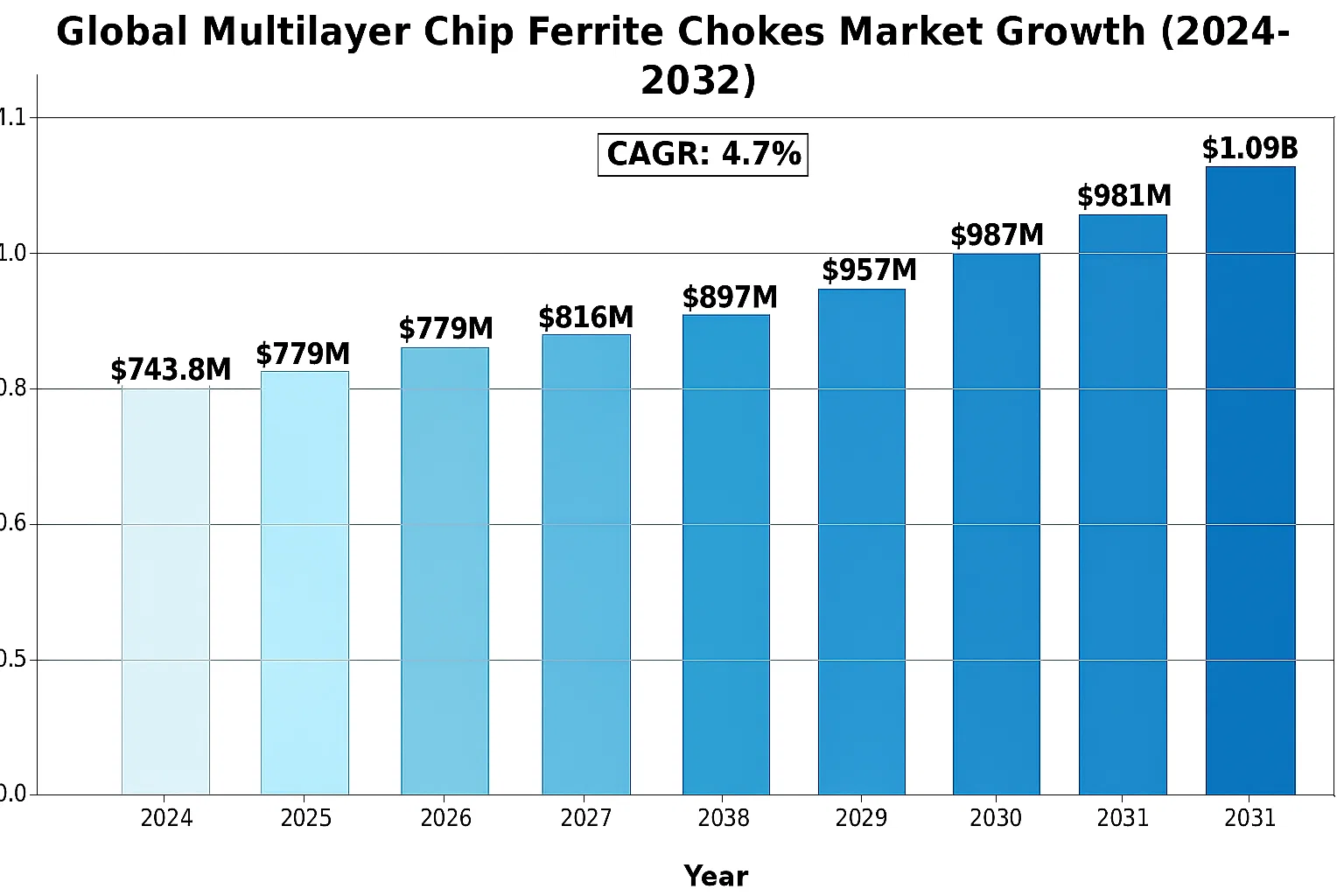
The global Multilayer Chip Ferrite Chokes Market size was valued at US$ 743.8 million in 2024 and is projected to reach US$ 1.09 billion by 2032, at a CAGR of 4.7% during the forecast period 2025-2032
Multilayer chip ferrite chokes, also known as multilayer chip inductors or beads, are passive electronic components designed to suppress electromagnetic interference (EMI) and noise in circuits. These compact devices utilize ferrite material to provide high impedance at specific frequencies while maintaining low DC resistance, making them ideal for applications requiring space efficiency and signal integrity.
The market growth is driven by increasing demand from consumer electronics like smartphones and laptops, where EMI suppression is critical. Furthermore, the automotive sector’s shift toward electric vehicles (EVs) and advanced driver-assistance systems (ADAS) has significantly boosted demand, as these systems rely heavily on noise filtration. Additionally, 5G infrastructure expansion and IoT device proliferation are creating new opportunities, with manufacturers focusing on miniaturized, high-performance solutions. Key players such as TDK, Murata, and Yageo continue to innovate, introducing advanced choke technologies to meet evolving industry requirements.
MARKET DYNAMICS
MARKET DRIVERS
Surging Demand for Consumer Electronics Fueling Market Expansion
The global consumer electronics sector is experiencing unprecedented growth, creating substantial demand for multilayer chip ferrite chokes. These components are critical for suppressing electromagnetic interference in smartphones, laptops, and smart home devices, which collectively represent an estimated 3.5 billion unit shipment annually. With consumers increasingly adopting connected devices—smartphone penetration is projected to reach 78% globally by 2025—manufacturers are compelled to integrate robust EMI suppression solutions. Major electronics brands now incorporate an average of 12-15 ferrite chokes per premium smartphone to ensure signal integrity, demonstrating their essential role in modern device architectures.
Electric Vehicle Revolution Accelerating Component Demand
The automotive industry’s rapid shift toward electrification represents a significant growth vector for multilayer chip ferrite chokes. Modern electric vehicles contain approximately 30% more electronic components than conventional vehicles, with power management systems requiring specialized EMI suppression. As EV production volumes are forecast to exceed 40 million units annually by 2030, the need for automotive-grade ferrite chokes is escalating correspondingly. These components ensure reliable operation of critical systems including battery management and autonomous driving modules, where even minor interference could compromise vehicle safety.
➤ Leading automotive suppliers have begun designing dedicated ferrite choke solutions capable of withstanding the extreme thermal and vibrational conditions characteristic of electric powertrains.
5G Infrastructure Deployment Creating New Application Horizons
The global rollout of 5G networks is creating unprecedented demand for high-frequency multilayer ferrite solutions. Each 5G base station requires 50-70 specialized chokes to manage signal integrity across multiple frequency bands. With telecommunications operators investing over $200 billion annually in network infrastructure, component manufacturers are developing innovative choke designs optimized for millimeter-wave frequencies. These advanced solutions enable the high-speed data transmission that 5G promises while maintaining the electromagnetic compatibility standards required in dense urban deployments.
MARKET RESTRAINTS
Raw Material Price Volatility Impacting Profit Margins
The multilayer chip ferrite choke market faces significant pressure from fluctuating raw material costs. Ferrite compositions require precise blends of iron oxide, nickel, zinc, and manganese—materials that have experienced price swings exceeding 30% annually in recent years. This volatility creates challenges for manufacturers attempting to maintain consistent pricing while preserving product quality. Several industry players have reported compression of gross margins by 3-5 percentage points due to these input cost variations, particularly affecting smaller manufacturers with less purchasing power.
Other Critical Restraints
Miniaturization Challenges
While device shrinkage creates opportunities, it simultaneously presents technical hurdles. Developing ferrite chokes with sufficient impedance characteristics in package sizes below 0201 (0.6 x 0.3mm) requires significant R&D investment. Yield rates for these ultra-compact components currently average just 65-70% compared to 85% for standard sizes, increasing production costs.
Regulatory Complexity
Differing electromagnetic compatibility standards across regions complicate product development. Compliance with EU’s CE marking, FCC Part 15 in North America, and China’s CCC certification requires extensive testing, adding 4-6 weeks to product development cycles and increasing time-to-market pressures.
MARKET CHALLENGES
Supply Chain Disruptions Testing Manufacturing Resilience
The global electronics supply chain’s fragility has emerged as a persistent challenge for ferrite choke producers. Average lead times for specialty materials have extended from 6-8 weeks to 14-16 weeks, forcing manufacturers to maintain larger inventories. The industry has responded by developing strategic stockpiles of critical materials, but this approach ties up working capital equivalent to 20-25% of annual revenue for mid-sized producers.
Additional Pressures
Technical Expertise Shortage
The specialized knowledge required for advanced ferrite formulations and high-frequency design is in critically short supply. Industry surveys indicate that 45% of manufacturers report difficulties filling materials science and RF engineering positions, slowing innovation cycles.
Counterfeit Component Proliferation
The commoditization of passive components has led to increased counterfeit activity, with trade organizations estimating that 8-12% of components in the global supply chain may be fraudulent. This undermines system reliability and brand reputation for legitimate manufacturers.
MARKET OPPORTUNITIES
Emerging IoT and Wearable Markets Present Untapped Potential
The exponential growth of IoT devices—projected to exceed 75 billion connected endpoints globally—creates substantial opportunities for compact ferrite solutions. Smart wearable manufacturers increasingly demand ultra-miniature chokes that can operate reliably in flexible circuits. Early adopters report achieving 30-40% gross margins on these specialized products, significantly higher than standard offerings. The medical wearables segment shows particular promise, with regulatory approvals for new devices incorporating advanced EMI suppression growing by 15% year-over-year.
Automotive Radar Systems Driving High-Frequency Innovation
Advanced driver assistance systems (ADAS) utilizing 77GHz radar represent a high-value application frontier. Each radar module requires 6-8 specialized chokes operating at unprecedented frequencies, with automotive OEMs willing to pay premium prices for qualified components. First movers in this space have secured long-term supply agreements with 5-7 year terms, underscoring the strategic importance of these components. The ADAS market’s projected 22% CAGR through 2030 suggests sustained demand for these specialized solutions.
➤ Tier 1 automotive suppliers have begun collaborating with component manufacturers to co-develop application-specific choke designs optimized for autonomous vehicle architectures.
Renewable Energy Systems Creating New Demand Channels
The renewable energy sector’s expansion presents promising new applications for power-grade ferrite chokes. Large-scale solar inverters and wind turbine converters require robust EMI suppression solutions capable of handling 10-15kW power levels. Component manufacturers developing specialized products for this segment report 20-25% faster revenue growth compared to traditional markets, with particularly strong demand emerging from Asia-Pacific markets leading renewable energy adoption.
MULTILAYER CHIP FERRITE CHOKES MARKET TRENDS
5G Network Expansion Accelerates Demand for EMI Suppression Components
The rapid global rollout of 5G infrastructure has emerged as the primary driver for multilayer chip ferrite chokes, with telecommunication applications accounting for approximately 28% of total market demand in 2024. These components play a critical role in base stations and network equipment, suppressing electromagnetic interference that could otherwise degrade signal quality in high-frequency 5G operations. Manufacturers are responding with specialized miniature ferrite choke designs featuring enhanced frequency ranges up to 10GHz to meet 5G requirements. The Asia-Pacific region, where over 60% of 5G deployments currently occur, has consequently become the fastest-growing market for these components, with annual demand increasing at a compound rate of 12-15%.
Other Trends
Automotive Electrification
The automotive sector’s transition toward electric vehicles represents another significant growth avenue, with EV applications now comprising nearly 22% of multilayer chip ferrite choke sales. Modern electric vehicles incorporate 30-50% more electronic components than conventional vehicles, creating substantial demand for EMI suppression in battery management systems, power converters, and motor drives. Leading manufacturers have developed automotive-grade ferrite chokes capable of withstanding harsh operating conditions, including temperature ranges from -55°C to 150°C, to meet stringent automotive reliability standards.
Miniaturization and High-Density Packaging
The relentless push for smaller electronic devices with greater functionality has transformed multilayer chip ferrite choke design parameters. Current market leaders offer components with sizes as small as 0.25×0.125mm, down 40% from standard sizes five years ago. This miniaturization trend particularly impacts consumer electronics, where smartphone manufacturers routinely incorporate 15-20 ferrite choke components per device to manage EMI in tightly packed circuit boards. Advanced ferrite materials with higher permeability values now enable equivalent performance in smaller form factors, though this has introduced new manufacturing challenges in maintaining consistent product quality during mass production.
COMPETITIVE LANDSCAPE
Key Industry Players
Market Leaders Expand Product Lines to Address Global Demand for EMI Suppression
The multilayer chip ferrite chokes market exhibits a consolidated competitive landscape dominated by established electronics component manufacturers. TDK Corporation and Murata Manufacturing collectively held over 35% of the global market share in 2024, leveraging their vertically integrated production capabilities and extensive R&D investments in advanced ferrite materials.
These industry giants maintain dominance through continuous product innovation – recently introducing ultra-miniaturized chokes for 5G applications and automotive-grade components meeting AEC-Q200 standards. Yageo (Chilisin) has emerged as a strong challenger, particularly in the consumer electronics segment where its cost-competitive offerings gained significant traction across Asian OEMs.
The market also features specialized players like TAIYO YUDEN and Samsung Electro-Mechanics focusing on high-reliability applications. These companies have been actively expanding their production capacities to meet growing demand from electric vehicle manufacturers and telecommunications infrastructure providers.
Meanwhile, Western players including Bourns and Vishay are strengthening their positions through strategic acquisitions and targeted investments in high-frequency choke technologies. Their growth reflects increasing requirements for EMI suppression in advanced driver assistance systems (ADAS) and industrial IoT applications.
List of Key Multilayer Chip Ferrite Choke Manufacturers
- TDK Corporation (Japan)
- Murata Manufacturing (Japan)
- Yageo Corporation (Chilisin) (Taiwan)
- Sunlord Electronics (China)
- TAIYO YUDEN (Japan)
- Samsung Electro-Mechanics (South Korea)
- Bourns, Inc. (U.S.)
- Vishay Intertechnology (U.S.)
- Fenghua Advanced Technology (China)
- Laird Performance Materials (DuPont) (U.S.)
- Würth Elektronik (Germany)
Segment Analysis:
By Type
General Grade Segment Leads Owing to Widespread Use in Consumer Electronics and Telecom Applications
The market is segmented based on type into:
- General Grade
- Subtypes: Low-frequency, High-frequency
- Automotive Grade
- Others
By Application
Consumer Electronics Segment Dominates Due to Rising Demand for Smartphones and Wearables
The market is segmented based on application into:
- Consumer Electronics
- Automotive
- Telecom/Datacom
- Others
By Material Composition
Nickel-Zinc Ferrites Lead Market Share for High-Frequency Applications
The market is segmented based on material composition into:
- Nickel-Zinc Ferrites
- Manganese-Zinc Ferrites
- Others
By Packaging Technology
Surface Mount Technology (SMT) Holds Majority Share for Space-Efficient Circuit Design
The market is segmented based on packaging technology into:
- Surface Mount Technology (SMT)
- Through-Hole Technology
Regional Analysis: Multilayer Chip Ferrite Chokes Market
North America
The North American region, particularly the U.S., dominates the multilayer chip ferrite chokes market due to its mature electronics industry and strong demand for advanced EMI suppression solutions. The robust presence of key market players such as TDK and Vishay further strengthens the market. Growth is driven by several factors, including increased investments in 5G infrastructure, the expanding automotive sector (especially electric vehicles), and strict regulatory compliance for electromagnetic compatibility (EMC) standards. The region also benefits from significant demand in consumer electronics, particularly high-end smartphones and IoT devices. However, rising production costs and supply chain complexities pose challenges for manufacturers.
Europe
Europe maintains a strong position in the multilayer chip ferrite chokes market, with Germany, the UK, and France leading in adoption. The region’s stringent regulatory environment around EMC and EMI suppression under EU directives accelerates demand for high-performance components. The automotive sector is a key growth driver, as European automakers integrate more electronics into vehicles, including ADAS and EV power systems. Additionally, the expansion of telecom infrastructure, particularly for 5G deployment, further boosts demand. However, the market faces competition from Asian manufacturers, which offer cost-effective alternatives. Despite this, European companies remain competitive through innovation, particularly in high-frequency and automotive-grade ferrite chokes.
Asia-Pacific
Asia-Pacific is the largest and fastest-growing market for multilayer chip ferrite chokes, led by China, Japan, South Korea, and India. The region benefits from a highly developed electronics manufacturing ecosystem, with companies like Murata, Taiyo Yuden, and Samsung Electro-Mechanics driving innovation. China, in particular, accounts for a significant share due to its massive consumer electronics and automotive production. The rapid rollout of 5G networks, along with government initiatives promoting EV adoption, further propels market growth. However, price competition among local manufacturers can pressure profit margins, and fluctuations in raw material availability remain a concern.
South America
The South American market is emerging, with Brazil and Argentina showing gradual growth in demand for multilayer chip ferrite chokes. While the consumer electronics and automotive sectors—especially in Brazil—are growing, economic instability and lower regulatory enforcement compared to North America and Europe hinder faster adoption. Import dependency on components from Asia also limits local production capabilities. Nonetheless, increasing investments in telecommunications infrastructure provide some opportunities, particularly for suppliers targeting mid-tier electronic manufacturers.
Middle East & Africa
The Middle East & Africa (MEA) region exhibits potential for growth, though the market remains underdeveloped. Countries like the UAE, Saudi Arabia, and Israel are focusing on digital transformation, driving demand for electronic components such as ferrite chokes in telecom and smart infrastructure applications. The automotive sector is also gradually adopting advanced electronics, though at a slower pace compared to other regions. Limited local manufacturing capabilities and reliance on imports from Asia and Europe constrain expansion. However, increasing foreign investments in high-tech industries suggest long-term growth potential.
Report Scope
This market research report provides a comprehensive analysis of the global and regional Multilayer Chip Ferrite Chokes markets, covering the forecast period 2025–2032. It offers detailed insights into market dynamics, technological advancements, competitive landscape, and key trends shaping the industry.
Key focus areas of the report include:
- Market Size & Forecast: Historical data and future projections for revenue, unit shipments, and market value across major regions and segments.
- Segmentation Analysis: Detailed breakdown by product type (General Grade, Automotive Grade, Others), technology, application (Consumer Electronics, Automotive, Telecom/Datacom), and end-user industry to identify high-growth segments and investment opportunities.
- Regional Outlook: Insights into market performance across North America, Europe, Asia-Pacific, Latin America, and the Middle East & Africa, including country-level analysis where relevant.
- Competitive Landscape: Profiles of leading market participants, including their product offerings, R&D focus, manufacturing capacity, pricing strategies, and recent developments such as mergers, acquisitions, and partnerships.
- Technology Trends & Innovation: Assessment of emerging technologies, integration of AI/IoT in EMI suppression, semiconductor design trends, and evolving industry standards.
- Market Drivers & Restraints: Evaluation of factors driving market growth along with challenges, supply chain constraints, regulatory issues, and market-entry barriers.
- Stakeholder Analysis: Insights for component suppliers, OEMs, system integrators, investors, and policymakers regarding the evolving ecosystem and strategic opportunities.
Primary and secondary research methods are employed, including interviews with industry experts, data from verified sources, and real-time market intelligence to ensure the accuracy and reliability of the insights presented.
FREQUENTLY ASKED QUESTIONS:
What is the current market size of Global Multilayer Chip Ferrite Chokes Market?
->Multilayer Chip Ferrite Chokes Market size was valued at US$ 743.8 million in 2024 and is projected to reach US$ 1.09 billion by 2032, at a CAGR of 4.7% during the forecast period 2025-2032
Which key companies operate in Global Multilayer Chip Ferrite Chokes Market?
-> Key players include TDK, Murata, Yageo (Chilisin), Sunlord, TAIYO YUDEN, Samsung Electro-Mechanics, Bourns, and Vishay, among others.
What are the key growth drivers?
-> Key growth drivers include rising demand for consumer electronics, expansion of 5G infrastructure, increasing EV adoption, and miniaturization trends in electronic components.
Which region dominates the market?
-> Asia-Pacific holds the largest market share (over 45%), driven by electronics manufacturing in China, Japan, and South Korea, with North America showing fastest growth due to EV and telecom advancements.
What are the emerging trends?
-> Emerging trends include development of high-frequency chokes for 5G applications, automotive-grade components for EVs, and integration of advanced materials for improved EMI suppression.

Get Sample Report PDF for Exclusive Insights
Report Sample Includes
- Table of Contents
- List of Tables & Figures
- Charts, Research Methodology, and more...
 Download Sample Report PDF