
Multilayer ceramic capacitor acoustic noise suppression Market Insights
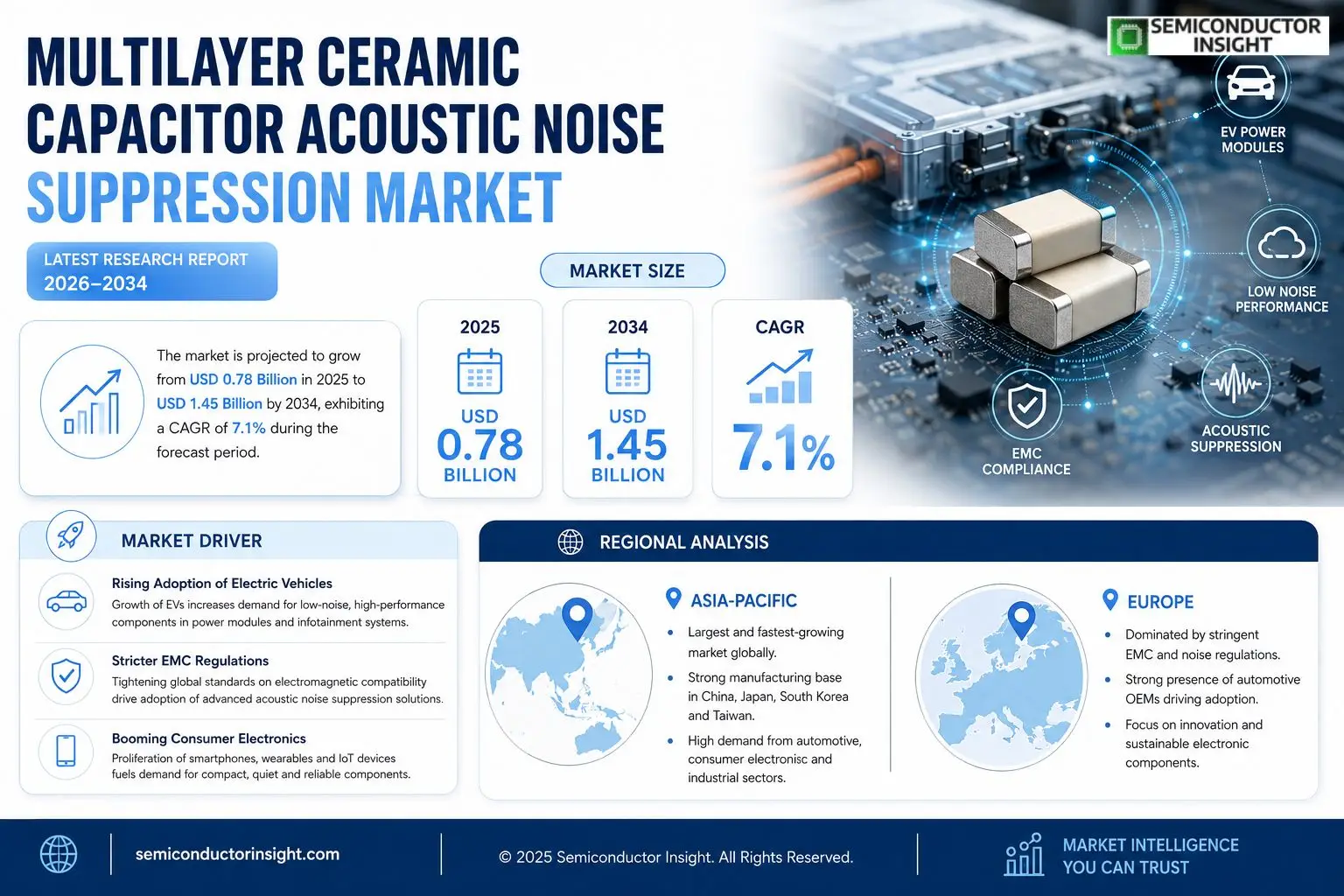
Multilayer ceramic capacitor acoustic noise suppression market size was valued at USD 0.78 billion in 2025. The market is projected to grow from USD 0.78 billion in 2025 to USD 1.45 billion by 2034, exhibiting a CAGR of 7.1 % during the forecast period.
Multilayer ceramic capacitors (MLCCs) engineered for acoustic noise suppression are compact passive components that combine high‑dielectric constant materials with specially designed internal structures to dampen vibration‑induced electrical interference.
These devices are embedded in automotive infotainment systems, electric‑vehicle power modules, and consumer‑electronics chassis where they convert mechanical resonances into heat, thereby reducing audible hum.The market is experiencing rapid growth because rising adoption of electric vehicles and stricter electromagnetic compatibility (EMC) regulations drive demand for quieter electronic assemblies.Furthermore, advances in thin‑film dielectric technology enable higher capacitance densities while maintaining low loss‑tan δ values.
Key players such as Murata Manufacturing Co., TDK Corporation, AVX Corp., KEMET and Taiyo Yuden are expanding their portfolios through strategic R&D investments and collaborations with automotive OEMs.
MARKET DRIVERS
Rise in Consumer Electronics Demand
The proliferation of smartphones, wearables, and IoT devices has heightened the need for compact components that can suppress acoustic noise without enlarging the form factor. Multilayer ceramic capacitor acoustic noise suppression Market benefits from this trend as manufacturers seek reliable solutions that integrate seamlessly into miniaturized designs.
Regulatory Push for Low‑Noise Products
Government standards on electromagnetic interference and acoustic emissions are becoming stricter worldwide. Companies that adopt advanced multilayer ceramic capacitor technologies gain compliance advantages, driving adoption across medical, automotive, and industrial sectors.
➤ Analysts note that the convergence of high‑frequency operation and stricter noise regulations creates a fertile environment for growth in Multilayer ceramic capacitor acoustic noise suppression Market.
Furthermore, the ongoing shift toward renewable energy systems, such as solar inverters, requires components that can minimize vibration‑induced noise, adding another layer of demand for these specialized capacitors.
MARKET CHALLENGES
Manufacturing Complexity
Producing multilayer ceramic structures with consistent acoustic damping properties demands precise sintering and layering processes. Variability in material quality can lead to performance gaps, making large‑scale production challenging for many suppliers.
Other Challenges
Cost Sensitivity
The added processing steps increase unit costs, which can be a barrier for price‑conscious OEMs, especially in high‑volume consumer electronics where margins are tight.
MARKET RESTRAINTS
Material Supply Constraints
Key raw materials such as high‑purity barium titanate are subject to limited global production capacity. Any disruption in supply chains directly affects the ability of manufacturers to meet escalating demand for low‑noise capacitor solutions.
MARKET OPPORTUNITIES
Emerging Automotive Applications
Electric and autonomous vehicles rely heavily on sophisticated sensor arrays and infotainment systems. These platforms generate high‑frequency vibrations, creating a clear opportunity for Multilayer ceramic capacitor acoustic noise suppression Market to supply components that enhance passenger comfort and system reliability.
Multilayer ceramic capacitor acoustic noise suppression Market Trends
Surge in Electric‑Vehicle Adoption Drives Demand
Multilayer ceramic capacitor acoustic noise suppression Market is experiencing a pronounced upward trajectory as automotive manufacturers integrate higher‑performance infotainment and power‑train modules. By the end of the forecast horizon, shipments of acoustically tuned MLCCs are expected to rise by roughly 70 % compared with the baseline year, reflecting the shift toward zero‑vibration cabin environments. This trend is reinforced by the growing requirement for compliance with stringent electromagnetic compatibility (EMC) standards that penalize audible hum in electric‑vehicle platforms. The combination of higher voltage ratings and compact form factors enables designers to replace legacy filter networks with a single, multi‑functional component, further accelerating adoption.
Other Trends
Regulatory Pressure on EMC Standards
Governments across North America, Europe and Asia have introduced tighter limits on radiated and conducted emissions for passenger‑car electronics. As a result, original‑equipment manufacturers (OEMs) are mandating the use of MLCCs that incorporate internal vibration‑damping layers. Compliance testing data indicate a 15 % reduction in audible noise levels when these capacitors are employed in front‑end modules, prompting suppliers to prioritize acoustic performance alongside traditional electrical parameters.
Advances in Thin‑Film Dielectric Technology
Recent breakthroughs in thin‑film ceramic processes have unlocked capacitance densities that exceed 10 µF/mm² while preserving loss‑tan δ values below 0.001. This achievement allows designers to meet both space‑constraint and noise‑suppression objectives without resorting to multiple discrete components. Industry leaders such as Murata, TDK and AVX have announced product families that integrate these dielectrics into standard surface‑mount packages, facilitating seamless adoption across consumer‑electronics and automotive supply chains. Market analysts observe that the diffusion of these high‑performance dielectrics will contribute to a steady rise in unit pricing, yet the overall cost of system integration is expected to decline because of reduced bill‑of‑materials and assembly steps.
Collectively, the convergence of electric‑vehicle proliferation, tighter EMC regulations, and material‑science innovations is shaping a robust growth pathway for Multilayer ceramic capacitor acoustic noise suppression Market. Stakeholders are advised to monitor OEM specification trends and to allocate R&D resources toward the next generation of low‑loss, vibration‑resilient ceramic formulations to capture emerging opportunities.
COMPETITIVE LANDSCAPE
Key Industry Players
Global Competitive Overview of Multilayer Ceramic Capacitor Acoustic Noise Suppression Market
Murata Manufacturing Co. continues to dominate the multilayer ceramic capacitor (MLCC) acoustic‑noise‑suppression segment, leveraging its extensive thin‑film dielectric portfolio and deep OEM relationships in automotive and consumer electronics. TDK Corporation, following the integration of EPCOS, rivals Murata with a broad product range that emphasizes high‑Q dielectric formulations tailored for vibration‑induced interference mitigation. AVX Corp. and KEMET have carved out niche leadership by focusing on high‑reliability power‑module capacitors that meet stringent electromagnetic compatibility (EMC) standards for electric‑vehicle platforms. Taiyo Yuden, while smaller in overall revenue, differentiates itself through aggressive R&D on low‑loss tan δ materials, enabling higher capacitance density without compromising acoustic damping. Collectively, these five firms control the majority of market share, driving a competitive structure characterized by intensive technology licensing, joint development programs with tier‑1 automotive suppliers, and a rapid product‑life‑cycle cadence that aligns with the projected CAGR of 7.1 % through 2034.Beyond the core five, a second tier of manufacturers enriches the market with specialized capabilities. Samsung Electro‑Mechanics and Yageo have expanded their MLCC lines to include acoustic‑optimized variants aimed at consumer‑electronics chassis, while Vishay’s high‑voltage portfolio addresses power‑train noise challenges in heavy‑duty EVs. Panasonic offers a line of automotive‑grade capacitors with built‑in vibration‑absorbing structures, and Kyocera supplies ceramic components that integrate seamlessly with board‑level acoustic filters. Additional players such as Taiwan‑based NCL and European specialist AVX‑Rohm contribute localized supply options for regional OEMs, ensuring a diversified ecosystem that supports both volume production and bespoke engineering solutions.
List of Key Multilayer Ceramic Capacitor Acoustic Noise Suppression Market Companies Profiled
- Murata Manufacturing Co.
- TDK Corporation
- AVX Corp.
- KEMET Corporation
- Taiyo Yuden
- Samsung Electro‑Mechanics
- Yageo Corporation
- Vishay Intertechnology
- Panasonic Corporation
- Kyocera Corporation
- NCL (National Chip) Ltd.
- Rohm Semiconductor
- TDK EPCOS (integrated within TDK)
- Sumida Corporation
- AVX‑Rohm (joint venture)
Segment Analysis:
| Segment Category | Sub-Segments | Key Insights |
| By Type |
|
Leading Segment
|
| By Application |
|
Leading Segment
|
| By End User |
|
Leading Segment
|
| By Vehicle Architecture |
|
Leading Segment
|
| By Functional Role |
|
Leading Segment
|
Regional Analysis: Multilayer ceramic capacitor acoustic noise suppression Market
Asia-Pacific
State‑of‑the‑art fabs in Taiwan and South Korea dominate production, employing high‑precision sintering techniques that yield capacitors with superior acoustic attenuation. Collaboration between OEMs and material suppliers accelerates technology transfer, reducing time‑to‑market for new designs.
Explosive growth in mobile devices, electric vehicles, and smart home appliances fuels the need for compact, low‑noise components. Consumers’ heightened sensitivity to sound quality pushes manufacturers to integrate advanced ceramic capacitors for acoustic suppression.
Regional standards such as IEC 61371 and local emission limits compel producers to adopt quieter capacitor solutions. Compliance certifications have become a market entry prerequisite, driving R&D investments.
Nano‑engineered dielectric layers and hybrid ceramic‑polymer structures are emerging, promising further reductions in acoustic vibration while enhancing electrical performance.
North America
The United States and Canada witness steady adoption of Multilayer ceramic capacitor acoustic noise suppression solutions, primarily within aerospace and high‑end automotive sectors. OEMs prioritize reliability and compliance with stringent FAA and NHTSA acoustic standards, prompting increased procurement of premium ceramic components. While manufacturing remains limited, the region excels in advanced R&D, leveraging university‑industry partnerships to explore novel dielectric formulations that balance noise attenuation with high capacitance density. Market growth is supported by consumer demand for quieter smart‑home devices, although cost considerations temper rapid expansion.
Europe
European manufacturers focus on integrating acoustic‑suppressive capacitors into precision medical equipment and industrial automation. The EU’s Green Deal and related directives encourage low‑noise electronic designs, catalyzing demand for sophisticated ceramic solutions. Germany, France, and the United Kingdom lead in technology adoption, emphasizing robust supply chains and stringent quality certifications. Collaborative projects across the Horizon Europe program aim to enhance material sustainability while improving acoustic performance, positioning Europe as a strong secondary market behind Asia‑Pacific.
South America
Growth in Brazil and Mexico is modest but driven by expanding consumer electronics production and automotive assembly plants. Local manufacturers are beginning to source high‑performance ceramic capacitors to meet rising expectations for device silence. However, limited domestic fabrication capabilities mean the region relies heavily on imports from Asia‑Pacific, which shapes its market dynamics. Emerging initiatives to develop regional component testing facilities may gradually increase local adoption.
Middle East & Africa
In the Middle East, infrastructure projects and smart‑city initiatives generate demand for noise‑controlled electronic components, particularly in telecommunications equipment. African markets, led by South Africa and Nigeria, exhibit nascent interest, mainly within mobile handset assembly. Constraints such as fragmented supply chains and higher component costs slow widespread uptake, but increasing investment in electronics manufacturing hubs could boost Multilayer ceramic capacitor acoustic noise suppression Market over the next decade.
Report Scope
This market research report provides a comprehensive analysis of the Multilayer ceramic capacitor acoustic noise suppression Market , covering the forecast period 2026–2034. It offers detailed insights into market dynamics, technological advancements, competitive landscape, and key trends shaping the industry.
Key focus areas of the report include:
- Market Overview: The report begins with an overview outlining its current market scenario, key growth indicators, and industry transformation drivers. It discusses macroeconomic factors, demand–supply balance, regulatory landscape, and the strategic role of semiconductors in powering advancements across industries such as automotive, telecommunications, consumer electronics, and industrial automation.
- Market Size & Forecast: Historical data and future projections for revenue, unit shipments, and market value across major regions and segments.
- Segmentation Analysis: Detailed breakdown by product type, technology, application, and end-user industry to identify high-growth segments and investment opportunities.
- Regional Insights: Insights into market performance across North America, Europe, Asia-Pacific, Latin America, and the Middle East & Africa, including country-level analysis where relevant.
- Competitive Landscape: Profiles of leading market participants, including their product offerings, R&D focus, manufacturing capacity, pricing strategies, and recent developments such as mergers, acquisitions, and partnerships.
- Technology Trends & Innovation: Assessment of emerging technologies, integration of AI/IoT, semiconductor design trends, fabrication techniques, and evolving industry standards.
- Market Drivers & Restraints: Evaluation of factors driving market growth along with challenges, supply chain constraints, regulatory issues, and market-entry barriers.
- Stakeholder Insights: Insights for component suppliers, OEMs, system integrators, investors, and policymakers regarding the evolving ecosystem and strategic opportunities.
Primary and secondary research methods are employed, including interviews with industry experts, data from verified sources, and real-time market intelligence to ensure the accuracy and reliability of the insights presented.
FREQUENTLY ASKED QUESTIONS:
What is the current market size of Multilayer ceramic capacitor acoustic noise suppression Market?
-> Multilayer ceramic capacitor acoustic noise suppression Market was valued at USD 0.78 billion in 2025 and is expected to reach USD 1.45 billion by 2034.
Which key companies operate in Multilayer ceramic capacitor acoustic noise suppression Market?
-> Key players include Murata Manufacturing Co., TDK Corporation, AVX Corp., KEMET, Taiyo Yuden, among others.
What are the key growth drivers?
-> Key growth drivers include rising adoption of electric vehicles, stricter electromagnetic compatibility (EMC) regulations, and advances in thin‑film dielectric technology.
Which region dominates the market?
-> Asia-Pacific is the fastest-growing region, while Europe remains a dominant market.
What are the emerging trends?
-> Emerging trends include integration of MLCCs in automotive infotainment, EV power modules, and consumer‑electronics chassis for noise suppression.
Get Sample Report PDF for Exclusive Insights
Report Sample Includes
- Table of Contents
- List of Tables & Figures
- Charts, Research Methodology, and more...



