Multi-pin Signal Adapter Market, Trends, Business Strategies 2026-2034

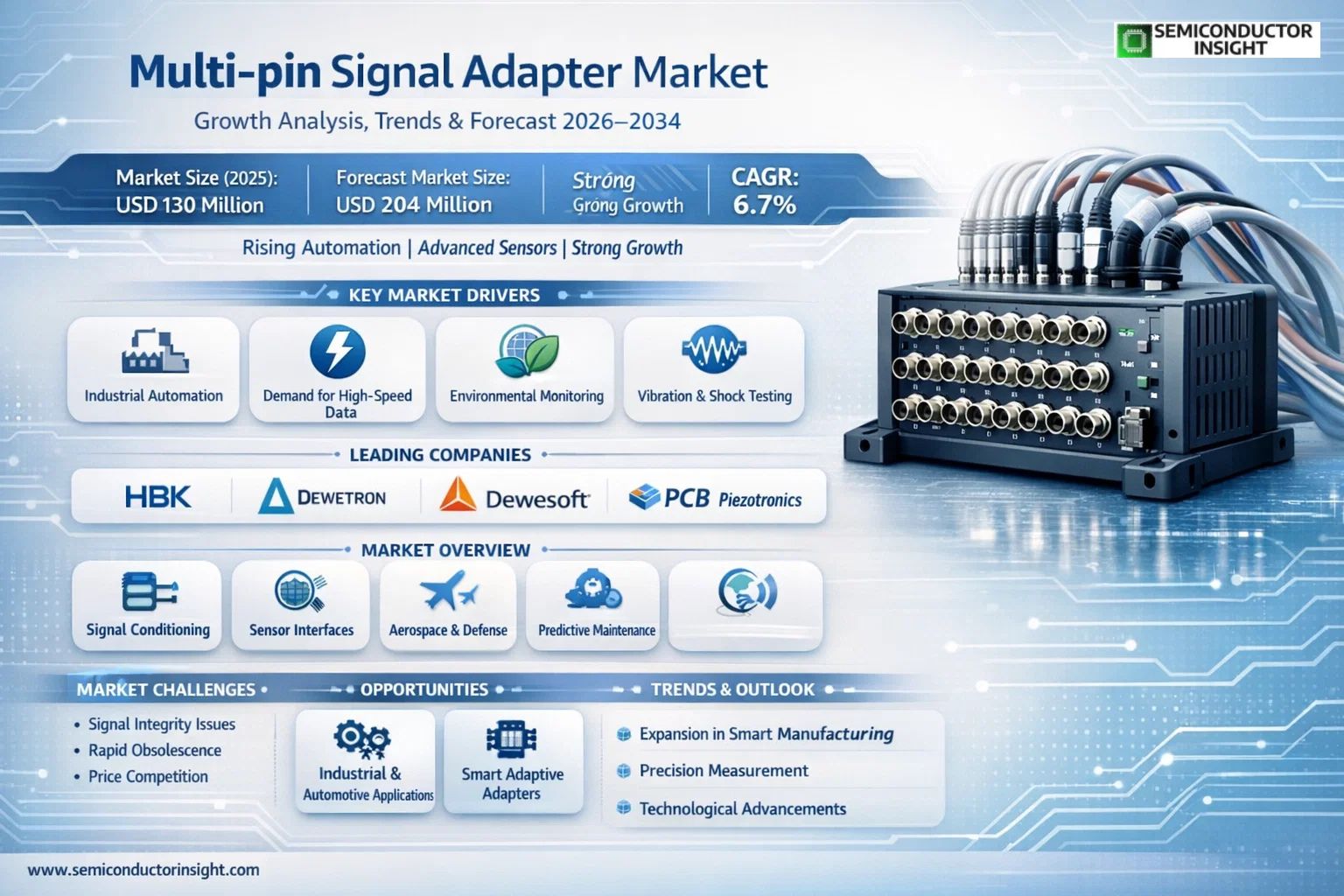
Global Multi-pin Signal Adapter Market was valued at USD 130 million in 2025 and is projected to reach USD 204 million by 2034, growing at a CAGR of 6.7% during the forecast period.

PDF Icon Download Sample Report PDF
  • Quick Dispatch

    All Orders

  • Secure Payment

    100% Secure Payment

Price range: $1,500.00 through $4,250.00

Clear

Multi-pin Signal Adapter Market Insights

Global Multi-pin Signal Adapter market size was valued at USD 130 million in 2025. The market is projected to grow from USD 138.7 million in 2026 to USD 204 million by 2034, exhibiting a CAGR of 6.7% during the forecast period.

A multi-pin signal adapter is an electronic device used to adapt, adjust, and optimize various types of electrical signals to meet the requirements of subsequent signal processing, recording, or transmission. These devices typically feature multiple pins or interfaces for connecting different types of sensors or signal sources and are engineered to convert raw input signals into more stable, accurate, and easy-to-process forms. They are critical components in applications demanding high precision and reliability across diverse signal types.

The market growth is primarily driven by accelerating industrial automation and the proliferation of advanced sensor-based monitoring systems across key sectors. Specifically, rising demand in vibration and shock measurement for predictive maintenance in manufacturing and aerospace, coupled with stringent environmental monitoring regulations globally, is fueling adoption. Furthermore, technological advancements leading to more compact, intelligent adapters with enhanced data integrity features are creating new opportunities. Key industry players such as HBK (Hottinger Brüel & Kjær), Dewetron, Dewesoft, Endevco (a Meggitt PLC company), and PCB Piezotronics are actively expanding their portfolios through innovation and strategic partnerships to capture this growing demand.
A

MARKET DRIVERS

Proliferation of Heterogeneous Electronic Ecosystems

The relentless advancement in consumer electronics, industrial automation, and telecommunications has led to a fragmented landscape of connection standards. This heterogeneity is a primary catalyst for the Multi-pin Signal Adapter Market, as these adapters serve as critical interoperability enablers. They bridge legacy systems with modern interfaces, allowing seamless data and power transmission between devices from different generations and manufacturers. The need to protect existing infrastructure investments while integrating new technology creates sustained demand for these essential components.

Demand for High-Speed Data and Power Transmission

The evolution towards high-definition video, real-time data acquisition, and fast-charging protocols necessitates adapters capable of handling increased bandwidth and power loads without signal degradation. Modern multi-pin signal adapters are engineered to support protocols like USB4, Thunderbolt, and HDMI 2.1, which require precise pin mapping and robust shielding. This technological arms race directly propels the market, as end-users seek reliable adapters to unlock the full performance potential of their high-end devices.

Global push for industrial IoT and smart manufacturing is fundamentally reliant on adaptable connectivity solutions, making high-fidelity signal adapters a cornerstone of digital transformation.

Furthermore, the rise of remote and hybrid work models has amplified the need for versatile connectivity at home offices, driving sales of docking stations and port replicators, which are sophisticated applications within the broader Multi-pin Signal Adapter Market.


MARKET CHALLENGES

Technical Complexity and Signal Integrity Issues

As data rates and power delivery specifications become more stringent, designing reliable multi-pin signal adapters becomes exponentially more difficult. Challenges include mitigating electromagnetic interference (EMI), managing heat dissipation from high-power pins, and ensuring strict impedance matching. A single poorly designed adapter can cause data corruption, device malfunctions, or even safety hazards, leading to costly returns and brand damage for manufacturers.

Other Challenges

Rapid Obsolescence of Standards

The fast-paced introduction and sunsetting of connection standards create a short product lifecycle. Manufacturers must constantly re-tool and re-design, increasing R&D costs and inventory risks for adapters that may quickly become obsolete.

Price Sensitivity and Counterfeit Products

In consumer segments, intense competition and the presence of low-quality counterfeit adapters that bypass safety certifications create a race-to-the-bottom on price, squeezing margins for legitimate players in the Multi-pin Signal Adapter Market and posing risks to consumers.


MARKET RESTRAINTS

Industry-Wide Push for Standardization

A significant long-term restraint for the Multi-pin Signal Adapter Market is the concerted effort by consortiums and major technology firms to reduce proprietary ports and converge on universal standards like USB-C. This trend towards a single, multi-purpose connector aims to reduce the need for adapters altogether. While convergence is gradual and uneven across industries, its eventual widespread adoption could curtail the market for certain types of legacy conversion adapters, compelling companies to innovate in higher-value, application-specific segments.


MARKET OPPORTUNITIES

Expansion into Specialized Industrial and Automotive Sectors

Beyond consumer electronics, significant growth lies in ruggedized and high-reliability adapters for industrial control systems, medical equipment, and automotive applications. These sectors require adapters that can withstand extreme temperatures, vibrations, and moisture while guaranteeing flawless signal transmission. Developing specialized solutions for these high-margin, low-volume niches represents a major opportunity for differentiation and growth within the Multi-pin Signal Adapter Market.

Integration of Active Electronics and Smart Features

The next frontier involves evolving from passive pin-to-pin connectors to active, intelligent adapters. Incorporating microchips for signal conditioning, protocol conversion, and power negotiation allows for more complex and reliable connectivity solutions. Opportunities abound in developing smart adapters with features like automatic device recognition, data logging, and enhanced security protocols, adding substantial value and moving the market away from commoditized offerings.

Multi-pin Signal Adapter Market Trends

Expansion into Industrial Automation and Smart Manufacturing

The demand for multi-pin signal adapters is being driven significantly by Global shift towards Industry 4.0 and smart manufacturing. These devices are critical for integrating diverse sensor arrays within automated production lines, enabling precise signal conditioning for process control and monitoring. Their role in converting raw sensor data into stable, accurate signals is foundational for real-time analytics and machine-to-machine communication. This trend is most pronounced in regions with strong industrial bases, such as North America, Europe, and increasingly, Asia-Pacific, where factories are upgrading legacy systems.

Other Trends

Precision in Vibration and Shock Measurement

A key application driving product development is in high-precision vibration and shock measurement, particularly within the aerospace and automotive testing sectors. Manufacturers are focusing on adapters that offer higher sampling rates, improved noise immunity, and greater channel density to manage complex multi-sensor setups. This necessitates specialized adapters capable of handling signals from accelerometers and strain gauges with minimal distortion, supporting advanced predictive maintenance and structural health monitoring systems.

Consolidation and Specialization Among Key Players

The competitive landscape is characterized by strategic movements among established manufacturers like HBK, Dewesoft, and PCB Piezotronics. These companies are focusing on innovation through both R&D and strategic mergers to expand their application-specific portfolios. Concurrently, there is a visible trend towards product specialization, with clear distinctions between general-purpose and special-purpose adapters tailored for niche applications like environmental monitoring or medical device testing. This dual approach of consolidation and specialization is shaping the market’s evolution, focusing on reliability and performance in critical measurement scenarios.

COMPETITIVE LANDSCAPE

Key Industry Players

A Concentrated Market with Dominant Specialists

Global multi-pin signal adapter market is characterized by a moderately concentrated competitive structure, with the top five players holding a significant revenue share as of 2025. Leading manufacturers, such as HBK (Hottinger, Brüel & Kjær) and Dewesoft, have established strong positions through their integrated solutions that combine high-precision adapters with advanced data acquisition hardware and software. This dominance is primarily driven by deep-rooted expertise in test and measurement, vibration analysis, and industrial condition monitoring, sectors that demand the high reliability and signal fidelity these adapters provide. The competitive focus is on technological innovation, product durability, and offering comprehensive system compatibility, especially for demanding applications in aerospace, automotive testing, and industrial automation. Significant barriers to entry include stringent performance certifications and the need for extensive R&D to meet niche application requirements.

Beyond the established leaders, the landscape includes a range of other significant players that cater to specialized or high-volume segments. Companies like PCB Piezotronics and Endevco are key forces in dynamic measurement and high-frequency applications, while Vishay Precision Group (through its Micro-Measurements division) holds substantial share in strain gauge signal conditioning. Other notable participants focus on cost-competitive general-purpose adapters for broader industrial automation or leverage regional supply chains to serve local markets effectively. The market is witnessing gradual consolidation trends, with strategic mergers and acquisitions aimed at expanding product portfolios and geographic reach. Competitive differentiation is increasingly tied to software integration, wireless connectivity options, and support for IoT-enabled predictive maintenance workflows.

List of Key Multi-pin Signal Adapter Companies Profiled

  • HBK (Hottinger, Brüel & Kjær)
  • Dewesoft d.o.o.
  • Dewetron GmbH
  • Endevco (A Meggitt PLC company)
  • Meggitt PLC
  • Vishay Micro-Measurements (Vishay Precision Group)
  • Wilcoxon Sensing Technologies
  • PCB Piezotronics (Amphenol)
  • KYOWA Electronic Instruments Co., Ltd.
  • National Instruments (NI)
  • HBM Test and Measurement
  • TE Connectivity
  • OMEGA Engineering
  • Keysight Technologies
  • Siemens AG

Segment Analysis:

Segment Category Sub-Segments Key Insights
By Type
  • General Purpose
  • Special Purpose
General Purpose adapters are foundational to the market due to their cost-effectiveness and versatility across numerous standard testing and measurement scenarios. These units are favored for their ability to handle a broad range of common signal conditioning tasks, which reduces the need for specialized equipment in general industrial and laboratory settings. Their widespread adoption is further driven by easier integration into existing systems and lower total cost of ownership for routine applications.
By Application
  • Vibration and Shock Measurement
  • Industrial Automation
  • Aerospace
  • Environmental Monitoring
  • Other
Vibration and Shock Measurement represents the most critical application segment, demanding the highest levels of precision and signal integrity from these adapters. This leadership is anchored in the essential role adapters play in converting raw sensor data into reliable, high-fidelity signals for predictive maintenance, structural testing, and quality control. The segment’s growth is reinforced by stringent industry standards and the expanding use of condition monitoring across manufacturing, automotive, and heavy machinery to prevent equipment failure and optimize operational lifetimes.
By End User
  • Original Equipment Manufacturers (OEMs)
  • System Integrators & Testing Laboratories
  • Maintenance & Repair Organizations (MROs)
Original Equipment Manufacturers (OEMs) are the primary end-users, as they integrate multi-pin signal adapters directly into sophisticated machinery, measurement systems, and industrial control panels during the manufacturing phase. This dominance is due to the critical need for embedded, high-performance signal conditioning to ensure the operational reliability and accuracy of the final product. OEM relationships with key adapter suppliers are often characterized by long-term contracts and collaborative development to meet specific technical and durability requirements for end-use in demanding fields like aerospace and automation.
By Product Feature
  • High-Channel Density
  • Modular & Expandable
  • Intrinsically Safe / Ruggedized
Modular & Expandable systems are gaining significant traction as they offer unparalleled flexibility for complex, evolving testing and monitoring setups. This feature allows users to start with a base configuration and add specific signal conditioning modules as application needs change or expand, protecting their initial investment. This adaptability is highly valued in research & development environments and for large-scale industrial projects where testing requirements are not static, facilitating cost-effective scaling and customization without replacing entire adapter units.
By Integration Level
  • Standalone/Desktop Units
  • Rack-Mounted Systems
  • Embedded/Board-Level Solutions
Rack-Mounted Systems are the leading integration format, particularly for high-channel-count applications in industrial and laboratory settings. Their dominance is driven by the need for organized, space-efficient, and centralized signal conditioning in control rooms, test benches, and data acquisition cabinets. These systems provide superior thermal management, easier cabling, and enhanced reliability for continuous operation, making them indispensable for synchronized multi-point measurement in vibration analysis, structural health monitoring, and large-scale automation projects where consistency and system integrity are paramount.

Regional Analysis: Global Multi-pin Signal Adapter Market

Asia-Pacific

The Asia-Pacific region is the undeniable powerhouse and leading region in Global Multi-pin Signal Adapter market. This dominance is fueled by a unique convergence of large-scale electronics manufacturing, rapid industrial automation, and significant investments in consumer electronics and telecommunications infrastructure. Countries like China, Japan, South Korea, and Taiwan are not just major end-markets but are also central hubs for the production of the electronic devices that require these adapters. The region’s vast manufacturing ecosystem demands robust connectivity solutions for test and measurement, production lines, and device assembly, creating sustained, high-volume demand. Furthermore, the aggressive rollout of 5G networks and the proliferation of IoT devices across smart cities and factories are introducing new, complex signal interfacing challenges that Multi-pin Signal Adapters are uniquely positioned to solve. The presence of leading OEMs and a strong focus on cost-competitive, yet reliable, component sourcing solidifies Asia-Pacific’s pivotal role in shaping both supply and demand dynamics for this critical market segment.

Manufacturing & Industrial Hub
The region’s core strength lies in its unparalleled electronics and industrial manufacturing base. This creates intrinsic demand for Multi-pin Signal Adapters used in automation equipment, PLC systems, robotic arms, and quality control instrumentation, ensuring the market is deeply integrated into the production value chain.
Technology Adoption & 5G Rollout
Asia-Pacific leads in adopting next-generation technologies. The deployment of 5G infrastructure and expansion of data centers require sophisticated signal routing and conversion, driving demand for high-frequency, high-density Multi-pin Signal Adapters in telecommunications and IT infrastructure.
Consumer Electronics Proliferation
As Global epicenter for smartphone, laptop, and wearable device production and consumption, the region generates continuous need for specialized adapters used in R&D, prototyping, testing, and after-market repair services for these devices.
Supply Chain Integration
Proximity to component suppliers and a mature logistics network for electronics allow for efficient supply chain integration. This enables faster time-to-market for new Multi-pin Signal Adapter designs that cater to evolving local and global OEM specifications.

North America
North America represents a high-value, innovation-driven market for Multi-pin Signal Adapters, characterized by demand for specialized, high-performance solutions. The region’s strength is in advanced sectors such as aerospace, defense, telecommunications, and automotive R&D, where reliability and precision under demanding conditions are paramount. The presence of leading technology firms and defense contractors fuels demand for custom-engineered adapters that meet stringent military and industrial standards. Furthermore, ongoing investments in upgrading telecom infrastructure, including 5G and fiber optics, alongside the growth of the electric and autonomous vehicle industry, create niches requiring robust signal interfacing and conversion components. The market here is less about volume and more about technological sophistication and adherence to rigorous certification processes.

Europe
The European Multi-pin Signal Adapter market is characterized by a strong emphasis on quality, standardization, and industrial applications within established manufacturing and automotive sectors. Germany, in particular, with its “Industry 4.0” initiatives, drives demand for adapters used in smart factories, industrial IoT, and precision automation systems. The region’s strict regulatory environment and emphasis on energy efficiency also influence product development, pushing for adapters that support complex control systems in automotive manufacturing, renewable energy installations, and industrial machinery. While growth is steady, it is closely tied to the pace of digital transformation in traditional industries and the region’s automotive electrification strategies, requiring reliable signal connectivity for testing and production.

South America
The South American market for Multi-pin Signal Adapters is emerging and is primarily driven by industrial modernization projects and growth in the telecommunications sector. Countries like Brazil and Argentina are seeing increased investment in mining, oil & gas, and agricultural automation, which utilize industrial control systems requiring reliable signal interfacing. The expansion of mobile networks and gradual improvements in broadband infrastructure also contribute to demand, though at a more measured pace compared to other regions. The market faces challenges related to economic volatility and import dependencies, but localized manufacturing initiatives and infrastructure development projects present gradual growth opportunities for standard adapter solutions.

Middle East & Africa
This region presents a diverse landscape for the Multi-pin Signal Adapter market, with growth pockets centered on infrastructure and energy projects. The Gulf Cooperation Council (GCC) countries, driven by visions for economic diversification, are investing heavily in smart city projects, telecommunications, and data center infrastructure, creating demand for commercial-grade adapters. In Africa, market activity is focused on telecommunications expansion and power infrastructure development. The mining and oil & gas sectors in specific nations also generate demand for ruggedized industrial adapters. Overall, the market is nascent but growing, with potential linked to large-scale government-led infrastructure initiatives and the gradual digitization of key economic sectors.

Report Scope

This market research report provides a comprehensive analysis of the Global Multi-pin Signal Adapter Market, covering the forecast period 2026–2034. It offers detailed insights into market dynamics, technological advancements, competitive landscape, and key trends shaping the industry.

Key focus areas of the report include:

  • Market Overview: The report begins with an overview outlining the current market scenario, key growth indicators, and industry transformation drivers. It discusses macroeconomic factors, demand-supply balance, regulatory landscape, and the strategic role of these adapters in high-precision applications across industries such as industrial automation, vibration and shock measurement, environmental monitoring, and aerospace.
  • Market Size & Forecast: Historical data and future projections for revenue, unit shipments, and market value across major regions and segments.
  • Segmentation Analysis: Detailed breakdown by product type (General Purpose, Special Purpose), application, and end-user industry to identify high-growth segments and investment opportunities.
  • Regional Insights: Insights into market performance across North America, Europe, Asia-Pacific, Latin America, and the Middle East & Africa, including country-level analysis for key markets like the U.S., China, Germany, and Japan.
  • Competitive Landscape: Profiles of leading market participants, including their product offerings, market share, manufacturing capacity, pricing strategies, and recent developments such as mergers, acquisitions, and partnerships.
  • Technology Trends & Innovation: Assessment of advancements in signal processing, adapter design, integration with data acquisition systems, and evolving industry standards for reliability and precision.
  • Market Drivers & Restraints: Evaluation of factors driving market growth along with challenges, supply chain constraints, regulatory issues, and market-entry barriers.
  • Stakeholder Insights: Insights for component suppliers, OEMs, system integrators, investors, and policymakers regarding the evolving ecosystem and strategic opportunities.

Primary and secondary research methods are employed, including interviews with industry experts, surveys of manufacturers and suppliers, and data from verified sources to ensure the accuracy and reliability of the insights presented.

FREQUENTLY ASKED QUESTIONS:

What is the current market size of Multi-pin Signal Adapter Market?

-> Global Multi-pin Signal Adapter Market was valued at USD 130 million in 2025 and is projected to reach USD 204 million by 2034, growing at a CAGR of 6.7% during the forecast period.

Which key companies operate in Multi-pin Signal Adapter Market?

-> Key players include HBK, Dewetron, Dewesoft, Endevco, Meggitt, Vishay Micro-Measurements, Wilcoxon, PCB Piezotronics, and KYOWA, among others. Global top five players held a significant revenue share in 2025.

What are the key growth drivers?

-> Key growth drivers include increasing demand for high-precision signal processing, growth in industrial automation, expansion of vibration and shock measurement applications, and advancements in environmental monitoring systems.

Which region dominates the market?

-> The market is analyzed across key regions including North America, Europe, Asia, South America, and the Middle East & Africa. Specific country-level markets such as the U.S. and China are highlighted for their estimated market sizes.

What are the emerging trends?

-> Emerging trends include the development of more compact and reliable adapters, integration with advanced data acquisition systems, and growing application in aerospace and other high-tech fields requiring multi-type signal processing.

Multi-pin Signal Adapter Market, Trends, Business Strategies 2026-2034

Get Sample Report PDF for Exclusive Insights

Report Sample Includes

  • Table of Contents
  • List of Tables & Figures
  • Charts, Research Methodology, and more...

PDF Icon Download Sample Report PDF
SKU: 359dd7986ab7
Category:
License Type

Corporate License, Excel License, PDF and Excel Databook License

Download Sample Report

Table of Content

1 Introduction to Research & Analysis Reports
1.1 Multi-pin Signal Adapter Market Definition
1.2 Market Segments
1.2.1 Segment by Type
1.2.2 Segment by Application
1.3 Global Multi-pin Signal Adapter Market Overview
1.4 Features & Benefits of This Report
1.5 Methodology & Sources of Information
1.5.1 Research Methodology
1.5.2 Research Process
1.5.3 Base Year
1.5.4 Report Assumptions & Caveats
2 Global Multi-pin Signal Adapter Overall Market Size
2.1 Global Multi-pin Signal Adapter Market Size: 2025 VS 2034
2.2 Global Multi-pin Signal Adapter Market Size, Prospects & Forecasts: 2020-2034
2.3 Global Multi-pin Signal Adapter Sales: 2020-2034
3 Company Landscape
3.1 Top Multi-pin Signal Adapter Players in Global Market
3.2 Top Global Multi-pin Signal Adapter Companies Ranked by Revenue
3.3 Global Multi-pin Signal Adapter Revenue by Companies
3.4 Global Multi-pin Signal Adapter Sales by Companies
3.5 Global Multi-pin Signal Adapter Price by Manufacturer (2020-2026)
3.6 Top 3 and Top 5 Multi-pin Signal Adapter Companies in Global Market, by Revenue in 2025
3.7 Global Manufacturers Multi-pin Signal Adapter Product Type
3.8 Tier 1, Tier 2, and Tier 3 Multi-pin Signal Adapter Players in Global Market
3.8.1 List of Global Tier 1 Multi-pin Signal Adapter Companies
3.8.2 List of Global Tier 2 and Tier 3 Multi-pin Signal Adapter Companies
4 Sights by Product
4.1 Overview
4.1.1 Segment by Type – Global Multi-pin Signal Adapter Market Size Markets, 2025 & 2034
4.1.2 General Purpose
4.1.3 Special Purpose
4.2 Segment by Type – Global Multi-pin Signal Adapter Revenue & Forecasts
4.2.1 Segment by Type – Global Multi-pin Signal Adapter Revenue, 2020-2026
4.2.2 Segment by Type – Global Multi-pin Signal Adapter Revenue, 2026-2034
4.2.3 Segment by Type – Global Multi-pin Signal Adapter Revenue Market Share, 2020-2034
4.3 Segment by Type – Global Multi-pin Signal Adapter Sales & Forecasts
4.3.1 Segment by Type – Global Multi-pin Signal Adapter Sales, 2020-2026
4.3.2 Segment by Type – Global Multi-pin Signal Adapter Sales, 2026-2034
4.3.3 Segment by Type – Global Multi-pin Signal Adapter Sales Market Share, 2020-2034
4.4 Segment by Type – Global Multi-pin Signal Adapter Price (Manufacturers Selling Prices), 2020-2034
5 Sights by Application
5.1 Overview
5.1.1 Segment by Application – Global Multi-pin Signal Adapter Market Size, 2025 & 2034
5.1.2 Industrial Automation
5.1.3 Vibration and Shock Measurement
5.1.4 Environmental Monitoring
5.1.5 Aerospace
5.1.6 Other
5.2 Segment by Application – Global Multi-pin Signal Adapter Revenue & Forecasts
5.2.1 Segment by Application – Global Multi-pin Signal Adapter Revenue, 2020-2026
5.2.2 Segment by Application – Global Multi-pin Signal Adapter Revenue, 2026-2034
5.2.3 Segment by Application – Global Multi-pin Signal Adapter Revenue Market Share, 2020-2034
5.3 Segment by Application – Global Multi-pin Signal Adapter Sales & Forecasts
5.3.1 Segment by Application – Global Multi-pin Signal Adapter Sales, 2020-2026
5.3.2 Segment by Application – Global Multi-pin Signal Adapter Sales, 2026-2034
5.3.3 Segment by Application – Global Multi-pin Signal Adapter Sales Market Share, 2020-2034
5.4 Segment by Application – Global Multi-pin Signal Adapter Price (Manufacturers Selling Prices), 2020-2034
6 Sights by Region
6.1 By Region – Global Multi-pin Signal Adapter Market Size, 2025 & 2034
6.2 By Region – Global Multi-pin Signal Adapter Revenue & Forecasts
6.2.1 By Region – Global Multi-pin Signal Adapter Revenue, 2020-2026
6.2.2 By Region – Global Multi-pin Signal Adapter Revenue, 2026-2034
6.2.3 By Region – Global Multi-pin Signal Adapter Revenue Market Share, 2020-2034
6.3 By Region – Global Multi-pin Signal Adapter Sales & Forecasts
6.3.1 By Region – Global Multi-pin Signal Adapter Sales, 2020-2026
6.3.2 By Region – Global Multi-pin Signal Adapter Sales, 2026-2034
6.3.3 By Region – Global Multi-pin Signal Adapter Sales Market Share, 2020-2034
6.4 North America
6.4.1 By Country – North America Multi-pin Signal Adapter Revenue, 2020-2034
6.4.2 By Country – North America Multi-pin Signal Adapter Sales, 2020-2034
6.4.3 United States Multi-pin Signal Adapter Market Size, 2020-2034
6.4.4 Canada Multi-pin Signal Adapter Market Size, 2020-2034
6.4.5 Mexico Multi-pin Signal Adapter Market Size, 2020-2034
6.5 Europe
6.5.1 By Country – Europe Multi-pin Signal Adapter Revenue, 2020-2034
6.5.2 By Country – Europe Multi-pin Signal Adapter Sales, 2020-2034
6.5.3 Germany Multi-pin Signal Adapter Market Size, 2020-2034
6.5.4 France Multi-pin Signal Adapter Market Size, 2020-2034
6.5.5 U.K. Multi-pin Signal Adapter Market Size, 2020-2034
6.5.6 Italy Multi-pin Signal Adapter Market Size, 2020-2034
6.5.7 Russia Multi-pin Signal Adapter Market Size, 2020-2034
6.5.8 Nordic Countries Multi-pin Signal Adapter Market Size, 2020-2034
6.5.9 Benelux Multi-pin Signal Adapter Market Size, 2020-2034
6.6 Asia
6.6.1 By Region – Asia Multi-pin Signal Adapter Revenue, 2020-2034
6.6.2 By Region – Asia Multi-pin Signal Adapter Sales, 2020-2034
6.6.3 China Multi-pin Signal Adapter Market Size, 2020-2034
6.6.4 Japan Multi-pin Signal Adapter Market Size, 2020-2034
6.6.5 South Korea Multi-pin Signal Adapter Market Size, 2020-2034
6.6.6 Southeast Asia Multi-pin Signal Adapter Market Size, 2020-2034
6.6.7 India Multi-pin Signal Adapter Market Size, 2020-2034
6.7 South America
6.7.1 By Country – South America Multi-pin Signal Adapter Revenue, 2020-2034
6.7.2 By Country – South America Multi-pin Signal Adapter Sales, 2020-2034
6.7.3 Brazil Multi-pin Signal Adapter Market Size, 2020-2034
6.7.4 Argentina Multi-pin Signal Adapter Market Size, 2020-2034
6.8 Middle East & Africa
6.8.1 By Country – Middle East & Africa Multi-pin Signal Adapter Revenue, 2020-2034
6.8.2 By Country – Middle East & Africa Multi-pin Signal Adapter Sales, 2020-2034
6.8.3 Turkey Multi-pin Signal Adapter Market Size, 2020-2034
6.8.4 Israel Multi-pin Signal Adapter Market Size, 2020-2034
6.8.5 Saudi Arabia Multi-pin Signal Adapter Market Size, 2020-2034
6.8.6 UAE Multi-pin Signal Adapter Market Size, 2020-2034
7 Manufacturers & Brands Profiles
7.1 HBK
7.1.1 HBK Company Summary
7.1.2 HBK Business Overview
7.1.3 HBK Multi-pin Signal Adapter Major Product Offerings
7.1.4 HBK Multi-pin Signal Adapter Sales and Revenue in Global (2020-2026)
7.1.5 HBK Key News & Latest Developments
7.2 Dewetron
7.2.1 Dewetron Company Summary
7.2.2 Dewetron Business Overview
7.2.3 Dewetron Multi-pin Signal Adapter Major Product Offerings
7.2.4 Dewetron Multi-pin Signal Adapter Sales and Revenue in Global (2020-2026)
7.2.5 Dewetron Key News & Latest Developments
7.3 Dewesoft
7.3.1 Dewesoft Company Summary
7.3.2 Dewesoft Business Overview
7.3.3 Dewesoft Multi-pin Signal Adapter Major Product Offerings
7.3.4 Dewesoft Multi-pin Signal Adapter Sales and Revenue in Global (2020-2026)
7.3.5 Dewesoft Key News & Latest Developments
7.4 Endevco
7.4.1 Endevco Company Summary
7.4.2 Endevco Business Overview
7.4.3 Endevco Multi-pin Signal Adapter Major Product Offerings
7.4.4 Endevco Multi-pin Signal Adapter Sales and Revenue in Global (2020-2026)
7.4.5 Endevco Key News & Latest Developments
7.5 Meggitt
7.5.1 Meggitt Company Summary
7.5.2 Meggitt Business Overview
7.5.3 Meggitt Multi-pin Signal Adapter Major Product Offerings
7.5.4 Meggitt Multi-pin Signal Adapter Sales and Revenue in Global (2020-2026)
7.5.5 Meggitt Key News & Latest Developments
7.6 Vishay Micro-Measurements
7.6.1 Vishay Micro-Measurements Company Summary
7.6.2 Vishay Micro-Measurements Business Overview
7.6.3 Vishay Micro-Measurements Multi-pin Signal Adapter Major Product Offerings
7.6.4 Vishay Micro-Measurements Multi-pin Signal Adapter Sales and Revenue in Global (2020-2026)
7.6.5 Vishay Micro-Measurements Key News & Latest Developments
7.7 Wilcoxon
7.7.1 Wilcoxon Company Summary
7.7.2 Wilcoxon Business Overview
7.7.3 Wilcoxon Multi-pin Signal Adapter Major Product Offerings
7.7.4 Wilcoxon Multi-pin Signal Adapter Sales and Revenue in Global (2020-2026)
7.7.5 Wilcoxon Key News & Latest Developments
7.8 PCB Piezotronics
7.8.1 PCB Piezotronics Company Summary
7.8.2 PCB Piezotronics Business Overview
7.8.3 PCB Piezotronics Multi-pin Signal Adapter Major Product Offerings
7.8.4 PCB Piezotronics Multi-pin Signal Adapter Sales and Revenue in Global (2020-2026)
7.8.5 PCB Piezotronics Key News & Latest Developments
7.9 KYOWA
7.9.1 KYOWA Company Summary
7.9.2 KYOWA Business Overview
7.9.3 KYOWA Multi-pin Signal Adapter Major Product Offerings
7.9.4 KYOWA Multi-pin Signal Adapter Sales and Revenue in Global (2020-2026)
7.9.5 KYOWA Key News & Latest Developments
8 Global Multi-pin Signal Adapter Production Capacity, Analysis
8.1 Global Multi-pin Signal Adapter Production Capacity, 2020-2034
8.2 Multi-pin Signal Adapter Production Capacity of Key Manufacturers in Global Market
8.3 Global Multi-pin Signal Adapter Production by Region
9 Key Market Trends, Opportunity, Drivers and Restraints
9.1 Market Opportunities & Trends
9.2 Market Drivers
9.3 Market Restraints
10 Multi-pin Signal Adapter Supply Chain Analysis
10.1 Multi-pin Signal Adapter Industry Value Chain
10.2 Multi-pin Signal Adapter Upstream Market
10.3 Multi-pin Signal Adapter Downstream and Clients
10.4 Marketing Channels Analysis
10.4.1 Marketing Channels
10.4.2 Multi-pin Signal Adapter Distributors and Sales Agents in Global
11 Conclusion
12 Appendix
12.1 Note
12.2 Examples of Clients
12.3 DisclaimerList of Tables
Table 1. Key Players of Multi-pin Signal Adapter in Global Market
Table 2. Top Multi-pin Signal Adapter Players in Global Market, Ranking by Revenue (2025)
Table 3. Global Multi-pin Signal Adapter Revenue by Companies, (US$, Mn), 2020-2026
Table 4. Global Multi-pin Signal Adapter Revenue Share by Companies, 2020-2026
Table 5. Global Multi-pin Signal Adapter Sales by Companies, (K Units), 2020-2026
Table 6. Global Multi-pin Signal Adapter Sales Share by Companies, 2020-2026
Table 7. Key Manufacturers Multi-pin Signal Adapter Price (2020-2026) & (US$/Unit)
Table 8. Global Manufacturers Multi-pin Signal Adapter Product Type
Table 9. List of Global Tier 1 Multi-pin Signal Adapter Companies, Revenue (US$, Mn) in 2025 and Market Share
Table 10. List of Global Tier 2 and Tier 3 Multi-pin Signal Adapter Companies, Revenue (US$, Mn) in 2025 and Market Share
Table 11. Segment by Type – Global Multi-pin Signal Adapter Revenue, (US$, Mn), 2025 & 2034
Table 12. Segment by Type – Global Multi-pin Signal Adapter Revenue (US$, Mn), 2020-2026
Table 13. Segment by Type – Global Multi-pin Signal Adapter Revenue (US$, Mn), 2026-2034
Table 14. Segment by Type – Global Multi-pin Signal Adapter Sales (K Units), 2020-2026
Table 15. Segment by Type – Global Multi-pin Signal Adapter Sales (K Units), 2026-2034
Table 16. Segment by Application – Global Multi-pin Signal Adapter Revenue, (US$, Mn), 2025 & 2034
Table 17. Segment by Application – Global Multi-pin Signal Adapter Revenue, (US$, Mn), 2020-2026
Table 18. Segment by Application – Global Multi-pin Signal Adapter Revenue, (US$, Mn), 2026-2034
Table 19. Segment by Application – Global Multi-pin Signal Adapter Sales, (K Units), 2020-2026
Table 20. Segment by Application – Global Multi-pin Signal Adapter Sales, (K Units), 2026-2034
Table 21. By Region – Global Multi-pin Signal Adapter Revenue, (US$, Mn), 2026-2034
Table 22. By Region – Global Multi-pin Signal Adapter Revenue, (US$, Mn), 2020-2026
Table 23. By Region – Global Multi-pin Signal Adapter Revenue, (US$, Mn), 2026-2034
Table 24. By Region – Global Multi-pin Signal Adapter Sales, (K Units), 2020-2026
Table 25. By Region – Global Multi-pin Signal Adapter Sales, (K Units), 2026-2034
Table 26. By Country – North America Multi-pin Signal Adapter Revenue, (US$, Mn), 2020-2026
Table 27. By Country – North America Multi-pin Signal Adapter Revenue, (US$, Mn), 2026-2034
Table 28. By Country – North America Multi-pin Signal Adapter Sales, (K Units), 2020-2026
Table 29. By Country – North America Multi-pin Signal Adapter Sales, (K Units), 2026-2034
Table 30. By Country – Europe Multi-pin Signal Adapter Revenue, (US$, Mn), 2020-2026
Table 31. By Country – Europe Multi-pin Signal Adapter Revenue, (US$, Mn), 2026-2034
Table 32. By Country – Europe Multi-pin Signal Adapter Sales, (K Units), 2020-2026
Table 33. By Country – Europe Multi-pin Signal Adapter Sales, (K Units), 2026-2034
Table 34. By Region – Asia Multi-pin Signal Adapter Revenue, (US$, Mn), 2020-2026
Table 35. By Region – Asia Multi-pin Signal Adapter Revenue, (US$, Mn), 2026-2034
Table 36. By Region – Asia Multi-pin Signal Adapter Sales, (K Units), 2020-2026
Table 37. By Region – Asia Multi-pin Signal Adapter Sales, (K Units), 2026-2034
Table 38. By Country – South America Multi-pin Signal Adapter Revenue, (US$, Mn), 2020-2026
Table 39. By Country – South America Multi-pin Signal Adapter Revenue, (US$, Mn), 2026-2034
Table 40. By Country – South America Multi-pin Signal Adapter Sales, (K Units), 2020-2026
Table 41. By Country – South America Multi-pin Signal Adapter Sales, (K Units), 2026-2034
Table 42. By Country – Middle East & Africa Multi-pin Signal Adapter Revenue, (US$, Mn), 2020-2026
Table 43. By Country – Middle East & Africa Multi-pin Signal Adapter Revenue, (US$, Mn), 2026-2034
Table 44. By Country – Middle East & Africa Multi-pin Signal Adapter Sales, (K Units), 2020-2026
Table 45. By Country – Middle East & Africa Multi-pin Signal Adapter Sales, (K Units), 2026-2034
Table 46. HBK Company Summary
Table 47. HBK Multi-pin Signal Adapter Product Offerings
Table 48. HBK Multi-pin Signal Adapter Sales (K Units), Revenue (US$, Mn) and Average Price (US$/Unit) & (2020-2026)
Table 49. HBK Key News & Latest Developments
Table 50. Dewetron Company Summary
Table 51. Dewetron Multi-pin Signal Adapter Product Offerings
Table 52. Dewetron Multi-pin Signal Adapter Sales (K Units), Revenue (US$, Mn) and Average Price (US$/Unit) & (2020-2026)
Table 53. Dewetron Key News & Latest Developments
Table 54. Dewesoft Company Summary
Table 55. Dewesoft Multi-pin Signal Adapter Product Offerings
Table 56. Dewesoft Multi-pin Signal Adapter Sales (K Units), Revenue (US$, Mn) and Average Price (US$/Unit) & (2020-2026)
Table 57. Dewesoft Key News & Latest Developments
Table 58. Endevco Company Summary
Table 59. Endevco Multi-pin Signal Adapter Product Offerings
Table 60. Endevco Multi-pin Signal Adapter Sales (K Units), Revenue (US$, Mn) and Average Price (US$/Unit) & (2020-2026)
Table 61. Endevco Key News & Latest Developments
Table 62. Meggitt Company Summary
Table 63. Meggitt Multi-pin Signal Adapter Product Offerings
Table 64. Meggitt Multi-pin Signal Adapter Sales (K Units), Revenue (US$, Mn) and Average Price (US$/Unit) & (2020-2026)
Table 65. Meggitt Key News & Latest Developments
Table 66. Vishay Micro-Measurements Company Summary
Table 67. Vishay Micro-Measurements Multi-pin Signal Adapter Product Offerings
Table 68. Vishay Micro-Measurements Multi-pin Signal Adapter Sales (K Units), Revenue (US$, Mn) and Average Price (US$/Unit) & (2020-2026)
Table 69. Vishay Micro-Measurements Key News & Latest Developments
Table 70. Wilcoxon Company Summary
Table 71. Wilcoxon Multi-pin Signal Adapter Product Offerings
Table 72. Wilcoxon Multi-pin Signal Adapter Sales (K Units), Revenue (US$, Mn) and Average Price (US$/Unit) & (2020-2026)
Table 73. Wilcoxon Key News & Latest Developments
Table 74. PCB Piezotronics Company Summary
Table 75. PCB Piezotronics Multi-pin Signal Adapter Product Offerings
Table 76. PCB Piezotronics Multi-pin Signal Adapter Sales (K Units), Revenue (US$, Mn) and Average Price (US$/Unit) & (2020-2026)
Table 77. PCB Piezotronics Key News & Latest Developments
Table 78. KYOWA Company Summary
Table 79. KYOWA Multi-pin Signal Adapter Product Offerings
Table 80. KYOWA Multi-pin Signal Adapter Sales (K Units), Revenue (US$, Mn) and Average Price (US$/Unit) & (2020-2026)
Table 81. KYOWA Key News & Latest Developments
Table 82. Multi-pin Signal Adapter Capacity of Key Manufacturers in Global Market, 2023-2026 (K Units)
Table 83. Global Multi-pin Signal Adapter Capacity Market Share of Key Manufacturers, 2023-2026
Table 84. Global Multi-pin Signal Adapter Production by Region, 2020-2026 (K Units)
Table 85. Global Multi-pin Signal Adapter Production by Region, 2026-2034 (K Units)
Table 86. Multi-pin Signal Adapter Market Opportunities & Trends in Global Market
Table 87. Multi-pin Signal Adapter Market Drivers in Global Market
Table 88. Multi-pin Signal Adapter Market Restraints in Global Market
Table 89. Multi-pin Signal Adapter Raw Materials
Table 90. Multi-pin Signal Adapter Raw Materials Suppliers in Global Market
Table 91. Typical Multi-pin Signal Adapter Downstream
Table 92. Multi-pin Signal Adapter Downstream Clients in Global Market
Table 93. Multi-pin Signal Adapter Distributors and Sales Agents in Global Market

List of Figures
Figure 1. Multi-pin Signal Adapter Product Picture
Figure 2. Multi-pin Signal Adapter Segment by Type in 2025
Figure 3. Multi-pin Signal Adapter Segment by Application in 2025
Figure 4. Global Multi-pin Signal Adapter Market Overview: 2025
Figure 5. Key Caveats
Figure 6. Global Multi-pin Signal Adapter Market Size: 2025 VS 2034 (US$, Mn)
Figure 7. Global Multi-pin Signal Adapter Revenue: 2020-2034 (US$, Mn)
Figure 8. Multi-pin Signal Adapter Sales in Global Market: 2020-2034 (K Units)
Figure 9. The Top 3 and 5 Players Market Share by Multi-pin Signal Adapter Revenue in 2025
Figure 10. Segment by Type – Global Multi-pin Signal Adapter Revenue, (US$, Mn), 2025 & 2034
Figure 11. Segment by Type – Global Multi-pin Signal Adapter Revenue Market Share, 2020-2034
Figure 12. Segment by Type – Global Multi-pin Signal Adapter Sales Market Share, 2020-2034
Figure 13. Segment by Type – Global Multi-pin Signal Adapter Price (US$/Unit), 2020-2034
Figure 14. Segment by Application – Global Multi-pin Signal Adapter Revenue, (US$, Mn), 2025 & 2034
Figure 15. Segment by Application – Global Multi-pin Signal Adapter Revenue Market Share, 2020-2034
Figure 16. Segment by Application – Global Multi-pin Signal Adapter Sales Market Share, 2020-2034
Figure 17. Segment by Application -Global Multi-pin Signal Adapter Price (US$/Unit), 2020-2034
Figure 18. By Region – Global Multi-pin Signal Adapter Revenue, (US$, Mn), 2026 & 2034
Figure 19. By Region – Global Multi-pin Signal Adapter Revenue Market Share, 2020 VS 2025 VS 2034
Figure 20. By Region – Global Multi-pin Signal Adapter Revenue Market Share, 2020-2034
Figure 21. By Region – Global Multi-pin Signal Adapter Sales Market Share, 2020-2034
Figure 22. By Country – North America Multi-pin Signal Adapter Revenue Market Share, 2020-2034
Figure 23. By Country – North America Multi-pin Signal Adapter Sales Market Share, 2020-2034
Figure 24. United States Multi-pin Signal Adapter Revenue, (US$, Mn), 2020-2034
Figure 25. Canada Multi-pin Signal Adapter Revenue, (US$, Mn), 2020-2034
Figure 26. Mexico Multi-pin Signal Adapter Revenue, (US$, Mn), 2020-2034
Figure 27. By Country – Europe Multi-pin Signal Adapter Revenue Market Share, 2020-2034
Figure 28. By Country – Europe Multi-pin Signal Adapter Sales Market Share, 2020-2034
Figure 29. Germany Multi-pin Signal Adapter Revenue, (US$, Mn), 2020-2034
Figure 30. France Multi-pin Signal Adapter Revenue, (US$, Mn), 2020-2034
Figure 31. U.K. Multi-pin Signal Adapter Revenue, (US$, Mn), 2020-2034
Figure 32. Italy Multi-pin Signal Adapter Revenue, (US$, Mn), 2020-2034
Figure 33. Russia Multi-pin Signal Adapter Revenue, (US$, Mn), 2020-2034
Figure 34. Nordic Countries Multi-pin Signal Adapter Revenue, (US$, Mn), 2020-2034
Figure 35. Benelux Multi-pin Signal Adapter Revenue, (US$, Mn), 2020-2034
Figure 36. By Region – Asia Multi-pin Signal Adapter Revenue Market Share, 2020-2034
Figure 37. By Region – Asia Multi-pin Signal Adapter Sales Market Share, 2020-2034
Figure 38. China Multi-pin Signal Adapter Revenue, (US$, Mn), 2020-2034
Figure 39. Japan Multi-pin Signal Adapter Revenue, (US$, Mn), 2020-2034
Figure 40. South Korea Multi-pin Signal Adapter Revenue, (US$, Mn), 2020-2034
Figure 41. Southeast Asia Multi-pin Signal Adapter Revenue, (US$, Mn), 2020-2034
Figure 42. India Multi-pin Signal Adapter Revenue, (US$, Mn), 2020-2034
Figure 43. By Country – South America Multi-pin Signal Adapter Revenue Market Share, 2020-2034
Figure 44. By Country – South America Multi-pin Signal Adapter Sales, Market Share, 2020-2034
Figure 45. Brazil Multi-pin Signal Adapter Revenue, (US$, Mn), 2020-2034
Figure 46. Argentina Multi-pin Signal Adapter Revenue, (US$, Mn), 2020-2034
Figure 47. By Country – Middle East & Africa Multi-pin Signal Adapter Revenue, Market Share, 2020-2034
Figure 48. By Country – Middle East & Africa Multi-pin Signal Adapter Sales, Market Share, 2020-2034
Figure 49. Turkey Multi-pin Signal Adapter Revenue, (US$, Mn), 2020-2034
Figure 50. Israel Multi-pin Signal Adapter Revenue, (US$, Mn), 2020-2034
Figure 51. Saudi Arabia Multi-pin Signal Adapter Revenue, (US$, Mn), 2020-2034
Figure 52. UAE Multi-pin Signal Adapter Revenue, (US$, Mn), 2020-2034
Figure 53. Global Multi-pin Signal Adapter Production Capacity (K Units), 2020-2034
Figure 54. The Percentage of Production Multi-pin Signal Adapter by Region, 2025 VS 2034
Figure 55. Multi-pin Signal Adapter Industry Value Chain
Figure 56. Marketing Channels