Market Insights
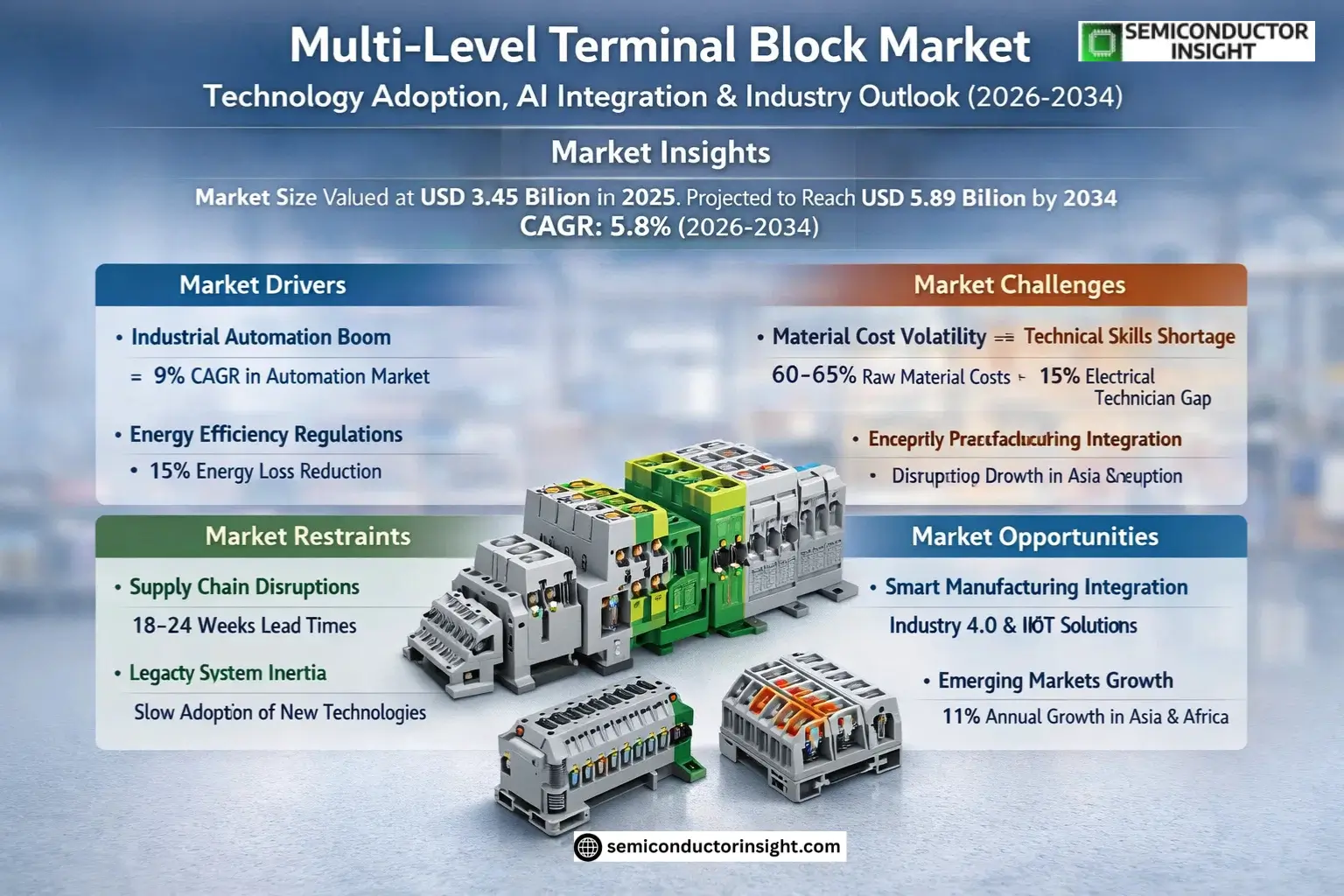
Global Multi-Level Terminal Block Market size was valued at USD 3.45 billion in 2025. The market is projected to grow from USD 3.72 billion in 2026 to USD 5.89 billion by 2034, exhibiting a CAGR of 5.8% during the forecast period.
Multi-Level Terminal Blocks are modular, insulated devices that facilitate secure electrical connections in complex wiring systems. These components enable efficient distribution of power and signals across multiple circuits while ensuring space optimization and ease of maintenance. Key product variations include screw-type, spring-cage, and push-in terminal blocks, each catering to specific industrial requirements.
The market growth is driven by accelerating industrial automation investments and expanding renewable energy infrastructure deployments worldwide. Recent technological advancements in terminal block design, such as tool-less installation features and enhanced current-carrying capacities, are further propelling adoption rates across sectors like manufacturing and transportation. Leading manufacturers including Phoenix Contact and WAGO are introducing innovative solutions with integrated diagnostics capabilities to address evolving industry needs for smart connectivity solutions.
MARKET DRIVERS
Industrial Automation Boom Fuels Demand
Multi-Level Terminal Block Market is experiencing significant growth, driven by the rapid expansion of industrial automation. Modern manufacturing facilities are increasingly adopting modular wiring systems, with multi-level terminal blocks providing the necessary connectivity for complex control panels. Global industrial automation market is projected to grow at 9% CAGR through 2030, directly impacting terminal block requirements.
Energy Efficiency Regulations
Stringent energy efficiency standards worldwide are pushing manufacturers to upgrade electrical infrastructure. Multi-level terminal blocks with improved contact technologies reduce energy losses by up to 15% compared to conventional options. The IEC 60947-7-1 standard specifically addresses terminal block performance, creating compliance-driven demand.
The renewable energy sector adoption is accelerating growth, with solar and wind installations requiring robust power distribution solutions that multi-level terminal blocks provide.
MARKET CHALLENGES
Material Cost Volatility
Copper price fluctuations directly impact multi-level terminal block manufacturing costs, with raw materials representing 60-65% of production expenses. Many manufacturers struggle to maintain profitability while meeting competitive pricing pressures in the industrial components market.
Other Challenges
Technical Skills Shortage
The installation and maintenance of advanced multi-level terminal blocks requires trained technicians, with an estimated 15% gap in qualified electrical professionals across major markets.
Standardization Complexities
Regional variations in electrical standards create compliance challenges for multi-level terminal block manufacturers operating in global markets.
MARKET RESTRAINTS
Supply Chain Disruptions
Multi-Level Terminal Block Market faces constraints from ongoing global supply chain issues, with lead times for certain models extending to 18-24 weeks. This has prompted some users to postpone upgrades or seek alternative solutions, temporarily affecting market growth.
Legacy System Inertia
Many industrial facilities continue using traditional terminal blocks due to the significant costs associated with complete panel rewiring. This installed base resistance is slowing adoption rates despite the advantages of multi-level solutions.
MARKET OPPORTUNITIES
Smart Manufacturing Integration
The Industry 4.0 revolution presents significant opportunities for intelligent multi-level terminal blocks with built-in diagnostics. These advanced units can monitor connection integrity and predict maintenance needs, commanding 25-30% price premiums over standard models.
Emerging Market Expansion
Developing economies in Asia and Africa are constructing new industrial facilities at record pace, creating demand for modern electrical components. Multi-Level Terminal Block Market in Southeast Asia alone is growing at 11% annually.
Multi-Level Terminal Block Market Trends
Rising Demand in Industrial Automation
Multi-Level Terminal Block Market is witnessing significant growth driven by increasing automation in manufacturing facilities globally. These components play a critical role in panel-building and equipment wiring, with major adopters in automotive, food processing, and machinery sectors. Companies are prioritizing modular and high-density terminal blocks to reduce panel space requirements.
Other Trends
Transition to Push-In Technology
Push-in terminal blocks are gaining market share due to faster installation times compared to traditional screw-type variants. This trend is particularly strong in Europe where labor costs are high and installation efficiency is prioritized. Manufacturers are developing enhanced push-in models with improved vibration resistance.
Growing Renewable Energy Applications
Multi-Level Terminal Blocks are seeing increased adoption in solar and wind power installations. The need for reliable electrical connections in harsh outdoor environments has driven innovation in materials and sealing technologies. Leading manufacturers are offering specialized product lines with enhanced UV and moisture resistance for renewable energy applications.
Electrification of Transportation Infrastructure
The expansion of electric vehicle charging networks and rail electrification projects is creating new demand opportunities. Terminal block manufacturers are developing solutions that meet the specific voltage and current requirements of transportation applications while complying with stringent safety standards.
Smart Manufacturing Integration
Industry 4.0 initiatives are driving the development of intelligent terminal blocks with built-in monitoring capabilities. These advanced products enable predictive maintenance by providing real-time data on connection integrity and temperature, aligning with the broader smart factory ecosystem. Leading suppliers are collaborating with automation solution providers to integrate these smart components.
COMPETITIVE LANDSCAPE
Key Industry Players
Strategic Positioning in the Evolving Terminal Block Market
Phoenix Contact and WAGO dominate Multi-Level Terminal Block Market, collectively holding significant revenue share through their diversified product portfolios and global distribution networks. These leaders continue to invest in R&D, particularly in spring cage and push-in terminal technologies that address industrial automation demands. The market structure remains moderately consolidated, with the top five players accounting for approximately 45% of global revenue in 2025.
Specialized players like Connectwell and Wieland Electric have carved strong niches in specific applications such as rail transportation and renewable energy systems. Regional manufacturers including Dinkle in Asia and Curtis Industries in North America compete through localized supply chains and cost-effective solutions. Recent technological advancements focus on high-current density designs and modular configurations to serve evolving Industry 4.0 requirements.
List of Key Multi-Level Terminal Block Companies Profiled
- Phoenix Contact
- WAGO
- Connectwell
- Weidmuller
- ABB
- Wieland Electric
- Omron
- Dinkle
- Reliance
- Leipole
- Elmex Controls
- Curtis Industries
- Zhejiang Sipun Electric Co., Ltd.
Segment Analysis:
| Segment Category | Sub-Segments | Key Insights |
| By Type |
|
Screw Type dominates due to its robust mechanical connection and vibration resistance.
|
| By Application |
|
Industrial Automation leads demand due to extensive wiring requirements.
|
| By End User |
|
OEMs represent the largest buying group in this market.
|
| By Current Rating |
|
Medium Current terminals are most prevalent across industries.
|
| By Mounting Method |
|
DIN Rail Mount is the industry standard for multi-level terminal blocks.
|
Regional Analysis: Multi-Level Terminal Block Market
China accounts for the largest Multi-Level Terminal Block consumption in Asia-Pacific, supported by its electronics and automation equipment manufacturing clusters. The country’s focus on industrial upgrading is driving demand for higher-quality terminal blocks with vibration resistance and modular designs.
Japanese manufacturers lead in developing compact, high-performance Multi-Level Terminal Blocks for robotics and precision machinery. The market benefits from strong R&D capabilities and stringent quality standards in industrial applications requiring reliable electrical connections.
India’s Multi-Level Terminal Block Market is expanding rapidly with automation adoption in automotive and renewable energy sectors. Government initiatives like Make in India are encouraging local production while foreign manufacturers establish assembly plants to meet growing domestic demand.
Indonesia, Vietnam, and Thailand show strong growth in Multi-Level Terminal Block adoption driven by foreign direct investment in manufacturing. The region benefits from cost advantages and improving technical capabilities in electrical component production.
North America
North America maintains strong demand for Multi-Level Terminal Blocks, particularly in industrial automation and energy sectors. The U.S. leads with high adoption in manufacturing and utilities, where reliable terminal blocks are critical for equipment uptime. Canadian markets focus on rugged solutions for harsh environments in mining and oil/gas industries. Regional manufacturers emphasize smart terminal blocks with diagnostic capabilities to meet Industry 4.0 requirements. Strict electrical safety regulations drive innovation in fire-resistant and UL-certified products across the region.
Europe
Europe shows steady growth in Multi-Level Terminal Block adoption with emphasis on energy efficiency and automation. Germany remains the largest market, driven by its machine building sector’s demand for high-density terminal solutions. Scandinavian countries lead in renewable energy applications requiring weather-resistant terminal blocks. EU regulations promoting electrical safety and energy efficiency shape product development strategies. Manufacturers focus on sustainable materials and modular designs to meet diverse industrial needs across the region.
South America
South America’s Multi-Level Terminal Block Market grows with industrial expansion in Brazil and Argentina. Mining and oil industries drive demand for explosion-proof terminal solutions. Infrastructure development projects create opportunities in construction-related electrical applications. Regional manufacturers compete on price while international brands emphasize technical support and certification compliance. Economic fluctuations impact market growth patterns across different countries in the region.
Middle East & Africa
The MEA region shows growing Multi-Level Terminal Block demand from oil/gas and construction sectors. GCC countries invest in industrial automation, while African markets see increasing infrastructure development. Harsh environmental conditions favor specialized terminal blocks with corrosion resistance. Limited local manufacturing leads to strong import dependence, with Middle East serving as a distribution hub for surrounding African markets.
Report Scope
This market research report provides a comprehensive analysis of the Multi-Level Terminal Block Market , covering the forecast period 2025–2034. It offers detailed insights into market dynamics, technological advancements, competitive landscape, and key trends shaping the industry.
Key focus areas of the report include:
- Market Overview: The report begins with an overview outlining its current market scenario, key growth indicators, and industry transformation drivers. It discusses macroeconomic factors, demand–supply balance, regulatory landscape, and the strategic role of terminal blocks in powering advancements across industries such as industrial automation, new energy, construction, and transportation.
- Market Size & Forecast: Historical data and future projections for revenue, unit shipments, and market value across major regions and segments.
- Segmentation Analysis: Detailed breakdown by product type, technology, application, and end-user industry to identify high-growth segments and investment opportunities.
- Regional Insights: Insights into market performance across North America, Europe, Asia, South America, and Middle East & Africa, including country-level analysis where relevant.
- Competitive Landscape: Profiles of leading market participants, including their product offerings, R&D focus, manufacturing capacity, pricing strategies, and recent developments such as mergers, acquisitions, and partnerships.
- Technology Trends & Innovation: Assessment of emerging technologies, product design trends, and evolving industry standards.
- Market Drivers & Restraints: Evaluation of factors driving market growth along with challenges, supply chain constraints, regulatory issues, and market-entry barriers.
- Stakeholder Insights: Insights for component suppliers, OEMs, system integrators, investors, and policymakers regarding the evolving ecosystem and strategic opportunities.
Primary and secondary research methods are employed, including interviews with industry experts, data from verified sources, and real-time market intelligence to ensure the accuracy and reliability of the insights presented.
FREQUENTLY ASKED QUESTIONS:
What is the current market size of Multi-Level Terminal Block Market?
-> Multi-Level Terminal Block Market size was valued at USD 3.45 billion in 2025. The market is projected to grow from USD 3.72 billion in 2026 to USD 5.89 billion by 2034, exhibiting a CAGR of 5.8% during the forecast period.
Which key companies operate in Multi-Level Terminal Block Market?
-> Key players include Phoenix Contact, WAGO, Connectwell, Weidmuller, ABB, Wieland Electric, Omron, Dinkle, Reliance, Leipole, among others.
What are the key growth segments?
-> The Screw Type segment is projected to reach USD million by 2034, growing at a CAGR of % in next six years.
Which region dominates the market?
-> Asia is the fastest-growing region, with China expected to reach USD million by 2034.
What are the main applications?
-> Main applications include Industrial Automation, New Energy, Construction, Transportation, and others.
Get Sample Report PDF for Exclusive Insights
Report Sample Includes
- Table of Contents
- List of Tables & Figures
- Charts, Research Methodology, and more...
 Download Sample Report PDF