MARKET INSIGHTS
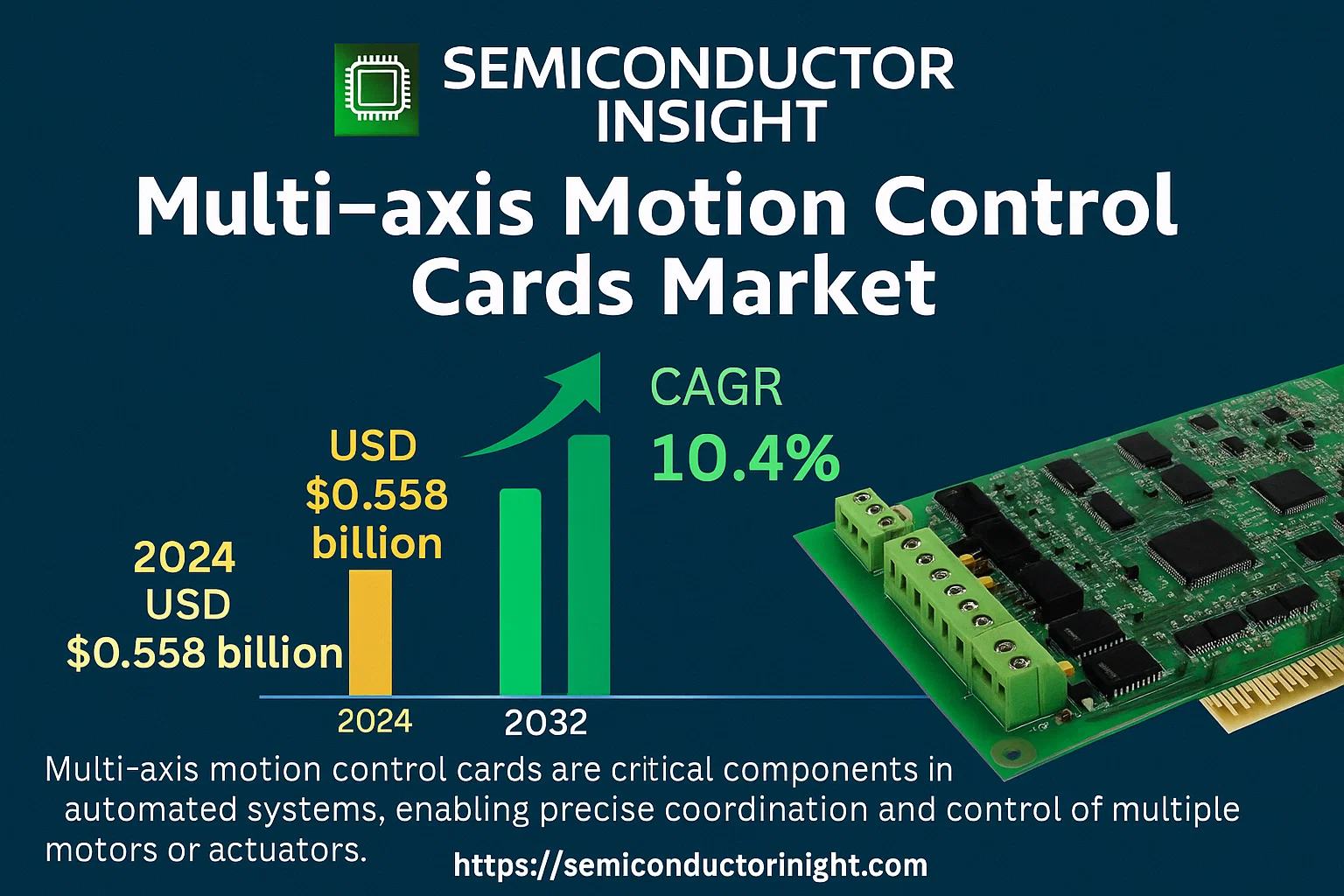
Global Multi-axis Motion Control Cards Market was valued at USD 0.558 billion in 2024 and is projected to reach USD 1.098 billion by 2032, exhibiting a CAGR of 10.4% during the forecast period.
Multi-axis motion control cards are critical components in automated systems, enabling precise coordination and control of multiple motors or actuators. These cards are essential for applications requiring high precision and synchronized movement across multiple axes, such as in robotics, CNC machining, semiconductor manufacturing, and automated assembly lines. Their ability to handle complex motion profiles and integrate with various control systems makes them indispensable in modern industrial automation.
The market growth is primarily driven by the accelerating adoption of automation across manufacturing, logistics, and healthcare sectors. The rise of Industry 4.0 and smart manufacturing initiatives has increased the demand for sophisticated motion control solutions that can handle high-speed, high-precision tasks. Additionally, the growing complexity of automated systems, such as multi-arm robots and advanced CNC machines, requires more sophisticated control cards capable of managing multiple axes simultaneously. The integration of these cards with IoT and AI-driven predictive maintenance systems further enhances their value proposition, contributing to market expansion.
However, the market faces challenges such as the high initial investment required for advanced multi-axis systems, which can be a barrier for small and medium-sized enterprises. Additionally, the complexity of integrating these cards into existing systems and the need for specialized technical expertise can slow down adoption. The rapid pace of technological change also poses a risk of obsolescence for current solutions.
Key players in the market include Omron, Estun Automation, Galil, OMS Motion, MotiCont, Delta Electronics, ADLINK Technology, Advantech, Taiwan Pulse Motion, Googol Technology, Shenzhen Leadshine, Chengdu Leetro, Adtech (Shenzhen) Technology, Inovance, Shenzhen INVT Electric, Shenzhen YAKO, and Shenzhen Just Motion Control Electromechanics. These companies are focusing on developing more integrated and user-friendly solutions, reducing integration complexity, and offering more flexible pricing models to address the cost challenges.
Looking forward, the market is expected to benefit from the ongoing industrial automation trend, the growing adoption of collaborative robots, and the increasing demand for high-precision manufacturing in sectors like aerospace and medical devices. The integration of AI and machine learning for predictive maintenance and optimization will further drive the adoption of advanced multi-axis motion control cards.
MARKET DRIVERS
Rising Demand for Industrial Automation and Robotics
The relentless push towards Industry 4.0 and smart manufacturing is a primary driver for the multi-axis motion control cards market. As industries seek to improve precision, efficiency, and flexibility in production lines, the integration of advanced robotics and automated machinery has surged. Multi-axis control cards are critical components that enable the complex, synchronized movement required by modern industrial robots and CNC machines. The global industrial automation market is projected to grow significantly, directly fueling demand for sophisticated motion control solutions.
Advancements in Semiconductor and Electronics Manufacturing
The manufacturing of semiconductors and electronics requires extreme precision at microscopic levels. Multi-axis motion control cards provide the high-speed, nanometer-level accuracy needed for processes like wafer handling, photolithography, and component placement. The ongoing miniaturization of electronic devices and the expansion of 5G infrastructure are creating sustained demand from this high-tech sector, which relies heavily on advanced motion control systems to maintain its competitive edge.
➤ The integration of AI and IoT capabilities is transforming motion control cards from simple positioning devices into intelligent system components that can predict maintenance needs and optimize performance in real-time.
Furthermore, the adoption of these cards is expanding into new applications such as medical devices, including surgical robots and advanced diagnostic equipment, where reliability and precision are non-negotiable. The medical device industry’s stringent requirements are pushing the boundaries of motion control technology, creating a robust and high-value market segment.
MARKET CHALLENGES
High Complexity and Integration Costs
Implementing multi-axis motion control systems involves significant engineering complexity and cost. The cards must be meticulously integrated with motors, drives, sensors, and higher-level software platforms like PLCs and HMIs. This integration often requires specialized expertise, leading to high upfront costs for system design, programming, and commissioning. For small and medium-sized enterprises, these costs can be a major barrier to adoption, limiting market penetration.
Other Challenges
Cybersecurity Vulnerabilities
As motion control systems become more connected to corporate networks and the cloud for data analytics and remote monitoring, they become potential targets for cyberattacks. A security breach could lead to production downtime, safety hazards, or intellectual property theft, making robust cybersecurity a critical and costly challenge for manufacturers and end-users.
Rapid Technological Obsolescence
The pace of innovation in electronics and software is extremely fast. Motion control cards can become obsolete within a few years as new protocols, communication standards (like OPC UA, TSN), and processing capabilities emerge. This creates a challenge for both vendors, who must continuously invest in R&D, and for end-users, who face the dilemma of upgrading systems frequently to stay competitive.
MARKET RESTRAINTS
Economic Volatility and Capital Expenditure Constraints
Global economic uncertainty and cyclical downturns in key industrial sectors, such as automotive and general manufacturing, act as a significant restraint. During periods of economic contraction, companies often delay or cancel capital expenditures on new automation equipment, which directly impacts the demand for multi-axis motion control cards. The long sales cycles associated with large industrial automation projects further amplify the market’s sensitivity to economic fluctuations.
Availability of Alternative Solutions and Intense Competition
The market faces competition from integrated solutions offered by major automation vendors, where motion control functionality is embedded within a PLC or a dedicated controller, reducing the need for a separate card. Additionally, the presence of numerous regional and global players leads to intense price competition, which can squeeze profit margins and restrain market growth for standalone card providers.
MARKET OPPORTUNITIES
Expansion into Emerging Economies and New Application Areas
There is substantial growth potential in emerging economies across Asia-Pacific, Latin America, and Eastern Europe. As these regions continue to industrialize and modernize their manufacturing bases, the demand for automation equipment, including multi-axis motion control cards, is expected to rise sharply. Governments in these regions are often promoting industrial automation through initiatives, creating a favorable environment for market expansion.
Development of Customized Solutions for Niche Applications
Opportunities abound for vendors who can develop highly customized motion control solutions for niche but high-growth applications. These include renewable energy systems (solar panel and wind turbine manufacturing), 3D printing/additive manufacturing, and electric vehicle battery production lines. These specialized applications often have unique requirements that standard off-the-shelf products cannot meet, opening doors for innovation and premium pricing.
Adoption of Cloud-Based and Servitization Models
The shift towards cloud computing and “as-a-service” business models presents a significant opportunity. Vendors can offer motion control functionality via cloud-based platforms, reducing the need for powerful local hardware and providing remote monitoring, predictive maintenance, and performance analytics. This servitization model can create new, recurring revenue streams and deepen customer relationships.
Multi-axis Motion Control Cards Market Trends
Accelerated Growth Fueled by Industrial Automation
The global Multi-axis Motion Control Cards market is experiencing robust growth, with its value projected to surge from $558 million in 2024 to $1,098 million by 2032, representing a compound annual growth rate (CAGR) of 10.4%. This expansion is primarily driven by the accelerating trend towards automation across manufacturing, logistics, and assembly operations. These essential components enable precise, coordinated control of multiple motors in critical applications such as CNC machining, robotics, and automated assembly lines, directly supporting efforts to enhance operational efficiency and productivity.
Other Trends
Rise of Smart Manufacturing and Robotics
The movement toward Industry 4.0 and smart manufacturing is a dominant trend, where interconnected systems using IoT demand the real-time data exchange and intelligent control provided by multi-axis motion control cards. Concurrently, the rapid expansion of the robotics market across industrial, healthcare, and logistics sectors is creating substantial demand. The precise, synchronized movements required by advanced robotic applications are inherently dependent on the capabilities of these control systems.
Technological Innovation and Application Demand
Continuous advancements in technology are significantly enhancing market dynamics. Improved motion control algorithms, the integration of artificial intelligence for predictive maintenance, and enhanced feedback systems are increasing the performance and capabilities of these cards. This technological evolution, coupled with an increasing need for high precision in sectors like semiconductor and medical device manufacturing, is encouraging adoption in a wider range of applications. However, the market faces challenges, including the high initial investment and complexity of system integration, which can be a barrier for small and medium-sized enterprises. The competitive landscape also exerts pricing pressure, while concerns regarding technological obsolescence and the need for specialized expertise remain relevant considerations for potential adopters.
COMPETITIVE LANDSCAPE
Key Industry Players
Dominance of Established Automation Leaders and Specialized Niche Players
The global multi-axis motion control cards market features a dynamic competitive environment characterized by the presence of globally recognized automation corporations alongside highly specialized manufacturers. Established giants like Omron, Delta Electronics, and Advantech leverage their extensive product portfolios, significant R&D capabilities, and global distribution networks to secure a strong market position. These companies offer comprehensive solutions that integrate motion control cards with other automation components like PLCs and HMIs, providing a significant value proposition to large-scale industrial customers. The market is moderately concentrated, with the top five players accounting for a notable share of global revenues, reflecting the technical expertise and brand reputation required to compete effectively. Competition is largely based on product performance, reliability, technical support, and the ability to offer solutions for high-growth applications such as robotics, machine tools, and semiconductor manufacturing.
Beyond the major international players, the landscape includes a number of significant companies that have carved out strong positions in specific geographic regions or application niches. In the Asia-Pacific region, particularly in China and Taiwan, companies such as Estun Automation, Googol Technology, and Inovance have become formidable competitors. These players often compete effectively on price and by offering products tailored to the needs of local manufacturing industries. Additionally, specialized technology firms like Galil (a subsidiary of Allied Motion) and ADLINK Technology focus on high-performance or embedded motion control solutions, catering to demanding applications that require precision and high-speed coordination. Niche players and emerging companies continue to enter the market, often introducing innovations in connectivity, such as EtherCAT integration, and focusing on emerging applications driven by Industry 4.0 trends.
List of Key Multi-axis Motion Control Cards Companies Profiled
- Omron
- Estun Automation
- Galil
- OMS Motion
- MotiCont
- Delta Electronics
- ADLINK Technology
- Advantech
- Taiwan Pulse Motion
- Googol Technology
- Shenzhen Leadshine
- Chengdu Leetro
- Adtech (Shenzhen) Technology
- Inovance
- Shenzhen INVT Electric
Segment Analysis:
| Segment Category | Sub-Segments | Key Insights |
| By Type |
|
6-axis cards are the leading segment due to their optimal balance between complexity and capability, serving as the backbone for most industrial robotics and complex automated systems. This configuration provides sufficient degrees of freedom for articulated robotic arms and intricate motion paths, making it a versatile and widely adopted standard. Meanwhile, 8-axis and 16-axis cards are gaining traction for highly sophisticated applications requiring exceptional coordination, such as advanced semiconductor manufacturing or complex multi-stage assembly lines, where precision across numerous interdependent movements is critical for operational success and product quality. |
| By Application |
|
Industrial Robot applications represent the leading segment, driven by the expansive growth in automation across manufacturing and logistics. The demand for precise, coordinated movement in robotic arms for tasks like welding, material handling, and assembly is a primary driver. Following closely, the Semiconductor application segment exhibits the most demanding requirements for precision and accuracy, where multi-axis control is essential for wafer handling, lithography, and testing equipment. The Machine Tool segment remains a strong, established market, particularly for CNC machining centers that rely on multi-axis control for complex contouring and cutting operations to produce high-value components. |
| By End User |
|
Automotive Manufacturing is the leading end-user segment, characterized by its extensive use of robotic assembly lines, automated welding systems, and precision machining that are heavily dependent on multi-axis control for efficiency and quality. The Electronics & Semiconductor sector is another critical driver, demanding the highest levels of precision for manufacturing circuit boards and microchips, where even micron-level inaccuracies can lead to product failure. The Healthcare & Medical Devices segment is an emerging area of strong growth, utilizing these cards for advanced surgical robots and high-precision diagnostic equipment manufacturing, highlighting the technology’s expansion into life-critical applications. |
| By Technology Level |
|
Advanced/Ethernet-based control cards are becoming the dominant segment, as they align with Industry 4.0 initiatives by enabling real-time data exchange, remote diagnostics, and network integration crucial for smart factories. While Standard Motion Control solutions maintain relevance for less complex or cost-sensitive applications, the trend is decisively shifting towards smarter, connected systems. The nascent but rapidly evolving AI-Integrated Intelligent Control segment represents the future frontier, offering predictive maintenance, adaptive motion paths, and self-optimizing performance, which is poised to revolutionize automation by enhancing system intelligence and reducing unplanned downtime significantly. |
| By System Integration |
|
Integrated Controllers (All-in-One) are emerging as the leading segment for new system deployments, as they reduce complexity, simplify cabling, and offer a more compact footprint, which is highly valued in space-constrained modern factories. PC-Based Systems continue to hold a significant share, favored for their flexibility, powerful processing capabilities, and ease of software updates, making them ideal for research, development, and custom application scenarios. Standalone Cards remain essential for retrofitting older machinery or for applications where a distributed control architecture is preferred, demonstrating the market’s need for versatile integration options to meet diverse operational requirements. |
Regional Analysis: Multi-axis Motion Control Cards Market
Asia-Pacific
The unparalleled concentration of electronics manufacturing, from smartphones to semiconductors, creates massive, sustained demand for multi-axis motion control cards. These cards are essential for the precision and speed required in surface-mount technology (SMT) lines, PCB assembly, and testing equipment, making the region’s manufacturing base a primary driver of market growth and innovation in motion control technology.
Widespread adoption of Industry 4.0 and significant government-backed initiatives for smart manufacturing are accelerating the integration of automated systems. This trend directly boosts the demand for advanced multi-axis cards that can coordinate complex robotic arms, automated guided vehicles (AGVs), and sophisticated CNC machines, positioning the region as a key testing ground for next-generation motion control applications.
A dense network of specialized component suppliers, card manufacturers, and systems integrators fosters a highly competitive and innovative environment. This ecosystem enables rapid iteration, cost-optimization, and customization of motion control solutions to meet the specific needs of diverse local industries, from electric vehicle battery production to advanced packaging machinery.
Emerging sectors such as electric vehicle manufacturing, renewable energy equipment (like solar panel and wind turbine production), and advanced medical devices are creating new, high-value applications for precision motion control. This diversification beyond traditional manufacturing ensures long-term, resilient growth for the multi-axis motion control card market in the region.
North America
The North American market for multi-axis motion control cards is characterized by a strong focus on high-value, technologically advanced applications. The region is a leader in demanding sectors such as aerospace, defense, and medical devices, where precision, reliability, and compliance with stringent regulatory standards are paramount. There is significant investment in automation within traditional manufacturing to enhance productivity and reshore production capabilities. Furthermore, robust research and development activities, particularly in areas like robotics for logistics and advanced semiconductor packaging, drive the need for cutting-edge motion control solutions. The market is influenced by a preference for integrated solutions that offer advanced features such as networking capabilities and sophisticated software interfaces.
Europe
Europe maintains a strong and mature market for multi-axis motion control cards, underpinned by its world-leading automotive industry and a strong base of precision engineering. German-led initiatives in Industrie 4.0 continue to drive the modernization of manufacturing, emphasizing the need for flexible and interconnected automation systems that rely on sophisticated motion control. There is also significant demand from niche, high-precision sectors such as pharmaceutical manufacturing, packaging machinery, and renewable energy equipment production. The market is characterized by a high emphasis on quality, energy efficiency, and adherence to strict industrial and environmental regulations, influencing the specifications of motion control cards adopted in the region.
South America
The South American market for multi-axis motion control cards is developing, with growth primarily concentrated in the industrial sectors of Brazil and Argentina. The adoption is driven by the need to modernize agricultural machinery, food and beverage processing equipment, and mining operations to improve efficiency and output. While the market is smaller compared to other regions, there is growing recognition of the benefits of automation. The adoption pace is often influenced by economic stability and investment in industrial infrastructure, with a focus on cost-effective and robust solutions suitable for the local industrial landscape.
Middle East & AfricaMiddle East & Africa
The market in the Middle East & Africa is nascent but shows potential for growth, driven by diversification efforts away from oil dependency. In the Middle East, particularly in the GCC countries, investments in advanced manufacturing, aerospace, and infrastructure projects are creating pockets of demand for high-performance motion control. In Africa, the market is very limited but emerging slowly, with potential applications in mining automation and the establishment of new manufacturing hubs. The overall market dynamics are shaped by large-scale industrial projects and a gradual, strategic move towards adopting advanced automation technologies.
Report Scope
This market research report provides a comprehensive analysis of the Multi-axis Motion Control Cards Market, covering the forecast period 2025–2032. It offers detailed insights into market dynamics, technological advancements, competitive landscape, and key trends shaping the industry.
Key focus areas of the report include:
- Market Overview: The report begins with an overview outlining its current market scenario, key growth indicators, and industry transformation drivers. It discusses macroeconomic factors, demand–supply balance, regulatory landscape, and the strategic role of semiconductors in powering advancements across industries such as automotive, telecommunications, consumer electronics, and industrial automation.
- Market Size & Forecast: Historical data and future projections for revenue, unit shipments, and market value across major regions and segments.
- Segmentation Analysis: Detailed breakdown by product type, technology, application, and end-user industry to identify high-growth segments and investment opportunities.
- Regional Insights: Insights into market performance across North America, Europe, Asia-Pacific, Latin America, and the Middle East & Africa, including country-level analysis where relevant.
- Competitive Landscape: Profiles of leading market participants, including their product offerings, R&D focus, manufacturing capacity, pricing strategies, and recent developments such as mergers, acquisitions, and partnerships.
- Technology Trends & Innovation: Assessment of emerging technologies, integration of AI/IoT, semiconductor design trends, fabrication techniques, and evolving industry standards.
- Market Drivers & Restraints: Evaluation of factors driving market growth along with challenges, supply chain constraints, regulatory issues, and market-entry barriers.
- Stakeholder Insights: Insights for component suppliers, OEMs, system integrators, investors, and policymakers regarding the evolving ecosystem and strategic opportunities.
Primary and secondary research methods are employed, including interviews with industry experts, data from verified sources, and real-time market intelligence to ensure the accuracy and reliability of the insights presented.
FREQUENTLY ASKED QUESTIONS:
What is the current market size of Multi-axis Motion Control Cards Market?
-> Global Multi-axis Motion Control Cards Market was valued at USD 558 million in 2024 and is projected to reach USD 1098 million by 2032, growing at a CAGR of 10.4% during the forecast period.
Which key companies operate in Multi-axis Motion Control Cards Market?
-> Key players include Omron, Estun Automation, Galil, OMS Motion, MotiCont, Delta Electronics, ADLINK Technology, Advantech, Taiwan Pulse Motion, and Googol Technology, among others.
What are the key growth drivers?
-> Key growth drivers include growing automation across industries, rising demand for robotics, advancements in technology, Industry 4.0 initiatives, and the increasing need for precision and accuracy in manufacturing.
Which region dominates the market?
-> A detailed regional analysis is provided, covering market performance across North America, Europe, Asia, South America, and the Middle East & Africa.
What are the emerging trends?
-> Emerging trends include the integration of AI, enhanced feedback systems, smart manufacturing enabled by IoT, and the demand for flexible, customizable motion control solutions.

Get Sample Report PDF for Exclusive Insights
Report Sample Includes
- Table of Contents
- List of Tables & Figures
- Charts, Research Methodology, and more...
 Download Sample Report PDF