
MARKET INSIGHTS
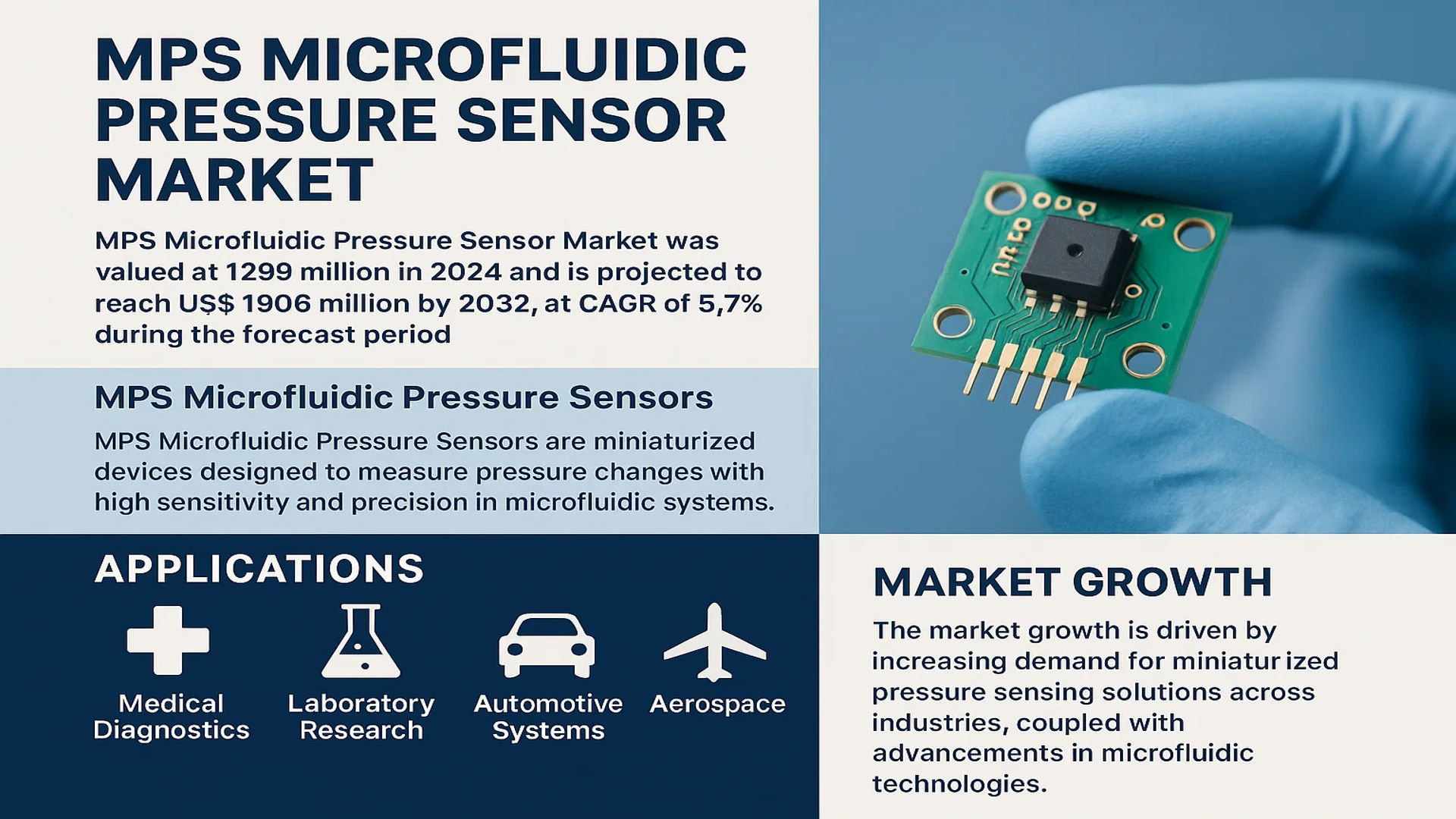
The global MPS Microfluidic Pressure Sensor Market was valued at 1299 million in 2024 and is projected to reach US$ 1906 million by 2032, at a CAGR of 5.7% during the forecast period.
MPS Microfluidic Pressure Sensors are miniaturized devices designed to measure pressure changes with high sensitivity and precision in microfluidic systems. These sensors play a critical role in applications requiring accurate fluid monitoring and control, particularly in medical diagnostics, laboratory research, automotive systems, and aerospace. The compact design allows integration into micro-scale environments where traditional sensors cannot operate effectively.
The market growth is driven by increasing demand for miniaturized pressure sensing solutions across industries, coupled with advancements in microfluidic technologies. The medical sector, in particular, is adopting these sensors for point-of-care diagnostics and lab-on-a-chip applications. While North America currently dominates the market due to strong R&D investments, Asia-Pacific is expected to witness the fastest growth, fueled by expanding electronics manufacturing and healthcare infrastructure development in countries like China and Japan.
MARKET DYNAMICS
MARKET DRIVERS
Expanding Applications in Medical Diagnostics and Lab-on-a-Chip Technologies Boost Demand
The MPS microfluidic pressure sensor market is experiencing significant growth due to its increasing adoption in medical diagnostics and lab-on-a-chip (LOC) applications. These sensors enable real-time monitoring of minute pressure variations in microfluidic channels, which is essential for precise fluid control in point-of-care testing, DNA sequencing, and drug discovery. The global diagnostics market’s continued expansion, coupled with the rising demand for portable diagnostic devices, is accelerating MPS sensor integration. Manufacturers are innovating to enhance sensor sensitivity and reliability, further driving adoption in clinical laboratories and research facilities.
Growth in Automotive and Aerospace Sectors Enhances Market Prospects
MPS microfluidic pressure sensors are increasingly utilized in automotive and aerospace applications for monitoring fuel injection systems, cabin pressure, and hydraulic controls. The automotive industry’s shift toward electrification and autonomous driving necessitates advanced sensing technologies, creating opportunities for high-precision pressure sensors. Similarly, the aerospace sector relies on these sensors for critical flight systems, where reliability under extreme conditions is paramount. With increasing investments in electric vehicle manufacturing and next-generation aircraft, demand for MPS sensors is projected to surge, reinforcing market growth.
Other Drivers
The rise of Industry 4.0 and smart manufacturing is also contributing to market expansion, as microfluidic sensors play a crucial role in automated fluid handling systems. Additionally, government initiatives supporting technological advancements in electronics and IoT integration are fostering innovation in sensor design and functionality.
MARKET CHALLENGES
High Manufacturing Costs and Miniaturization Hurdles Pose Challenges
Despite their widespread applications, MPS microfluidic pressure sensors face challenges related to high production costs and miniaturization constraints. The fabrication of these sensors often involves complex microfabrication techniques, such as photolithography and etching, which demand specialized equipment and skilled labor. These factors contribute to elevated manufacturing expenses, limiting scalability for cost-sensitive industries. Additionally, achieving consistent performance in increasingly smaller sensor designs remains a technical hurdle, slowing down deployment in ultra-compact devices.
Other Challenges
Calibration and Long-Term Stability Issues Maintaining sensor accuracy over prolonged use is another industry challenge, as environmental factors and material degradation can affect performance. Ensuring long-term reliability while minimizing maintenance requirements remains a critical area of development for manufacturers.
MARKET RESTRAINTS
Limited Standardization and Intense Competition Hinder Market Penetration
The MPS microfluidic pressure sensor market lacks uniform industry standards, leading to compatibility issues across different applications. This inconsistency complicates integration efforts for end-users, restraining widespread adoption. Moreover, the market is highly competitive, with key players focusing on proprietary technologies, which limits interoperability. Small-scale manufacturers often struggle to compete with established firms, further concentrating market dominance among a few industry leaders.
Other Restraints
Supply chain disruptions and material shortages have also impacted sensor production, delaying deployments in critical sectors. While efforts to diversify supply chains are underway, dependence on specialized components continues to pose risks.
MARKET OPPORTUNITIES
Integration with AI and IoT Opens New Application Avenues
The convergence of MPS sensors with artificial intelligence (AI) and the Internet of Things (IoT) presents a transformative opportunity. Smart sensors capable of predictive maintenance and autonomous calibration are gaining traction in industrial and healthcare settings. This trend is expected to drive demand, as AI-enhanced pressure sensors can optimize fluidic operations with minimal human intervention. Emerging applications in wearable health monitors and smart agriculture further highlight the growth potential for this technology.
Other Opportunities
Strategic partnerships between sensor manufacturers and technology firms are enabling rapid advancements. Collaborative R&D efforts aimed at improving energy efficiency and wireless connectivity are likely to spur the next wave of innovation in microfluidic sensing.
MPS MICROFLUIDIC PRESSURE SENSOR MARKET TRENDS
Miniaturization and Advanced Integration Technologies Driving Market Growth
The MPS microfluidic pressure sensor market is experiencing significant growth due to increasing demand for miniaturized, high-precision sensors in medical and industrial applications. The ability of these sensors to monitor tiny pressure changes in microfluidic systems is revolutionizing fields such as in-vitro diagnostics (IVD), lab-on-a-chip devices, and precision fluid control systems. A major trend is the integration of MEMS (Micro-Electro-Mechanical Systems) technology with microfluidics, enabling real-time pressure monitoring with sub-pascal resolution. Furthermore, the adoption of IoT connectivity allows seamless data transmission, facilitating remote monitoring in critical applications like patient care and industrial automation.
Other Trends
Expansion in Point-of-Care Diagnostics
The rapid expansion of point-of-care diagnostic systems is fueling demand for MPS microfluidic pressure sensors. These sensors play a crucial role in portable medical devices by ensuring precise fluid handling in microfluidic channels, which is essential for accurate test results. Wearable health monitors and compact diagnostic devices are increasingly incorporating these sensors, contributing to the market’s projected CAGR of 5.7% through 2032. The adoption of disposable microfluidic cartridges in diagnostics is also accelerating, as they require highly sensitive pressure sensors to ensure reliability and reduce contamination risks.
Industry 4.0 and Smart Manufacturing Fueling Sensor Adoption
The growing implementation of Industry 4.0 and automated manufacturing processes is driving the adoption of MPS microfluidic pressure sensors in industrial automation and fluid handling systems. These sensors are critical in ensuring efficiency in applications such as flow control in chemical processing, inkjet printing, and micro-dispensing technologies. Additionally, advancements in silicon-based pressure sensors have improved their robustness, enabling usage in harsh environments. Collaborations between sensor manufacturers and industrial automation leaders are further enhancing design innovations, leading to products that offer higher accuracy, lower power consumption, and enhanced resistance to environmental fluctuations.
COMPETITIVE LANDSCAPE
Key Industry Players
Innovation and Strategic Expansion Drive Market Competition
The global MPS Microfluidic Pressure Sensor market exhibits a fragmented yet highly competitive landscape, characterized by the presence of both established multinational companies and specialized niche players. Elveflow and Fluigent have emerged as frontrunners in this space, leveraging their expertise in microfluidics and precision sensor technology to capture significant market share. These companies excel in catering to high-demand sectors such as medical diagnostics and laboratory automation through their reliable, high-sensitivity pressure sensing solutions.
Siemens and TE Connectivity hold strong positions due to their diversified industrial portfolios and extensive distribution networks. These industry giants benefit from economies of scale and vertical integration, allowing them to offer competitively priced solutions while maintaining high performance standards. Their dominance is particularly evident in the aerospace & defense and oil & gas sectors, where stringent reliability requirements create barriers for smaller competitors.
Recent market developments show increasing activity among mid-tier players seeking to differentiate themselves. Superior Sensor Technology has gained traction through its proprietary pressure sensor architectures that enable unmatched accuracy in microfluidic applications. Similarly, LabSmith has strengthened its market position by focusing on customizable solutions for academic and research institutions, demonstrating how specialization can create competitive advantages in this evolving market.
The competitive intensity is further amplified by strategic movements across the industry. Several key players have recently announced partnerships with microfluidic system integrators, while others are actively pursuing mergers and acquisitions to expand their technological capabilities. This dynamic environment suggests we may see significant shifts in market positioning as companies race to develop next-generation sensors with enhanced miniaturization and IoT connectivity features.
List of Key MPS Microfluidic Pressure Sensor Companies
- Elveflow (France)
- Atlantis Bioscience (Singapore)
- Fluigent (France)
- Superior Sensor Technology (U.S.)
- LabSmith (U.S.)
- Siemens (Germany)
- Syrris (UK)
- Dynisco (U.S.)
- TE Connectivity (Switzerland)
- IDEX (U.S.)
- Dichbio (China)
- Wenhao (China)
- DX Fluidics (South Korea)
Segment Analysis:
By Type
Non-Thermal Segment Leads Due to High Precision in Sensitive Applications
The market is segmented based on type into:
- Non-thermal
- Subtypes: Piezoresistive, Capacitive, and others
- Thermal
By Application
Medical Segment Dominates with Increasing Adoption in Diagnostic Devices
The market is segmented based on application into:
- Medical
- Laboratory
- Automotive
- Aviation
- Others
By End-User
Healthcare Sector Holds Largest Share with Rising Diagnostic Needs
The market is segmented based on end-user into:
- Healthcare
- Research Institutions
- Industrial
- Defense
- Others
Regional Analysis: MPS Microfluidic Pressure Sensor Market
North America
North America leads the global MPS microfluidic pressure sensor market, driven by substantial investments in medical technology and aerospace sectors. The U.S. dominates demand, accounting for over 60% of the regional market share, as major players like TE Connectivity and IDEX expand production capacities. The region benefits from robust R&D infrastructure, with applications in precision medical devices (e.g., lab-on-a-chip diagnostics) and aviation fuel systems. Regulatory standards, such as FDA approvals for medical-grade sensors, further solidify market growth. However, high production costs and competition from Asian manufacturers pose challenges for domestic suppliers.
Europe
Europe’s market thrives on innovations in microfluidics-enabled diagnostics and industrial automation. Germany and the U.K. are key contributors, with Siemens and Fluigent spearheading advancements in thermal MPS sensors for pharmaceutical labs. The EU’s emphasis on miniaturized, energy-efficient components aligns with microfluidic sensor applications in environmental monitoring and automotive safety systems. While stringent data privacy laws (e.g., GDPR) elevate compliance costs, collaborations between academia and manufacturers continue to drive product development. The region’s CAGR is projected at 4.9%, slightly below the global average due to market saturation.
Asia-Pacific
Asia-Pacific is the fastest-growing region, propelled by China’s electronics manufacturing boom and India’s expanding healthcare infrastructure. China alone captures 35% of global demand, with local firms like Dichbio and Wenhao offering cost-competitive alternatives to Western brands. Japan and South Korea focus on high-accuracy sensors for semiconductor fabrication, while Southeast Asia sees rising adoption in point-of-care testing devices. Price sensitivity remains a hurdle, but government initiatives—such as China’s “Made in 2025” plan—are accelerating domestic production capabilities. The region’s market is expected to surpass North America in volume by 2030.
South America
The market in South America is nascent but growing, with Brazil and Argentina investing in oil and gas applications for pipeline monitoring. Limited local expertise and reliance on imports constrain expansion, though partnerships with global suppliers (e.g., Dynisco) are improving accessibility. Economic instability and fluctuating raw material costs deter large-scale adoption, but niche demand in biotechnology research offers incremental opportunities. The region’s growth hinges on stabilization of trade policies and increased FDI in industrial automation.
Middle East & Africa
The MEA market is emerging, driven by UAE and Saudi Arabia’s focus on diversifying from oil-dependent economies. Precision agriculture and water desalination projects utilize microfluidic sensors for resource management, while Israel’s tech ecosystem fosters innovations in defense applications. Infrastructure gaps and low awareness of advanced sensor technologies slow progress, though partnerships with European firms are bridging this divide. The region’s long-term potential lies in smart city initiatives, with Dubai’s AI-driven healthcare labs serving as a key adoption driver.
Report Scope
This market research report provides a comprehensive analysis of the Global MPS Microfluidic Pressure Sensor Market, covering the forecast period 2024–2032. It offers detailed insights into market dynamics, technological advancements, competitive landscape, and key trends shaping the industry.
Key focus areas of the report include:
- Market Size & Forecast: Historical data and future projections for revenue, unit shipments, and market value across major regions and segments. The market was valued at USD 1,299 million in 2024 and is projected to reach USD 1,906 million by 2032, growing at a CAGR of 5.7%.
- Segmentation Analysis: Detailed breakdown by product type (Non-thermal, Thermal), application (Oil & Gas, Aerospace & Defense, Electronics, Others), and end-user industry to identify high-growth segments and investment opportunities.
- Regional Outlook: Insights into market performance across North America, Europe, Asia-Pacific, Latin America, and the Middle East & Africa, including country-level analysis. The U.S. and China are key growth markets.
- Competitive Landscape: Profiles of leading market participants including Elveflow, Atlantis Bioscience, Fluigent, Superior Sensor Technology, and LabSmith, among others, covering their product offerings, R&D focus, and recent developments.
- Technology Trends & Innovation: Assessment of emerging technologies, integration of AI/IoT in microfluidics, and advancements in semiconductor fabrication techniques.
- Market Drivers & Restraints: Evaluation of factors driving market growth such as increasing demand in medical and automotive applications, along with challenges like supply chain constraints and regulatory hurdles.
- Stakeholder Analysis: Insights for component suppliers, OEMs, system integrators, investors, and policymakers regarding strategic opportunities in the evolving microfluidics ecosystem.
Primary and secondary research methods are employed, including interviews with industry experts and data from verified sources, to ensure the accuracy and reliability of the insights presented.
FREQUENTLY ASKED QUESTIONS:
What is the current market size of Global MPS Microfluidic Pressure Sensor Market?
-> MPS Microfluidic Pressure Sensor Market was valued at 1299 million in 2024 and is projected to reach US$ 1906 million by 2032, at a CAGR of 5.7% during the forecast period.
Which key companies operate in Global MPS Microfluidic Pressure Sensor Market?
-> Key players include Elveflow, Atlantis Bioscience, Fluigent, Superior Sensor Technology, LabSmith, Siemens, Syrris, Dynisco, TE Connectivity, and IDEX, among others.
What are the key growth drivers?
-> Key growth drivers include increasing demand in medical diagnostics, laboratory automation, and aerospace applications, along with advancements in microfluidic technologies.
Which region dominates the market?
-> North America currently leads the market, while Asia-Pacific is expected to witness the highest growth rate during the forecast period.
What are the emerging trends?
-> Emerging trends include integration of IoT in microfluidics, development of miniaturized sensors, and increasing adoption in point-of-care diagnostics.

Get Sample Report PDF for Exclusive Insights
Report Sample Includes
- Table of Contents
- List of Tables & Figures
- Charts, Research Methodology, and more...
 Download Sample Report PDF


