MARKET INSIGHTS
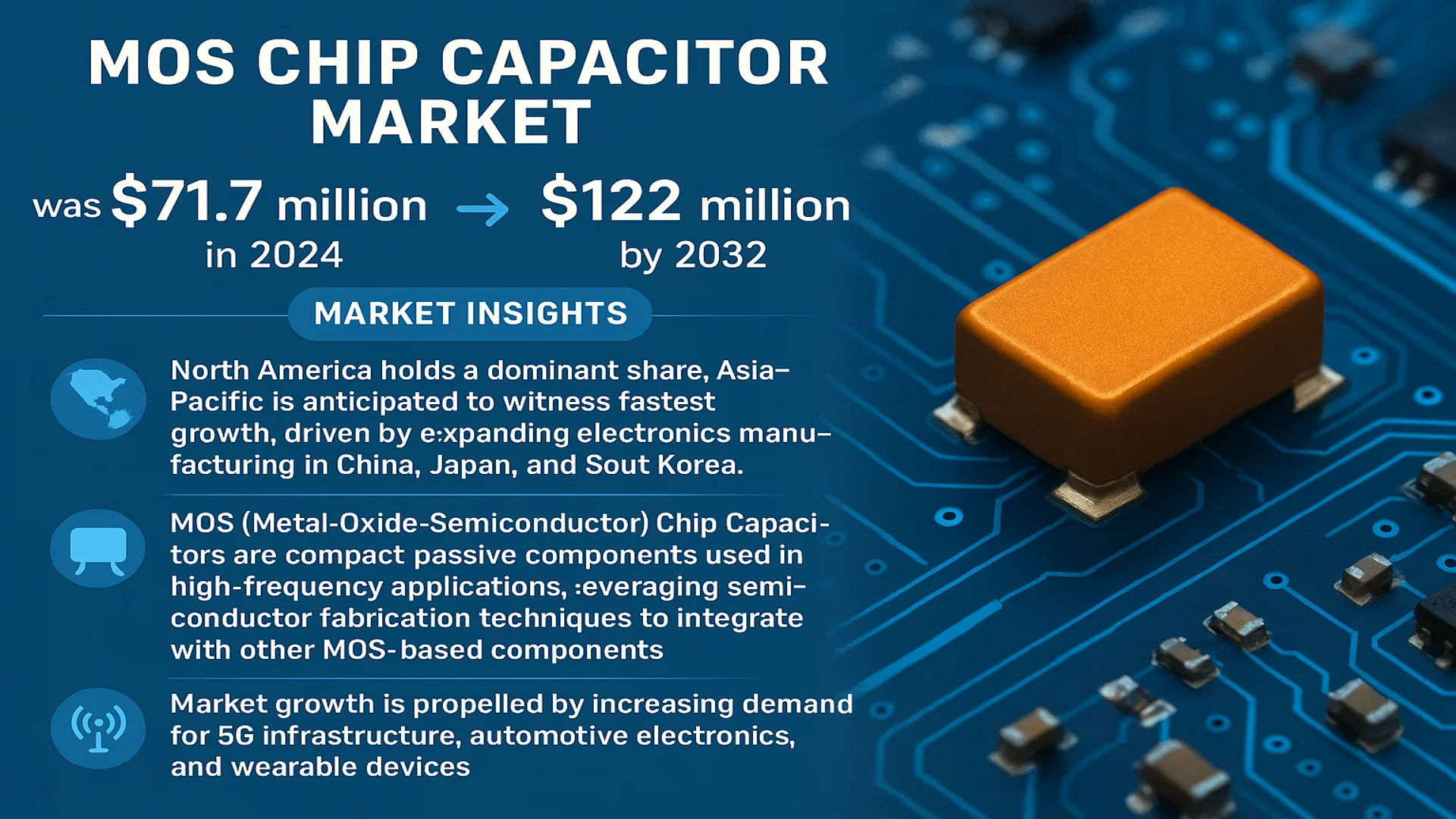
The global MOS Chip Capacitor Market was valued at 71.7 million in 2024 and is projected to reach US$ 122 million by 2032, at a CAGR of 6.9% during the forecast period. While North America holds a dominant share, Asia-Pacific is anticipated to witness the fastest growth, driven by expanding electronics manufacturing in China, Japan, and South Korea.
MOS (Metal-Oxide-Semiconductor) Chip Capacitors are compact passive components widely used in high-frequency applications such as RF circuits, power management systems, and IoT devices. These capacitors leverage semiconductor fabrication techniques to integrate seamlessly with other MOS-based components, offering superior performance in miniaturized electronic designs. Their key advantages include low leakage current, high capacitance density, and excellent temperature stability.
The market growth is propelled by increasing demand for 5G infrastructure, automotive electronics, and wearable devices. However, supply chain disruptions in semiconductor raw materials pose challenges. Key players like Murata Manufacturing and KYOCERA AVX are investing in advanced MOS capacitor technologies to address emerging application needs in AI processors and electric vehicle power systems.
MARKET DYNAMICS
MARKET DRIVERS
Proliferation of 5G Technology and IoT Devices to Fuel Market Expansion
The rapid adoption of 5G networks and Internet of Things (IoT) devices is significantly driving demand for MOS chip capacitors. These components are critical for managing high-frequency signals and ensuring stable performance in compact electronic designs. The global 5G infrastructure market is projected to surpass $110 billion by 2028, creating substantial demand for high-performance passive components like MOS capacitors. Furthermore, the IoT market is expected to grow at a CAGR of 13% over the next five years, requiring over 30 billion connected devices worldwide, many of which will incorporate multiple MOS chip capacitors for power management and signal conditioning.
Automotive Electrification to Accelerate Product Adoption
The automotive industry’s shift towards electric and autonomous vehicles presents a major growth opportunity for MOS chip capacitors. Modern vehicles contain advanced electronic systems for battery management, infotainment, and advanced driver assistance systems (ADAS), all requiring reliable passive components. With electric vehicle production expected to reach 30 million units annually by 2030, demand for high-quality MOS capacitors is set to increase significantly. These components are particularly valued for their ability to withstand harsh automotive environments while maintaining performance consistency.
➤ The increasing focus on miniaturization in automotive electronics has led to a 40% rise in demand for chip capacitors with smaller form factors but higher capacitance values over the past three years.
Growing Investments in Semiconductor Manufacturing to Support Market Growth
Global investments in semiconductor fabrication plants have reached record levels, with annual capital expenditures exceeding $150 billion. This expansion is being driven by government initiatives and private sector investments to address chip shortages and boost domestic production capabilities. Many of these new fabrication facilities will prioritize advanced MOSFET and capacitor technologies, creating favorable conditions for MOS chip capacitor manufacturers. The CHIPS and Science Act in the United States alone has allocated over $50 billion for semiconductor research and manufacturing, which will directly benefit component suppliers.
MARKET CHALLENGES
Supply Chain Disruptions and Material Shortages to Hinder Market Growth
The MOS chip capacitor market continues to face significant supply chain challenges, particularly regarding raw material availability. Specialized ceramic powders and precious metals used in manufacturing have experienced price volatility and supply constraints. Lead times for certain capacitor types have extended to 40-50 weeks in some cases, forcing manufacturers to implement allocation strategies. These disruptions are particularly problematic for industries with just-in-time production models, such as automotive and consumer electronics.
Other Key Challenges
Manufacturing Complexity
The precision required in MOS capacitor production creates high barriers to entry. Maintaining consistent dielectric thickness and electrode alignment at nanometer scales requires expensive equipment and rigorous quality control processes. Yield optimization remains a persistent challenge, particularly for high-density designs.
Thermal Management Issues
As components shrink in size while operating at higher frequencies, heat dissipation becomes a critical concern. Developing capacitor materials and designs that can withstand elevated temperatures without performance degradation adds complexity to product development cycles.
MARKET RESTRAINTS
Price Competition from Alternative Technologies to Limit Growth Potential
While MOS chip capacitors offer superior performance in many applications, they face increasing competition from alternative technologies such as polymer capacitors and multi-layer ceramic capacitors (MLCCs). These alternatives often provide cost advantages in price-sensitive applications, particularly where the full performance benefits of MOS capacitors aren’t required. In consumer electronics, where component costs are heavily scrutinized, manufacturers may opt for lower-cost alternatives, reducing market share for premium MOS capacitor products.
Technical Limitations in High-Power Applications to Constrain Market Expansion
MOS chip capacitors face inherent limitations in high-voltage and high-power applications compared to other capacitor technologies. While they excel in high-frequency circuits and precision applications, their relatively lower voltage ratings compared to film or electrolytic capacitors restrict their use in power conversion systems. This limitation becomes particularly relevant in renewable energy and industrial power systems where operating voltages often exceed 600V.
MARKET OPPORTUNITIES
Emerging Applications in Medical Electronics to Create New Growth Avenues
The medical device industry presents significant opportunities for MOS chip capacitor manufacturers. Advanced diagnostic equipment, implantable devices, and portable medical electronics increasingly require components that combine small form factors with exceptional reliability. The global medical electronics market is projected to grow at 7% annually through 2030, with specialized capacitors playing a crucial role in life-supporting equipment where failure is not an option. Recent innovations in capacitor materials have enabled better performance in sterilization processes and long-term implantation applications.
Advancements in Material Science to Enable Next-Generation Products
Breakthroughs in dielectric materials and electrode technologies are creating opportunities for enhanced MOS capacitor products. Researchers have developed new nanocomposite dielectrics that offer 30% higher energy density than conventional materials while maintaining stability at higher temperatures. These innovations will enable capacitors with better performance characteristics across wider operating conditions. Additionally, alternative electrode materials like conductive polymers show promise for reducing costs while improving reliability in certain applications.
MOS CHIP CAPACITOR MARKET TRENDS
Expansion in 5G and IoT Technologies Driving Market Growth
The global MOS chip capacitor market is experiencing robust growth, primarily driven by the rapid deployment of 5G infrastructure and the increasing adoption of Internet of Things (IoT) devices. MOS chip capacitors play a critical role in high-frequency applications, making them indispensable in 5G base stations, smartphones, and IoT sensors. With the global 5G infrastructure market projected to expand significantly, demand for high-performance capacitors with low equivalent series resistance (ESR) and high-temperature stability has surged. Furthermore, the integration of advanced materials, such as silicon-based MOS capacitors, is improving efficiency while meeting miniaturization demands in next-generation electronics.
Other Trends
Automotive Electrification and ADAS Applications
The rise in automotive electrification and the proliferation of Advanced Driver Assistance Systems (ADAS) are contributing to the growing demand for MOS chip capacitors. Modern electric vehicles (EVs) require compact, high-reliability components to support power management, battery monitoring, and infotainment systems. In 2024, the automotive segment accounted for approximately 25% of the MOS chip capacitor market, with projections indicating further growth as autonomous driving technologies advance. Capacitors with enhanced thermal stability and longevity are increasingly critical in ensuring the safety and efficiency of automotive electronics.
Increasing Demand for Portable and Wearable Electronics
The consumer electronics industry continues to fuel demand for MOS chip capacitors, particularly in the wearable device segment. Smartwatches, fitness trackers, and wireless earbuds require miniature, energy-efficient components to optimize battery life and performance. The global wearable electronics market is expected to exceed $100 billion by 2032, further accelerating the need for ultra-compact capacitors. Manufacturers are focusing on developing capacitors with higher capacitance density to accommodate shrinking device footprints while maintaining high-frequency performance for Bluetooth and Wi-Fi connectivity.
COMPETITIVE LANDSCAPE
Key Industry Players
Market Leaders Leverage Technological Advancements to Maintain Dominance
The global MOS Chip Capacitor market features a moderately consolidated structure, with established players competing alongside emerging manufacturers. Murata Manufacturing commands a significant market share, driven by its extensive product portfolio and strong foothold in key regions such as Asia-Pacific and North America. The company’s emphasis on miniaturization and high-performance capacitors has solidified its leadership position.
Vishay Intertechnology and ROHM Semiconductor also hold substantial market shares, owing to their innovations in semiconductor components and strategic acquisitions. These companies have invested heavily in R&D to enhance the efficiency and reliability of MOS Chip Capacitors for applications in telecommunications and automotive sectors.
Additionally, players such as MACOM and KYOCERA AVX are focusing on expanding their manufacturing capabilities to cater to the growing demand for high-frequency and ultra-compact capacitors. Collaborations with automotive and industrial electronics manufacturers have enabled these companies to gain a competitive edge in niche markets.
Meanwhile, mid-sized manufacturers are adopting aggressive pricing strategies and rapid customization solutions to penetrate emerging markets. However, the dominance of top-tier players, coupled with their extensive distribution networks, presents formidable challenges for new entrants.
List of Key MOS Chip Capacitor Manufacturers Profiled
- Murata Manufacturing (Japan)
- Vishay Intertechnology (U.S.)
- ROHM Semiconductor (Japan)
- MACOM Technology Solutions (U.S.)
- KYOCERA AVX (U.S.)
- TDK Corporation (Japan)
- Taiyo Yuden Co., Ltd. (Japan)
- KEMET Corporation (U.S.)
- Walsin Technology Corporation (Taiwan)
- Johanson Technology Inc. (U.S.)
Segment Analysis:
By Type
NMOS Segment Leads Due to High-Frequency Performance and Low Power Consumption
The market is segmented based on type into:
- NMOS
- Subtypes: Low-voltage, High-voltage, and others
- PMOS
- Subtypes: Standard, High-performance, and others
- Others
By Application
Telecommunication Segment Dominates Due to Rising Demand for 5G and High-Speed Data Transmission
The market is segmented based on application into:
- Automotive
- Medical
- Telecommunication
- Industrial
- Others
By End-User
Consumer Electronics Sector Holds Major Share Owing to Miniaturization Trends
The market is segmented based on end-user into:
- Consumer Electronics
- Aerospace & Defense
- IT & Data Centers
- Energy & Power
- Others
Regional Analysis: MOS Chip Capacitor Market
Asia-Pacific
The Asia-Pacific region is the largest and fastest-growing market for MOS Chip Capacitors, driven by the thriving electronics manufacturing sectors in China, Japan, South Korea, and India. China alone accounts for a significant portion of global demand due to its expansive semiconductor and telecommunications industries. The increasing adoption of 5G technology, IoT devices, and electric vehicles has accelerated the need for high-performance chip capacitors. While Japan and South Korea lead in technological advancements, India is emerging as a key player due to government initiatives like “Make in India.” Despite cost pressures, a shift toward advanced NMOS and PMOS-based capacitors is evident, supported by strong R&D investments.
North America
North America remains a critical hub for innovation in MOS Chip Capacitors, particularly in the U.S. With major semiconductor companies and a robust automotive electronics market, demand for miniaturized, high-frequency capacitors is rising. The region benefits from strong collaborations between academia and industry, fostering advancements in applications like medical devices and aerospace. However, supply chain dependencies on Asia for raw materials pose challenges. The focus is on niche applications requiring ultra-reliable capacitors with low ESR (Equivalent Series Resistance) and high temperature tolerance.
Europe
Europe’s market growth is bolstered by stringent quality standards and the presence of leading automotive and industrial electronics manufacturers. Germany, France, and the U.K. are key contributors, with a strong emphasis on energy-efficient and high-durability components. Regulatory compliance with RoHS and REACH directives influences product innovations. While the region lags behind Asia in volume production, it excels in specialized applications, such as medical implants and industrial automation, where precision and longevity are critical. Investments in renewable energy systems further drive demand for high-voltage MOS capacitors.
South America
The South American market is in its nascent stages, with Brazil and Argentina showing gradual growth in consumer electronics and automotive sectors. Limited local manufacturing capabilities result in heavy reliance on imports, which inflates costs. Economic instability and inadequate infrastructure hinder large-scale adoption, although increasing foreign investments in electronics assembly plants present long-term opportunities. The market is dominated by cost-effective solutions, with slower uptake of advanced NMOS/PMOS technologies compared to other regions.
Middle East & Africa
The Middle East and Africa region exhibits moderate demand, primarily driven by telecommunications and oil & gas industries. The UAE and Saudi Arabia are investing in smart city projects, fostering demand for advanced electronics. However, the lack of domestic semiconductor production restricts market expansion. In Africa, slow industrialization and low purchasing power limit growth, though increasing mobile penetration offers incremental opportunities. The market remains price-sensitive, with buyers prioritizing basic functionalities over cutting-edge specifications.
Report Scope
This market research report provides a comprehensive analysis of the global and regional MOS Chip Capacitor markets, covering the forecast period 2024–2032. It offers detailed insights into market dynamics, technological advancements, competitive landscape, and key trends shaping the industry.
Key focus areas of the report include:
- Market Size & Forecast: Historical data and future projections for revenue, unit shipments, and market value across major regions and segments. The global MOS Chip Capacitor market was valued at USD 71.7 million in 2024 and is projected to reach USD 122 million by 2032, growing at a CAGR of 6.9%.
- Segmentation Analysis: Detailed breakdown by product type (NMOS, PMOS, Others), technology, application (Automotive, Medical, Telecommunication, Industrial, Others), and end-user industry to identify high-growth segments and investment opportunities.
- Regional Outlook: Insights into market performance across North America (U.S., Canada, Mexico), Europe (Germany, France, U.K., Italy, Russia), Asia-Pacific (China, Japan, South Korea, India), Latin America, and the Middle East & Africa, including country-level analysis.
- Competitive Landscape: Profiles of leading market participants including Murata Manufacturing, Vishay, ROHM Semiconductor, MACOM, and KYOCERA AVX, covering their product offerings, R&D focus, manufacturing capacity, and recent developments.
- Technology Trends & Innovation: Assessment of emerging semiconductor technologies, miniaturization trends, integration with AI/IoT applications, and evolving fabrication techniques.
- Market Drivers & Restraints: Evaluation of factors driving market growth such as increasing demand for compact electronic components, along with challenges like supply chain constraints and raw material price volatility.
- Stakeholder Analysis: Insights for component suppliers, OEMs, system integrators, investors, and policymakers regarding strategic opportunities in the evolving MOS Chip Capacitor ecosystem.
Primary and secondary research methods are employed, including interviews with industry experts, data from verified sources, and real-time market intelligence to ensure the accuracy and reliability of the insights presented.
FREQUENTLY ASKED QUESTIONS:
What is the current market size of Global MOS Chip Capacitor Market?
-> MOS Chip Capacitor Market was valued at 71.7 million in 2024 and is projected to reach US$ 122 million by 2032, at a CAGR of 6.9% during the forecast period.
Which key companies operate in Global MOS Chip Capacitor Market?
-> Key players include Murata Manufacturing, Vishay, ROHM Semiconductor, MACOM, and KYOCERA AVX, among others.
What are the key growth drivers?
-> Key growth drivers include increasing demand for miniaturized electronic components, growth in 5G infrastructure, automotive electronics expansion, and medical device innovation.
Which region dominates the market?
-> Asia-Pacific is the largest and fastest-growing region, driven by semiconductor manufacturing in China, Japan, and South Korea, while North America remains a key innovation hub.
What are the emerging trends?
-> Emerging trends include development of ultra-compact capacitors, integration with advanced semiconductor packaging, and increasing adoption in AI/ML hardware applications.

Get Sample Report PDF for Exclusive Insights
Report Sample Includes
- Table of Contents
- List of Tables & Figures
- Charts, Research Methodology, and more...