Monocular Vision Camera Module Market Insights
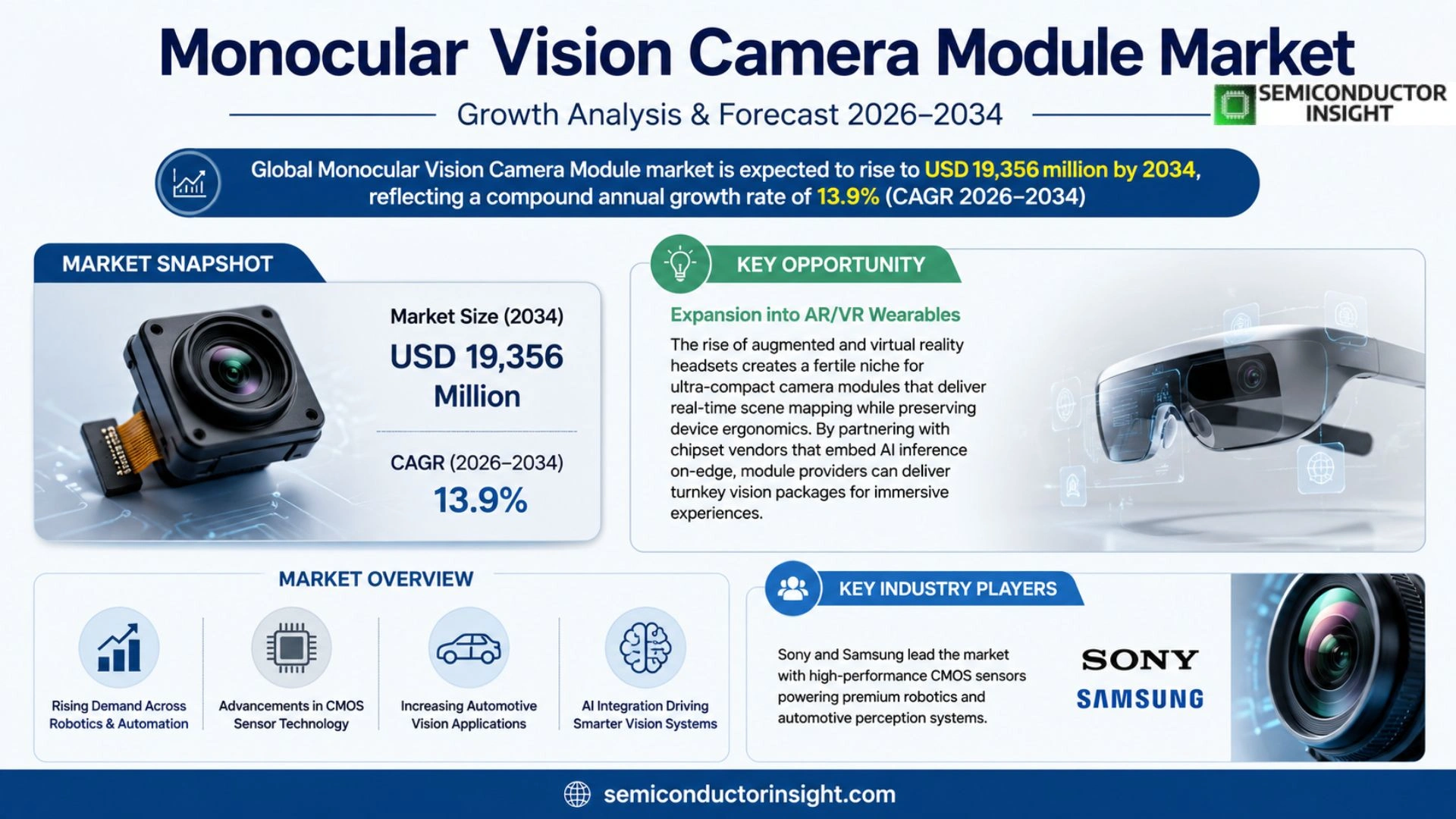
Global Monocular Vision Camera Module market size was USD 7,877 million in 2025 and is expected to rise to USD 19,356 million by 2034, reflecting a compound annual growth rate of 13.9% over the period.
A Monocular Vision Camera Module consists of a single optical sensor paired with lens optics and processing electronics that capture two‑dimensional images and extract features such as object detection, depth inference, motion tracking and scene understanding. Because it relies on one camera, the solution remains compact, cost‑effective and well suited for robotics, drones, mobile devices and embedded AI vision systems.
The industry chain spans three layers: upstream suppliers provide CMOS image sensors, lenses and IC components (e.g., Sony, Omnivision, ON Semiconductor); midstream manufacturers integrate these parts into calibrated modules; downstream users embed the modules in robotics, automotive ADAS, UAVs and industrial inspection equipment. Value creation now hinges on AI‑enabled perception rather than raw resolution alone.
MARKET DRIVERS
Advancements in Miniaturized Optics
The relentless push toward smaller, lighter imaging systems has lowered the size envelope of monocular vision camera modules without compromising resolution. Manufacturers are integrating silicon‑based lenses and stacked sensor architectures, which enable integration into drones, wearable devices, and robotic platforms. This engineering progress expands the addressable product portfolio and fuels demand across multiple end‑uses.
Growth of Autonomous Navigation Solutions
Automotive and logistics firms are moving from radar‑centric designs to vision‑centric perception stacks for lane‑keeping, obstacle avoidance, and last‑mile delivery. The precise depth cues offered by monocular modules, when combined with AI‑driven image processing, create a cost‑effective alternative to stereoscopic rigs. Consequently, OEMs are allocating larger engineering budgets to incorporate these modules into next‑generation platforms.
➤ “The convergence of AI inference chips and compact optics is reshaping how manufacturers evaluate visual sensing options.”
Regulatory encouragement for safer autonomous systems has prompted early adopters to pilot monocular vision solutions in controlled environments. Stakeholder confidence is rising as field trials demonstrate reliable performance under varied lighting conditions, encouraging wider commercial roll‑out.
MARKET CHALLENGES
Calibration Complexity in Dynamic Environments
Accurate depth estimation from a single lens hinges on precise calibration of intrinsic parameters and real‑time compensation for temperature‑induced drift. Field deployments in outdoor or industrial settings often encounter rapid temperature swings, forcing frequent recalibration cycles that increase maintenance overhead.
Other Challenges
Supply‑Chain Volatility
The reliance on high‑purity silicon wafers and specialty optical coatings makes the monocular vision camera module supply chain vulnerable to fluctuations in raw‑material pricing and geopolitical tensions. Shortages can delay product launches and erode margin expectations.
MARKET RESTRAINTS
Limited Low‑Light Performance
While modern sensors achieve impressive signal‑to‑noise ratios, monocular designs still lag behind multi‑sensor arrays in low‑light scenarios. Applications such as nighttime surveillance or subterranean robotics require supplemental illumination, adding cost and design complexity.
Manufacturers seeking to enter regulated sectors such as automotive safety must meet stringent illumination standards, which can restrict the adoption of purely monocular solutions until sensor sensitivity improves further.
MARKET OPPORTUNITIES
Expansion into AR/VR Wearables
The rise of augmented and virtual reality headsets creates a fertile niche for ultra‑compact camera modules that deliver real‑time scene mapping while preserving device ergonomics. By partnering with chipset vendors that embed AI inference on‑edge, module providers can deliver turnkey vision packages for immersive experiences.
Emerging markets in low‑cost agricultural drones present another growth vector. Farmers increasingly rely on aerial imaging for crop health monitoring; a lightweight monocular module reduces payload weight, extending flight time and lowering operational expenses.
Finally, the integration of depth‑from‑defocus algorithms enables monocular systems to rival stereoscopic depth accuracy without additional hardware. Early adopters that embed such software stacks stand to capture premium pricing and lock‑in customers seeking a streamlined vision solution.
Monocular Vision Camera Module Market Trends
Shift from Consumer Devices to Intelligent Robotics
The market, valued at roughly 7,877 million dollars in 2025, is forecasted to climb to about 19,356 million dollars by 2032. This expansion is anchored in a clear reallocation of demand: robotics, autonomous‑driving systems, and unmanned aerial vehicles are now absorbing a larger share of unit shipments than traditional consumer electronics. The underlying driver is the need for compact perception hardware that can be fused with edge‑AI processors. By offering depth inference and motion‑tracking from a single lens, manufacturers deliver a cost‑effective alternative to stereo or LiDAR solutions, allowing system integrators to raise functional density without inflating bill‑of‑materials. Consequently, original equipment manufacturers are willing to pay premium prices for modules that bundle sensor, lens, and calibration software into a ready‑to‑deploy package.
Other Trends
Supply‑Chain Consolidation Around Core Sensor Providers
Upstream, the dominance of a handful of CMOS sensor makers,Sony, Omnivision, and Onsemi,has generated a de‑facto bottleneck that incentivizes mid‑stream assemblers to lock‑in long‑term supply agreements. This concentration accelerates design standardisation, reducing time‑to‑market for new AI‑enabled vision units. At the same time, the mid‑stream capacity of roughly 260 million units per year provides enough headroom to accommodate the projected increase in robot‑grade demand without triggering severe excess inventory.
AI‑Integrated Perception Becomes the Core Value Proposition
Beyond raw resolution, buyers now evaluate modules on algorithmic performance: the ability to deliver reliable obstacle detection at 30 frames per second, or to support simultaneous localisation and mapping (SLAM) on limited compute budgets. Vendors that embed specialised DSPs or offer tightly coupled software stacks are seeing gross profit margins near 32 percent, compared with the lower‑margin segment that sells purely optical components. This shift reshapes the competitive landscape, rewarding companies that can marry hardware excellence with proprietary AI pipelines, and pressuring pure‑hardware firms to either acquire software capabilities or partner with AI specialists.
COMPETITIVE LANDSCAPE
Key Industry Players
Monocular Vision Camera Module market – competitive dynamics and concentration
At the apex of the value chain, Sony and Samsung command the largest share of revenue, largely because they supply high‑performance CMOS sensors that feed both premium robotics and emerging automotive perception stacks. Their ability to bundle sensor optics, on‑chip AI accelerators and validated reference boards gives them leverage over midsize integrators, who must negotiate pricing and lead‑time constraints with these upstream giants. The market architecture remains a three‑tier system: upstream component makers (sensor, lens, driver IC), midstream module assemblers that add calibration software and mechanical housing, and downstream OEMs that embed the finished unit into drones, service robots or ADAS platforms. Concentration ratios indicate that the top five firms capture roughly one‑third of global sales, reinforcing the influence of sensor provenance on module pricing and design cycles.
Beyond the headline names, a cluster of specialist firms injects differentiated capability into the ecosystem. Omnivision and Onsemi focus on low‑cost, high‑volume sensors tailored for consumer‑grade UAVs, while Sunny Optical Technology differentiates through bespoke lens assemblies that improve depth‑inference accuracy. LG Innotek, Teledyne and Panasonic have built niche reputations by integrating rigid‑body vibration isolation and thermal management into their modules, a decisive factor for industrial inspection equipment. European players such as Basler and Vision Components add strength in machine‑vision software stacks, whereas Asian manufacturers,including STMicroelectronics, AMS Osram, O‑Film Group and Primax Electronics,supply power‑management ICs and optical filters that complete the perception pipeline. Collectively, these niche actors expand the competitive set and raise the bar for system‑level performance.
List of Key Monocular Vision Camera Module Companies Profiled
- Sony
- Samsung
- Omnivision
- Onsemi
- Sunny Optical Technology
- LG Innotek
- Teledyne
- Panasonic
- Fujifilm
- STMicroelectronics
- AMS Osram
- Basler
- Vision Components
- O‑Film Group
- Primax Electronics
- Chicony Electronics
- Luxvisions Innovation
Segment Analysis:
| Segment Category | Sub-Segments | Key Insights |
| By Type |
|
High‑Resolution Trend The industry is moving toward higher pixel counts to support richer perception algorithms. ‑ Customers value the ability to extract finer features for object classification. ‑ Integration of AI at the sensor level amplifies the relevance of high‑resolution modules. ‑ Suppliers are focusing on miniaturization while preserving image quality. |
| By Application |
|
Robotics Dominance Robotics applications prioritize compact, low‑cost vision solutions that can be embedded in collaborative arms and mobile platforms. ‑ The shift from pure imaging to perception‑enabled modules drives demand for integrated depth‑inference algorithms. ‑ Automotive ADAS leverages monocular cameras for lane‑keeping assistance and pedestrian detection, valuing reliability over raw resolution. ‑ Drone manufacturers appreciate the weight savings and power efficiency of single‑lens systems. |
| By End User |
|
OEM Focus OEMs are seeking turnkey modules that reduce time‑to‑market for AI‑enabled products. ‑ System integrators value flexible interface options that simplify board‑level design. ‑ Academic and research labs drive early adoption of experimental perception pipelines, influencing feature roadmaps. |
| By Resolution |
|
Resolution‑Driven Differentiation Higher resolution feeds enable more sophisticated AI models for scene understanding. ‑ Yet, many cost‑sensitive applications remain anchored to VGA or HD levels where processing overhead stays manageable. ‑ The market sees a clear tiered ecosystem: basic perception for consumer wearables versus premium perception for autonomous systems. |
| By Interface Type |
|
Interface Flexibility Designers prioritize interfaces that align with existing compute platforms and power budgets. ‑ MIPI CSI dominates mobile‑centric designs due to its low‑power footprint. ‑ GMSL and Ethernet are favored in automotive and industrial contexts for longer cable runs and robust data integrity. ‑ Emerging USB‑C implementations provide plug‑and‑play simplicity for rapid prototyping. |
Regional Analysis: Monocular Vision Camera Module Market
North America
Proximity to silicon fabs in Arizona and Texas shortens lead times for sensor wafers, enabling rapid iteration on lens‑module assemblies. This logistical edge reduces inventory risk and allows OEMs to respond swiftly to evolving vehicle‑platform timelines, a crucial factor in maintaining competitive pricing structures.
The Federal Motor Vehicle Safety Standards (FMVSS) and Transport Canada guidelines provide explicit criteria for monocular vision performance, granting manufacturers a predictable compliance path. Clear test protocols accelerate certification, limiting costly redesign cycles and fostering confidence among downstream integrators.
Beyond automotive, industrial robotics firms in the Midwest leverage monocular modules for precision pick‑and‑place tasks, while aerospace contractors in the Pacific Northwest adopt them for lightweight navigation systems. This diversification dilutes reliance on any single sector, stabilizing revenue streams during cyclical downturns.
The Silicon Valley corridor and Boston’s Route 128 corridor host a concentration of vision‑algorithm specialists who co‑develop firmware optimized for monocular optics. Their contributions elevate image‑processing efficiency, allowing customers to extract higher fidelity data without inflating module size or power consumption.
Europe
European manufacturers profit from a harmonized standards regime that eases cross‑border component deployment. The EU’s push toward higher‑level autonomous driving mandates creates incentive structures for firms that can certify monocular vision modules against the latest safety assessment protocols. German automotive giants, in partnership with niche optics firms in the Netherlands, are experimenting with compact sensors that blend high dynamic range with low‑light resilience,attributes prized for city‑center deployments. Additionally, the region’s strong emphasis on sustainability drives interest in low‑power modules, prompting R&D teams to explore novel packaging materials that meet both performance and environmental criteria.
Asia‑Pacific
Asia‑Pacific’s rapid adoption of electric and autonomous mobility platforms fuels a burgeoning appetite for compact vision hardware. Chinese manufacturers excel at scaling production volumes, leveraging economies of scale to offer cost‑effective monocular solutions to domestic car makers. Meanwhile, Japanese firms focus on precision engineering, delivering modules with tighter tolerances that appeal to high‑end robotics applications. The convergence of aggressive government incentives for smart‑city initiatives and a proliferating network of mobile‑mapping projects positions the region as a fertile ground for diversified end‑use cases, ranging from unmanned delivery drones to advanced manufacturing inspection lines.
South America
In South America, emerging logistics networks are prompting fleet operators to seek affordable perception technologies that can retrofit legacy trucks. Brazilian start‑ups are pioneering low‑cost monocular camera packages that integrate with open‑source perception stacks, allowing rapid customization for varied road conditions. Market participants also note a growing interest from agricultural equipment manufacturers, who value the modules’ ability to detect canopy density and terrain irregularities, thereby enhancing autonomous field operations.
Middle East & Africa
The Middle East & Africa region exhibits a distinct focus on security and surveillance deployments, where rugged monocular vision modules are prized for border‑patrol drones and remote oil‑field monitoring. Investment funds in the United Arab Emirates are backing joint ventures that blend local manufacturing capacity with European optical expertise, aiming to reduce import dependency. In Sub‑Saharan Africa, pilot projects in smart‑transport corridors are testing low‑power monocular sensors to improve traffic management under challenging climatic conditions, signaling nascent but strategically important demand pockets.
Report Scope
This market research report provides a comprehensive analysis of the Monocular Vision Camera Module Market , covering the forecast period 2026–2034. It offers detailed insights into market dynamics, technological advancements, competitive landscape, and key trends shaping the industry.
Key focus areas of the report include:
- Market Overview: The report begins with an overview outlining its current market scenario, key growth indicators, and industry transformation drivers. It discusses macroeconomic factors, demand–supply balance, regulatory landscape, and the strategic role of semiconductors in powering advancements across industries such as automotive, telecommunications, consumer electronics, and industrial automation.
- Market Size & Forecast: Historical data and future projections for revenue, unit shipments, and market value across major regions and segments.
- Segmentation Analysis: Detailed breakdown by product type, technology, application, and end-user industry to identify high-growth segments and investment opportunities.
- Regional Insights: Insights into market performance across North America, Europe, Asia-Pacific, Latin America, and the Middle East & Africa, including country-level analysis where relevant.
- Competitive Landscape: Profiles of leading market participants, including their product offerings, R&D focus, manufacturing capacity, pricing strategies, and recent developments such as mergers, acquisitions, and partnerships.
- Technology Trends & Innovation: Assessment of emerging technologies, integration of AI/IoT, semiconductor design trends, fabrication techniques, and evolving industry standards.
- Market Drivers & Restraints: Evaluation of factors driving market growth along with challenges, supply chain constraints, regulatory issues, and market-entry barriers.
- Stakeholder Insights: Insights for component suppliers, OEMs, system integrators, investors, and policymakers regarding the evolving ecosystem and strategic opportunities.
Primary and secondary research methods are employed, including interviews with industry experts, data from verified sources, and real-time market intelligence to ensure the accuracy and reliability of the insights presented.
FREQUENTLY ASKED QUESTIONS:
What is the current market size of Monocular Vision Camera Module Market?
-> Global Monocular Vision Camera Module Market was valued at USD 7,877 million in 2025 and is expected to reach USD 19,356 million by 2034, growing at a CAGR of 13.9%
Which key companies operate in Monocular Vision Camera Module Market?
-> Key players include Sony, Samsung, Omnivision, Onsemi, Sunny Optical Technology, LG Innotek, Teledyne, Canon, Panasonic, Fujifilm, among others.
What are the key growth drivers?
-> Key growth drivers include the shift from consumer electronics to robotics and automotive intelligence, increasing integration of AI algorithms for perception, rising adoption of ADAS and autonomous drones, and higher value‑per‑unit demand in industrial automation.
Which region dominates the market?
-> Asia-Pacific leads the market, driven by strong demand in China, Japan, and South Korea for robotics, UAVs, and automotive ADAS applications.
What are the emerging trends?
-> Emerging trends include AI‑enabled perception modules, higher‑resolution yet compact designs, and the convergence of imaging hardware with edge‑computing software to create smart vision systems.

Get Sample Report PDF for Exclusive Insights
Report Sample Includes
- Table of Contents
- List of Tables & Figures
- Charts, Research Methodology, and more...
 Download Sample Report PDF