MARKET INSIGHTS
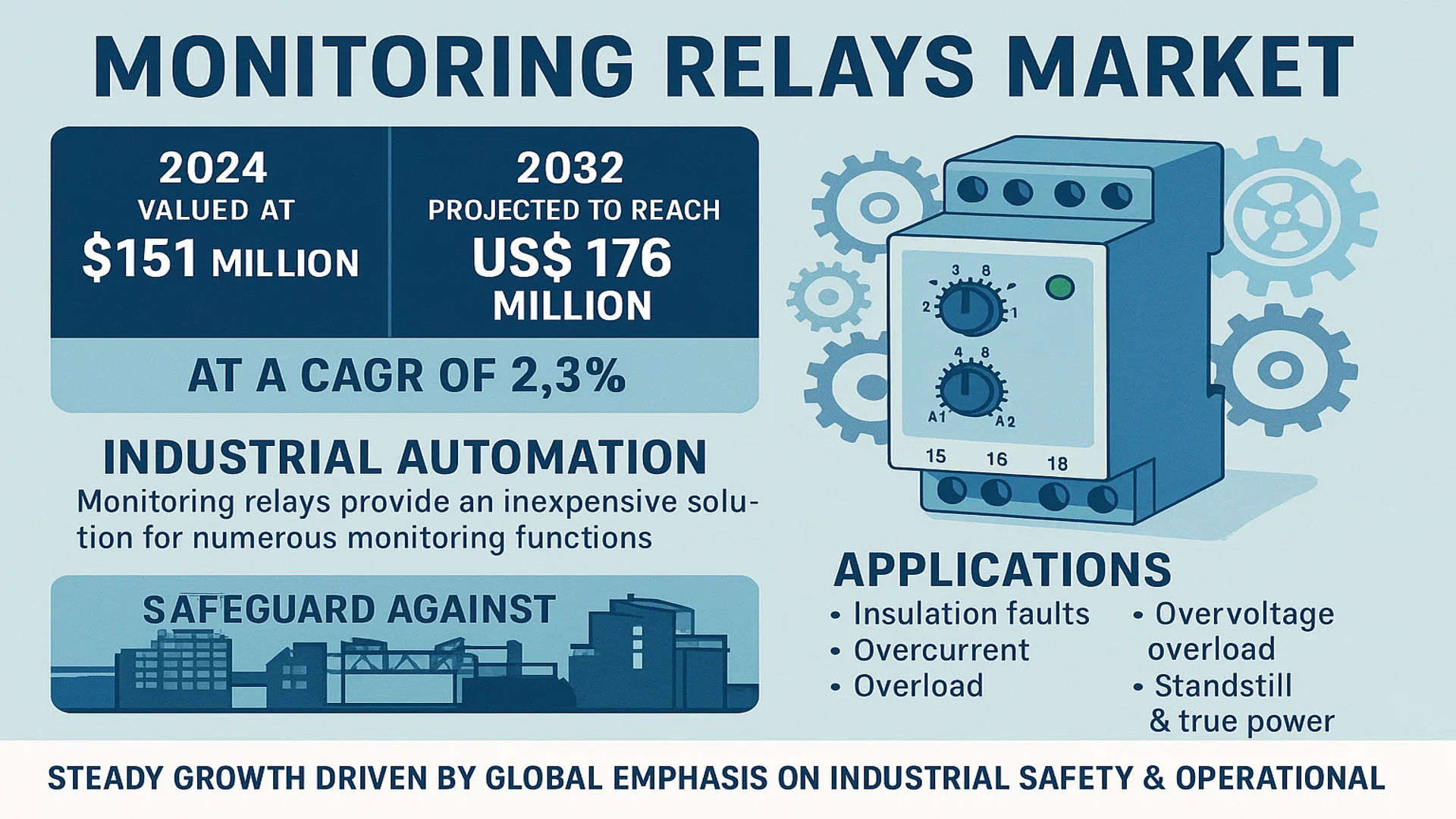
The global Monitoring Relays Market was valued at 151 million in 2024 and is projected to reach US$ 176 million by 2032, at a CAGR of 2.3% during the forecast period.
Monitoring Relays are specialized electromechanical or solid-state devices designed to continuously monitor specific electrical parameters within a system. They function as a critical component in industrial automation by providing an inexpensive solution for numerous monitoring functions, ensuring error-free and cost-effective operation. These relays are engineered to protect personnel and machinery against a wide array of faults, including insulation faults, residual voltages, overvoltage, overcurrent, overload, temperature overload, as well as monitoring standstill and true power.
The market’s steady growth is primarily driven by the increasing global emphasis on industrial safety and the need for operational reliability across key sectors like manufacturing, power, and transportation. Furthermore, the ongoing modernization of aging infrastructure and the integration of Industry 4.0 principles, which demand smarter and more connected monitoring solutions, are contributing to market expansion. The competitive landscape is consolidated, with key players such as Omron, Eaton, ABB, Siemens, and Schneider Electric collectively holding approximately 75% of the global market share, underscoring their significant influence on product development and market trends.
MARKET DYNAMICS
MARKET DRIVERS
Increasing Industrial Automation and Smart Manufacturing Initiatives to Drive Market Growth
The global push toward industrial automation and smart manufacturing is significantly driving the monitoring relays market. With manufacturing facilities increasingly adopting Industry 4.0 principles, there is a growing need for reliable protection and monitoring solutions to ensure operational efficiency and equipment safety. Monitoring relays play a critical role in detecting abnormalities in electrical parameters such as voltage, current, frequency, and phase sequence, preventing equipment damage and reducing downtime. The manufacturing sector’s investment in automation technologies has been substantial, with global spending on industrial automation projected to exceed $400 billion annually. This increased automation adoption directly correlates with higher demand for monitoring relays across various applications including motor protection, compressor systems, and conveyor belt operations.
Stringent Safety Regulations and Standards to Boost Market Adoption
Growing emphasis on workplace safety and stringent regulatory requirements across industries are driving the adoption of monitoring relays. Regulatory bodies worldwide have implemented rigorous safety standards that mandate the use of protective devices to prevent electrical hazards, equipment damage, and personnel injuries. Monitoring relays provide essential protection against insulation faults, phase failures, voltage fluctuations, and temperature excursions, ensuring compliance with international safety standards such as IEC 60947, UL 508, and other regional regulations. The increasing number of safety-related incidents in industrial settings has prompted organizations to invest more comprehensively in protective devices, with monitoring relays becoming a fundamental component of modern electrical protection systems.
Infrastructure Development and Power Sector Investments to Fuel Market Expansion
Global infrastructure development and substantial investments in the power sector are creating robust growth opportunities for monitoring relays. The increasing deployment of renewable energy systems, smart grid technologies, and power distribution networks requires sophisticated monitoring and protection solutions. Monitoring relays are essential for ensuring grid stability, protecting sensitive equipment, and maintaining power quality in these complex systems. The global investment in power infrastructure has reached unprecedented levels, with renewable energy projects alone accounting for significant capital expenditure. This infrastructure expansion, particularly in developing regions, is driving substantial demand for reliable electrical protection devices including advanced monitoring relays with enhanced functionality and communication capabilities.
MARKET CHALLENGES
Price Sensitivity and Intense Market Competition to Challenge Growth Prospects
The monitoring relays market faces significant challenges due to price sensitivity among end-users and intense competition among manufacturers. While the global market is growing steadily, customers across various industries, particularly in price-sensitive regions, often prioritize cost over advanced features. This price pressure forces manufacturers to maintain competitive pricing while incorporating technological advancements, creating margin constraints. The market is characterized by the presence of numerous established players and emerging competitors, leading to price wars and reduced profitability. Additionally, the availability of low-cost alternatives from certain regions further exacerbates pricing challenges, making it difficult for manufacturers to maintain premium pricing for advanced monitoring relay solutions.
Other Challenges
Technical Complexity and Integration Issues
The increasing technical complexity of modern monitoring relays presents implementation challenges for end-users. Advanced relays with sophisticated features such as communication protocols, programmability, and network integration require specialized knowledge for proper installation and configuration. Many industrial facilities lack the technical expertise needed to fully utilize these advanced features, leading to underutilization of capabilities or improper implementation. The integration of monitoring relays with existing control systems and industrial networks can be particularly challenging, especially in older facilities where compatibility issues may arise, requiring additional investment in system upgrades or specialized engineering services.
Rapid Technological Obsolescence
The rapid pace of technological advancement in the electronics industry creates challenges related to product obsolescence and the need for continuous innovation. Monitoring relay manufacturers must constantly invest in research and development to keep pace with evolving technologies, customer requirements, and industry standards. This continuous innovation cycle requires significant financial investment and poses the risk of existing products becoming obsolete quickly. The short product life cycles in the electronics sector mean that manufacturers must carefully manage inventory, production planning, and product phasing to avoid excess stock of outdated models while ensuring availability of the latest technologies.
MARKET RESTRAINTS
Economic Volatility and Capital Expenditure Constraints to Restrain Market Growth
Economic uncertainty and fluctuations in industrial capital expenditure represent significant restraints for the monitoring relays market. During periods of economic downturn or uncertainty, industrial companies often delay or reduce investments in new equipment and automation systems, directly impacting the demand for monitoring relays. The capital-intensive nature of industrial projects means that decision-makers frequently postpone electrical system upgrades and expansions when economic conditions are unfavorable. This cyclical nature of industrial investment creates volatility in market demand, making it challenging for manufacturers to maintain consistent production levels and growth trajectories. The recent global economic challenges have particularly affected small and medium-sized enterprises, which constitute a substantial portion of the monitoring relays customer base.
Limited Technical Expertise and Training Requirements to Hinder Market Penetration
The shortage of qualified technical personnel and the extensive training requirements for proper monitoring relay implementation act as significant market restraints. As monitoring relays become more sophisticated with advanced features such as programmable settings, communication capabilities, and complex diagnostics, the need for trained technicians and engineers increases substantially. Many industrial facilities, particularly in developing regions and smaller operations, lack the technical resources to properly select, install, and maintain advanced monitoring relay systems. This knowledge gap often leads to suboptimal implementation, reduced system effectiveness, or reluctance to adopt newer technologies. The requirement for ongoing training and technical support adds to the total cost of ownership, making some customers hesitant to upgrade from simpler, traditional protection devices.
Supply Chain Disruptions and Component Availability Issues to Impact Market Stability
Global supply chain challenges and component availability issues continue to restrain the monitoring relays market. The electronics manufacturing industry has experienced significant disruptions in recent years, affecting the availability of critical components such as semiconductors, microcontrollers, and specialized electronic parts. These supply chain constraints have led to extended lead times, production delays, and increased manufacturing costs for monitoring relay manufacturers. The reliance on global supply networks makes the market vulnerable to geopolitical tensions, trade restrictions, and logistical challenges. Additionally, fluctuations in raw material prices and transportation costs further complicate production planning and pricing strategies, creating uncertainty in the market and potentially limiting growth opportunities.
MARKET OPPORTUNITIES
Integration with IoT and Industry 4.0 Technologies to Create New Growth Avenues
The integration of monitoring relays with Internet of Things (IoT) platforms and Industry 4.0 technologies presents substantial growth opportunities. Modern monitoring relays equipped with communication capabilities, data logging features, and network connectivity are becoming essential components of smart factory ecosystems. These advanced relays can provide real-time equipment health monitoring, predictive maintenance data, and operational analytics, enabling more efficient and proactive maintenance strategies. The global adoption of IoT in industrial settings is creating demand for intelligent monitoring solutions that can seamlessly integrate with broader automation systems. Manufacturers developing monitoring relays with enhanced connectivity features, cloud compatibility, and data analytics capabilities are well-positioned to capitalize on this growing market segment.
Expansion in Renewable Energy and Electric Vehicle Infrastructure to Drive Future Demand
The rapid expansion of renewable energy projects and electric vehicle infrastructure offers significant opportunities for monitoring relay manufacturers. Solar and wind power installations require sophisticated monitoring and protection systems to ensure grid stability and equipment safety. Monitoring relays play a crucial role in these applications by providing protection against voltage fluctuations, frequency variations, and phase imbalances. Similarly, the growing electric vehicle charging infrastructure requires reliable monitoring solutions to protect charging equipment and ensure electrical safety. The global commitment to renewable energy transition and electric mobility is driving substantial investments in these sectors, creating sustained demand for advanced monitoring and protection devices.
Emerging Markets and Infrastructure Modernization to Provide Growth Potential
Infrastructure modernization programs in emerging economies and the replacement of aging electrical systems in developed markets present significant growth opportunities. Many developing countries are investing heavily in industrial infrastructure, power distribution networks, and commercial facilities, creating substantial demand for electrical protection equipment. Simultaneously, developed markets are undertaking infrastructure modernization projects to replace aging electrical systems with more efficient and technologically advanced solutions. The need to upgrade outdated protection devices with modern monitoring relays that offer better accuracy, reliability, and additional features drives replacement demand. This dual opportunity across both emerging and established markets provides manufacturers with diverse growth pathways and reduces dependence on any single geographic region or market segment.
MONITORING RELAYS MARKET TRENDS
Integration of Industry 4.0 and IoT to Emerge as a Pivotal Trend in the Market
The global push towards Industry 4.0 and the Industrial Internet of Things (IIoT) is fundamentally reshaping the monitoring relays landscape. These devices are evolving from standalone protection units into intelligent nodes within connected ecosystems. Modern monitoring relays now feature embedded communication protocols like Modbus TCP/IP, PROFINET, and EtherNet/IP, enabling real-time data transmission to supervisory control and data acquisition (SCADA) systems and cloud platforms. This connectivity allows for predictive maintenance strategies, where potential faults such as motor overload or phase imbalance can be flagged before they cause costly downtime. The global manufacturing sector’s investment in smart factory technologies, which exceeded $345 billion in 2023, is a primary driver for this sophisticated, networked functionality. This trend is moving the market beyond basic protection towards comprehensive asset management and operational intelligence, creating significant added value for end-users.
Other Trends
Rising Demand for Energy Efficiency and Grid Stability
Heightened focus on energy conservation and the stability of power grids worldwide is accelerating the adoption of advanced monitoring relays, particularly power and power factor types. These devices are critical for optimizing energy consumption in industrial facilities by monitoring parameters like true power, reactive power, and power factor, enabling automatic correction through capacitor banks. With the International Energy Agency reporting that industrial motor systems account for over 40% of global electricity consumption, even minor efficiency gains translate into substantial cost savings and reduced carbon emissions. Furthermore, the integration of renewable energy sources into the grid introduces new challenges related to voltage and frequency stability, which monitoring relays are uniquely positioned to mitigate, ensuring a reliable and efficient power supply.
Miniaturization and Enhanced Functional Integration
A significant trend is the relentless drive towards product miniaturization without compromising on functionality or reliability. Manufacturers are developing increasingly compact devices that combine multiple monitoring functions—such as voltage, current, and temperature—into a single, space-saving unit. This is particularly crucial in modern control panel designs, where real estate is at a premium due to the proliferation of automation components. The adoption of advanced surface-mount technology (SMT) and more efficient microprocessor designs has been instrumental in this shift. This miniaturization, coupled with enhanced user interfaces featuring clear LED indicators and simple DIP-switch or potentiometer configuration, reduces installation time and complexity. This trend directly addresses the need for cost-effective, high-density control solutions across sectors like building automation and transportation, where panel space is severely constrained.
COMPETITIVE LANDSCAPE
Key Industry Players
Companies Strive to Strengthen their Product Portfolio to Sustain Competition
The global Monitoring Relays market exhibits a semi-consolidated competitive structure, characterized by the presence of both established multinational corporations and specialized niche players. This landscape is dominated by a handful of key manufacturers who collectively hold a significant portion of the market share. The market’s dynamism is fueled by continuous innovation, strategic expansions, and a strong focus on enhancing product reliability and functionality for critical applications in manufacturing, power, and infrastructure.
Omron Corporation and Siemens AG are recognized as preeminent leaders, a position fortified by their extensive global distribution networks and comprehensive portfolios that include advanced three-phase and temperature monitoring relays. Their growth is further propelled by deep-rooted relationships across diverse industrial sectors and consistent investment in research and development. Similarly, Eaton and ABB command considerable influence, leveraging their strong brand reputation and technological expertise to provide robust solutions for voltage and current monitoring, which are essential for modern industrial automation and energy management systems.
These leading entities are actively pursuing growth through strategic initiatives, including geographical expansion into emerging markets and the launch of next-generation products with enhanced connectivity features for Industry 4.0 applications. Such moves are anticipated to solidify their market positions throughout the forecast period.
Meanwhile, other significant participants like Schneider Electric, PHOENIX CONTACT, and Finder S.p.A. are intensifying their market presence. They are achieving this through substantial investments in R&D focused on miniaturization and smart relay technologies, alongside forming strategic partnerships with system integrators. This ensures their offerings remain competitive and aligned with evolving industry demands for safety and operational efficiency.
List of Key Monitoring Relays Companies Profiled
- Omron Corporation (Japan)
- Eaton Corporation plc (Ireland)
- ABB Ltd. (Switzerland)
- Siemens AG (Germany)
- Finder S.p.A. (Italy)
- Schneider Electric SE (France)
- PHOENIX CONTACT GmbH (Germany)
- Banner Engineering Corp. (U.S.)
- Pilz GmbH & Co. KG (Germany)
- Broyce Control (U.K.)
Segment Analysis:
By Type
Three Phase Relays Segment Dominates the Market Due to Critical Industrial Applications
The market is segmented based on type into:
- Three Phase
- Single Phase
- Temperature/Thermistor
- Power & Power Factor
- Others
By Application
Manufacturing Segment Leads Due to High Demand for Process Automation and Machine Safety
The market is segmented based on application into:
- Manufacturing
- Transportation
- Power Industry
- Building
- Others
Regional Analysis: Monitoring Relays Market
Asia-Pacific
The Asia-Pacific region is the dominant force in the global Monitoring Relays market, accounting for the largest share of both volume consumption and revenue. This leadership position is fueled by massive industrial expansion, particularly in the manufacturing and power sectors across China and India. The relentless pace of infrastructure development, including smart city initiatives and extensive power grid modernization projects, creates a continuous demand for reliable electrical protection systems. While cost sensitivity remains a factor, driving the popularity of standard single-phase and three-phase relays, there is a clear and accelerating trend towards the adoption of more sophisticated devices. These include advanced units for power factor correction and temperature monitoring, as industries increasingly prioritize energy efficiency, operational safety, and the prevention of costly machinery downtime. The region’s manufacturing hubs are a primary end-user, utilizing these relays to safeguard automated production lines and complex machinery from electrical faults.
Europe
Europe represents a mature yet steadily growing market characterized by a strong emphasis on safety, precision, and regulatory compliance. Strict mandates, including the EU’s Machinery Directive and ATEX regulations for explosive atmospheres, compel industries to integrate high-performance monitoring relays into their systems. The region’s advanced manufacturing base, particularly in Germany and Italy, demands sophisticated relays for process control and automation, with a significant uptake in temperature/thermistor and power monitoring types. Furthermore, Europe’s ambitious green energy transition and investments in modernizing its building infrastructure are key drivers. The push for energy efficiency in buildings and the integration of renewable sources into the power grid necessitate precise monitoring of electrical parameters, supporting demand for advanced relays. Innovation from leading European players like Siemens, Schneider Electric, and Finder focuses on developing compact, intelligent, and network-ready devices that offer enhanced diagnostics and connectivity for Industry 4.0 applications.
North America
The North American market is driven by a robust industrial sector and a high awareness of operational safety and equipment protection. Significant investments in upgrading aging industrial infrastructure and power generation facilities underpin steady demand. Regulations from bodies like OSHA (Occupational Safety and Health Administration) and standards from NFPA (National Fire Protection Association) incentivize the use of monitoring relays to ensure workplace safety and prevent electrical hazards. The region shows strong adoption across diverse applications, from safeguarding motors in manufacturing plants to monitoring critical power systems in data centers and commercial buildings. There is a notable preference for reliable, high-quality products from established vendors, with a growing interest in relays that offer communication capabilities for integration into broader industrial IoT and building management systems. The well-developed technological landscape fosters the adoption of the latest innovations in relay technology.
South America
The South American market for monitoring relays is in a developing phase, presenting significant growth opportunities alongside considerable challenges. Economic volatility and fluctuating industrial investment in key countries like Brazil and Argentina can lead to inconsistent demand patterns. While basic relay types for overload and phase failure protection are commonly used in the region’s mining, oil & gas, and manufacturing sectors, the adoption of more advanced and expensive variants is slower. This is primarily due to budget constraints and less stringent enforcement of industrial safety regulations compared to North America or Europe. However, gradual infrastructure development projects and a growing focus on improving industrial productivity are expected to drive the market forward over the long term, gradually increasing the penetration of these essential protective devices.
Middle East & Africa
The Middle East & Africa region is an emerging market where demand is primarily concentrated in nations with active industrial and infrastructure development programs, such as Saudi Arabia, the UAE, and South Africa. Key drivers include large-scale construction projects, investments in power and water desalination plants, and the expansion of the oil & gas sector, all of which require electrical protection for critical assets. Demand is largely for durable and reliable relays that can operate effectively in harsh environmental conditions. However, market growth is often tempered by factors such as limited technical expertise, price sensitivity, and underdeveloped industrial safety standards in certain areas. Despite these hurdles, the long-term outlook remains positive, fueled by ongoing economic diversification efforts and urban development across the region.
Report Scope
This market research report provides a comprehensive analysis of the global and regional Monitoring Relays markets, covering the forecast period 2025–2032. It offers detailed insights into market dynamics, technological advancements, competitive landscape, and key trends shaping the industry.
Key focus areas of the report include:
- Market Size & Forecast: Historical data and future projections for revenue, unit shipments, and market value across major regions and segments.
- Segmentation Analysis: Detailed breakdown by product type, technology, application, and end-user industry to identify high-growth segments and investment opportunities.
- Regional Outlook: Insights into market performance across North America, Europe, Asia-Pacific, Latin America, and the Middle East & Africa, including country-level analysis where relevant.
- Competitive Landscape: Profiles of leading market participants, including their product offerings, R&D focus, manufacturing capacity, pricing strategies, and recent developments such as mergers, acquisitions, and partnerships.
- Technology Trends & Innovation: Assessment of emerging technologies, integration of AI/IoT, semiconductor design trends, fabrication techniques, and evolving industry standards.
- Market Drivers & Restraints: Evaluation of factors driving market growth along with challenges, supply chain constraints, regulatory issues, and market-entry barriers.
- Stakeholder Analysis: Insights for component suppliers, OEMs, system integrators, investors, and policymakers regarding the evolving ecosystem and strategic opportunities.
Primary and secondary research methods are employed, including interviews with industry experts, data from verified sources, and real-time market intelligence to ensure the accuracy and reliability of the insights presented.
FREQUENTLY ASKED QUESTIONS:
What is the current market size of Global Monitoring Relays Market?
-> Monitoring Relays Market was valued at 151 million in 2024 and is projected to reach US$ 176 million by 2032, at a CAGR of 2.3% during the forecast period.
Which key companies operate in Global Monitoring Relays Market?
-> Key players include Omron, Eaton, ABB, Siemens, Finder, Schneider Electric, PHOENIX CONTACT, Banner, Pilz, and Broyce Control, among others.
What are the key growth drivers?
-> Key growth drivers include increasing industrial automation, stringent safety regulations, and demand for reliable electrical protection systems.
Which region dominates the market?
-> Asia-Pacific is the fastest-growing region, while Europe maintains significant market share due to advanced manufacturing infrastructure.
What are the emerging trends?
-> Emerging trends include integration of IoT connectivity, smart monitoring capabilities, and energy-efficient relay designs.

Get Sample Report PDF for Exclusive Insights
Report Sample Includes
- Table of Contents
- List of Tables & Figures
- Charts, Research Methodology, and more...
 Download Sample Report PDF