Mobile TCON Chips Market Insights
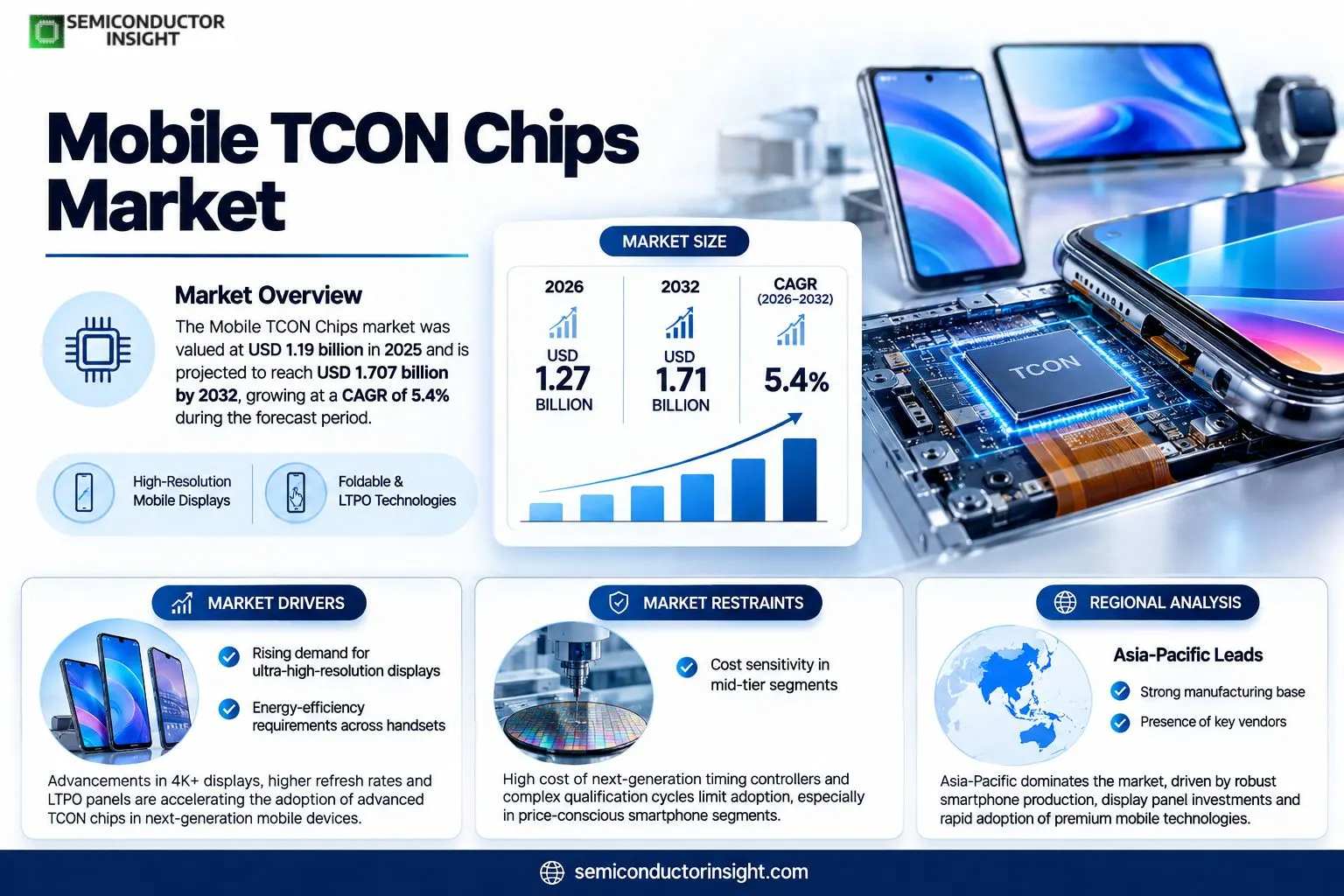
Mobile TCON Chips market was valued at USD 1.19 billion in 2025 and is projected to reach USD 1.707 billion by 2032, exhibiting a CAGR of 5.4% during the forecast period.
Mobile TCON (Timing Controller) chips are semiconductor devices used in mobile displays to regulate timing and control signals between the display panel and the graphics or application processor. They manage pixel rendering, refresh rates, color accuracy and resolution, ensuring smooth high‑quality visual output on smartphones, tablets and wearable devices.The market is experiencing growth because smartphones continue to adopt higher‑resolution panels, adaptive refresh rates of 90 Hz to 120 Hz, and emerging LTPO or foldable technologies that demand more sophisticated timing control. Meanwhile, integration of TCON functionality into driver ICs or SoCs concentrates supply among a limited set of Taiwanese and Korean vendors, while Chinese manufacturers expand in mid‑range segmentscreating both differentiation opportunities for incumbents and high entry barriers for newcomers.
MARKET DRIVERS
Rising Demand for Ultra‑High‑Resolution Displays
Smart‑phone manufacturers are increasingly integrating 4K and beyond panels to differentiate premium models. This shift forces OEMs to source Mobile TCON Chips capable of handling greater pixel counts while preserving latency thresholds, creating a clear incentive for chip vendors to expand capacity.
Energy‑Efficiency Requirements Across Handsets
Battery endurance remains a decisive factor for consumers; consequently, chip designers are prioritising architectures that reduce power draw per frame. The industry’s focus on sub‑10‑milliwatt operation for high‑refresh‑rate screens accelerates investment in advanced process nodes.
➤ “The convergence of higher resolution and lower power targets is reshaping supply strategies for Mobile TCON chips.”
Beyond smartphones, the rollout of 5G-enabled tablets and portable gaming devices intensifies demand for chips that can sustain high‑bandwidth video streams without compromising thermal budgets.
MARKET CHALLENGES
Complex Qualification and Testing Cycles
Every new display generation requires exhaustive validation of timing controllers under diverse lighting and motion scenarios. These cycles extend time‑to‑market and inflate development budgets, especially for smaller OEMs lacking in‑house testing facilities.
Other Challenges
Supply‑Chain Fragility
Geopolitical tensions and the concentration of advanced silicon fabs in limited regions create periodic shortages, compelling manufacturers to maintain buffer inventories that erode margins.
MARKET RESTRAINTS
Cost Sensitivity in Mid‑Tier Segments
While flagship devices can absorb premium TCON pricing, mid‑range smartphonesaccounting for the bulk of shipmentsremain highly price‑conscious. The elevated cost of next‑generation controllers can deter adoption unless manufacturers achieve economies of scale.
MARKET OPPORTUNITIES
Emergence of Foldable and Rollable Form Factors
Foldable smartphones and rollable displays impose unique timing and signaling demands on TCON chips, such as dynamic bezel compensation and flexible substrate compatibility. Suppliers that engineer adaptable controllers stand to capture a niche yet rapidly expanding segment.
Mobile TCON Chips Market Trends
Higher Refresh‑Rate Displays Elevate TCON Value
Smartphone manufacturers have moved almost uniformly toward panels that support 90 Hz, 120 Hz and even 144 Hz refresh rates. The timing‑controller embedded in each display must synchronise pixel output with the graphics processor at a speed that leaves almost no margin for error. Consequently, the functional worth of each Mobile TCON Chip has risen sharply, especially in flagship models where adaptive refresh‑rate algorithms balance performance with battery life. LTPO‑backed OLED panels amplify this effect: they require the TCON to adjust voltage and timing on‑the‑fly, a capability that directly translates into smoother scrolling and lower power draw. As foldable and flexible screens gain market share, the demand for TCONs that can handle irregular signal paths and rapid mode switches has become a decisive factor in product differentiation.
Other Trends
Supply‑Side Consolidation and Integration
The supplier ecosystem is characterised by a handful of firms that dominate high‑end segments, notably Taiwanese and Korean designers that already embed advanced algorithms into their silicon. At the same time, the industry observes a steady migration of basic TCON functions into larger display‑driver ICs or directly into SoCs, shrinking the pool of pure‑play TCON vendors. Chinese companies have made noticeable inroads in mid‑range and entry‑level devices, leveraging local panel makers to shorten design cycles. This dual trendtightening concentration at the top and widening participation at the lower tiercreates a landscape where strategic partnerships are essential for firms that wish to stay relevant in premium applications while still exploiting volume growth in cost‑sensitive segments.
Premiumization Shifts Growth from Volume to Value
While total shipments of mobile devices have levelled off, consumer appetite for premium experiences continues to rise. Flagship smartphones now bundle high‑resolution OLED panels, per‑pixel HDR support and AI‑driven refresh‑rate management, all of which rely on sophisticated timing control. This shift pushes manufacturers to source TCONs that can deliver higher precision, tighter latency budgets and more robust power‑optimization features, raising the average selling price of each chip. For OEMs, the implication is clear: investing in bespoke TCON solutionsoften co‑designed with panel suppliersoffers a pathway to differentiate their devices without inflating the overall bill of materials dramatically. Mobile TCON Chips Market therefore reflects a broader industry move toward value‑added components that underpin the next generation of mobile visual experiences.
COMPETITIVE LANDSCAPEKey Industry Players
Mobile TCON Chips Competitive Overview – 2025‑2032
The Mobile TCON segment remains tightly held by a handful of vendors whose deep integration expertise couples semiconductor design with panel‑level optimization. Samsung’s Display Division leverages its vertical supply chain to embed timing‑control logic directly into its AMOLED driver ICs, securing a dominant share of flagship‑grade smartphones. Novatek, headquartered in Taiwan, commands the mid‑to‑high tier by offering separate TCON solutions that balance performance with cost, a positioning that resonates with Chinese OEMs pursuing premium features without relinquishing margin. This concentration reflects the high entry barriers associated with timing accuracy, power‑saving algorithms, and the need for co‑development with panel manufacturers.Beyond the top tier, a diverse cohort of specialists sustains market depth. Parade Technologies and LX Semicon supply niche‑focused TCONs for foldable and LTPO displays, where flexibility and adaptive refresh demand bespoke timing engines. Himax Technologies and Analogix excel in integrating TCON functions with LVDS/eDP driver ICs for tablet‑class devices, enabling compact board layouts. Magnachip, Raydium, THine Electronics, Focal Tech, Hi‑image Tech and Sunplus Technology address entry‑level and wearable markets, often partnering with regional panel makers to tailor power‑efficiency profiles. Their collective activity keeps the ecosystem responsive to rapid cadence changes in resolution and refresh rates, while also providing alternatives for OEMs wary of over‑reliance on a single supplier.
List of Key Mobile TCON Chips Companies Profiled
- Samsung Electronics
- Novatek Microelectronics Corp.
- Parade Technologies
- LX Semicon
- Himax Technologies
- Analogix
- Magnachip Semiconductor
- Raydium Semiconductor
- THine Electronics
- FocalTech Systems
- Hi‑Image Technologies
- Sunplus Technology
Segment Analysis:
| Segment Category | Sub-Segments | Key Insights |
| By Type |
|
OLED TCON Chip is emerging as the dominant type due to several qualitative factors:
|
| By Application |
|
Mobilephones remain the primary application driver, shaped by evolving display expectations:
|
| By End User |
|
Premium Flagship Devices shape the market trajectory through:
|
| By Panel Technology |
|
LTPO is gaining momentum because:
|
| By Integration Mode |
|
Integrated with Display Driver IC is emerging as the preferred approach because:
|
Regional Analysis: Mobile TCON Chips Market
Asia‑Pacific
The bulk of mobile display fabs are clustered in Taiwan, South Korea, and China, allowing TCON suppliers to embed themselves within the same industrial parks as panel makers. This spatial closeness accelerates prototype feedback loops and trims time‑to‑market for new controller generations.
Smartphone penetration remains vigorous, with consumers gravitating toward higher refresh‑rate and HDR‑capable screens. That appetite drives OEMs to source more sophisticated TCON chips capable of handling increased pixel rates without sacrificing power efficiency.
Regional standards bodies have harmonised interface specifications, yet each market retains distinct certification pathways. Companies that navigate these nuances swiftly can secure faster product introductions and avoid costly redesigns.
Recent disruptions highlighted the need for diversified sourcing of substrates and components. Suppliers are now establishing secondary lines in Vietnam and the Philippines to cushion against geopolitical or pandemic‑related shocks.
North America
North America remains a pivotal arena for Mobile TCON Chips Market because of its concentration of design‑centred firms and early‑adopter consumer base. The United States hosts several chipset innovators that emphasize integration with advanced driver‑level software, catering to high‑end flagship devices. While manufacturing is less localized than in Asia‑Pacific, the region’s strong intellectual‑property framework encourages investment in next‑generation timing‑control architectures. Partnerships between U.S. design houses and Asian fab operators create a trans‑Pacific value chain that balances creativity with cost efficiency.
Europe
European manufacturers value reliability and energy‑efficiency, shaping Mobile TCON Chips Market toward low‑power designs compatible with stringent environmental directives. Countries such as Germany and France nurture collaborations between automotive‑grade semiconductor firms and mobile‑device suppliers, translating rigorous safety standards into robust display‑control solutions. Although the continent imports most silicon, its focus on sustainable production practices influences suppliers to adopt greener manufacturing footprints, thereby impacting product roadmaps worldwide.
South America
In South America, market momentum stems from rising smartphone replacement cycles and a growing appetite for mid‑range devices with premium visual experiences. Local distributors often act as aggregators, bundling TCON chips with display modules sourced from neighboring Asian exporters. The region’s fragmented retail landscape pushes chip providers to offer flexible pricing models and localized technical support, fostering a modest but steady expansion of Mobile TCON Chips Market.
Middle East & Africa
The Middle East & Africa region displays a cautious but upward trajectory in Mobile TCON Chips Market. Rapid urbanisation and increasing penetration of 5G‑enabled smartphones generate demand for higher‑resolution panels, prompting regional importers to seek more capable timing controllers. Business‑to‑business relationships with Asian manufacturers dominate, yet emerging local tech hubs in the United Arab Emirates and Kenya are beginning to explore joint‑development projects that could diversify supply options over the next decade.
Report Scope
This market research report provides a comprehensive analysis of Mobile TCON Chips Market , covering the forecast period 2026–2034. It offers detailed insights into market dynamics, technological advancements, competitive landscape, and key trends shaping the industry.
Key focus areas of the report include:
- Market Overview: The report begins with an overview outlining its current market scenario, key growth indicators, and industry transformation drivers. It discusses macroeconomic factors, demand–supply balance, regulatory landscape, and the strategic role of semiconductors in powering advancements across industries such as automotive, telecommunications, consumer electronics, and industrial automation.
- Market Size & Forecast: Historical data and future projections for revenue, unit shipments, and market value across major regions and segments.
- Segmentation Analysis: Detailed breakdown by product type, technology, application, and end-user industry to identify high-growth segments and investment opportunities.
- Regional Insights: Insights into market performance across North America, Europe, Asia-Pacific, Latin America, and the Middle East & Africa, including country-level analysis where relevant.
- Competitive Landscape: Profiles of leading market participants, including their product offerings, R&D focus, manufacturing capacity, pricing strategies, and recent developments such as mergers, acquisitions, and partnerships.
- Technology Trends & Innovation: Assessment of emerging technologies, integration of AI/IoT, semiconductor design trends, fabrication techniques, and evolving industry standards.
- Market Drivers & Restraints: Evaluation of factors driving market growth along with challenges, supply chain constraints, regulatory issues, and market-entry barriers.
- Stakeholder Insights: Insights for component suppliers, OEMs, system integrators, investors, and policymakers regarding the evolving ecosystem and strategic opportunities.
Primary and secondary research methods are employed, including interviews with industry experts, data from verified sources, and real-time market intelligence to ensure the accuracy and reliability of the insights presented.
FREQUENTLY ASKED QUESTIONS:
What is the current market size of Mobile TCON Chips Market?
-> Mobile TCON Chips Market was valued at USD 1190 million in 2025 and is expected to reach USD 1707 million by 2032, growing at a CAGR of 5.4% during the forecast period.
Which key companies operate in Mobile TCON Chips Market?
-> Key players include Novatek, Parade Technologies, Samsung, LX Semicon, Himax Technologies, Hi-image Tech, Analogix, Magnachip, Raydium, Focal Tech, and THine Electronics.
What are the key growth drivers?
-> Key growth drivers include advancements in high‑resolution and high‑refresh‑rate displays, adoption of LTPO and foldable OLED technologies, increasing demand for power‑efficient timing control, and premium‑segment device differentiation.
Which region dominates the market?
-> Asia dominates Mobile TCON Chips Market, driven by strong manufacturing bases in Taiwan, South Korea, and China, which host most of the leading semiconductor vendors.
What are the emerging trends?
-> Emerging trends include greater integration of TCON functions into SoCs, AI‑enabled display optimization, adaptive refresh‑rate technology for energy savings, and the rise of foldable and flexible display applications.
Get Sample Report PDF for Exclusive Insights
Report Sample Includes
- Table of Contents
- List of Tables & Figures
- Charts, Research Methodology, and more...
 Download Sample Report PDF