Market Insights
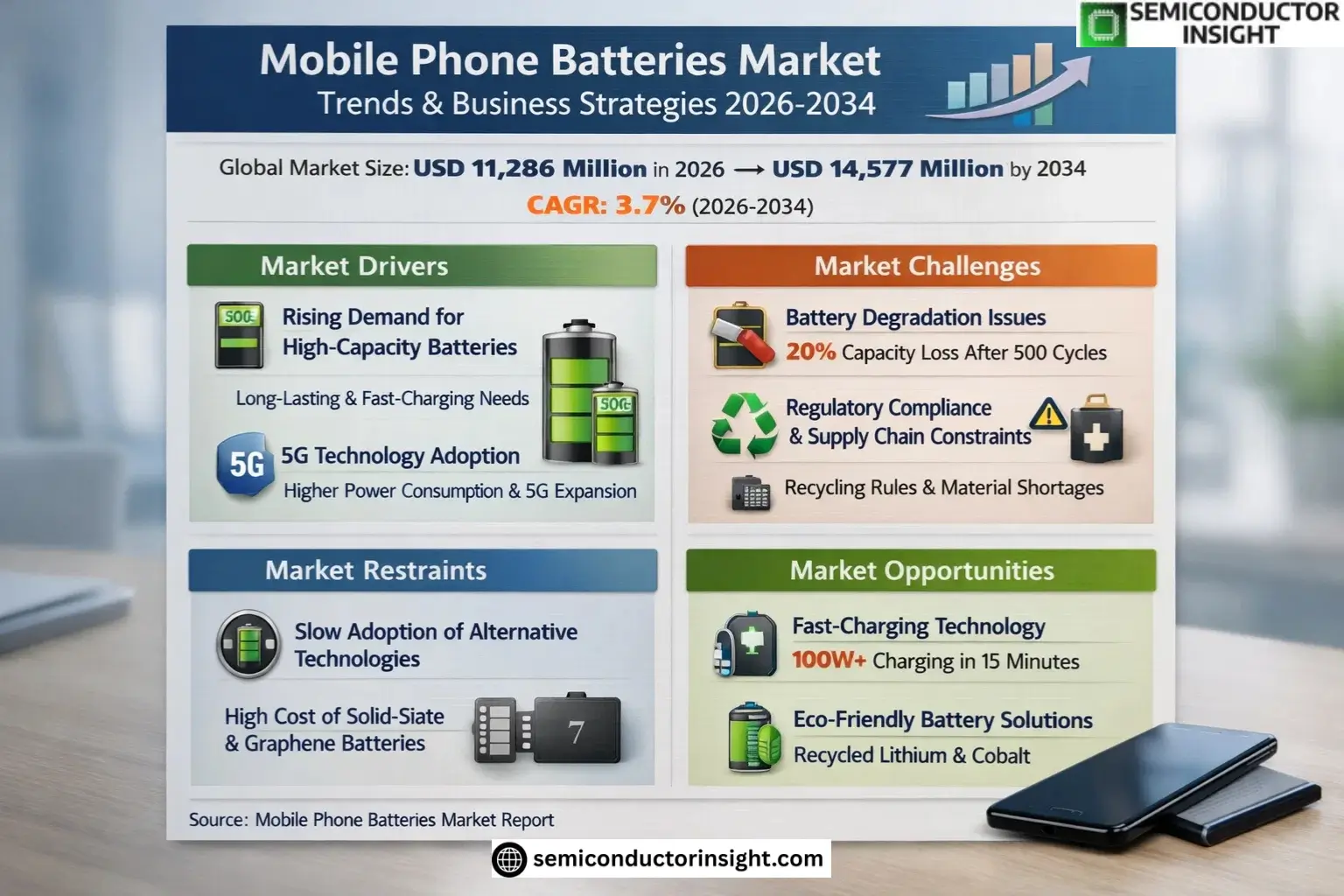
Global Mobile Phone Batteries Market was valued at USD 11,286 million in 2026 and is projected to reach USD 14,577 million by 2034, exhibiting a CAGR of 3.7% during the forecast period.
Mobile phone batteries are core functional components responsible for storing and delivering electrical energy in smartphones, directly influencing battery life, safety, and overall user experience. The mainstream technology is based on lithium-ion and lithium-polymer batteries, primarily in pouch-cell form factors. As smartphones evolve toward higher performance with features like high-refresh-rate displays and 5G connectivity, requirements for energy density, fast-charging compatibility, and thermal management continue to increase.
The market growth is driven by rising smartphone adoption globally alongside advancements in battery technologies. However, challenges such as raw material price volatility and stringent manufacturing quality standards impact industry margins. Key players like ATL, LG Energy Solution, and Samsung SDI dominate the market with strong supply chain integration and R&D investments in next-generation battery solutions.
MARKET DRIVERS
Rising Demand for High-Capacity Batteries
Global Mobile Phone Batteries Market is experiencing growth driven by increasing demand for high-capacity, fast-charging solutions. With smartphone usage averaging 5-6 hours daily, consumers prioritize long-lasting battery performance. Manufacturers are responding with lithium-ion batteries exceeding 5000mAh capacities.
5G Technology Adoption
5G network expansion is significantly impacting battery requirements. 5G phones consume 20-30% more power than 4G devices, creating demand for advanced battery solutions. This technology shift is prompting innovations in energy density and thermal management systems.
Emerging markets are witnessing accelerated smartphone penetration, with Asia-Pacific accounting for 40% of global smartphone shipments, further driving battery demand.
MARKET CHALLENGES
Battery Degradation Issues
Mobile phone batteries typically lose 20% of their capacity after 500 charge cycles, creating consumer dissatisfaction. Manufacturers face technical hurdles in extending battery lifespan while maintaining compact form factors.
Other Challenges
Regulatory Compliance
Strict environmental regulations on battery disposal and recycling in regions like the EU are increasing production costs. The Battery Directive requires 70% recycling efficiency for lithium batteries.
Supply Chain Constraints
The Mobile Phone Batteries Market faces material shortages, particularly for lithium and cobalt. Price fluctuations for these raw materials increased by 18% in 2023 compared to previous year.
MARKET RESTRAINTS
Slow Adoption of Alternative Technologies
Despite research into solid-state and graphene batteries, commercialization remains limited due to high production costs. Current alternatives cost 3-4 times more than conventional lithium-ion batteries, restricting market adoption.
MARKET OPPORTUNITIES
Fast-Charging Technology
The development of 100W+ fast charging solutions presents significant growth potential. Current technologies can charge a 4000mAh battery to 50% in 15 minutes, with further improvements underway. This addresses the critical consumer need for reduced charging times.
Eco-Friendly Battery Solutions
Sustainable battery production using recycled materials is gaining traction. Leading manufacturers are achieving 15-20% cost savings through recycled cobalt and lithium, while meeting environmental standards.
Mobile Phone Batteries Market Trends
Shift Toward High-Energy-Density Battery Solutions
Mobile Phone Batteries Market is experiencing significant demand for higher energy-density solutions as smartphone manufacturers push for improved performance. Modern devices require batteries that can support power-intensive features like high-refresh-rate displays and 5G connectivity without compromising device thickness or weight. Lithium-ion and lithium-polymer pouch-cell batteries remain dominant, representing over 90% of total market volume.
Other Trends
Fast Charging Technology Integration
Smartphone brands are prioritizing fast-charging compatibility, with over 65% of mid-range and flagship models now featuring fast-charging capabilities. Battery manufacturers are responding with optimized cell designs that balance charging speed with thermal management and cycle life. This trend is particularly strong in Asian markets, where over 80% of consumers consider charging speed a critical purchase factor.
Customized Battery Designs for Emerging Form Factors
The rise of foldable smartphones has created demand for specialized battery solutions that can accommodate unique device architectures. Leading manufacturers are developing multi-cell configurations and flexible battery designs to meet these requirements, though production complexity remains a challenge for widespread adoption across all price segments.
Supply Chain Consolidation and Quality Standards
The mobile phone battery industry continues to consolidate around established manufacturers with comprehensive quality management systems. Major smartphone brands increasingly require suppliers to meet stringent safety certifications, with less than 10% of the global supply base qualifying for flagship device partnerships. This trend favors large-scale producers with integrated R&D and manufacturing capabilities.
Sustainability and Regulatory Compliance Pressures
Environmental regulations are driving changes in battery material selection and recycling processes. Over 70% of major manufacturers have implemented dedicated recycling programs, while new EU battery directives are accelerating the adoption of more sustainable production methods throughout the supply chain.
COMPETITIVE LANDSCAPE
Key Industry Players
Concentrated Market Dynamics in Mobile Phone Battery Sector
Mobile Phone Batteries Market is dominated by established Asian manufacturers with deep integration into smartphone supply chains. ATL (Amperex Technology Limited), a subsidiary of TDK Corporation, leads the market with partnerships across Apple, Huawei, and other premium smartphone brands. Samsung SDI and LG Energy Solution maintain strong positions through captive supply to Samsung Electronics and LG smartphones, while also serving external OEMs. These top players control over 60% of the global market share through technological leadership in lithium polymer batteries and fast-charging solutions.
Second-tier suppliers like Sunwoda and Zhuhai CosMX Battery have gained traction with Chinese smartphone brands through competitive pricing and flexible customization. Emerging players such as Huizhou Desay Battery and BYD are focusing on high-growth segments like foldable phone batteries and ultra-fast charging technologies. The market also features specialized manufacturers like Simplo Technology and Dynapack, which provide battery solutions for mid-range smartphone segments with strong presence in the EMS/ODM ecosystem.
List of Key Mobile Phone Battery Companies Profiled
- ATL (Amperex Technology Limited)
- LG Energy Solution
- Samsung SDI
- Zhuhai CosMX Battery
- Sunwoda Electronic
- Huizhou Desay Battery
- Dynapack International Technology
- BYD Company
- Simplo Technology
- Dongguan NVT Technology
- EVE Energy
- Leoch International Technology
- Lishen Battery
- BAK Power Battery
- TWS (Tianjin Lishen Battery)
Segment Analysis:
| Segment Category | Sub-Segments | Key Insights |
| By Type |
|
Lithium-polymer Batteries
|
| By Application |
|
Flagship Segment
|
| By End User |
|
Smartphone OEMs
|
| By Structural Design |
|
Pouch-cell Design
|
| By Charging Capability |
|
Fast-charging Battery
|
Regional Analysis: Asia-Pacific Mobile Phone Batteries Market
Asia-Pacific Dominates Mobile Battery Innovation
China contributes over 60% of global mobile battery production with extensive supply chains and cost advantages. Major OEMs source batteries from Shenzhen-based manufacturers who implement advanced production techniques. Environmental regulations are pushing Chinese firms toward greener battery solutions.
South Korean companies lead in energy density improvements and safety innovations. Samsung SDI and LG Chem develop proprietary battery chemistries for premium smartphones. Collaborations with global smartphone brands ensure continuous technology transfers and joint development projects.
Japan maintains technological leadership through materials science breakthroughs in anode and cathode components. Domestic firms specialize in ultra-thin battery designs for foldable phones. Research institutions collaborate closely with manufacturers on next-generation battery technologies.
Emerging Southeast Asian markets show rapid adoption of affordable smartphones, boosting replacement battery demand. Local assembly plants are establishing battery testing and certification centers. Governments implement quality standards to ensure battery safety in tropical climates.
North America
The North American Mobile Phone Batteries Market emphasizes premium battery solutions and safety standards. U.S. manufacturers focus on specialized batteries for rugged smartphones and military applications. Stringent regulations drive innovation in battery recycling processes. The region shows strong demand for fast-charging technologies compatible with wireless charging ecosystems.
Europe
European markets prioritize sustainable battery solutions with strict environmental regulations shaping product development. German and French research centers lead in developing biodegradable battery components. The EU battery directive influences regional design standards while Nordic countries invest heavily in cold-weather battery performance enhancements.
South America
South America experiences growing demand for cost-effective battery replacements as smartphone adoption increases. Brazil serves as the regional hub for battery distribution with local assembly of entry-level smartphone batteries. Market growth is tempered by fluctuating import regulations and currency volatility affecting component costs.
Middle East & Africa
The MEA region shows divergent trends with Gulf states demanding premium battery solutions while African markets prioritize durability and affordability. Extreme temperatures drive innovation in thermal management systems. Local assembly plants are emerging in key markets to reduce import dependence for mobile phone batteries.
Report Scope
This market research report provides a comprehensive analysis of the Mobile Phone Batteries Market, covering the forecast period 2026–2034. It offers detailed insights into market dynamics, technological advancements, competitive landscape, and key trends shaping the industry.
Key focus areas of the report include:
- Market Overview: The report begins with an overview outlining its current market scenario, key growth indicators, and industry transformation drivers. It discusses macroeconomic factors, demand–supply balance, regulatory landscape, and the strategic role of mobile phone batteries in powering advancements across consumer electronics.
- Market Size & Forecast: Historical data and future projections for revenue, unit shipments, and market value across major regions and segments.
- Segmentation Analysis: Detailed breakdown by product type (lithium-ion, lithium-polymer), structural design (single-cell, multi-cell), charging capability (standard, fast-charging), and application (entry/mid-range, upper mid-range, flagship).
- Regional Insights: Insights into market performance across North America, Europe, Asia, South America, and the Middle East & Africa, including country-level analysis.
- Competitive Landscape: Profiles of leading market participants, including their product offerings, R&D focus, manufacturing capacity, and recent developments.
- Technology Trends & Innovation: Assessment of emerging battery technologies, energy density improvements, fast-charging integration, and structural customization.
- Market Drivers & Restraints: Evaluation of factors driving market growth along with challenges such as raw material volatility and margin pressures.
- Stakeholder Insights: Insights for battery manufacturers, smartphone OEMs, investors, and policymakers regarding the evolving ecosystem.
Primary and secondary research methods are employed, including interviews with industry experts, data from verified sources, and real-time market intelligence to ensure accuracy.
FREQUENTLY ASKED QUESTIONS:
What is the current market size of Mobile Phone Batteries Market?
-> Mobile Phone Batteries Market was valued at USD 11,286 million in 2026 and is projected to reach USD 14,577 million by 2034, exhibiting a CAGR of 3.7% during the forecast period.
What is the growth rate of the Mobile Phone Batteries Market?
-> The market is growing at a CAGR of 3.7% during the forecast period 2026-2034.
Which key companies operate in Mobile Phone Batteries Market?
-> Key players include ATL, LG Energy Solution, Samsung SDI, Zhuhai CosMX Battery, Sunwoda, Huizhou Desay Battery, Dynapack, BYD, Simplo Technology, and Dongguan NVT Technology.
What are the key growth drivers?
-> Key growth drivers include rising smartphone functionality demands, adoption of fast-charging technologies, increasing energy density requirements, and the growth of premium/foldable smartphones.
Which region dominates the market?
-> Asia is the dominant market, accounting for the largest share of production and consumption.
What are the emerging trends?
-> Emerging trends include higher energy density batteries, improved fast-charging solutions, customized battery designs for foldable phones, and tighter system-level integration.
Get Sample Report PDF for Exclusive Insights
Report Sample Includes
- Table of Contents
- List of Tables & Figures
- Charts, Research Methodology, and more...
 Download Sample Report PDF