
Miniature Electroacoustic Components Market Insights
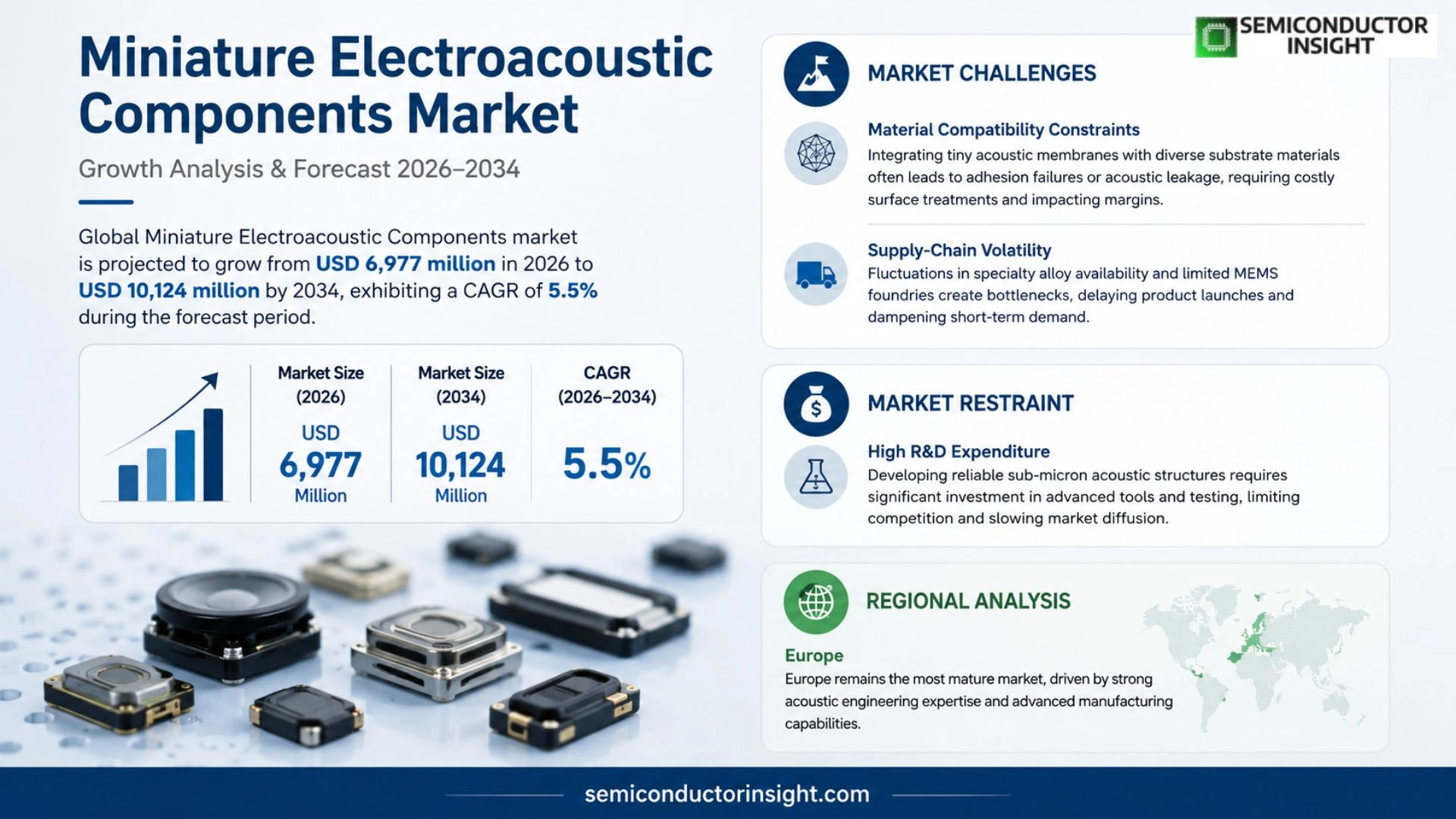
Global Miniature Electroacoustic Components market is projected to grow from USD 6,977 million in 2026 to USD 10,124 million by 2034, exhibiting a CAGR of 5.5% during the forecast period.
Miniature electroacoustic components are highly integrated small‑form‑factor devices that convert acoustic energy into electrical signals or vice versa. They enable sound capture, playback, receiver output and alert‑tone generation within extremely limited space while balancing power consumption, thickness and reliability. Core technologies span traditional electret condenser microphones (ECM), dynamic receivers and micro speakers as well as newer MEMS microphones, balanced‑armature receivers and MEMS microspeakers.
The market’s expansion is fueled by rising demand from OEMs and ODMs designing smartphones, true‑wireless earbuds, hearing aids, AR/VR headsets and automotive cockpit systems. Because these components directly affect speech‑recognition accuracy, call clarity and device form factor, manufacturers are intensifying development of low‑distortion ASIC‑paired solutions and water‑resistant packaging.
MARKET DRIVERS
Broad Adoption in Consumer Electronics
The surge in wearable devices, true‑wireless earbuds, and compact IoT sensors has forced manufacturers to shrink acoustic sub‑systems without sacrificing sound fidelity. As designers integrate miniature acoustic transducers directly onto printed circuit boards, Miniature Electroacoustic Components market experiences a measurable lift in volume. Companies that can deliver sub‑millimeter drivers at competitive yields are seeing increased order books from leading smartphone OEMs.
Advances in MEMS Manufacturing
Micro‑electromechanical‑system (MEMS) processes now support batch‑level production of diaphragms that are thinner and more uniform than legacy technologies. This technical edge reduces part‑to‑part variance, a critical metric for premium audio applications. The result is a greater willingness to allocate budget toward high‑performance miniature modules, reinforcing the market’s upward trajectory.
➤ “The convergence of ultra‑compact form‑factors and high‑resolution audio is reshaping component specifications,” notes a senior analyst at a leading research firm.
In parallel, regulatory frameworks encouraging low‑power operation are nudging OEMs toward smaller, more efficient acoustic parts. The ripple effect is higher procurement cycles for firms that can certify compliance, further energizing Miniature Electroacoustic Components market.
MARKET CHALLENGES
Material Compatibility Constraints
Integrating tiny acoustic membranes with diverse substrate materials (e.g., flexible polymers, high‑temperature ceramics) often triggers adhesion failures or acoustic leakage. These technical hurdles compel designers to adopt costly surface‑treatment steps, compressing margins for component suppliers.
Other Challenges
Supply‑Chain Volatility
Fluctuations in specialty alloy availability and limited numbers of qualified MEMS foundries create bottlenecks. When lead times extend, OEMs may defer product launches, dampening short‑term demand peaks.
MARKET RESTRAINTS
High R&D Expenditure
Developing reliable sub‑micron acoustic structures demands sustained investment in simulation tools, clean‑room facilities, and acoustic testing rigs. Smaller players lacking deep pockets find it difficult to compete, which narrows the competitive landscape and slows overall market diffusion.
Additionally, the precision alignment required for multi‑component assemblies escalates manufacturing complexity. Automating these steps remains an emerging capability; until it matures, labor‑intensive processes keep unit costs elevated, tempering broader adoption.
Finally, the lack of standardized performance metrics across regions hinders cross‑border sales. Buyers often request custom validation data, extending engineering cycles and discouraging smaller vendors from entering the market.
MARKET OPPORTUNITIES
Emerging Applications in Automotive Acoustics
Electric vehicles increasingly rely on active noise‑cancellation and in‑cabin sound enhancement. The tight packaging constraints of dashboard modules create a niche where ultra‑compact electroacoustic parts are indispensable. Suppliers that can certify automotive‑grade reliability are poised to capture a growing slice of Miniature Electroacoustic Components market.
Another promising avenue comes from medical wearables that monitor physiological signals while delivering therapeutic audio cues. These devices demand biocompatible, low‑power acoustic modules, a combination currently underserved by mainstream players. Targeted product development in this segment could unlock a high‑margin revenue stream.
Finally, the rise of edge‑AI audio processing platforms calls for integrated acoustic front‑ends that occupy minimal board real estate. Partnerships between component makers and AI chipset providers could accelerate co‑development, delivering bundled solutions that simplify system‑level design and open new channels for market expansion.
Miniature Electroacoustic Components Market Trends
Technology Convergence and MEMS Penetration
Miniature Electroacoustic Components market is being reshaped by the coexistence of legacy ECM microphones and dynamic receivers with emerging silicon‑based MEMS solutions. MEMS devices now account for a sizable share of new design‑in wins because their integrated ASICs enable tighter power budgets, higher consistency across large production volumes, and easier implementation of advanced audio algorithms such as beamforming and active noise cancellation. OEMs in smartphones, true‑wireless earbuds, and wearable health monitors are selecting MEMS parts not merely for size reduction but for the ability to embed AI‑driven voice interfaces without inflating board real‑estate. At the same time, high‑performance balanced‑armature and dynamic receivers retain relevance in professional‑audio and hearing‑aid niches where ultra‑low distortion and customized acoustic tuning remain decisive. This dual‑track technology landscape forces component suppliers to broaden their portfolios, invest in both silicon process expertise and precision mechanical tooling, and offer module‑level support that couples acoustic design with firmware updates.
Other Trends
Supply‑Chain Resilience and Regional Concentration
East Asia continues to dominate manufacturing capacity, but recent geopolitical frictions and component shortages have prompted leading firms to diversify sourcing across Southeast Asia and Europe. Companies that can certify compliance with REACH, RoHS, IATF 16949, and ASPICE are gaining preferential treatment from automotive and medical device customers, turning regulatory adherence into a competitive moat. Parallel to geographic diversification, many suppliers are moving from discrete part sales toward customized acoustic modules that bundle microphones, drivers, and signal‑processing ASICs. This shift reduces lead‑time variability for ODM partners and creates higher‑margin revenue streams tied to long‑term design‑in contracts rather than unit‑price competition. The emerging “module‑first” approach also aligns with OEM trends toward rapid platform iteration, where a single acoustic package can be re‑used across multiple product families with minimal redesign.
Application Diversification Across Verticals
Beyond the traditional consumer‑electronics base, Miniature Electroacoustic Components market is witnessing accelerated adoption in automotive cockpit systems, smart‑home security nodes, and point‑of‑care medical devices. In automobiles, ultra‑compact microphones enable voice‑command interfaces that function reliably despite cabin noise, while micro‑speakers support alert‑tone feedback for driver‑assist features. Smart‑home hubs benefit from water‑ and dust‑resistant micro‑speakers that can operate continuously in harsh environments. Meanwhile, hearing‑aid manufacturers are exploiting MEMS microspeakers to deliver broader bandwidth within a form factor that fits deeper ear canals, thereby improving user comfort and speech intelligibility. These cross‑industry deployments compel component makers to tailor acoustic performance parameters,such as signal‑to‑noise ratio, frequency response, and power consumption,to the specific regulatory and functional demands of each sector, reinforcing the market’s evolution from a single‑product commodity to a strategic, multi‑vertical platform.
COMPETITIVE LANDSCAPE
Key Industry Players
Miniature Electroacoustic Components – Competitive Landscape Overview
Knowles Corporation dominates the high‑performance segment, leveraging its deep expertise in balanced‑armature receivers and piezoelectric transducers to secure long‑term design‑in agreements with flagship smartphone and hearing‑aid makers. Its scale enables aggressive pricing on MEMS microphones while maintaining strict reliability standards required by automotive and medical OEMs. Sonion A/S complements this position by focusing on acoustic precision for premium earbuds, where signal‑to‑noise ratio and low distortion drive product differentiation. Together, these two firms illustrate a market structure where a handful of legacy players command the bulk of volume, yet must continuously augment their portfolios with ASIC‑paired MEMS solutions to stay relevant across emerging form factors.
Beyond the incumbents, a diverse group of specialists is reshaping the competitive terrain. AAC Technologies, Goertek, and Infineon have expanded MEMS microphone lines to address voice‑assistant growth in wearables and smart‑home devices. STMicroelectronics and Bosch Sensortec push silicon‑based microspeakers into automotive cockpits and AR/VR headsets, capitalising on their extensive automotive‑grade qualification portfolios. Smaller innovators such as xMEMS Labs, USound GmbH, and BSE Co. supply niche modules,buzzers, micro‑actuators, and customised acoustic kits,that enable OEMs to differentiate without redesigning core silicon. This fragmentation creates a dynamic where success depends less on unit price and more on certification breadth, supply‑chain resilience, and the ability to co‑develop algorithmic support for beamforming or noise cancellation.
List of Key Miniature Electroacoustic Components Companies Profiled
- Knowles Corporation
- Sonion A/S
- AAC Technologies Holdings Inc.
- Goertek Inc.
- Infineon Technologies AG
- STMicroelectronics N.V.
- Robert Bosch GmbH
- TXMEMS Labs, Inc.
- USound GmbH
- BD Products Limited
- Hosiden Corporation
- Foster Electric Company, Limited
- Gettop Acoustic Co., Ltd.
- Changzhou CXSound Electronic Co., Ltd.
- TDK Corporation
Segment Analysis:
| Segment Category | Sub-Segments | Key Insights |
| By Type |
|
MEMS Solutions
|
| By Application |
|
Consumer & Emerging Edge
|
| By End User |
|
OEM/ODM Collaboration
|
| By Technology |
|
Technology Convergence
|
| By Delivery Form |
|
Solution‑Oriented Supply
|
Regional Analysis: Miniature Electroacoustic Components Market
Europe
European design houses blend acoustic modeling with additive manufacturing, enabling geometries unattainable through conventional tooling. This approach shortens development cycles and unlocks performance gains that translate into higher‑fidelity sound in compact devices.
Harmonised EU directives on electromagnetic compatibility and environmental compliance create a predictable framework. Companies that align early with these standards avoid costly redesigns, giving them a competitive advantage in downstream markets.
A dense network of specialized component suppliers across Germany, France, and Italy reduces lead‑time volatility. Localised sourcing also mitigates geopolitical shocks that can disrupt longer offshore supply chains.
OEMs in wearables and smart‑home devices increasingly request modules with sub‑millimeter footprints. European firms respond with modular platforms that can be integrated across product families, enhancing volume flexibility.
North America
The United States drives adoption of miniature acoustic solutions through its large consumer‑electronics ecosystem. Venture capital activity fuels start‑ups that experiment with MEMS‑based transducers, challenging incumbents to accelerate their own R&D pipelines. At the same time, the region’s focus on acoustic branding,especially in premium automotive interiors,creates niche opportunities for highly engineered components that deliver nuanced sound signatures.
Asia‑Pacific
Asia‑Pacific offers the highest volume potential, spurred by rapid growth in mobile device manufacturing and a burgeoning IoT sector. Suppliers in China, South Korea, and Taiwan capitalize on economies of scale, pushing unit costs down while expanding product breadth. However, divergent regulatory standards across the sub‑region compel manufacturers to adopt flexible design architectures to remain globally competitive.
South America
Brazil and Argentina lead regional activity, mainly through localized assembly of consumer gadgets that embed miniature electroacoustic parts. While overall market size remains modest, governmental incentives for high‑tech manufacturing encourage partnerships with European firms, facilitating technology transfer and skill development.
Middle East & Africa
Growth in Miniature Electroacoustic Components market is anchored to infrastructure upgrades in the Gulf’s smart‑city projects. Emerging automotive assembly plants in the United Arab Emirates seek compact acoustic modules for cabin‑level sound management, prompting early‑stage collaborations with established European suppliers.
Report Scope
This market research report provides a comprehensive analysis of the Miniature Electroacoustic Components Market , covering the forecast period 2026–2034. It offers detailed insights into market dynamics, technological advancements, competitive landscape, and key trends shaping the industry.
Key focus areas of the report include:
- Market Overview: The report begins with an overview outlining its current market scenario, key growth indicators, and industry transformation drivers. It discusses macroeconomic factors, demand–supply balance, regulatory landscape, and the strategic role of semiconductors in powering advancements across industries such as automotive, telecommunications, consumer electronics, and industrial automation.
- Market Size & Forecast: Historical data and future projections for revenue, unit shipments, and market value across major regions and segments.
- Segmentation Analysis: Detailed breakdown by product type, technology, application, and end-user industry to identify high-growth segments and investment opportunities.
- Regional Insights: Insights into market performance across North America, Europe, Asia-Pacific, Latin America, and the Middle East & Africa, including country-level analysis where relevant.
- Competitive Landscape: Profiles of leading market participants, including their product offerings, R&D focus, manufacturing capacity, pricing strategies, and recent developments such as mergers, acquisitions, and partnerships.
- Technology Trends & Innovation: Assessment of emerging technologies, integration of AI/IoT, semiconductor design trends, fabrication techniques, and evolving industry standards.
- Market Drivers & Restraints: Evaluation of factors driving market growth along with challenges, supply chain constraints, regulatory issues, and market-entry barriers.
- Stakeholder Insights: Insights for component suppliers, OEMs, system integrators, investors, and policymakers regarding the evolving ecosystem and strategic opportunities.
Primary and secondary research methods are employed, including interviews with industry experts, data from verified sources, and real-time market intelligence to ensure the accuracy and reliability of the insights presented.
FREQUENTLY ASKED QUESTIONS:
What is the current market size of Miniature Electroacoustic Components Market?
-> Miniature Electroacoustic Components market is projected to grow from USD 6,977 million in 2026 to USD 10,124 million by 2034, exhibiting a CAGR of 5.5%
Which key companies operate in Miniature Electroacoustic Components Market?
-> Key players include AAC Technologies Holdings Inc., Knowles Corporation, Sonion A/S, STMicroelectronics N.V., Infineon Technologies AG, Bosch Sensortec, xMEMS Labs, Inc., TDK Corporation, Goertek Inc., Hosiden Corporation, Gettop Acoustic Co., Ltd., BSE Co., Ltd., and other leading acoustic component manufacturers.
What are the key growth drivers?
-> Key growth drivers include rising demand for consumer electronics, expansion of smart automotive and medical device applications, increasing adoption of MEMS technologies, AI‑enabled voice interaction, noise‑cancellation and spatial‑audio capabilities, and the push for miniaturization and low‑power solutions in wearables and AR/VR devices.
Which region dominates the market?
-> Asia, particularly East Asia, remains the dominant region, driven by extensive manufacturing bases, strong OEM demand for smartphones, wearables, automotive cockpit systems, and a robust supply‑chain ecosystem.
What are the emerging trends?
-> Emerging trends include greater MEMS penetration, integration of acoustic components with AI/IoT platforms, development of modularized and customizable acoustic solutions, stricter compliance with automotive and environmental standards, and the convergence of audio technologies across consumer, automotive, medical, and industrial segments.

Get Sample Report PDF for Exclusive Insights
Report Sample Includes
- Table of Contents
- List of Tables & Figures
- Charts, Research Methodology, and more...
