MIMO Radar IC Market Insights
MIMO Radar IC market size was valued at USD 1,027 million in 2025 and is expected to reach USD 1,767 million by 2034, reflecting a CAGR of 8.3% over the forecast period.
Multiple‑input multiple‑output (MIMO) radar chips are high‑performance integrated circuits that enable simultaneous transmission and reception on several channels. By employing multiple antenna arrays they improve spatial diversity and anti‑jamming capability, making them essential for applications such as defense surveillance, aviation navigation, weather monitoring and intelligent transportation.The upward trajectory of the market stems from rising defense budgets, expanding autonomous‑vehicle programs and increasing demand for precise environmental sensing. Upstream suppliersincluding semiconductor fabs, RF component makers and antenna manufacturersbenefit from capacity utilization rates around 82 % and average selling prices near USD 45 per unit. Downstream adopters range from military agencies and aerospace firms to smart‑city infrastructure providers. Ongoing policy support for advanced radar technologies together with breakthroughs in signal‑processing algorithms and AI‑enhanced data fusion further strengthen adoption across civilian and military domains.
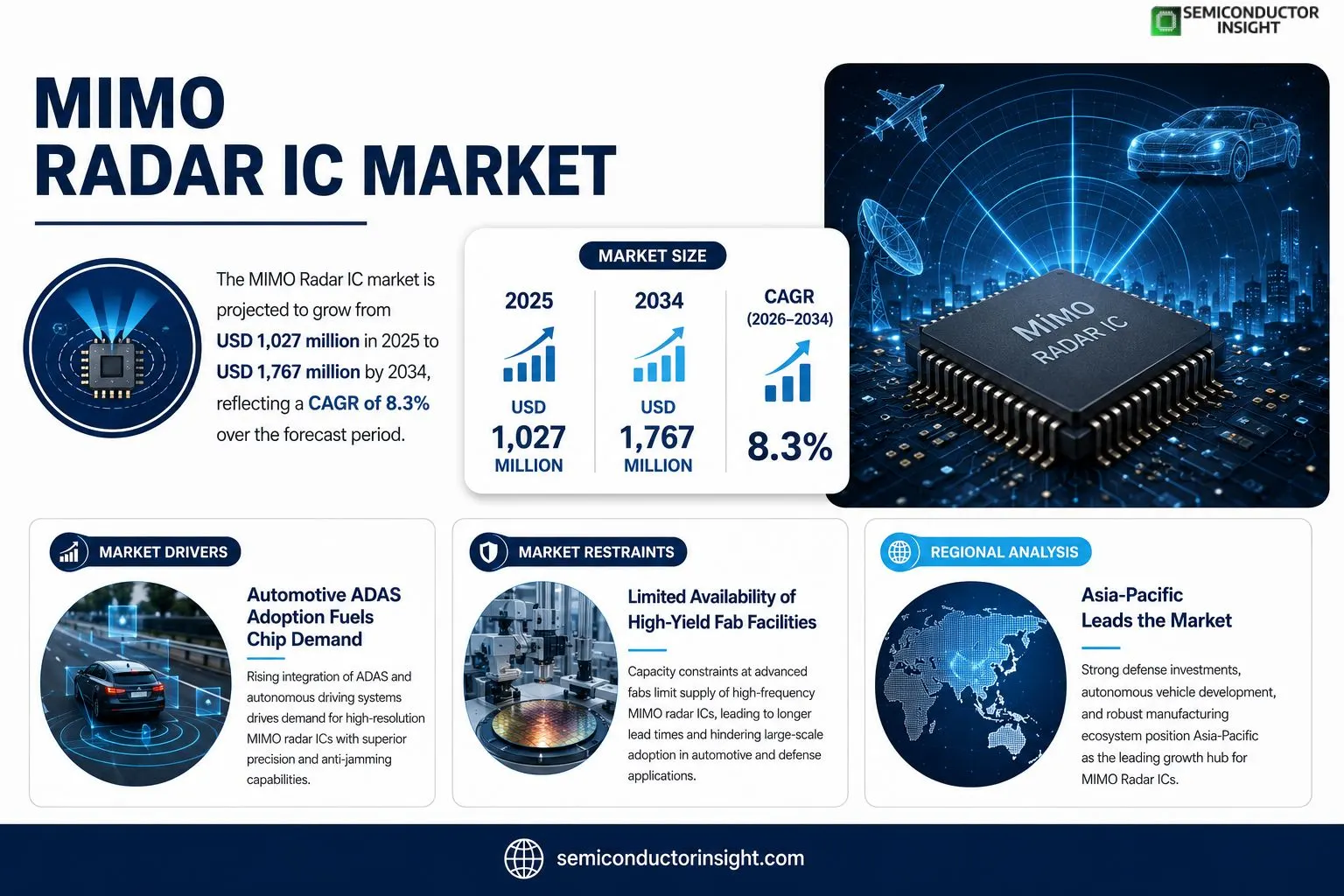
MARKET DRIVERS
Automotive ADAS Adoption Fuels Chip Demand
Vehicle manufacturers are integrating advanced driver‑assistance systems (ADAS) across a broader model range, prompting a sharp rise in the need for high‑resolution sensing solutions. MIMO Radar ICs deliver the angular precision required for lane‑keeping, adaptive cruise control, and collision avoidance, making them a preferred choice over single‑input designs. This shift not only expands the addressable volume of automotive electronics but also shortens development cycles for OEMs seeking to meet regulatory safety standards.
5G‑Enabled Infrastructure Consolidates Radar Deployment
Telecom operators are deploying dense 5G small‑cell networks that integrate sensing functions to enable smart‑city services such as traffic monitoring and drone traffic management. The convergence of communications and radar on a single MIMO IC platform reduces bill‑of‑materials and eases integration, encouraging municipalities to allocate budget for radar‑enhanced broadband projects. Consequently, the non‑automotive segment of MIMO Radar IC Market has been registering double‑digit annual growth.
➤ Manufacturers that co‑design radar ASICs with system‑level partners gain a time‑to‑market advantage, capturing early orders from both automotive OEMs and telecom providers.
Supply‑chain resilience, bolstered by on‑shoring initiatives in semiconductor fabrication, has lowered lead times for critical RF components. As a result, system integrators can plan multi‑year product roadmaps with greater confidence, reinforcing demand for scalable MIMO Radar IC solutions.
MARKET CHALLENGES
Cost Pressures in High‑Volume Production
Although the unit price of MIMO Radar ICs has fallen steadily, manufacturers still confront margin compression when scaling to automotive volumes of several hundred million units per year. The need for advanced packagingsuch as silicon‑in‑silicon interposersadds a fixed overhead that small players struggle to amortize, potentially limiting market entry to a handful of well‑capitalized firms.
Other Challenges
Regulatory Fragmentation
Differing radar frequency allocations across regions (e.g., 76‑81 GHz in Europe versus 77‑81 GHz in North America) compel designers to create multiple device variants, inflating engineering effort and inventory complexity.
MARKET RESTRAINTS
Limited Availability of High‑Yield Fab Facilities
Only a small number of foundries currently offer the sub‑10 µm lithography required for high‑frequency MIMO Radar ICs with low phase noise. Capacity constraints at these fabs translate into longer lead times, which in turn discourages some OEMs from committing to large‑scale radar projects until supply certainty improves.
MARKET OPPORTUNITIES
Emerging Defense and Aerospace Applications
Defense contractors are modernizing legacy radar arrays with compact MIMO ICs that enable multi‑target tracking and electronic‑counter‑measure resilience. The aerospace sector, meanwhile, is exploring lightweight radar modules for unmanned aerial vehicles, where size, weight, and power (SWaP) constraints are paramount. These niches present high‑margin opportunities for vendors that can certify their designs to stringent MIL‑STD requirements, potentially adding several hundred million dollars to the overall MIMO Radar IC Market in the next five years.
MIMO Radar IC Market Trends
AI‑Augmented Signal Processing Boosts Chip Capability
MIMO Radar IC Market is witnessing a shift as developers embed artificial‑intelligence modules directly into the radar chip stack. By merging real‑time beam‑forming algorithms with on‑chip neural networks, manufacturers can deliver detection ranges that exceed traditional limits while trimming processing latency. This technical evolution satisfies the rising demand from autonomous‑vehicle OEMs for instantaneous obstacle classification, and from defense agencies for rapid target discrimination in contested spectra. The ripple effect is evident in pricing trends: despite an average selling price of roughly US$45 per unit, profit margins remain strong at 40‑45 %, reflecting the premium value placed on enhanced analytics capability.
Other Trends
Distributed MIMO Architectures Gain Market Share
Clients in aerospace and smart‑city infrastructure are increasingly opting for distributed antenna configurations rather than centralized arrays. The approach spreads transceiver elements across a wider physical footprint, mitigating line‑of‑sight constraints and improving resilience against jamming. Adoption rates have nudged the segment’s share upward, prompting semiconductor fabs to re‑engineer wafer layouts for higher inter‑connect density. Cost composition data reveals that RF component and antenna system expenses now account for about 30 % of total outlays, underscoring the strategic importance of supply‑chain alignment with antenna manufacturers.
Policy‑Backed Investment Fuels Deployment in Defense and Smart‑Mobility
Government programmes targeting advanced radar capabilities have allocated substantial funding to both military reconnaissance platforms and civilian traffic‑management networks. This fiscal support cushions the capital intensity of R&D, where design and verification activities consume roughly 35 % of the overall cost structure. As a result, MIMO Radar IC Market’s revenue trajectory climbs from US$1.03 billion in 2025 toward an estimated US$1.77 billion by 2034, with unit shipments projected to reach 25 million pieces in 2025. The convergence of defense‑grade reliability requirements and the push for low‑emission, high‑resolution traffic monitoring creates a cross‑sector demand curve that compels original equipment manufacturers to embed radar modules early in product roadmaps.
COMPETITIVE LANDSCAPE
Key Industry Players
MIMO Radar IC Competitive Overview – 2025 & Beyond
The MIMO radar IC arena is dominated by a handful of semiconductor powerhouses that leverage deep R&D budgets and mature fabs to sustain margins above 40 %. Texas Instruments remains the de‑facto leader, chiefly because its 77‑GHz radar portfolio integrates low‑loss RF front‑ends with an in‑house digital processor, allowing system integrators to shave bill‑of‑materials costs while meeting the 80 % capacity utilization benchmark. Close behind, NXP Semiconductors and Infineon capture a sizeable share of automotive‑grade modules, thanks to aggressive IP‑centric design cycles that compress time‑to‑market for autonomous‑driving OEMs. Analog Devices differentiates itself through high‑resolution signal‑processing cores that address defense‑grade anti‑jamming requirements, a segment that commands premium pricing and drives the overall gross‑profit envelope. Collectively, these four firms command roughly two‑thirds of revenue, structuring the market into a tiered hierarchy where scale, RF‑design expertise, and proximity to end‑user specifications dictate competitive advantage.Beyond the tier‑one cluster, a diverse set of niche players fuels innovation in frequency‑band specialization and form‑factor optimization. Qorvo and Skyworks excel in compact antenna‑array integration, enabling cost‑effective deployment in intelligent‑transportation sensors. Murata and Keysight supply high‑precision test and verification equipment, creating an ecosystem that accelerates iteration cycles for emerging 81 GHz‑plus designs. Smaller but technically agile firms such as Fujitsu, Renesas, and Marconi focus on custom‑ASIC solutions for meteorological and air‑space‑surveillance applications, where reliability under extreme environmental stress is paramount. Broadcom’s recent acquisition of a radar‑front‑end portfolio signals a strategic pivot toward data‑fusion‑centric architectures, potentially reshaping value chains for AI‑enhanced perception systems. This breadth of specialized contributors ensures that the market does not become a monolith but remains responsive to divergent end‑user demands across defense, aerospace, and smart‑city domains.
List of Key MIMO Radar IC Companies Profiled
- Texas Instruments
- NXP Semiconductors
- Infineon Technologies
- Analog Devices
- Qorvo
- Skyworks Solutions
- Murata Manufacturing
- Keysight Technologies
- Fujitsu Limited
- Renesas Electronics
- Marconi Electronics
- Broadcom Inc.
- STMicroelectronics
- NEC Corporation
- MediaTek Inc.
Segment Analysis:
| Segment Category | Sub-Segments | Key Insights |
| By Type |
|
Above 81 GHz
|
| By Application |
|
Autonomous driving
|
| By End User |
|
Defense agencies
|
| By Architecture |
|
Distributed MIMO radar chip
|
| By Integration Level |
|
Integrated sensor‑fusion IC
|
Regional Analysis: MIMO Radar IC Market
North America
Government contracts for next‑generation fighter radars drive demand for high‑precision MIMO ICs, prompting local fabs to prioritize low‑latency production lines. The downstream effect is a spillover of capabilities into commercial automotive applications.
Tier‑1 suppliers tap North American design houses to integrate multi‑beam radar modules, shortening time‑to‑market for advanced driver‑assistance systems that comply with emerging safety standards.
Proximity between silicon fabs, packaging partners, and test labs reduces lead times, enabling iterative refinement of antenna‑array configurations without incurring extensive logistics overhead.
Universities in Massachusetts and Arizona feed graduate talent directly into start‑ups focused on mmWave circuitry, ensuring a continuous influx of fresh ideas and expertise.
Europe
European manufacturers balance legacy radar expertise with a growing emphasis on sustainable mobility. German and French defense firms, accustomed to stringent certification regimes, embed rigorous validation steps into MIMO IC development, raising overall reliability. Simultaneously, the EU’s focus on green technologies incentivizes automotive OEMs to adopt radar solutions that improve energy efficiency through better object‑tracking algorithms. The convergence of these forces creates a market where high‑performance chips coexist with regulatory compliance, prompting local suppliers to differentiate through precision engineering rather than sheer volume.
Asia‑Pacific
The Asia‑Pacific corridor benefits from expansive manufacturing capacity and aggressive cost optimization. Chinese semiconductor giants leverage economies of scale to produce MIMO Radar ICs at lower price points, attracting budget‑conscious vehicle makers. Japan, however, counters with premium designs that prioritize low power consumption, catering to the high‑end segment of autonomous taxis. The regional dynamic is therefore a dichotomy: cost‑driven mass production on one side, ultra‑efficient niche products on the other, each shaping distinct adoption pathways across the continent.
South America
In South America, emerging economies view MIMO Radar technology as a catalyst for modernizing transport infrastructure. Brazil’s recent aerospace initiatives have spurred collaborations with North American chip designers, fostering technology transfer that elevates local design capabilities. While market size remains modest, the region’s focus on building indigenous expertise hints at a longer‑term shift toward self‑reliance, potentially opening avenues for regional standards that differ from those in mature markets.
Middle East & Africa
The Middle East leverages sovereign wealth funds to invest in advanced radar research, seeking to embed these capabilities into defense and smart‑city projects. African nations, still at an early adoption stage, explore partnerships with European firms to pilot radar‑enhanced traffic management systems. Though overall demand is nascent, strategic funding and pilot deployments signal a gradual build‑up of market interest, positioning the region as a future growth frontier for specialized MIMO Radar IC solutions.
Report Scope
This market research report provides a comprehensive analysis of the MIMO Radar IC Market , covering the forecast period 2026–2034. It offers detailed insights into market dynamics, technological advancements, competitive landscape, and key trends shaping the industry.
Key focus areas of the report include:
- Market Overview: The report begins with an overview outlining its current market scenario, key growth indicators, and industry transformation drivers. It discusses macroeconomic factors, demand–supply balance, regulatory landscape, and the strategic role of semiconductors in powering advancements across industries such as automotive, telecommunications, consumer electronics, and industrial automation.
- Market Size & Forecast: Historical data and future projections for revenue, unit shipments, and market value across major regions and segments.
- Segmentation Analysis: Detailed breakdown by product type, technology, application, and end-user industry to identify high-growth segments and investment opportunities.
- Regional Insights: Insights into market performance across North America, Europe, Asia-Pacific, Latin America, and the Middle East & Africa, including country-level analysis where relevant.
- Competitive Landscape: Profiles of leading market participants, including their product offerings, R&D focus, manufacturing capacity, pricing strategies, and recent developments such as mergers, acquisitions, and partnerships.
- Technology Trends & Innovation: Assessment of emerging technologies, integration of AI/IoT, semiconductor design trends, fabrication techniques, and evolving industry standards.
- Market Drivers & Restraints: Evaluation of factors driving market growth along with challenges, supply chain constraints, regulatory issues, and market-entry barriers.
- Stakeholder Insights: Insights for component suppliers, OEMs, system integrators, investors, and policymakers regarding the evolving ecosystem and strategic opportunities.
Primary and secondary research methods are employed, including interviews with industry experts, data from verified sources, and real-time market intelligence to ensure the accuracy and reliability of the insights presented.
FREQUENTLY ASKED QUESTIONS:
What is the current market size of MIMO Radar IC Market?
-> MIMO Radar IC Market was valued at USD 1027 million in 2025 and is expected to reach USD 1767 million by 2034, at a CAGR of 8.3% during the forecast period.
Which key companies operate in MIMO Radar IC Market?
-> Key players include upstream semiconductor manufacturers, RF component suppliers, antenna array manufacturers, as well as downstream defense equipment manufacturers, aerospace firms, and intelligent transportation system suppliers.
What are the key growth drivers?
-> Key growth drivers include increasing demand for intelligence, networking, and automation; military‑civilian integration applications; policy support for advanced radar technologies; and technological innovations such as AI‑enhanced signal processing.
Which region dominates the market?
-> The market shows strong activity across North America, Europe, and Asia‑Pacific, with Asia‑Pacific emerging as a leading growth hub due to extensive defense investments and autonomous‑vehicle development.
What are the emerging trends?
-> Emerging trends include integration of AI and advanced signal‑processing algorithms, expansion of 5G‑enabled autonomous driving solutions, and increased adoption in smart‑city and meteorological monitoring applications.
Get Sample Report PDF for Exclusive Insights
Report Sample Includes
- Table of Contents
- List of Tables & Figures
- Charts, Research Methodology, and more...
 Download Sample Report PDF