Middle East AI Smart Oil Pipeline Leak Detection Sensor Chip Market Insights
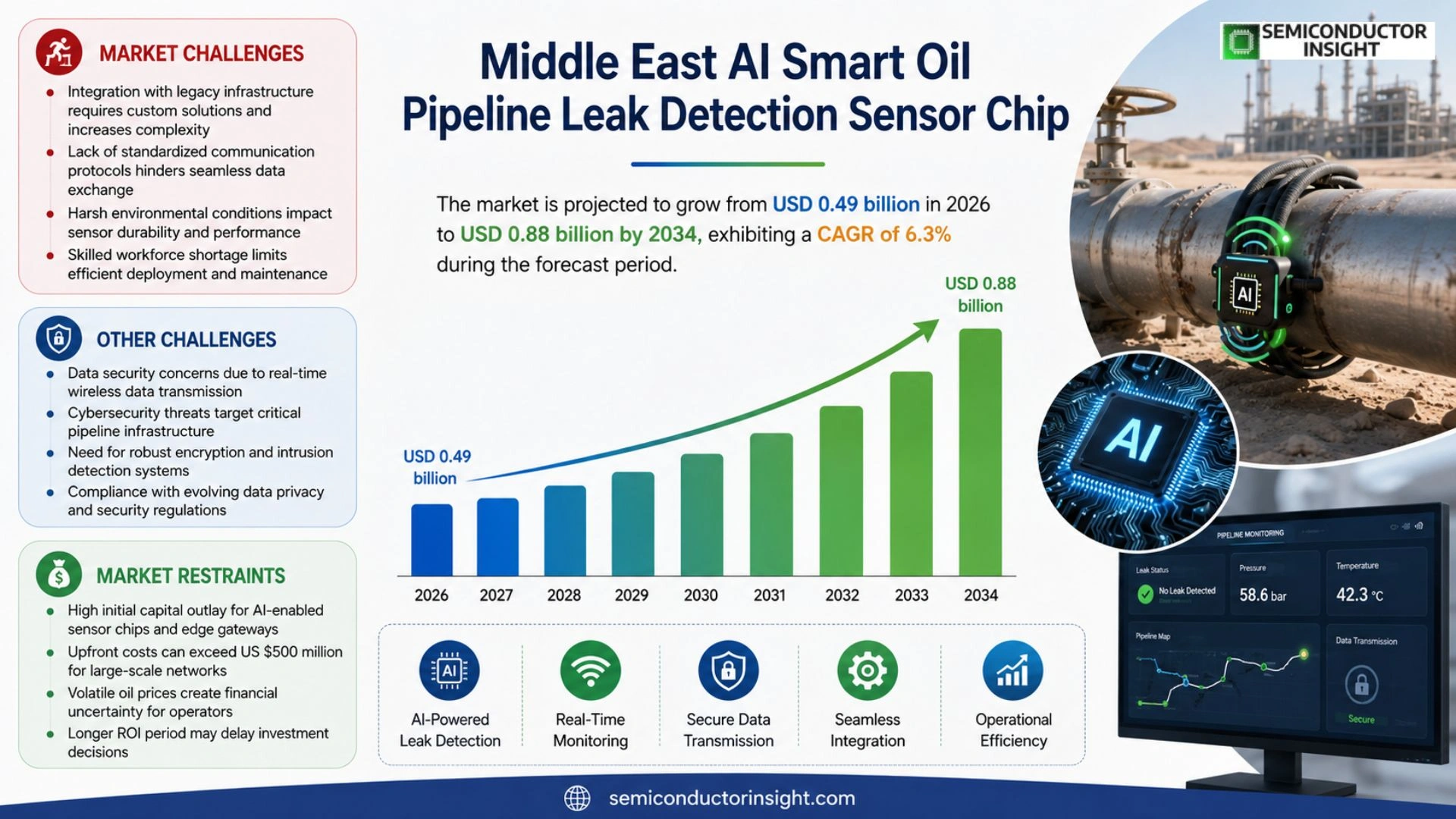
Global Middle East AI Smart Oil Pipeline Leak Detection Sensor Chip market size was valued at USD 0.46 billion in 2025. The market is projected to grow from USD 0.49 billion in 2026 to USD 0.88 billion by 2034, exhibiting a CAGR of 6.3% during the forecast period.
AI‑smart oil pipeline leak detection sensor chips combine MEMS pressure transducers, acoustic resonators and embedded machine‑learning processors that analyse vibration patterns and hydrocarbon signatures in real time. By performing edge inference on‑chip, these devices can differentiate between normal operational noise and minute leak events, enabling autonomous shut‑down or alert generation within seconds. Their low power consumption, rugged packaging for harsh environments and seamless integration into existing SCADA networks make them essential for enhancing safety, reducing environmental impact and optimising maintenance cycles across the Middle East’s extensive oil transport infrastructure.
MARKET DRIVERS
Regulatory Pressure Boosts Adoption
The Gulf Cooperation Council has tightened emission standards for oil transport, compelling operators to install advanced leak detection systems. As a result, Middle East AI Smart Oil Pipeline Leak Detection Sensor Chip Market sees a surge in demand from national oil companies seeking compliance and reduced fines.
Technological Advancements in AI Sensors
Recent breakthroughs in edge‑AI processing enable sensor chips to analyze vibration and acoustic signatures in real time, decreasing false‑positive rates to below 2 %. This reliability fuels capital investment, with several projects allocating up to 15 % of retrofit budgets to AI‑enabled chips.
➤ “Deploying AI sensor chips reduces unplanned shutdowns by an estimated 30 % and cuts spill remediation costs by half.”
Infrastructure‑as‑a‑service models further lower entry barriers, allowing smaller exploration firms to access the same detection capabilities without heavy upfront spending.
MARKET CHALLENGES
Integration with Legacy Infrastructure
Older pipelines lack standardized communication protocols, making seamless data exchange with modern AI chips difficult. Engineers often need custom adapters, which extend project timelines and raise integration costs.
Other Challenges
Data Security Concerns
The transmission of real‑time leak data over wireless networks raises cybersecurity worries. Operators must invest in encryption and intrusion‑detection systems to protect critical infrastructure.
MARKET RESTRAINTS
High Initial Capital Outlay
Although long‑term savings are evident, the upfront cost of AI‑enabled sensor chips and supporting edge gateways can exceed US $500 million for large‑scale networks. Financial constraints in volatile oil price environments may delay adoption.
Skilled Workforce Shortage
Deploying and maintaining sophisticated AI detection systems requires specialized data scientists and field technicians. The current talent pool in the region is limited, leading to longer training cycles and higher labor expenses.
MARKET OPPORTUNITIES
Expansion into Remote Offshore Fields
Offshore platforms in the Red Sea and Arabian Gulf are integrating AI sensor chips to monitor hard‑to‑reach sections of pipeline. This creates a niche market where ruggedized chips with low power consumption are highly valued.
Partnerships with Digital‑Twin Providers
Collaborations between chip manufacturers and digital‑twin solution vendors enable predictive maintenance simulations, opening new revenue streams and encouraging end‑to‑end ecosystem contracts.
Middle East AI Smart Oil Pipeline Leak Detection Sensor Chip Market Trends
Edge‑AI Integration Enables Real‑Time Leak Detection
The deployment of AI‑enabled sensor chips is reshaping leak monitoring across the Middle East’s extensive pipeline network. By embedding machine‑learning inference directly on the chip, the devices evaluate vibration signatures and hydrocarbon fingerprints within milliseconds, allowing autonomous shutdown or alert generation without reliance on central servers. This edge‑computing capability reduces latency, curtails data‑bandwidth requirements, and improves reliability in remote locations where communications may be intermittent. Operators report a measurable decline in false‑positive alarms, which translates into fewer unnecessary maintenance trips and lower operational expenditures. The trend reflects a broader industry shift toward digitized safety mechanisms that combine low power draw, rugged design, and seamless integration with existing supervisory control and data acquisition (SCADA) platforms.
Other Trends
Rugged Packaging for Harsh Desert Conditions
Sensor chips destined for the Middle East must endure extreme temperature swings, high humidity, and abrasive sand exposure. Manufacturers are introducing hermetic ceramic enclosures and conformal coating techniques that protect MEMS pressure transducers and acoustic resonators from corrosion and mechanical shock. These packaging advances maintain calibration stability over the device’s lifecycle, thus preserving detection accuracy even after prolonged field exposure. Additionally, the incorporation of low‑temperature co‑fire processes enables the chips to operate reliably at temperatures exceeding 120 °C, a critical requirement for installations near upstream processing facilities and offshore platforms. The robust form factor not only extends service intervals but also aligns with regional regulatory expectations for equipment resilience.
SCADA Compatibility Enhances Operational Efficiency
Interoperability with legacy SCADA systems remains a decisive factor for widespread adoption. The latest sensor chips feature standardized communication protocols such as Modbus TCP/IP and OPC UA, allowing seamless data aggregation into central monitoring dashboards. Real‑time analytics derived from on‑chip processing are presented alongside traditional sensor streams, providing operators with a unified view of pipeline health. This convergence reduces the need for separate diagnostic tools and simplifies training requirements for maintenance crews. Furthermore, the ability to trigger automated valve closures directly from the sensor node shortens response times during leak events, mitigating environmental impact and preserving product integrity. The combined effect of edge intelligence and SCADA alignment is fostering a more proactive maintenance culture across the region’s oil transport infrastructure.
COMPETITIVE LANDSCAPE
Key Industry Players
Competitive Overview of Middle East AI Smart Oil Pipeline Leak Detection Sensor Chip Market
The market is anchored by a handful of multinational industrial‑automation and oil‑field‑service giants that have leveraged deep R&D investments to integrate MEMS transducers with edge‑AI processors. Honeywell drives the segment with its “SmartSense” chip family, offering end‑to‑end analytics that are already embedded in Saudi Arabia’s mainline pipelines. Siemens and ABB follow closely, delivering modular sensor platforms that align with regional SCADA standards and benefit from extensive service networks across the Gulf. GE Oil & Gas, Schlumberger and Halliburton round out the top tier, each supplying proprietary firmware that supports real‑time leak classification, thereby shaping a market structure where scale, integration capability and long‑term service contracts dominate competitive advantage.
Beyond the tier‑one firms, a diverse set of niche and specialist players enriches the ecosystem. STMicroelectronics and Texas Instruments contribute high‑precision MEMS pressure cores that are repackaged by regional system integrators. Infineon and Analog Devices focus on low‑power AI inference engines tailored for harsh desert conditions. Local petrochemical conglomerates such as Saudi Aramco, Qatar Petroleum and Abu Dhabi National Oil Company (ADNOC) have launched in‑house sensor programs that combine domestic semiconductor sourcing with custom analytics. Meanwhile, emerging technology firms like Saipem, NXP Semiconductors and Yokogawa add value through specialized acoustic resonator designs and cloud‑connected diagnostics, ensuring that the competitive landscape remains vibrant and innovation‑driven.
List of Key AI Smart Oil Pipeline Leak Detection Sensor Chip Companies Profiled
- Honeywell International Inc.
- Siemens AG
- ABB Ltd.
- GE Oil & Gas
- Schlumberger Limited
- Halliburton Company
- STMicroelectronics
- Texas Instruments
- Infineon Technologies AG
- Analog Devices, Inc.
- Saudi Aramco
- Qatar Petroleum
- Abu Dhabi National Oil Company (ADNOC)
- Saipem
- NXP Semiconductors
- Yokogawa Electric Corporation
Segment Analysis:
| Segment Category | Sub-Segments | Key Insights |
| By Type |
|
MEMS‑based sensor chips are the dominant type because they offer robust pressure sensing combined with low power consumption.
|
| By Application |
|
Real‑time leak detection drives market traction as operators prioritize immediate response to prevent environmental damage.
|
| By End User |
|
National oil corporations dominate usage because they oversee the largest network of high‑capacity pipelines across the region.
|
| By Deployment Mode |
|
Edge‑installed chips are preferred as they keep processing local to the sensor.
|
| By Functional Benefits |
|
Safety enhancement is the most compelling benefit, shaping procurement decisions across the Middle East.
|
Regional Analysis: Middle East AI Smart Oil Pipeline Leak Detection Sensor Chip Market
Gulf states have enacted stringent pipeline integrity regulations mandating continuous monitoring. Authorities incentivize AI‑enabled sensor deployment by offering tax rebates and fast‑track approvals, fostering a regulatory climate that accelerates technology rollout while ensuring compliance with international environmental standards.
Operators are embracing edge computing combined with machine‑learning models to process sensor data locally, minimizing latency. The harsh desert environment has driven innovations in ruggedized packaging, enabling reliable performance across extreme temperature swings and sand ingress.
High‑profile initiatives include a cross‑border pipeline monitoring program linking Saudi Arabia and the UAE, and an Egyptian offshore platform pilot that integrates AI chips for early leak detection, showcasing scalable use cases for the region.
Sovereign wealth funds and private equity firms are allocating capital to startups specializing in AI sensor chips. Strategic joint ventures with global semiconductor firms are reducing time‑to‑market for locally produced solutions, reinforcing the region’s leadership position.
North America
North America continues to prioritize pipeline safety through extensive legacy infrastructure upgrades. U.S. and Canadian operators leverage AI‑enhanced sensor chips to address aging assets, focusing on predictive maintenance to avoid costly spills. While the market is mature, firms are exploring integration with cloud‑based analytics platforms, driving incremental efficiency gains. Collaborative research programs between major oil majors and technology providers sustain innovation pipelines, though adoption rates are tempered by stringent environmental review processes.
Europe
European oil and gas firms are navigating a transition toward greener energy portfolios, yet pipeline integrity remains a core operational focus. The EU’s Emissions Trading System and strict environmental directives encourage the deployment of AI‑powered leak detection sensors to demonstrate compliance. Market participants emphasize modular sensor designs compatible with both on‑shore and offshore assets, and there is growing interest in retrofitting existing pipelines with wireless sensor networks to reduce installation disruption.
Asia‑Pacific
Asia‑Pacific exhibits rapid growth in oil transit corridors, prompting operators to adopt smart sensor chips for real‑time monitoring across extensive pipeline networks. Nations such as India, China, and Indonesia are investing in digital transformation initiatives that embed AI analytics at the edge, improving response times to potential leaks. While the region benefits from lower manufacturing costs, challenges around data standardization and cross‑border regulatory alignment persist, shaping a nuanced adoption landscape.
South America
South America’s oil sector, centered in Brazil, Colombia, and Ecuador, is increasingly turning to AI sensor technologies to safeguard remote pipeline segments traversing diverse terrains. Regional entities prioritize cost‑effective solutions that combine robustness with low power consumption, given limited grid connectivity. Partnerships with multinational equipment suppliers facilitate technology transfer, though fiscal constraints and political volatility can delay large‑scale deployments.
Report Scope
This market research report provides a comprehensive analysis of the Middle East AI Smart Oil Pipeline Leak Detection Sensor Chip Market , covering the forecast period 2026–2034. It offers detailed insights into market dynamics, technological advancements, competitive landscape, and key trends shaping the industry.
Key focus areas of the report include:
- Market Overview: The report begins with an overview outlining its current market scenario, key growth indicators, and industry transformation drivers. It discusses macroeconomic factors, demand–supply balance, regulatory landscape, and the strategic role of semiconductors in powering advancements across industries such as automotive, telecommunications, consumer electronics, and industrial automation.
- Market Size & Forecast: Historical data and future projections for revenue, unit shipments, and market value across major regions and segments.
- Segmentation Analysis: Detailed breakdown by product type, technology, application, and end-user industry to identify high-growth segments and investment opportunities.
- Regional Insights: Insights into market performance across North America, Europe, Asia-Pacific, Latin America, and the Middle East & Africa, including country-level analysis where relevant.
- Competitive Landscape: Profiles of leading market participants, including their product offerings, R&D focus, manufacturing capacity, pricing strategies, and recent developments such as mergers, acquisitions, and partnerships.
- Technology Trends & Innovation: Assessment of emerging technologies, integration of AI/IoT, semiconductor design trends, fabrication techniques, and evolving industry standards.
- Market Drivers & Restraints: Evaluation of factors driving market growth along with challenges, supply chain constraints, regulatory issues, and market-entry barriers.
- Stakeholder Insights: Insights for component suppliers, OEMs, system integrators, investors, and policymakers regarding the evolving ecosystem and strategic opportunities.
Primary and secondary research methods are employed, including interviews with industry experts, data from verified sources, and real-time market intelligence to ensure the accuracy and reliability of the insights presented.
FREQUENTLY ASKED QUESTIONS:
What is the current market size of Middle East AI Smart Oil Pipeline Leak Detection Sensor Chip Market?
-> Middle East AI Smart Oil Pipeline Leak Detection Sensor Chip market is projected to grow from USD 0.49 billion in 2026 to USD 0.88 billion by 2034, exhibiting a CAGR of 6.3%.
Which key companies operate in Middle East AI Smart Oil Pipeline Leak Detection Sensor Chip Market?
-> Key players include Axalta Coating Systems, AkzoNobel, BASF SE, PPG, Sherwin-Williams, and 3M, among others.
What are the key growth drivers?
-> Key growth drivers include railway infrastructure investments, urbanization, and demand for durable coatings.
Which region dominates the market?
-> Asia-Pacific is the fastest-growing region, while Europe remains a dominant market.
What are the emerging trends?
-> Emerging trends include bio-based coatings, smart coatings, and sustainable rail solutions.

Get Sample Report PDF for Exclusive Insights
Report Sample Includes
- Table of Contents
- List of Tables & Figures
- Charts, Research Methodology, and more...
 Download Sample Report PDF