Middle East AI Semiconductor Investment Market Insights
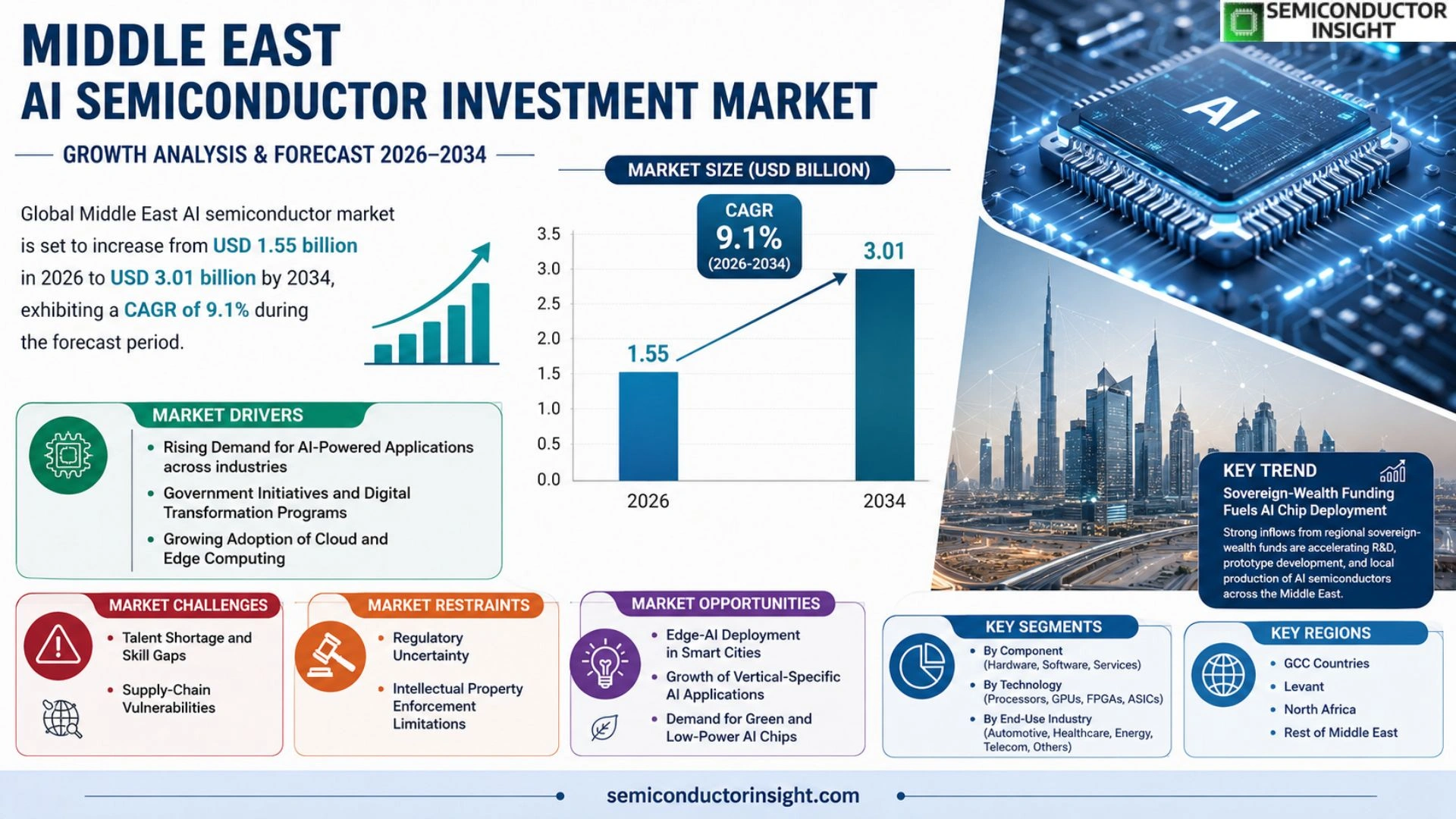
Global Middle East AI semiconductor market size was valued at USD 1.42 billion in 2025. The market is set to increase from USD 1.55 billion in 2026 to USD 3.01 billion by 2034, exhibiting a CAGR of 9.1% during the forecast period.
AI semiconductors are specialized integrated circuits designed to accelerate artificial‑intelligence workloads such as machine‑learning inference and training. These chips incorporate architectures like GPUs, TPUs, neuromorphic processors and edge‑AI ASICs that enable high‑throughput matrix operations while optimizing power efficiency.
The expansion is fueled by rising sovereign‑wealth‑fund allocations toward digital transformation, growing demand for edge computing in smart cities across the Gulf Cooperation Council, and increasing adoption of autonomous systems in oil‑and‑gas operations. Moreover, partnerships between regional telecom operators and global chipmakers are accelerating deployment of high‑performance compute nodes, while government initiatives such as Saudi Arabia’s Vision 2030 allocate billions toward AI research infrastructure.
MARKET DRIVERS
Government Funding Initiatives
The surge of sovereign‑wealth funds allocating capital to AI‑enabled chip design has reshaped the investment climate. Strategic earmarks for semiconductor fabs and R&D centers are translating into tangible pipelines, encouraging private players to scale quickly in Middle East AI Semiconductor Investment Market.
Corporate Partnerships and Ecosystem Building
Leading global chipmakers are forging joint ventures with regional tech firms, creating a network that blends advanced process know‑how with local market insight. This collaborative model reduces time‑to‑market for AI‑optimized silicon and improves access to talent pools across the Gulf.
➤ “Strategic co‑investment between public funds and private innovators is turning the Gulf into a corridor for AI‑centric semiconductor deployments.”
Beyond financing, policy frameworks that streamline customs, protect intellectual property, and offer tax incentives are lowering entry barriers. These enablers are prompting venture capital managers to allocate larger check sizes, effectively accelerating the maturation of Middle East AI Semiconductor Investment Market.
MARKET CHALLENGES
Talent Shortage and Skill Gaps
Even as capital flows increase, the region grapples with an insufficient pipeline of engineers proficient in AI‑specific hardware design. Companies often resort to overseas recruitment, inflating operating costs and extending project timelines.
Other Challenges
Supply‑Chain Vulnerabilities
Geopolitical tensions and limited local fabrication capacity force many firms to depend on external foundries. Disruptions in these channels can delay product roll‑outs and erode confidence among investors.
MARKET RESTRAINTS
Regulatory Uncertainty
Frequent revisions to export‑control legislations and data‑sovereignty rules create an unpredictable operating environment. Investors tend to adopt a cautious stance when regulatory trajectories are unclear, slowing the pace of new fund commitments.
In addition, the nascent legal infrastructure for intellectual‑property enforcement in some jurisdictions can deter multinational players from committing large‑scale projects, limiting the overall depth of the market.
MARKET OPPORTUNITIES
Edge‑AI Deployment in Smart Cities
The rollout of smart‑city initiatives across the Gulf states is demanding localized AI processing power to meet latency and data‑privacy requirements. This creates a niche for edge‑focused semiconductor solutions, offering investors a clear pathway to revenue within Middle East AI Semiconductor Investment Market.
Further, the emergence of vertical‑specific AI applications,such as oil‑field monitoring and autonomous logistics,opens avenues for custom silicon that can command premium pricing, encouraging deeper capital infusion from both strategic and financial investors.
Finally, the growing appetite for green‑energy technologies is spurring demand for low‑power AI chips that can optimize renewable‑energy grids. Companies that align their product roadmaps with sustainability objectives are well positioned to capture a share of the next wave of investment.
Middle East AI Semiconductor Investment Market Trends
Sovereign‑Wealth Funding Fuels AI Chip Deployment
The influx of capital from regional sovereign‑wealth funds is reshaping the investment climate for AI semiconductors across the Gulf. By earmarking billions for digital transformation, governments have created a fiscal runway that encourages both domestic start‑ups and foreign chip designers to establish R&D centers locally. This financial backing is not merely a line‑item; it reflects a strategic intent to embed advanced compute capability within key sectors such as oil‑and‑gas, logistics, and public services. As a result, venture rounds have grown in size, and the pace of prototype to production transitions has accelerated, giving firms a clearer path from concept to market.
Other Trends
Edge Computing in Gulf Smart Cities
Smart‑city initiatives in Dubai, Riyadh, and Doha demand AI inference at the network edge to meet latency constraints for traffic management, surveillance, and utilities monitoring. Edge‑optimized ASICs and neuromorphic processors are attracting investment because they balance high‑throughput matrix operations with power budgets suitable for distributed installations. The trend is reinforced by municipal contracts that stipulate on‑site processing, thereby limiting reliance on distant cloud resources and opening a niche for localized semiconductor vendors.
Telecom Partnerships Accelerate High‑Performance Nodes
Regional telecom operators have entered joint ventures with global chipmakers to field next‑generation compute nodes that support 5G‑enabled AI services. These collaborations are driven by the need to deliver real‑time analytics for network optimization, predictive maintenance, and consumer‑facing AI applications. By co‑hosting design teams and sharing production facilities, partners reduce time‑to‑market and mitigate technology transfer barriers. The outcome is a steady pipeline of customized GPU/TPU solutions that address the specific bandwidth and power profiles of Middle East networks, reinforcing the overall investment narrative for the AI semiconductor segment.
COMPETITIVE LANDSCAPE
Key Industry Players
Middle East AI Semiconductor Investment Market – Competitive Overview
The investment arena is largely shaped by sovereign‑wealth entities that have turned AI chips into a strategic asset class. Saudi Arabia’s Public Investment Fund (PIF) has earmarked multi‑billion‑dollar commitments to secure capacity in NVIDIA’s data‑center GPUs and to back joint‑development projects with Intel, positioning the Kingdom as a de‑facto hub for high‑performance AI workloads. Abu Dhabi Investment Authority (ADIA) follows a similar playbook, acquiring equity stakes in Intel’s emerging AI‑fab initiatives and channeling capital into regional venture funds that nurture edge‑AI ASIC design houses. This top‑down financing model creates a tiered market structure: a handful of global giants paired with deep‑pocketed regional backers dominate supply, while a secondary tier of boutique developers relies on selective partnerships to access foundry services. The concentration of capital accelerates scale‑up timelines, but also locks entry behind substantial financial thresholds.
Beyond the sovereign layer, telecom operators and specialist start‑ups populate the niche segment of the market. Etisalat and Saudi Telecom Company (STC) are repurposing existing fiber infrastructure into low‑latency edge nodes, commissioning custom ASICs that blend neuromorphic inference with power‑saving modes for smart‑city sensors. The UAE‑based Group 42 (G42) has announced an internal silicon design team targeting oil‑field analytics, leveraging local talent to produce application‑specific processors that can survive harsh offshore conditions. Qatar Investment Authority (QIA) recently funded a series‑A round for SynapseTech, a Dubai start‑up focused on brain‑inspired processors. Smaller players such as Mediatech AI (Saudi) and Bayanat (UAE) are carving out boutique markets in security‑camera analytics and autonomous logistics, respectively, often collaborating with global foundries under technology‑licensing agreements. These varied entrants collectively broaden the ecosystem, introducing differentiated architectures that challenge the dominance of the larger chipmakers.
List of Key AI Semiconductor Companies Profiled
- Saudi Public Investment Fund (PIF)
- Abu Dhabi Investment Authority (ADIA)
- Qatar Investment Authority (QIA)
- Intel
- Etisalat
- NVIDIA
- Saudi Telecom Company (STC)
- AMD
- Group 42 (G42)
- SynapseTech (UAE)
- Mediatech AI (Saudi)
- Bayanat (UAE)
- Ooredoo Qatar
- Kuwait Investment Authority (KIA)
- Huawei Middle East
Segment Analysis:
| Segment Category | Sub-Segments | Key Insights |
| By Type |
|
Edge‑AI ASICs are emerging as the dominant hardware choice for regional initiatives.
|
| By Application |
|
Smart‑city infrastructure drives investment because AI chips enable real‑time analytics for traffic, utilities, and public safety.
|
| By End User |
|
Government agencies are pivotal because policy frameworks and sovereign investment shape the market.
|
| By Funding Source |
|
Sovereign wealth funds lead investment activity by aligning capital with national AI agendas.
|
| By Strategic Initiative |
|
Digital transformation programmes act as a catalyst for AI semiconductor deployment across sectors.
|
Regional Analysis: Middle East AI Semiconductor Investment Market
Dubai’s free‑zone clusters and Riyadh’s technology parks act as magnets for start‑ups that need proximity to financing and regulatory guidance. Their modular infrastructures allow rapid scaling of design teams and prototype testing, reducing time‑to‑market for AI‑optimized chips.
Partnerships between regional universities and multinational chip firms create curricula focused on neuromorphic computing and low‑latency inference. Graduates emerge with practical experience, lowering onboarding costs for investors seeking skilled engineering talent.
Sovereign wealth funds allocate dedicated AI‑semiconductor mandates, while private equity firms launch series‑A funds that co‑invest with global foundries. This blended approach spreads risk while providing sufficient capital to sustain multi‑year R&D cycles.
Emerging standards on data residency and export controls compel chip designers to embed compliance features early. Early alignment with these rules enhances market acceptance across both public‑sector contracts and commercial deployments.
North America
The United States continues to dominate the global AI‑chip supply chain, yet its investors now monitor Middle East projects closely for complementary edge solutions. Collaborative R&D labs in Silicon Valley are testing low‑power architectures that could be repurposed for oil‑field sensors across the Gulf. Canadian firms, leveraging strong AI research bases, are exploring partnerships that grant access to the region’s test‑bed environments, thereby extending their technology reach beyond the traditional North American market.
Europe
European chipmakers view Middle East as a strategic gateway to emerging AI applications in energy management and smart cities. German and French multinational groups have signed memoranda of understanding with Gulf sovereign funds to co‑develop ASICs optimized for renewable‑grid analytics. Meanwhile, the EU’s emphasis on standards harmonization dovetails with regional regulatory trends, encouraging joint certification pathways that streamline cross‑border product launches.
Asia‑Pacific
Companies headquartered in Taiwan, South Korea, and Japan are actively scouting Middle Eastern pilots to validate their high‑density AI cores under harsh climatic conditions. The region’s demand for rugged edge devices aligns with Asian manufacturers’ expertise in packaging and thermal management. In turn, Asian investors are allocating capital to joint ventures that embed their process technologies within local design houses, securing a foothold in a market that values both performance and regional compliance.
South America
Though geographically distant, South American stakeholders recognize Middle East’s role in shaping next‑generation AI hardware standards. Brazilian telecom operators, for instance, are evaluating Gulf‑tested AI accelerators for future 5G rollouts. Argentine venture funds are beginning to allocate seed capital to startups that can bridge the technology gap between the two regions, anticipating a future where cross‑continental supply chains deliver interoperable semiconductor solutions.
Report Scope
This market research report provides a comprehensive analysis of the Middle East AI Semiconductor Investment Market , covering the forecast period 2026–2034. It offers detailed insights into market dynamics, technological advancements, competitive landscape, and key trends shaping the industry.
Key focus areas of the report include:
- Market Overview: The report begins with an overview outlining its current market scenario, key growth indicators, and industry transformation drivers. It discusses macroeconomic factors, demand–supply balance, regulatory landscape, and the strategic role of semiconductors in powering advancements across industries such as automotive, telecommunications, consumer electronics, and industrial automation.
- Market Size & Forecast: Historical data and future projections for revenue, unit shipments, and market value across major regions and segments.
- Segmentation Analysis: Detailed breakdown by product type, technology, application, and end-user industry to identify high-growth segments and investment opportunities.
- Regional Insights: Insights into market performance across North America, Europe, Asia-Pacific, Latin America, and Middle East & Africa, including country-level analysis where relevant.
- Competitive Landscape: Profiles of leading market participants, including their product offerings, R&D focus, manufacturing capacity, pricing strategies, and recent developments such as mergers, acquisitions, and partnerships.
- Technology Trends & Innovation: Assessment of emerging technologies, integration of AI/IoT, semiconductor design trends, fabrication techniques, and evolving industry standards.
- Market Drivers & Restraints: Evaluation of factors driving market growth along with challenges, supply chain constraints, regulatory issues, and market-entry barriers.
- Stakeholder Insights: Insights for component suppliers, OEMs, system integrators, investors, and policymakers regarding the evolving ecosystem and strategic opportunities.
Primary and secondary research methods are employed, including interviews with industry experts, data from verified sources, and real-time market intelligence to ensure the accuracy and reliability of the insights presented.
FREQUENTLY ASKED QUESTIONS:
What is the current market size of Middle East AI Semiconductor Investment Market?
-> Middle East AI Semiconductor Investment Market was valued at USD 1.42 billion in 2025 and is expected to reach USD 3.01 billion by 2034.
Which key companies operate in Middle East AI Semiconductor Investment Market?
-> Key players include Axalta Coating Systems, AkzoNobel, BASF SE, PPG, Sherwin-Williams, and 3M, among others.
What are the key growth drivers?
-> Key growth drivers include railway infrastructure investments, urbanization, and demand for durable coatings.
Which region dominates the market?
-> Asia-Pacific is the fastest-growing region, while Europe remains a dominant market.
What are the emerging trends?
-> Emerging trends include bio-based coatings, smart coatings, and sustainable rail solutions.
Get Sample Report PDF for Exclusive Insights
Report Sample Includes
- Table of Contents
- List of Tables & Figures
- Charts, Research Methodology, and more...
 Download Sample Report PDF