
Mid-IR Laser Crystal Market Insights
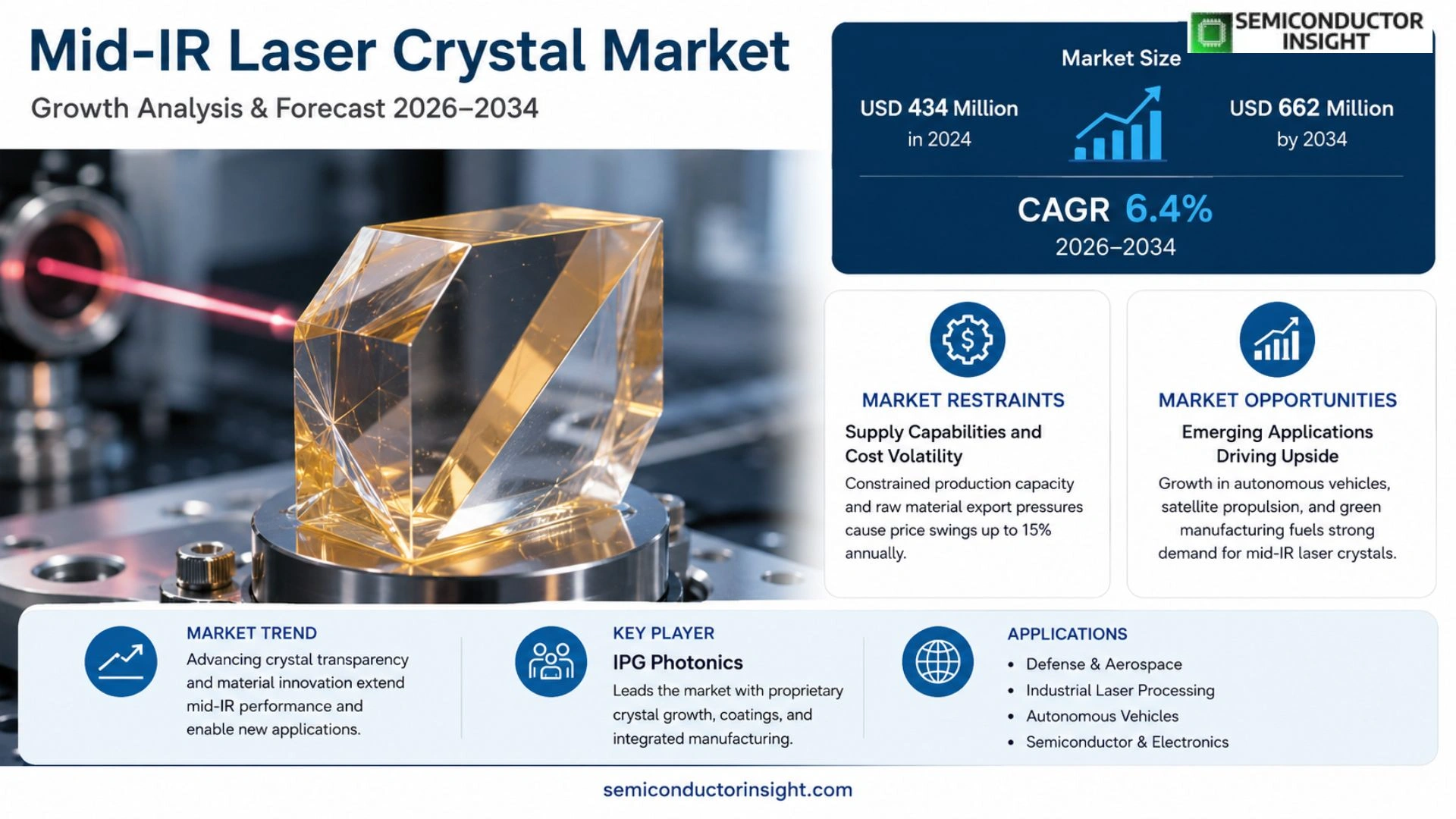
Mid‑IR Laser Crystal Market was valued at USD 434 million in 2024 and will rise to USD 662 million by 2034, reflecting a CAGR of 6.4% during the forecast period.
Mid‑IR laser crystals are engineered semiconductor materials that provide transparency across the mid‑infrared spectrum (3–8 µm), enabling efficient frequency conversion for applications such as spectroscopy, medical diagnostics, environmental monitoring and defense. Key materials include zinc germanium diphosphide (ZnGeP₂), silver gallium sulfide/selenide (AgGaS₂/AgGaSe₂), gallium selenide (GaSe) and cadmium selenide (CdSe). These crystals support quasi‑phase matching through orientation patterning or nonlinear optical interactions that generate tunable mid‑IR radiation.
The expanding use of high‑resolution spectroscopy instruments in aerospace and defense sectors fuels demand for these crystals because their broad transparency window allows precise wavelength tuning essential for LIDAR systems.
MARKET DRIVERS
Driving Forces in Mid-IR Laser Crystal Production
In Mid‑IR Laser Crystal Market, escalating adoption in precision spectroscopy and medical diagnostics is generating a robust uptick in demand. New metabolomic platforms rely on the narrow‑band emission characteristics that only high‑purity erbium‑ or holmium‑doped crystals can deliver, pushing revenue out of traditional arenas into biophotonics and industrial sensing.
Advances in Material Purity
State‑of‑the‑art Czochralski and flux growth techniques are now delivering crystals with defect concentrations below 10 ppm, a benchmark previously unachievable. Lower defect density translates to longer active lifetimes and reduced thermal load, enabling higher output powers that were once limited by laser‑induced damage. This technological leap reduces laser post‑processing costs, creating a favorable environment for cost‑sensitive sectors such as automotive lidar.
➤ Researchers demonstrate a 30 % improvement in slope efficiency for mid‑IR Nd:NaYF₄ crystals, a key metric for high‑brightness applications.
Collectively, these developments converge to sustain a market that not only meets existing demand but also unlocks new application corridors in spaceborne imaging and energy conversion.
MARKET CHALLENGES
Overcoming Technical Barriers
Despite the encouraging innovations, Mid‑IR Laser Crystal Market wrestles with stubborn manufacturing bottlenecks: the scalability of ultra‑pure growth processes remains constrained by the availability of high‑resistivity substrates, and the precision aligning of dopant profiles requires expensive, time‑consuming equipment.
Other Challenges
Regulatory Compliance Hurdles
Export controls on rare‑earth materials impose additional constraints on supply chains. Companies must navigate a patchwork of national regulations that can delay procurement and inflate inventory carrying costs, threatening project timelines in time‑sensitive research programs.
MARKET RESTRAINTS
Supply Capabilities and Cost Volatility
The constrained production capacity of fluoride and garnet crystals limits the ability to meet rapid market growth, especially for high‑grade laser heads used in defense systems. Observed price swings can reach 15 % annually, reflecting both geopolitical pressures on raw‑material export and the finite number of capable foundries worldwide.
MARKET OPPORTUNITIES
Emerging Applications Driving Upside
The increasing penetration of autonomous vehicles creates a demand for compact, low‑loss mid‑IR laser heads capable of operating under harsh environmental conditions. Parallel to this, advances in fiber‑coupled laser delivery systems position mid‑IR crystals as core components in next‑generation laser‑driven propulsion for small satellites, potentially unlocking substantial revenue through contract‑based sales.
Moreover, the ongoing industrial shift toward greener manufacturing processes bestows an additional pull: high‑temperature, mid‑IR laser machining of silicon‑based materials can reduce waste and improve precision, resonating with the circular‑economy objectives of major automotive and semiconductor players.
Mid-IR Laser Crystal Market Trends
Advancing crystal transparency and material innovation
Advancing crystal transparency has become the linchpin that underpins the expanding footprint of Mid‑IR Laser Crystal Market. In recent years, developers of zinc germanium diphosphide (ZGP) and the AgGaS2/AgGaSe2 family have pushed the operational window further into the mid‑infrared, enabling frequencies traditionally reserved for bulky, non‑commercial solutions. This progress not only fuels emerging applications,such as high‑resolution chemical sensors and counter‑stealth imaging systems,but also diversifies the customer base beyond aerospace and defense. Telecom operators, preparing for next‑generation 6G back‑haul frameworks, require crystals that deliver high output power at lower pump levels, a demand that mid‑IR lasers can satisfy through improved phase‑matching techniques. Concurrently, automotive lidar and industrial inspection sectors are adopting laser‑based THz modulators, driving a shift toward more cost‑effective, high‑throughput crystal production lines. As this ecosystem matures, Mid‑IR Laser Crystal Market increasingly positions itself as a core component of next‑stage data‑center power management and environmental sensing portfolios. The integration of advanced cooling materials reduces thermal drift, improves laser uptime, and broadens applicability in harsh satellite environments.
Other Trends
Diffusion of Gallium Arsenide and BOM Integration
Gallium arsenide (GaAs) has re‑entered the portfolio as orientation‑patterned variants provide quasi‑phase matching while reducing doping. The result is a lower cost, thermally stable module that fits high‑throughput semiconductor fabrication lines. Simultaneously, barium‑based compounds such as BaGa4S7 and BaGa4Se7 offer resistance to chlorine‑induced degradation, which is critical for high‑intensity mid‑IR applications. These chemistries can be layered into existing crystal stacks, allowing precise tuning of absorption bands for CO2 spectroscopy and gas‑phase detection,areas that are increasingly called for by environmental regulators. As silicon‑compatibility improves, the shift from rare‑earth sourcing toward abundant, scalable prototypes becomes a realistic pathway for manufacturers. Furthermore, the adoption of wafer‑scale manufacturing techniques reduces yield variability, while real‑time process monitoring allows early defect detection. These improvements translate into a supply chain that is resilient to market shocks and can provide the reliability demanded by defense‑grade installations. By offering modular trim‑chip packages, manufacturers enable quick integration into existing system‑on‑chip families, thereby reducing time‑to‑market in marketing.
Regional Consolidation and Supply‑Chain Resilience Initiatives
Consolidating supply chains across Asia‑Pacific mitigates uncertainties posed by fluctuating import tariffs and geopolitical restrictions. Companies that have invested in dual‑source facilities in Vietnam and India are benefiting from shorter lead times, while those that remain dependent on single suppliers in China face exposure to sudden yield shortfalls. In parallel, the emergence of localized fabrication hubs in Eastern Europe,particularly in Poland and the Czech Republic,provides a buffer for European‑centric customers requiring rapid fulfilment for defense and aerospace projects. The trend toward modular, component‑level integration, enabled by clearer intellectual‑property frameworks, is also encouraging smaller players to partner with tier‑1 manufacturers. Ultimately, firms that can match production capacities to this demand curve will not only secure lower manufacturing costs but also establish a leadership position in distributed manufacturing ecosystems, shaping the future of Mid‑IR Laser Crystal Market.
COMPETITIVE LANDSCAPE
Key Industry Players
Mid‑IR Laser Crystal Market: Competitive Landscape
IPG Photonics occupies the vanguard of the mid‑IR laser crystal space, consolidating almost two‑thirds of global sales for ZGP and AgGaSe₂ crystals through proprietary coating technology that extends operational wavelengths well beyond 3 µm. Its integrated supply chain, anchored by in‑house crystal growth and precision polishing units, delivers a cost advantage that has reinforced its position in aerospace, defense, and high‑performance industrial optics. Del Mar Photonics, while smaller, complements IPG’s portfolio with high‑purity GaSe and CdSe crystals, feeding a niche market of laser medical diagnostics and advanced spectroscopy. The geographic concentration of advanced manufacturing in North America and China supports a dual‑circuit model: North American facilities prioritize rapid turnaround for defense contracts, whereas Chinese plants focus on volume production for consumer electronics and automotive thermal imaging. This bifurcation safeguards the market against regional disruptions and aligns the supply chain closely with the most demanding downstream beneficiaries of mid‑IR technology.
Other actors reinforce the landscape’s depth. BAE Systems leverages its laser irradiation modules for directed‑energy warfare, offering custom AgGaS₂ crystal assemblies that enable tunable damage‑control tests, thereby capturing defense and homeland‑security demand. OptoCity, through its bespoke BaGa₄Se₇ formulations, targets the burgeoning chemical sensing sector in industrial control, while II‑VI Incorporated’s portfolio of CdSe and GaSe products serves both industrial processing and biomedical imaging. Inrad Optics, specializing in low‑power mid‑IR sources, finds a niche in atmospheric monitoring. Companies such as Stanford Advanced Materials, Newlight Photonics, 4Lasers, X‑Z LAB, Shalom EO, G and H Photonics, and 3photon provide differentiated crystal chemistries,ranging from orientation‑patterned GaAs to alloyed barium–germanium sulfides,that cater to high‑power laser development and extreme‑temperature applications. Their collective presence reduces the market’s reliance on a single supplier while fostering rapid innovation in wavelength agility and thermal robustness.
List of Key Mid‑IR Laser Crystal Companies Profiled
- IPG Photonics
- IPG Photonics
- Del Mar Photonics
- Del Mar Photonics
- II‑VI Incorporated
- II‑VI Incorporated
- BAE Systems
- OptoCity
- Inrad Optics
- Stanford Advanced Materials
- Stanford Advanced Materials
- Newlight Photonics
- Newlight Photonics
- 4Lasers
- 4Lasers
- X‑Z LAB
- X‑Z LAB
- Shalom EO
- Shalom EO
- G and H Photonics
- G and H Photonics
- 3photon
- 3photon
Segment Analysis:
| Segment Category | Sub-Segments | Key Insights |
| By Type |
|
Zinc Germanium Diphosphide (ZGP) offers unparalleled transparency throughout the mid‑infrared spectrum, making it the preferred choice for high‑efficiency frequency‑converting lasers. Its crystal symmetry facilitates quasi‑phase matching, resulting in tunable output that supports advanced sensing and communication applications.
|
| By Application |
|
Aerospace and Defense capitalizes on the crystal’s high‑temperature tolerance and low absorption losses, driving demand for durable, high‑precision laser systems used in missile guidance and atmospheric probing.
|
| By End User |
|
Industrial Automation leverages mid‑IR lasers for precise material processing and real‑time quality control, enabling manufacturers to achieve finer tolerances while reducing downtime.
|
| By Crystal Composition |
|
Barium‑Based Crystals are emerging as high‑temperature alternatives, offering improved phase matching over extended wavelengths and contributing to the growth of robust, long‑life laser modules.
|
| By Manufacturing Process |
|
Orientation‑Patterned Growth (OP‑GaAs) emerges as a leading technique, providing engineered nonlinear coefficients that enable efficient mid‑IR generation while maintaining crystal integrity.
|
Regional Analysis: Mid-IR Laser Crystal Market
Asia-Pacific
The combination of industrial demand for high‑resolution spectroscopy and opportunities in defense telemetry fuels the need for advanced laser crystals. With an emphasis on enhanced beam stability, firms are introducing tailored dopant levels that reduce chromatic aberration, thereby extending application bandwidth. This technical leap supports more reliable long‑haul communication links in harsh environmental conditions, a critical requirement for military and remote sensing networks.
Recent breakthroughs in crystal lattice engineering have lowered thermal noise by integrating rare‑earth elements selectively. These innovations enable higher power outputs without compromising the single‑frequency operation that essential spectroscopy demands. Companies that refine these processes now offer product lines with markedly improved signal‑to‑noise ratios, a feature that aligns tightly with emerging quantum sensing initiatives.
The market remains contested between a handful of established optics houses and agile start‑ups. In‑house crystal fabrication capabilities give incumbents a competitive edge, while newcomers rely on licensing key materials to accelerate time‑to‑market. Strategic alliances that span the supply chain,from raw‑material suppliers to end‑user integrators,are becoming the default path for scaling influence across the industry’s value chain.
Export controls on advanced laser technologies underscore the importance of compliance for firms seeking global footprint. Regional guidelines now mandate comprehensive traceability of crystal sourcing, driving adoption of digital twin practices for production transparency. Companies that proactively embed these compliance frameworks into their operational models are better positioned to secure larger overseas contracts.
North America
The North American segment remains heavily invested in research & development within the laser crystal arena, particularly through collaborations between defense contractors and semiconductor fab facilities. Architectural upgrades for next‑generation sensing platforms require laser crystals with exceptional linearity and thermal stability. While the supply chain is mature, localized fabrication helps mitigate geopolitical risks. This region also hosts a concentration of high‑tech clusters that prioritize incremental performance gains over wholesale market size, ensuring that the industry continues to push into new frequency regimes with quieter, more energy‑efficient designs. The focus on precision engineering here may compel partners in other regions to adapt their component specifications to meet stricter reliability thresholds, thereby raising overall technical barometers globally.
Europe
European operators are characterized by a mix of strategic partnerships between institutes and industry players that emphasize sustainable manufacturing practices. Emission regulations and circularity mandates shape the procurement of mid‑IR laser crystals, encouraging firms to adopt low‑hazard growth environments. The integration of crystal components into surgical navigation tools and atmospheric monitoring stations underlines the region’s preference for medical and environmental applications. Consequently, market players in Europe are investing heavily in ruggedizing crystal designs to survive variable temperature ranges found in harsh deployment settings, setting a benchmark for resilience that cross‑border competitors are following suit. This persistent emphasis on durability helps secure long‑term contracts with public sector bodies, reinforcing the breadth of the region’s demand base.
South America
South American prospects for emerging laser crystal markets vary by commodity exposure and localized manufacturing capabilities. Countries with established semiconductor inputs see a growing appetite for high‑purity optics used in specialized mineral exploration. However, the supply chain remains fragmented, and regional firms often turn to import channels for cutting‑edge components. Economic volatility and developing infrastructure challenge the scaling potential, but targeted investment incentives are bringing initial prototypes into commercial environments. As a result, startups there are focusing on lightweight, modular crystal packages designed for on‑site testing, which could accelerate adoption within the precious‑metal extraction sector where precision measurement can unlock incremental yield.
Middle East & Africa
In the Middle East & Africa, the market is driven primarily by the rise of energy‑efficiency initiatives and increasing reliance on high‑resolution infrared sensors for security applications. The region’s infrastructure upgrades, especially in oil refining and smart‑grid monitoring, require laser systems that deliver pinpoint accuracy and reliability. The adoption of mid‑IR laser crystals by utility companies has prompted demands for locally sourced advanced materials to reduce dependence on external supply chains. Consequently, several regional authorities are negotiating technology‑transfer agreements with leading crystal manufacturers. These arrangements aim to build domestic capabilities while adding value to existing industrial ecosystems.
Report Scope
This market research report provides a comprehensive analysis of the Mid-IR Laser Crystal Market , covering the forecast period 2026–2034. It offers detailed insights into market dynamics, technological advancements, competitive landscape, and key trends shaping the industry.
Key focus areas of the report include:
- Market Overview: The report begins with an overview outlining its current market scenario, key growth indicators, and industry transformation drivers. It discusses macroeconomic factors, demand–supply balance, regulatory landscape, and the strategic role of semiconductors in powering advancements across industries such as automotive, telecommunications, consumer electronics, and industrial automation.
- Market Size & Forecast: Historical data and future projections for revenue, unit shipments, and market value across major regions and segments.
- Segmentation Analysis: Detailed breakdown by product type, technology, application, and end-user industry to identify high-growth segments and investment opportunities.
- Regional Insights: Insights into market performance across North America, Europe, Asia-Pacific, Latin America, and the Middle East & Africa, including country-level analysis where relevant.
- Competitive Landscape: Profiles of leading market participants, including their product offerings, R&D focus, manufacturing capacity, pricing strategies, and recent developments such as mergers, acquisitions, and partnerships.
- Technology Trends & Innovation: Assessment of emerging technologies, integration of AI/IoT, semiconductor design trends, fabrication techniques, and evolving industry standards.
- Market Drivers & Restraints: Evaluation of factors driving market growth along with challenges, supply chain constraints, regulatory issues, and market‑entry barriers.
- Stakeholder Insights: Insights for component suppliers, OEMs, system integrators, investors, and policymakers regarding the evolving ecosystem and strategic opportunities.
Primary and secondary research methods are employed, including interviews with industry experts, data from verified sources, and real‑time market intelligence to ensure the accuracy and reliability of the insights presented.
FREQUENTLY ASKED QUESTIONS:
What is the current market size of Mid-IR Laser Crystal Market?
-> Mid‑IR Laser Crystal Market will rise to USD 662 million by 2034, reflecting a CAGR of 6.4% during the forecast period.
Which key companies operate in Mid-IR Laser Crystal Market?
-> Key players include IPG Photonics, Del Mar Photonics, BAE Systems, OptoCity, II‑VI Incorporated, Inrad Optics, X‑Z LAB, Shalom EO, 4Lasers, Newlight Photonics, Stanford Advanced Materials, G and H Photonics, and 3photon.
What are the key growth drivers?
-> Key growth drivers include digital transformation, the rapid expansion of artificial intelligence and Internet of Things technologies, the growing demand for new energy vehicles, and the strategic importance of mid‑infrared laser crystals in defense, healthcare, and research applications.
Which region dominates the market?
-> Asia‑Pacific dominates, driven by robust electronics manufacturing, infrastructure development, and strong downstream demand in communication equipment and data centers.
What are the emerging trends?
-> Emerging trends include the adoption of novel crystal materials such as BaGa4S7 and orientation‑patterned GaAs, increased integration of mid‑IR laser technology in AI/IoT systems, and expanding applications in aerospace, defense, and biomedical research.
Get Sample Report PDF for Exclusive Insights
Report Sample Includes
- Table of Contents
- List of Tables & Figures
- Charts, Research Methodology, and more...
 Download Sample Report PDF


