
MARKET INSIGHTS
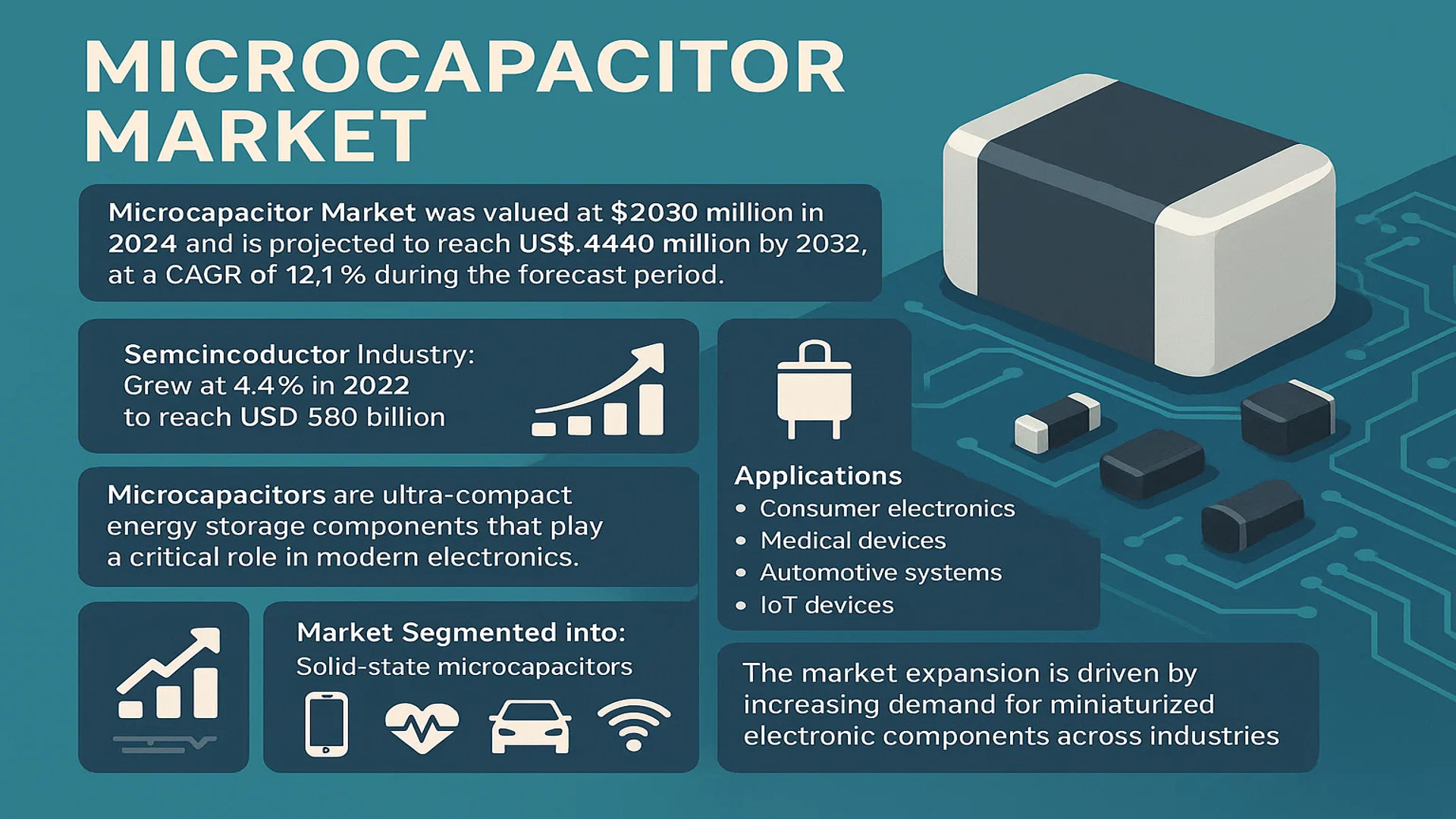
The global Microcapacitor Market was valued at 2030 million in 2024 and is projected to reach US$ 4440 million by 2032, at a CAGR of 12.1% during the forecast period. This growth is significantly higher than the broader semiconductor industry, which grew at 4.4% in 2022 to reach USD 580 billion.
Microcapacitors are ultra-compact energy storage components that play a critical role in modern electronics. These components store and release electrical energy in microelectronic circuits, enabling functions such as power conditioning, signal processing, and energy harvesting. The market is segmented into solid-state microcapacitors and microsupercapacitors, with applications spanning consumer electronics, medical devices, automotive systems, and IoT devices.
The market expansion is driven by increasing demand for miniaturized electronic components across industries. While consumer electronics remains the largest application segment, emerging technologies like 5G networks and wearable devices are creating new opportunities. However, the industry faces challenges in material innovation and manufacturing scalability. Recent developments include advancements in nanostructured materials that enhance energy density while maintaining the small form factor that defines this product category.
MARKET DYNAMICS
MARKET DRIVERS
Proliferation of Miniaturized Electronics to Propel Microcapacitor Demand
The global push toward compact and high-performance electronic devices is accelerating the adoption of microcapacitors. With consumer electronics shrinking in size yet requiring higher energy storage, components like microcapacitors have become indispensable. The solid-state microcapacitor segment alone accounted for over 62% market share in 2024 due to its reliability in smartphones, wearables, and IoT devices. Recent innovations in material science have enabled microcapacitors to achieve energy densities exceeding 15 Wh/L, making them viable for space-constrained applications. Leading manufacturers are investing heavily in research to further enhance performance while reducing footprints, signaling robust market expansion.
5G Infrastructure Deployment Creates New Growth Avenues
Rollouts of 5G networks worldwide present a significant opportunity for microcapacitor suppliers. These components play critical roles in RF power amplifiers and signal processing units within base stations, where their low ESR and high-frequency characteristics are essential. With over 2 million 5G base stations projected to be operational globally by 2025, the demand for high-performance microcapacitors is set for exponential growth. Moreover, the transition to millimeter-wave frequencies in advanced 5G implementations requires capacitors with exceptional stability at high frequencies – a niche where microcapacitors outperform traditional alternatives.
Automotive Electrification Trends Drive Innovation
The automotive industry’s shift toward electrification presents substantial opportunities for microcapacitor applications. Advanced driver-assistance systems (ADAS), in-vehicle networking, and power management circuits increasingly rely on these components. The market for automotive microcapacitors grew by over 18% year-over-year in 2023, with electric vehicles requiring nearly 30% more capacitor content per vehicle compared to conventional models. As automakers aim for higher levels of autonomy, the need for reliable, high-temperature tolerant microcapacitors in sensor fusion and control modules will continue escalating.
MARKET RESTRAINTS
Complex Manufacturing Processes Increase Cost Barriers
While microcapacitors offer superior performance characteristics, their production involves intricate thin-film deposition and precision patterning techniques that significantly elevate manufacturing costs. The specialized equipment required for atomic layer deposition (ALD) and other fabrication processes represents a multimillion-dollar investment, creating high barriers to entry. This cost structure makes microcapacitors 3-5 times more expensive than conventional MLCCs in comparable applications, limiting their adoption in price-sensitive market segments. Furthermore, yield rates in microcapacitor production typically range between 65-80%, compared to over 95% for mature capacitor technologies, exacerbating cost pressures.
Material Supply Chain Vulnerabilities Pose Risks
The microcapacitor industry faces challenges related to the availability and pricing of key raw materials. High-purity dielectric materials such as hafnium oxide and specialty electrode metals experience periodic shortages, with lead times extending beyond six months during supply disruptions. These materials account for approximately 40-50% of total production costs, making manufacturers vulnerable to price volatility. Recent geopolitical tensions have further complicated procurement strategies, forcing companies to maintain higher inventory levels and reconsider single-source supplier dependencies.
MARKET CHALLENGES
Technical Limitations in High-Voltage Applications
Microcapacitors currently face performance constraints in high-voltage environments, typically maxing out at around 50V while conventional capacitors can handle several hundred volts. This limitation restricts their use in power electronics applications such as industrial motor drives and renewable energy systems. While research institutes are investigating novel dielectric materials to address this challenge, commercial solutions capable of operating at 100V or above remain several years from market readiness. The industry must overcome fundamental material science hurdles to expand into these lucrative applications.
Standardization and Qualification Hurdles
The lack of standardized testing protocols for microcapacitor performance creates adoption challenges in regulated industries like aerospace and medical devices. Qualification processes can extend beyond 18 months due to rigorous reliability testing requirements, slowing time-to-market for new products. Additionally, the absence of unified industry specifications makes it difficult for designers to compare products across suppliers, potentially delaying design cycles. Industry consortiums are working to establish common testing methodologies, but progress remains slow due to differing technical approaches among major manufacturers.
MARKET OPPORTUNITIES
Emerging Applications in Flexible and Wearable Electronics
The rapid growth of flexible electronics presents transformative opportunities for microcapacitor technology. Recent advancements in stretchable dielectric materials have enabled the development of microcapacitors that maintain performance under mechanical deformation. The wearable technology sector, projected to exceed $100 billion by 2026, particularly benefits from these innovations. Medical patches incorporating flexible microcapacitors for continuous health monitoring represent a particularly promising application area, with prototypes demonstrating stable operation through 10,000 bending cycles.
Integration with Advanced Packaging Technologies
Advanced packaging approaches like 2.5D and 3D IC integration are creating new possibilities for embedded microcapacitors. By incorporating capacitors directly into package substrates or interposers, designers can achieve superior power delivery performance while saving board space. Major semiconductor manufacturers are actively developing these solutions, with test vehicles demonstrating 30-40% reductions in power delivery network impedance compared to discrete implementations. As heterogeneous integration becomes mainstream in high-performance computing applications, demand for embedded microcapacitor solutions will likely surge.
MICROCAPACITOR MARKET TRENDS
Miniaturization and High-Density Energy Storage Drive Microcapacitor Adoption
The microcapacitor market is experiencing rapid growth due to the increasing demand for compact, high-efficiency energy storage solutions in modern electronics. Microcapacitors, known for their ultra-small form factor and high energy density, are critical components in applications like wearables, IoT devices, and portable medical equipment. Recent advancements in 3D printing and nanomaterials, such as graphene-based electrodes, have significantly improved capacitance while maintaining a minimal footprint. The global microcapacitor market, valued at USD 2.03 billion in 2024, is projected to reach USD 4.44 billion by 2032, growing at a CAGR of 12.1%. Solid-state microcapacitors dominate the segment, accounting for over 60% of the market share, owing to their stability and longevity compared to traditional counterparts.
Other Trends
Integration with Advanced Semiconductor Technologies
The semiconductor industry’s shift toward high-performance computing (HPC), AI accelerators, and 5G infrastructure is accelerating the demand for microcapacitors. These devices are crucial for power delivery networks (PDNs) in next-gen chips, ensuring stable voltage regulation and reduced signal noise. For instance, leading semiconductor manufacturers are collaborating with capacitor producers to embed microcapacitors directly into silicon interposers, enhancing energy efficiency in processors. In 2022, the semiconductor sector alone contributed USD 580 billion globally, with HPC and automotive ICs driving 17% growth in the Americas—highlighting the synergistic potential between microcapacitors and semiconductor innovations.
Rise of Edge Computing and IoT Applications
Edge computing and IoT deployments are creating unprecedented demand for microcapacitors, particularly in low-power, high-reliability applications. With projections of over 75 billion connected IoT devices by 2025, microcapacitors enable energy autonomy in sensors and microcontrollers, reducing reliance on bulky batteries. Microsupercapacitors, a sub-segment, are gaining traction due to their rapid charge-discharge cycles, making them ideal for energy harvesting systems. Additionally, consumer electronics—a key application segment—continues to leverage microcapacitors for slimmer designs in smartphones and wearables, where space constraints necessitate ultra-thin energy solutions. The Asia-Pacific market, despite a slight 2% decline in semiconductor sales in 2022, remains a hotspot for IoT-driven microcapacitor demand, led by China and South Korea’s electronics manufacturing hubs.
COMPETITIVE LANDSCAPE
Key Industry Players
Technological Innovation and Strategic Alliances Drive Market Competition
The global microcapacitor market is characterized by a dynamic competitive environment, with established semiconductor firms and emerging technology specialists vying for market share. This sector has seen remarkable growth, with the market projected to expand from $2.03 billion in 2024 to $4.44 billion by 2032, representing a compound annual growth rate (CAGR) of 12.1%. While Asia-Pacific leads in production capacity, North American and European companies dominate in research and high-end applications.
Picosun Group has emerged as a frontrunner, particularly in atomic layer deposition (ALD) technology for microcapacitors. The Finnish company’s proprietary thin-film deposition methods have made it indispensable for next-generation electronic components. Another significant player, Jameco Electronics, leverages its extensive North American distribution network to supply microcapacitors across multiple industries, from consumer electronics to industrial automation.
Meanwhile, Jyh Hsu (JEC) Electronics Ltd. has carved out a strong position in the Asian market through cost-effective manufacturing solutions. Their vertically integrated production model allows competitive pricing while maintaining quality standards required for consumer electronics applications. This regional specialization highlights how companies are adapting their strategies to capitalize on localized advantages.
The market has also seen increased activity in mergers and acquisitions, with larger semiconductor firms acquiring specialized microcapacitor developers to bolster their portfolios. These strategic moves are reshaping the competitive hierarchy as industry leaders seek to offer comprehensive component solutions. Research and development investments are particularly concentrated in microsupercapacitor technology, which promises higher energy density and faster charging capabilities.
List of Key Microcapacitor Companies Profiled
- Picosun Group (Finland)
- Jameco Electronics (U.S.)
- Jyh Hsu (JEC) Electronics Ltd. (Taiwan)
- Behniko Co (South Korea)
- Murata Manufacturing Co., Ltd. (Japan)
- TDK Corporation (Japan)
- AVX Corporation (U.S.)
- KEMET Corporation (U.S.)
- Vishay Intertechnology, Inc. (U.S.)
Segment Analysis:
By Type
Solid-state Microcapacitors Segment Leads Due to Enhanced Energy Efficiency
The market is segmented based on type into:
- Solid-state Microcapacitors
- Microsupercapacitors
By Application
Consumer Electronics Dominates the Market Owing to Rising Demand for Miniaturized Components
The market is segmented based on application into:
- Consumer Electronics
- Household Appliances
- Others
By Technology
MEMS-based Microcapacitors Show Significant Growth Potential
The market is segmented based on technology into:
- Thin-film Technology
- MEMS Technology
- Others
Regional Analysis: Microcapacitor Market
Asia-Pacific
As the dominant force in the global Microcapacitor market, Asia-Pacific holds a commanding position, driven primarily by semiconductor and electronics manufacturing hubs in China, Japan, and South Korea. The region accounted for over 50% of global Microcapacitor demand in 2024, fueled by its thriving consumer electronics and automotive sectors. China’s focused policy support for semiconductor localization (backed by initiatives like the “Big Fund III” with $40 billion in allocated capital) creates significant opportunities for Microcapacitor manufacturers. Japan remains a leader in technological advancement, particularly in solid-state Microcapacitors for IoT devices, while South Korea’s robust R&D investments (with companies like Samsung dedicating 7.5% of revenue to R&D in 2023) propel innovation in ultra-miniaturized components.
North America
North America represents the second-largest Microcapacitor market, with the U.S. contributing over 80% of regional revenue due to strong defense, aerospace, and medical technology sectors. Stringent miniaturization requirements in next-generation electronics and increasing adoption of 5G infrastructure (with $250 billion invested in U.S. 5G deployment by 2025) propel demand for high-performance Microcapacitors. Canada is gaining traction in energy storage applications, supported by government funding for clean technology projects. However, the region faces challenges in cost competitiveness compared to Asian suppliers, prompting increased strategic partnerships and reshoring initiatives among North American manufacturers.
Europe
European markets demonstrate steady growth in Microcapacitor adoption, led by Germany’s industrial automation sector and France’s focus on MEMS-based applications. EU regulations emphasizing energy efficiency (such as the updated Ecodesign Directive) drive demand for advanced Microsupercapacitors in smart devices and renewable energy systems. The automotive industry remains a key consumer, particularly for Microcapacitors used in electric vehicle power management, with several European manufacturers developing hermetically sealed designs for extreme-temperature operations. While facing price pressure from Asian imports, European firms maintain competitiveness through customization capabilities and specialized certification standards for medical and defense applications.
South America
South America’s Microcapacitor market shows nascent growth, concentrated mainly in Brazil’s telecommunications and Argentina’s energy sectors. Limited local manufacturing capacity results in heavy reliance on imports from Asia and North America, though regional players are emerging in Brazil’s free trade zones to serve the automotive industry. Challenges include currency volatility (with the Brazilian real fluctuating over 12% annually) and infrastructure limitations for high-tech manufacturing. However, growing investments in Brazil’s consumer electronics production (expanding 9% year-on-year) present opportunities for Microcapacitor suppliers targeting cost-sensitive applications.
Middle East & Africa
This region represents the smallest but fastest-growing Microcapacitor market (projected 14.8% CAGR through 2032), driven by UAE’s electronics manufacturing ambitions and Saudi Arabia’s industrial diversification programs. Israel stands out with specialized Microcapacitors for military and agricultural sensor networks, while South Africa leads in mining equipment applications. The market remains constrained by limited technical expertise and fragmented distribution networks, though large-scale projects like Saudi Arabia’s NEOM smart city (budgeted at $500 billion) and growing smartphone penetration across Africa (expected to reach 88% by 2030) create substantial long-term growth potential for Microcapacitor technologies.
Report Scope
This market research report provides a comprehensive analysis of the Global Microcapacitor Market, covering the forecast period 2024–2032. It offers detailed insights into market dynamics, technological advancements, competitive landscape, and key trends shaping the industry.
Key focus areas of the report include:
- Market Size & Forecast: Historical data and future projections for revenue, unit shipments, and market value across major regions and segments. The global microcapacitor market was valued at USD 2,030 million in 2024 and is projected to reach USD 4,440 million by 2032, growing at a CAGR of 12.1%.
- Segmentation Analysis: Detailed breakdown by product type (Solid-state Microcapacitors, Microsupercapacitors), application (Consumer Electronics, Household Appliances, Others), and end-user industry to identify high-growth segments and investment opportunities.
- Regional Outlook: Insights into market performance across North America, Europe, Asia-Pacific, Latin America, and the Middle East & Africa, including country-level analysis where relevant. Asia-Pacific dominates the market, driven by semiconductor manufacturing hubs in China, Japan, and South Korea.
- Competitive Landscape: Profiles of leading market participants, including their product offerings, R&D focus, manufacturing capacity, pricing strategies, and recent developments such as mergers, acquisitions, and partnerships.
- Technology Trends & Innovation: Assessment of emerging technologies, integration of AI/IoT, semiconductor design trends, and fabrication techniques driving microcapacitor advancements.
- Market Drivers & Restraints: Evaluation of factors driving market growth, such as rising demand for miniaturized electronic components, along with challenges like supply chain constraints and regulatory issues.
- Stakeholder Analysis: Insights for component suppliers, OEMs, system integrators, investors, and policymakers regarding the evolving ecosystem and strategic opportunities.
Primary and secondary research methods are employed, including interviews with industry experts, data from verified sources, and real-time market intelligence to ensure the accuracy and reliability of the insights presented.
FREQUENTLY ASKED QUESTIONS:
What is the current market size of Global Microcapacitor Market?
-> Microcapacitor Market was valued at 2030 million in 2024 and is projected to reach US$ 4440 million by 2032, at a CAGR of 12.1% during the forecast period.
Which key companies operate in Global Microcapacitor Market?
-> Key players include Picosun Group, Jameco Electronics, Jyh Hsu (JEC) Electronics Ltd., Picosun, and Behniko Co, among others.
What are the key growth drivers?
-> Key growth drivers include rising demand for compact electronic devices, advancements in semiconductor technologies, and increasing adoption in consumer electronics and IoT applications.
Which region dominates the market?
-> Asia-Pacific is the largest and fastest-growing market, driven by semiconductor manufacturing hubs in China, Japan, and South Korea.
What are the emerging trends?
-> Emerging trends include miniaturization of electronic components, integration of AI/IoT, and development of high-performance solid-state microcapacitors.

Get Sample Report PDF for Exclusive Insights
Report Sample Includes
- Table of Contents
- List of Tables & Figures
- Charts, Research Methodology, and more...
 Download Sample Report PDF

