MARKET INSIGHTS
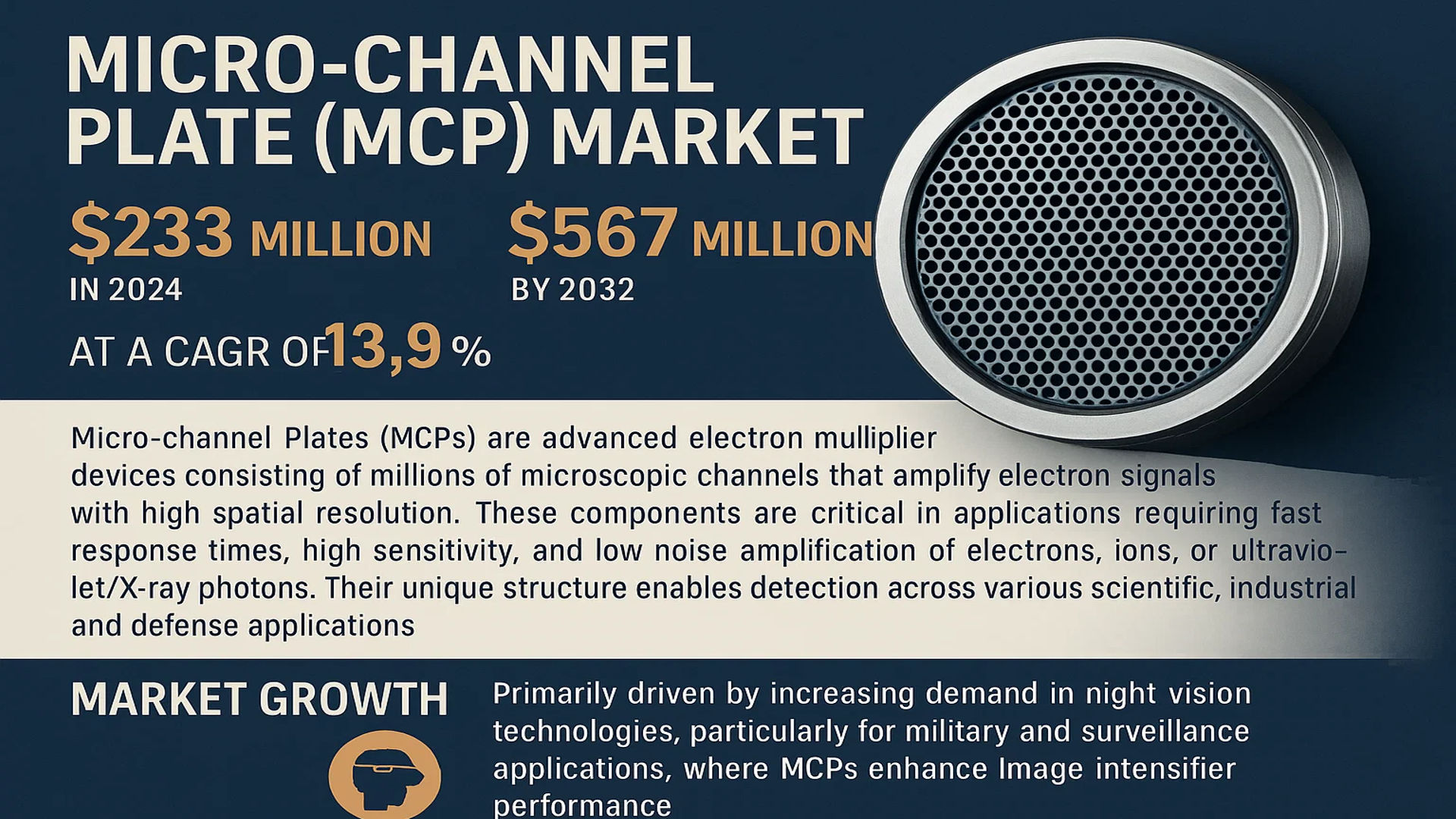
The global Micro-channel Plate (MCP) Market was valued at 233 million in 2024 and is projected to reach US$ 567 million by 2032, at a CAGR of 13.9% during the forecast period.
Micro-channel Plates (MCPs) are advanced electron multiplier devices consisting of millions of microscopic channels that amplify electron signals with high spatial resolution. These components are critical in applications requiring fast response times, high sensitivity, and low noise amplification of electrons, ions, or ultraviolet/X-ray photons. Their unique structure enables detection across various scientific, industrial, and defense applications.
The market growth is primarily driven by increasing demand in night vision technologies, particularly for military and surveillance applications, where MCPs enhance image intensifier performance. Furthermore, expanding applications in scientific research—including nuclear physics, space exploration, and medical diagnostics—are accelerating adoption. Key players like Hamamatsu Photonics and PHOTONIS Technologies dominate the market, collectively holding over 70% share. The Asia-Pacific region leads consumption due to robust defense spending and research investments, while North America and Europe maintain strong positions in innovation-driven applications.
MARKET DYNAMICS
MARKET DRIVERS
Increasing Defense and Surveillance Investments Fueling Night Vision Demand
Global military modernization programs and rising border security concerns are significantly boosting the adoption of night vision devices, directly driving the micro-channel plate (MCP) market. With night vision capabilities becoming standard in modern warfare systems, militaries worldwide are allocating substantial budgets – estimated at over $50 billion annually – for advanced electro-optical equipment. The miniaturization trend in defense electronics also favors MCP integration, as these components provide high-gain electron amplification in compact form factors essential for portable devices. Recent technological improvements have enhanced MCP durability and lifespan in harsh environments, making them more attractive for defense applications.
Expansion of Scientific Research Infrastructure Creating New Applications
Governments are increasing investments in fundamental physics research, with particle accelerator facilities and space observation programs requiring sophisticated detection systems. MCPs serve as critical components in time-of-flight mass spectrometers, electron microscopes, and space-based X-ray detectors – applications experiencing growing demand across academic and industrial research sectors. The global research equipment market has been expanding at approximately 7% CAGR, creating consistent demand growth for high-performance MCPs. Emerging applications in quantum computing research and advanced materials science further contribute to this upward trend, as these cutting-edge fields require ultra-sensitive particle detection capabilities.
Medical Imaging Advancements Driving Healthcare Adoption
The healthcare sector is witnessing growing utilization of MCP-based detectors in specialized medical imaging systems, particularly for low-dose X-ray applications and high-speed fluorescence imaging. Digital radiography systems increasingly incorporate MCP technology to enhance signal amplification while maintaining image resolution, addressing the need for reduced patient radiation exposure. While medical applications currently represent a smaller market segment compared to defense and research uses, their rapid 12-15% annual growth rate indicates significant future potential. The push toward early disease detection and minimally invasive procedures continues to create new opportunities for MCP integration in diagnostic equipment.
MARKET RESTRAINTS
High Production Costs and Complex Manufacturing Processes Limit Accessibility
Micro-channel plate manufacturing involves specialized glass processing and lead oxide reduction techniques that require controlled environments and expensive equipment. The production yield challenges associated with maintaining uniform pore structures across large plate areas contribute to high unit costs, particularly for premium-grade MCPs used in scientific instruments. These cost factors create barriers for small and medium-sized enterprises looking to adopt MCP technology, restraining market expansion in commercial applications. The specialized nature of production has also led to consolidation among manufacturers, with limited new entrants due to the substantial capital investment required for fabrication facilities.
Supply Chain Vulnerabilities Impacting Market Stability
The MCP industry faces supply chain challenges stemming from the specialized raw materials required, particularly lead glass formulations and high-purity metals used in photocathodes. Geopolitical factors affecting rare material availability and fluctuations in global logistics costs have introduced volatility in component pricing and delivery timelines. These disruptions become particularly problematic for defense and aerospace customers operating under strict project timelines, potentially causing them to seek alternative technologies for critical programs. The limited number of qualified suppliers for key materials exacerbates these supply chain risks, creating a restraint on market growth during periods of economic uncertainty.
Alternative Technologies Competing in Key Applications
Emerging solid-state detector technologies are beginning to compete with MCPs in certain applications, particularly where form factor or power constraints outweigh the need for ultra-high sensitivity. Semiconductor-based solutions benefit from continuous improvements in fabrication processes, gradually narrowing the performance gap with MCP detectors in visible and near-infrared ranges. While MCPs maintain clear advantages for specialized applications requiring ns-level time resolution or single-photon detection, the development of alternative technologies creates competitive pressure that could slow market growth in some segments unless MCP manufacturers continue advancing their technical specifications.
MARKET OPPORTUNITIES
Space Exploration Programs Creating High-Value Applications
Growing international investments in space science missions present significant opportunities for high-performance MCP detectors. The extreme sensitivity and radiation tolerance of advanced MCP designs make them ideal for space-based X-ray telescopes, solar observation instruments, and planetary exploration payloads. With over 90 planned science missions to be launched before 2030 requiring sophisticated detection systems, space agencies represent a premium market segment willing to pay for cutting-edge MCP technology. The development of lighter weight and more power-efficient MCP variants specifically for space applications could unlock substantial new revenue streams for manufacturers.
Quantum Technology Development Driving Innovation Demand
The emergence of quantum technologies creates novel opportunities for MCP applications in fundamental physics research and quantum communication systems. Single-photon detection requirements in quantum key distribution networks align well with MCP capabilities, while research into quantum imaging techniques may create additional specialized applications. National quantum initiatives across major economies have allocated billions toward technology development, with significant portions directed at enabling hardware like ultra-sensitive detectors. Manufacturers investing in MCP designs optimized for quantum applications can position themselves at the forefront of this high-growth sector.
Medical Technology Convergence Expanding Healthcare Possibilities
The convergence of medical imaging with advanced analytics and artificial intelligence is driving innovation in diagnostic equipment, creating opportunities for next-generation MCP detectors. Potential applications include high-speed dynamic imaging for cardiovascular studies and low-dose spectral CT systems where MCP technology could provide superior signal-to-noise characteristics. As healthcare systems prioritize early disease detection and precision medicine, the demand for advanced imaging modalities incorporating MCP detectors is expected to rise. Collaborations between medical device manufacturers and MCP specialists could accelerate the development of specialized solutions for these emerging healthcare applications.
MARKET CHALLENGES
Stringent Export Controls and Regulatory Compliance
The dual-use nature of MCP technology subjects manufacturers to complex international trade regulations, particularly for high-performance variants used in military systems. Compliance with evolving export control regimes requires significant administrative resources and can delay product deliveries to global customers. The classification of certain MCP technologies as strategic commodities creates additional documentation requirements and may restrict sales to specific end-users. These regulatory burdens present ongoing operational challenges for companies operating in international markets while also impacting the pace of technological collaboration across borders.
Technology Transfer and Intellectual Property Protection
The MCP industry faces challenges in protecting proprietary manufacturing know-how while meeting customer demands for technology transfer in defense and scientific applications. Proprietary glass formulations and surface treatment processes represent valuable intellectual property that requires careful safeguarding, particularly when engaging in international partnerships or establishing foreign production facilities. The need to balance IP protection with market expansion objectives creates operational complexities, as does the increasing incidence of reverse engineering attempts by competitors seeking to replicate advanced MCP designs without proper licensing.
Workforce Development and Skills Retention
Maintaining a skilled workforce presents an ongoing challenge for MCP manufacturers due to the specialized nature of production processes and the limited availability of trained personnel. The industry requires experts in materials science, vacuum technology, and precision glass processing – skill sets that are becoming increasingly rare in the labor market. Competition for qualified personnel from adjacent high-tech industries exacerbates workforce challenges, while the lengthy training periods required for new hires to achieve full productivity compound the problem. Without concerted efforts in workforce development, skills shortages could constrain the industry’s ability to scale production to meet growing demand.
MICRO-CHANNEL PLATE (MCP) MARKET TRENDS
Expanding Applications in Night Vision and Scientific Research Drive Market Growth
The global Micro-channel Plate (MCP) market is witnessing robust growth, driven by increasing demand in night vision applications, experimental physics, and medical diagnostics. The market, valued at $233 million in 2024, is projected to reach $567 million by 2032, reflecting a CAGR of 13.9%. Key drivers include advancements in defense technologies, particularly night vision devices, which account for a substantial share of MCP applications. Additionally, scientific research initiatives in nuclear physics, astrophysics, and space exploration are accelerating adoption, as MCPs serve as high-precision detectors for charged particles and electromagnetic radiation. Manufacturers are focusing on enhancing MCP durability and signal-to-noise ratios to cater to these evolving needs.
Other Trends
Technological Advancements in MCP Design
Innovations in MCP manufacturing, such as improved lead-free glass formulations and higher aspect-ratio channels, are boosting performance metrics like gain uniformity and lifespan. For instance, circular MCPs dominate the market with over 70% share, owing to their compatibility with traditional imaging systems. Meanwhile, rectangular MCPs are gaining traction in specialized applications requiring wider detection areas. The integration of MCPs with hybrid photodetectors and solid-state multipliers is further expanding their utility in time-of-flight mass spectrometry and electron microscopy.
Regional Market Dynamics and Competitive Landscape
Asia-Pacific leads global MCP demand with a 40% market share, fueled by defense modernization programs in China and India. Europe and North America follow closely, contributing 30% and 27% respectively, with strong R&D investments in particle physics and medical imaging. The market remains consolidated, with Hamamatsu Photonics and North Night Vision collectively holding over 70% of revenues. Recent collaborations between industry players and academic institutions aim to develop next-generation MCPs for quantum sensing and low-light imaging, presenting future growth opportunities.
COMPETITIVE LANDSCAPE
Key Industry Players
Strategic Growth Initiatives Drive Market Leadership in MCP Segment
The global Micro-channel Plate (MCP) market features a competitive yet concentrated landscape dominated by specialized manufacturers with strong technological capabilities. Hamamatsu Photonics and North Night Vision collectively hold over 70% market share, establishing them as clear frontrunners. This dominance stems from their vertically integrated production processes and longstanding expertise in photonics applications.
While these Japanese and Chinese players lead in manufacturing scale, European competitors like PHOTONIS Technologies S.A.S. differentiate through precision engineering, particularly for scientific instrumentation. The company’s recent acquisition of photon detection assets from a German researcher has strengthened its position in experimental physics applications.
Mid-sized innovators are making notable strides through product specialization. Incom Inc. has carved a niche in customized microchannel geometries, with their rectangular MCPs gaining traction in space-based sensors. Meanwhile, Tectra GmbH focuses on high-temperature resistant plates for industrial inspection systems, addressing a critical need in the energy sector.
The market’s competitive intensity is further evidenced by recent developments. Hamamatsu Photonics expanded its Shizuoka facility last quarter to meet growing demand, while North Night Vision secured several military contracts for next-generation night vision systems. Such strategic moves underscore how companies are leveraging both technological expertise and supply chain advantages to maintain competitive edges.
List of Key Micro-channel Plate Manufacturers Profiled
- Hamamatsu Photonics K.K. (Japan)
- North Night Vision Technology Co., Ltd. (China)
- PHOTONIS Technologies S.A.S. (France)
- Incom, Inc. (U.S.)
- Baspik (Russia)
- Tectra GmbH (Germany)
- Topag Lasertechnik GmbH (Germany)
- Photek Limited (UK)
- Burle Technologies (U.S.)
Segment Analysis:
By Type
Circular MCP Segment Leads the Market Due to Widespread Use in Imaging Applications
The market is segmented based on type into:
- Circular MCP
- Subtypes: Standard, High-Gain, Low-Noise, and others
- Rectangular MCP
- Others
- Subtypes: Custom shapes and specialized configurations
By Application
Night Vision Devices Segment Dominates Due to Military and Surveillance Demand
The market is segmented based on application into:
- Night vision devices
- Subtypes: Military, surveillance, and consumer applications
- Experimental physics
- Medical diagnosis
- Subtypes: X-ray detection and imaging systems
- Others
- Subtypes: Industrial inspection and scientific research
By End User
Defense Sector is the Primary Consumer of MCP Technology
The market is segmented based on end user into:
- Defense and military
- Healthcare
- Research institutions
- Industrial
- Others
Regional Analysis: Micro-channel Plate (MCP) Market
Asia-Pacific
Asia-Pacific dominates the global MCP market with a 40% share, propelled by robust demand in defense, medical imaging, and scientific research sectors. China leads regional growth through heavy investments in night vision technologies for military applications and expanding healthcare infrastructure requiring advanced diagnostic tools like digital X-ray detectors. India shows accelerating adoption in nuclear physics research and space programs, while Japan remains a key innovation hub for high-resolution imaging technologies. The region benefits from strong local manufacturing capabilities, lower production costs, and increasing R&D collaborations between academia and industry. However, intellectual property protection concerns occasionally hinder technology transfers from Western manufacturers.
Europe
Holding 30% market share, Europe sustains demand through its thriving particle physics research ecosystem (CERN collaborations), aerospace sector advancements, and stringent industrial inspection standards. Germany and France lead in medical and analytical instrumentation applications, with PHOTONIS Technologies capitalizing on regional expertise in photonics. The EU’s Horizon Europe program funds next-generation detector technologies, stimulating MCP innovation for quantum research. While environmental regulations positively influence material science advancements, they also increase compliance costs. European manufacturers maintain competitive advantage through specialized, high-performance MCP designs for niche scientific instruments.
North America
Accounting for 27% of global demand, the U.S. drives innovation in night vision systems (military and law enforcement) and cutting-edge physics experiments. Defense budgets exceeding $800 billion annually sustain procurement of MCP-based image intensifiers, while national labs continuously upgrade particle detection capabilities. Canada shows growing biomedical research applications. Though hampered by higher manufacturing costs compared to Asia, North American players like Incom invest in patented lead-free glass formulations to meet environmental standards and secure defense contracts. Recent DoD initiatives to modernize surveillance technologies present significant growth opportunities through 2030.
Middle East & Africa
This emerging market demonstrates increasing MCP adoption in oil & gas inspection equipment and border security applications. Israel leads technological adoption through defense electronics programs, while Saudi Arabia and UAE invest in radiation detection infrastructure. Limited local manufacturing capability creates import dependence, though joint ventures are forming to transfer night vision technology. Market growth faces constraints from low R&D expenditure (averaging 0.5% GDP vs 2.5% globally) and fragmented demand. Strategic collaborations with European and Asian suppliers help bridge technical gaps, particularly for counter-drone surveillance applications gaining traction across the region.
South America
The region shows moderate growth potential anchored by Brazil’s expanding aerospace sector and Argentina’s nuclear research programs. Economic volatility severely limits capital investments in advanced detection technologies, causing reliance on refurbished or legacy systems. Chile and Colombia exhibit steady demand for mining industry X-ray analyzers. While no major local manufacturers exist, regional distributors are establishing technical partnerships with Chinese and European producers to improve after-sales support. Infrastructure limitations in rural areas hinder full utilization of MCP-based medical diagnostic equipment, though urban hospital upgrades present selective opportunities.
Report Scope
This market research report provides a comprehensive analysis of the global Micro-channel Plate (MCP) market, covering the forecast period 2025–2032. It offers detailed insights into market dynamics, technological advancements, competitive landscape, and key trends shaping the industry.
Key focus areas of the report include:
- Market Size & Forecast: Historical data and future projections for revenue, unit shipments, and market value across major regions and segments. The global Micro-channel Plate (MCP) market was valued at USD 233 million in 2024 and is projected to reach USD 567 million by 2032, growing at a CAGR of 13.9% during the forecast period.
- Segmentation Analysis: Detailed breakdown by product type (circular MCP, rectangular MCP, others), application (night vision devices, experimental physics, medical diagnosis, others), and end-user industry to identify high-growth segments and investment opportunities. Circular MCPs dominate with over 70% market share, while night vision devices account for the largest application segment.
- Regional Outlook: Insights into market performance across North America, Europe, Asia-Pacific, Latin America, and the Middle East & Africa. Asia-Pacific leads with 40% market share, followed by Europe (30%) and North America (27%).
- Competitive Landscape: Profiles of leading market participants including Hamamatsu Photonics, North Night Vision, PHOTONIS Technologies S.A.S., Incom, Baspik, Tectra GmbH, and Topag Lasertechnik GmbH, covering their product portfolios, market strategies, and recent developments.
- Technology Trends & Innovation: Assessment of emerging MCP technologies, material advancements, and integration with imaging systems across various scientific and industrial applications.
- Market Drivers & Restraints: Evaluation of factors such as increasing defense spending, growth in scientific research, and demand for medical imaging, along with challenges like high production costs and technical complexities.
- Stakeholder Analysis: Strategic insights for component suppliers, OEMs, research institutions, and investors regarding market opportunities and the evolving technology landscape.
This report employs both primary and secondary research methodologies, including interviews with industry experts, analysis of company financials, and market data from verified sources to ensure accuracy and reliability.
FREQUENTLY ASKED QUESTIONS:
What is the current market size of Global Micro-channel Plate (MCP) Market?
-> Micro-channel Plate (MCP) Market was valued at 233 million in 2024 and is projected to reach US$ 567 million by 2032, at a CAGR of 13.9% during the forecast period.
Which key companies operate in Global Micro-channel Plate (MCP) Market?
-> Key players include Hamamatsu Photonics, North Night Vision, PHOTONIS Technologies S.A.S., Incom, Baspik, Tectra GmbH, and Topag Lasertechnik GmbH.
What are the key growth drivers?
-> Key growth drivers include increasing defense spending on night vision technologies, growing applications in scientific research, and rising demand for advanced medical imaging solutions.
Which region dominates the market?
-> Asia-Pacific is the largest market with 40% share, followed by Europe and North America.
What are the emerging trends?
-> Emerging trends include development of high-performance MCPs for space applications, miniaturization of MCP detectors, and integration with advanced imaging systems.

Get Sample Report PDF for Exclusive Insights
Report Sample Includes
- Table of Contents
- List of Tables & Figures
- Charts, Research Methodology, and more...
 Download Sample Report PDF