Micro Capillary Market Insights
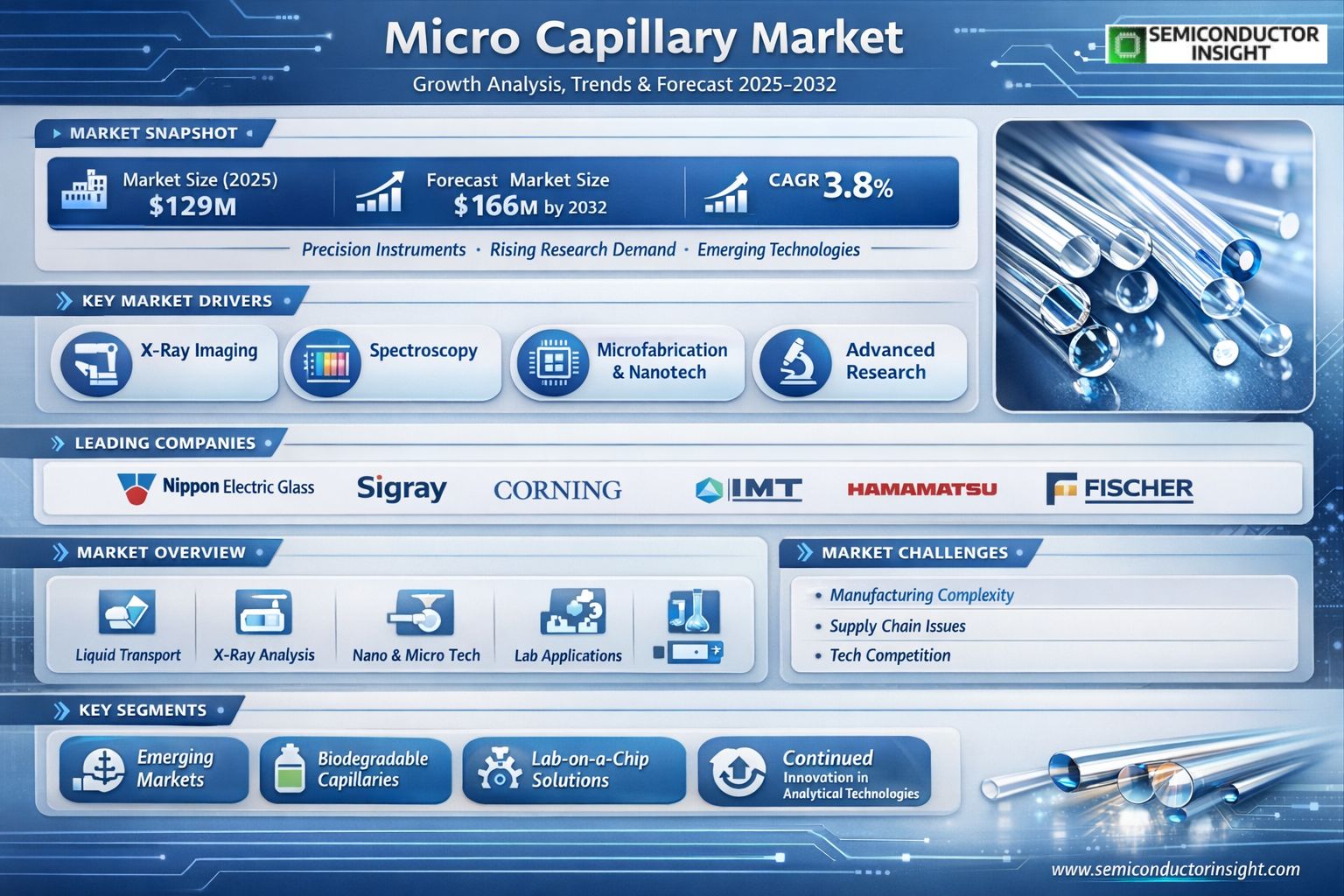
Global Micro Capillary market size was valued at USD 129 million in 2025. The market is projected to grow from USD 129 million in 2025 to USD 166 million by 2032, exhibiting a CAGR of 3.8% during the forecast period.
A micro-capillary is a very fine, hollow tube often used to transport or guide small quantities of liquids, gases, or radiation. In applications involving X-rays or light, micro-capillaries can help focus or direct beams, though a single micro-capillary does not typically produce a fully collimated or focused beam on its own. Product types primarily include Single Capillary and Multi Capillary.
Micro Capillary market is steadily expanding, driven by increasing demand in precision scientific instruments and advanced research fields. Key applications span X-Ray Imaging and Analysis, Spectroscopy, Microfabrication and Nanotechnology, and others. Furthermore, ongoing developments in analytical technologies bolster this trajectory. Leading players such as Nippon Electric Glass Co.,Ltd., Sigray, Inc., Corning Pyrex, Institute of Microchemical Technology Co., Ltd., Hamamatsu, FISCHER INSTRUMENTATION LTD., Hilgenberg GmbH, Sutter Instrument Company, and World Precision Instruments hold significant market presence with diverse portfolios.
MARKET DRIVERS
Advancements in Microfluidics Technology
Micro Capillary market benefits from rapid progress in microfluidics, enabling precise fluid handling at microscopic scales for applications in diagnostics and drug delivery. Innovations like fused silica microcapillaries enhance resolution in electrophoresis, supporting high-throughput analysis in biotech labs worldwide.
Growing Demand in Healthcare Diagnostics
Increasing prevalence of chronic diseases drives adoption of point-of-care testing devices that rely on microcapillaries for rapid blood analysis. The market sees a projected CAGR of 9.2% through 2030, fueled by portable analyzers in emerging economies.
➤ Miniaturization trends reduce sample volumes by up to 90%, accelerating lab workflows and cost efficiencies in pharmaceutical R&D.
Additionally, integration with AI-driven analytics amplifies the efficiency of microcapillary systems, positioning Micro Capillary market for sustained expansion in precision medicine.
MARKET CHALLENGES
Manufacturing Complexity
Producing microcapillaries demands ultra-precise fabrication techniques, such as photolithography, leading to high defect rates and elevated production costs. Scalability remains a hurdle for widespread adoption in Micro Capillary market.
Other Challenges
Supply Chain Vulnerabilities
Global disruptions affect raw material sourcing for high-purity glass and polymers, inflating prices by 15-20% in recent years and delaying market growth.
Competition from alternative technologies like lateral flow assays poses further pressure, requiring continuous innovation to maintain relevance in diagnostics applications.
MARKET RESTRAINTS
Regulatory Hurdles
Stringent FDA and EU approvals for medical-grade microcapillaries extend time-to-market by 2-3 years, constraining new entrants in Micro Capillary market. Compliance with ISO 13485 standards adds significant financial burdens.
High initial investment in cleanroom facilities limits participation to established players, with R&D costs averaging $5-10 million per product line.
Limited standardization across capillary dimensions hinders interoperability in multi-vendor systems, slowing adoption in integrated lab environments.
MARKET OPPORTUNITIES
Expansion in Emerging Markets
Asia-Pacific regions offer untapped potential for Micro Capillary market, with rising healthcare infrastructure investments projected to capture 35% market share by 2028. Affordable diagnostics drive demand in India and China.
Development of biodegradable microcapillaries aligns with sustainability goals, opening avenues in green biotech applications.
Partnerships between device manufacturers and pharma giants could accelerate lab-on-a-chip commercialization, boosting revenues through novel therapeutic monitoring solutions.
Micro Capillary Market Trends
Increasing Adoption in X-Ray Imaging and Analysis
Micro Capillary market continues to see robust demand driven by advancements in X-ray imaging and analysis applications, where these fine hollow tubes play a critical role in guiding and directing X-ray beams for precise focusing in research and industrial settings. As scientific instruments evolve, micro-capillaries enable higher resolution in non-destructive testing and material characterization, supporting sectors like medical diagnostics and semiconductor inspection. Industry surveys indicate that this application segment leads due to its necessity in collimating beams for accurate analysis, fostering innovation among manufacturers focused on material durability and beam efficiency.
Other Trends
Shift Towards Multi-Capillary Configurations
Market participants are observing a notable shift from single capillary to multi-capillary designs, enhancing throughput in parallel processing for spectroscopy and microfabrication tasks. This evolution addresses limitations of individual capillaries in handling complex beam arrays, with suppliers investing in scalable production techniques to meet demands from nanotechnology labs. Key challenges include maintaining uniformity across multiple channels, yet developments in glass and polymer composites are improving performance and reliability in high-precision environments.
Expansion in Regional Markets Particularly Asia
Geographically, Micro Capillary market exhibits strong momentum in Asia, led by Japan and China, where growing investments in advanced manufacturing and research facilities propel adoption across spectroscopy and other applications. Leading players such as Nippon Electric Glass and Hamamatsu are expanding capacities to serve local demands in microfabrication and nanotechnology, while North America maintains a foothold through innovation from firms like Sigray and Sutter Instrument. Competitive dynamics highlight top manufacturers’ strategies in mergers and product diversification to capture shares in emerging regions like Southeast Asia and India, ensuring sustained growth amid evolving industry drivers and technological integrations.
COMPETITIVE LANDSCAPE
Key Industry Players
Micro Capillary Market Leaders and Strategic Contenders
Micro Capillary market exhibits a moderately concentrated structure dominated by a few key manufacturers specializing in precision glass and instrumentation for applications in X-ray imaging, spectroscopy, and nanotechnology. Nippon Electric Glass Co., Ltd. emerges as a leading player, leveraging its expertise in advanced glass technologies to capture significant global revenue share, estimated among the top contributors in 2025. The top five players collectively hold a substantial portion of the market, driving innovation through high-quality single and multi-capillary products amid a projected CAGR of 3.8% through 2032. This oligopolistic dynamic fosters R&D investments, enabling precise beam guidance for scientific and industrial uses while navigating supply chain challenges in specialized materials.
Beyond the frontrunners, a cadre of niche significant players enriches the competitive landscape with tailored solutions for microfabrication and research needs. Companies like Sigray, Inc. and Hilgenberg GmbH focus on high-precision capillaries for advanced analytical instruments, while firms such as Sutter Instrument Company and World Precision Instruments excel in laboratory-grade offerings. These mid-tier entities, including SCHOTT and Hamamatsu, compete on customization and quality, capturing segments in regional markets like North America and Europe. Their strategies emphasize recent developments in product durability and integration with emerging technologies, challenging larger incumbents and spurring overall market growth to US$166 million by 2032.
List of Key Micro Capillary Companies Profiled
- Nippon Electric Glass Co.,Ltd.
- Sigray, Inc.
- Corning Pyrex
- Institute of Microchemical Technology Co., Ltd.
- Hamamatsu
- FISCHER INSTRUMENTATION LTD.
- Hilgenberg GmbH
- Animalab
- Sutter Instrument Company
- World Precision Instruments
- SCHOTT
- Bellco Glass, Inc
- Hampton Research
- MCS GmbH
Segment Analysis:
| Segment Category | Sub-Segments | Key Insights |
| By Type |
|
Single Capillary remains the leading segment due to its simplicity and precision in handling minute fluid volumes.
|
| By Application |
|
X-Ray Imaging and Analysis dominates as the key application segment, leveraging micro-capillaries for beam guidance.
|
| By End User |
|
Academic and Research Laboratories lead adoption, fueled by extensive R&D activities.
|
| By Material |
|
Borosilicate Glass holds prominence for its versatile properties in micro-capillary applications.
|
| By Configuration |
|
Straight configuration leads owing to its straightforward integration and reliability.
|
Regional Analysis: Micro Capillary Market
North America
Leading research centers in the U.S. and Canada drive Micro Capillary Market advancements, focusing on novel materials for enhanced durability and biocompatibility. Collaborative ecosystems spur breakthroughs in capillary arrays for genomics, streamlining workflows and reducing costs in high-volume labs.
Streamlined FDA approvals facilitate rapid deployment of Micro Capillary Market solutions, encouraging investments in next-gen devices for clinical trials. This environment supports iterative development, ensuring compliance while accelerating time-to-market for innovative products.
Dominant firms leverage proprietary micro capillary tech for drug discovery platforms, pursuing mergers to consolidate market share. Strategies center on vertical integration, from fabrication to end-user applications, fortifying competitive positioning through 2034.
Healthcare providers increasingly adopt Micro Capillary Market tools for efficient biomarker analysis, driven by demands for faster diagnostics. Trends highlight expansion into veterinary and environmental testing, broadening application scopes amid rising precision needs.
Europe
Europe exhibits strong growth in Micro Capillary market, propelled by stringent quality standards and collaborative EU-funded projects advancing microfluidic innovations. Trends focus on sustainable manufacturing processes for eco-friendly capillaries used in advanced therapeutics. Business strategies involve cross-border partnerships enhancing supply chains and market access across diverse economies. Key dynamics include integration with wearable health devices, supporting remote monitoring solutions. Regulatory harmonization accelerates adoption in pharmaceuticals, while academic hubs foster talent development. Projections to 2034 emphasize digital twin simulations for capillary optimization, positioning Europe as a reliability leader. Investment in green technologies aligns with broader sustainability goals, driving demand in research and industrial sectors.
Asia-Pacific
Asia-Pacific emerges as a dynamic force in Micro Capillary market, fueled by rapid industrialization and expanding biotech capabilities in China, Japan, and India. Trends highlight cost-effective production scaling for high-precision applications in diagnostics. Business strategies prioritize local manufacturing hubs and export growth, capitalizing on demographic-driven healthcare needs. Market dynamics reveal surging investments in point-of-care devices utilizing micro capillaries for infectious disease screening. Government incentives bolster R&D, fostering innovation ecosystems. Through 2034, emphasis on AI integration promises enhanced fluid dynamics control, solidifying regional competitiveness amid global supply shifts.
South America
South America shows promising potential in Micro Capillary market, with Brazil and Argentina leading through emerging biotech clusters. Trends center on affordable diagnostics tailored to tropical health challenges, leveraging micro capillaries for rapid pathogen detection. Business strategies involve technology transfers from global players, building domestic expertise. Market dynamics underscore infrastructure improvements enabling wider lab adoption. Collaborative initiatives with international firms accelerate skill development. By 2034, focus on localized production aims to reduce import dependencies, enhancing accessibility in underserved areas and supporting public health advancements.
Middle East & Africa
The Middle East & Africa region advances steadily in Micro Capillary market, driven by oil-funded diversification into life sciences in the Gulf states and research expansions in South Africa. Trends emphasize portable devices for remote healthcare delivery using durable micro capillaries. Business strategies feature public-private partnerships to overcome infrastructural hurdles. Market dynamics highlight growing telemedicine integrations, vital for vast geographies. Investments in training programs build capacity. Projections to 2034 predict accelerated growth via innovation incubators, positioning the region for strategic self-sufficiency in precision medical tools.
Report Scope
This market research report provides a comprehensive analysis of the Micro Capillary Market , covering the forecast period 2025–2032. It offers detailed insights into market dynamics, technological advancements, competitive landscape, and key trends shaping the industry.
Key focus areas of the report include:
- Market Overview: The report begins with an overview outlining its current market scenario, key growth indicators, and industry transformation drivers. It discusses macroeconomic factors, demand–supply balance, regulatory landscape, and the strategic role of micro-capillaries in powering advancements across industries such as X-Ray Imaging and Analysis, Spectroscopy, Microfabrication and Nanotechnology, and Others.
- Market Size & Forecast: Historical data and future projections for revenue, unit shipments, and market value across major regions and segments.
- Segmentation Analysis: Detailed breakdown by product type, technology, application, and end-user industry to identify high-growth segments and investment opportunities.
- Regional Insights: Insights into market performance across North America, Europe, Asia-Pacific, Latin America, and the Middle East & Africa, including country-level analysis where relevant.
- Competitive Landscape: Profiles of leading market participants, including their product offerings, R&D focus, manufacturing capacity, pricing strategies, and recent developments such as mergers, acquisitions, and partnerships.
- Technology Trends & Innovation: Assessment of emerging technologies, advanced fabrication techniques for single and multi capillaries, beam guidance innovations, and evolving industry standards.
- Market Drivers & Restraints: Evaluation of factors driving market growth along with challenges, supply chain constraints, regulatory issues, and market-entry barriers.
- Stakeholder Insights: Insights for component suppliers, OEMs, system integrators, investors, and policymakers regarding the evolving ecosystem and strategic opportunities.
Primary and secondary research methods are employed, including interviews with industry experts, data from verified sources, and real-time market intelligence to ensure the accuracy and reliability of the insights presented.
FREQUENTLY ASKED QUESTIONS:
What is the current market size of Micro Capillary Market?
-> Global Micro Capillary market was valued at USD 129 million in 2025 and is projected to reach USD 166 million by 2032, at a CAGR of 3.8% during the forecast period.
Which key companies operate in Micro Capillary Market?
-> Key players include Nippon Electric Glass Co.,Ltd., Sigray, Inc., Corning Pyrex, Institute of Microchemical Technology Co., Ltd., Hamamatsu, FISCHER INSTRUMENTATION LTD., Hilgenberg GmbH, Animalab, Sutter Instrument Company, World Precision Instruments, among others.
What are the key growth drivers?
-> Key growth drivers include demand in X-Ray Imaging and Analysis, Spectroscopy, Microfabrication and Nanotechnology applications, industry trends, and sales growth.
Which region dominates the market?
-> North America dominates the market, while Asia is the fastest-growing region.
What are the emerging trends?
-> Emerging trends include single and multi capillary developments, precise transport of liquids gases and radiation, and beam focusing in X-rays and light applications.

Get Sample Report PDF for Exclusive Insights
Report Sample Includes
- Table of Contents
- List of Tables & Figures
- Charts, Research Methodology, and more...
 Download Sample Report PDF