Market Insights
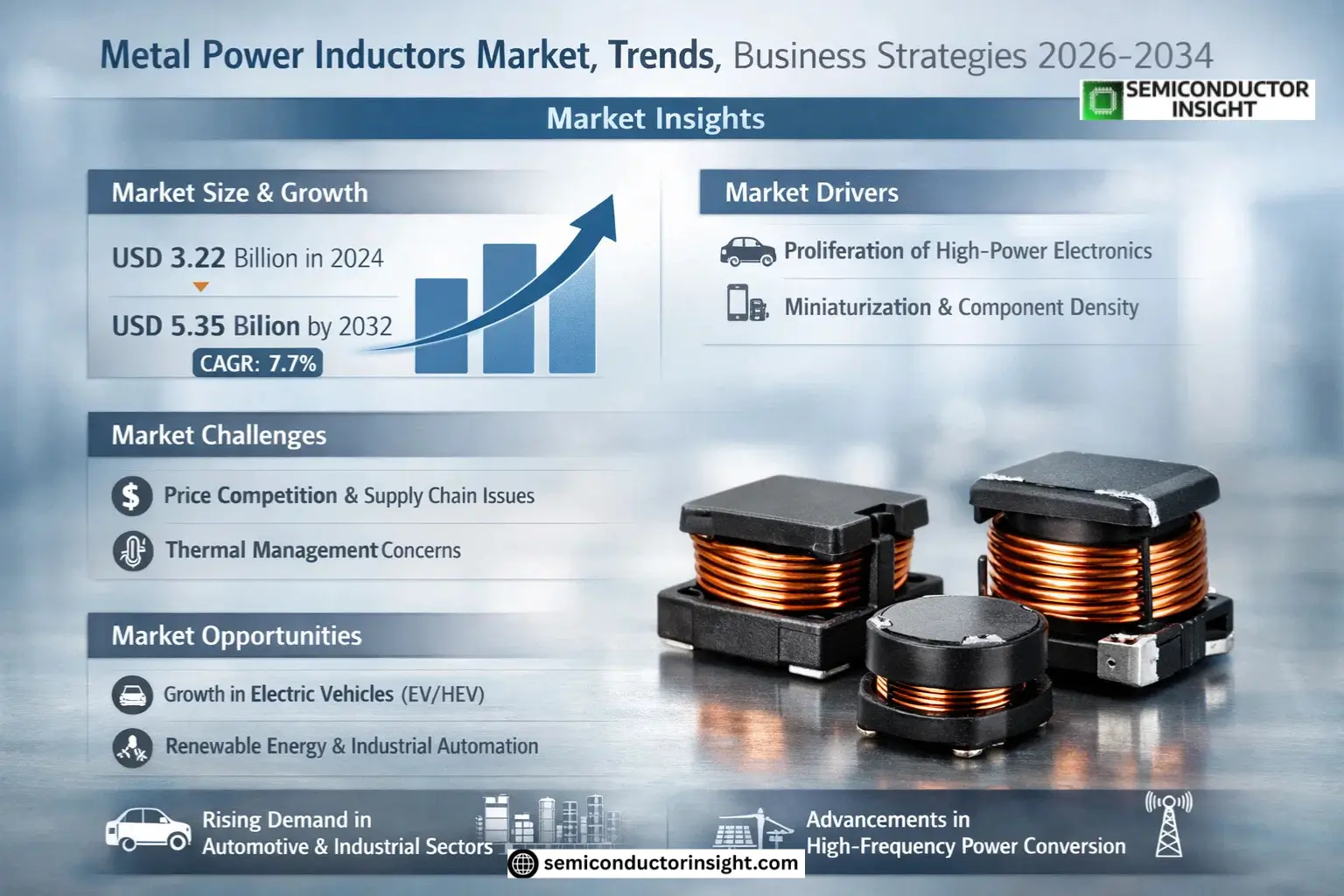
Global Metal Power Inductors Market size was valued at USD 3.22 billion in 2024. The market is projected to grow from USD 3.46 billion in 2025 to USD 5.35 billion by 2032, exhibiting a CAGR of 7.7% during the forecast period.
Metal power inductors are passive electronic components designed for power supply circuits, constructed using metal composite or ferrite materials. These inductors play a critical role in voltage conversion applications, ensuring stable power delivery to integrated circuits (ICs). Their design prioritizes maintaining inductance under current flow while minimizing resistance losses, achieved through metal powder-based cores and low-resistance copper windings.
The market growth is driven by increasing demand for compact and efficient power management solutions across industries such as consumer electronics, automotive, and telecommunications. The winding type segment dominates with a 60% market share due to its cost-effectiveness and reliability, while consumer electronics applications account for approximately 33% of total demand. Key players including TDK, Taiyo Yuden, and Chilisin collectively hold 36% of the global market share.
MARKET DRIVERS
Proliferation of High-Power Electronics
The escalating demand for efficient power management in automotive, industrial, and consumer electronics is a primary driver for the Metal Power Inductors Market. These components are critical for applications requiring high current handling, low DC resistance, and minimal core losses, such as voltage regulator modules and power supplies.
Miniaturization and Component Density
The relentless drive towards smaller, more powerful devices necessitates inductors with a high saturation current and a compact footprint. Metal composite and alloy power inductors excel in these areas, enabling higher power density in space-constrained applications like smartphones, servers, and electric vehicle powertrains.
Consequently, the expansion of 5G infrastructure and renewable energy systems further solidifies the growth trajectory for the Metal Power Inductors Market, as these sectors rely heavily on efficient power conversion.
MARKET CHALLENGES
Intense Price Competition and Supply Chain Volatility
Metal Power Inductors Market faces significant margin pressures due to intense competition, particularly from regional manufacturers. Fluctuations in the prices of raw materials like iron and metal alloys can disrupt production costs and profitability for market players.
Other Challenges
Technical Performance Trade-offs
Designers often face challenges balancing high saturation current with low core loss. Achieving optimal performance for high-frequency switching applications while managing electromagnetic interference (EMI) remains a complex engineering hurdle.
Thermal Management Issues
As power densities increase, effective heat dissipation becomes critical. Ensuring metal power inductors maintain performance and reliability under high-temperature conditions is a persistent challenge for manufacturers.
MARKET RESTRAINTS
High Initial Manufacturing Costs
The specialized manufacturing processes, including precision winding and the use of high-performance metal composite powders, contribute to the higher cost of metal power inductors compared to traditional ferrite-based alternatives. This can restrain their adoption in extremely cost-sensitive consumer applications.
Competition from Alternative Technologies
In certain low-to-mid power applications, advancements in multilayer ceramic inductors (MLCCs) and ferrite-core solutions present viable and sometimes less expensive alternatives, potentially limiting the growth potential for metal power inductors in specific market segments.
MARKET OPPORTUNITIES
Expansion in Electric and Hybrid Electric Vehicles (EV/HEV)
The automotive industry’s rapid shift towards electrification represents a massive growth avenue for the Metal Power Inductors Market. These components are essential for onboard chargers, DC-DC converters, and battery management systems, where high efficiency and thermal stability are paramount.
Growth in Renewable Energy and Industrial Automation
Increasing investments in solar inverters, wind turbines, and automated industrial machinery create strong demand for durable power inductors capable of handling high currents and operating reliably over long lifespans. This sector offers significant expansion potential for suppliers in the Metal Power Inductors Market.
Advancements in High-Frequency Power Conversion
Ongoing research into new metal alloy compositions and core structures is leading to inductors that perform efficiently at higher switching frequencies. This opens opportunities in next-generation telecommunications equipment and advanced computing hardware, driving innovation within the market.
Metal Power Inductors Market Trends
Automotive and Industrial Electronics Drive Market Expansion
Global Metal Power Inductors Market is experiencing a significant growth trajectory, projected to reach USD 5349 million by 2032 from a valuation of USD 3215 million in 2024, growing at a CAGR of 7.7%. A primary driver of this expansion is the escalating demand from the automotive electronics and industrial applications sectors. As vehicles become increasingly electrified and automated, the need for stable power conversion in systems like advanced driver-assistance systems (ADAS), infotainment, and power management units is surging. Similarly, the push for industrial automation and smart manufacturing necessitates highly reliable power supplies, where metal power inductors are critical components due to their efficiency and ability to handle high currents.
Other Trends
Winding Type Dominance and Material Innovation
In terms of product types, the Winding Type segment continues to dominate the market, holding a substantial 60% share. This dominance is attributed to its excellent performance in high-current applications and cost-effectiveness for consumer electronics. Concurrently, there is a strong trend towards material science innovation. Manufacturers are focusing on developing metal composite powders and advanced winding techniques to create inductors with even lower direct current resistance (DCR) and higher saturation currents, enabling smaller form factors and greater power density to meet the demands of next-generation compact devices.
Concentrated Competitive Landscape and Supply Chain Dynamics
The competitive landscape of the Metal Power Inductors Market is notably concentrated, with the top three companies TDK, Taiyo Yuden, and Chilisin collectively accounting for 36% of global market share. This concentration underscores the high technical barriers and significant R&D investments required. Current U.S. tariff policies and international trade dynamics are influencing competitive structures and regional economic performance. Companies are actively reassessing and diversifying their supply chains to enhance resilience against geopolitical risks and potential disruptions, ensuring a stable supply of these essential components to key downstream markets like consumer electronics, which itself holds about a 33% market share by application.
COMPETITIVE LANDSCAPE
Key Industry Players
A concentrated market dominated by a few global leaders, with a long tail of specialized suppliers.
Global Metal Power Inductors Market is characterized by a high degree of consolidation, with a trio of major players TDK Corporation, Taiyo Yuden, and Chilisin collectively commanding over a third of the global market share. This structure underscores the significant technological expertise, manufacturing scale, and established supply chain relationships required to compete at the highest level. These leading companies provide a broad portfolio of Metal Power Inductor solutions catering to demanding applications in consumer electronics, automotive, and telecommunications, driving innovation in efficiency, miniaturization, and thermal performance. The competitive dynamics are heavily influenced by continuous R&D investments to meet the evolving power requirements of next-generation electronic devices, creating a barrier to entry for new players and reinforcing the position of incumbents.
Beyond the market leaders, the landscape includes a diverse group of well-established international component manufacturers and regional specialists. Companies like Murata, Samsung Electro-Mechanics, and Vishay Intertechnology offer strong competition with their comprehensive passive component portfolios and global reach. Niche players such as Coilcraft, Wurth Elektronik, and Bourns are recognized for their high-performance and custom-designed inductor solutions, often targeting specific high-reliability segments like industrial automation and automotive electronics. Furthermore, a number of prominent Asian manufacturers, including Sumida, Panasonic, and Sunlord Electronics, exert significant influence, particularly within the high-volume consumer electronics supply chain, contributing to a competitive environment focused on cost-effectiveness and rapid time-to-market.
List of Key Metal Power Inductors Companies Profiled
- TDK Corporation
- Taiyo Yuden Co., Ltd.
- Murata Manufacturing Co., Ltd.
- Samsung Electro-Mechanics
- Sumida Corporation
- Vishay Intertechnology, Inc.
- Chilisin Electronics
- Bourns, Inc.
- Wurth Elektronik GmbH & Co. KG
- KYOCERA AVX Corporation
- MinebeaMitsumi Inc.
- Panasonic Holdings Corporation
- KEMET (a YAGEO Company)
- Coilcraft, Inc.
- Eaton Corporation
Segment Analysis:
| Segment Category | Sub-Segments | Key Insights |
| By Type |
|
Winding Type inductors demonstrate clear market dominance due to their superior performance characteristics. This segment benefits from high reliability and excellent energy efficiency, making them the preferred choice for power-intensive applications. Furthermore, their robust construction using metal powder-based materials ensures stable inductance under high current loads, which is critical for modern electronic devices demanding consistent power delivery. The manufacturing processes for winding types are also well-established, contributing to their widespread adoption and cost-effectiveness for large-scale production. |
| By Application |
|
Consumer Electronics represents the most significant application segment, driven by the pervasive integration of power management circuits in smartphones, laptops, and home appliances. The relentless miniaturization trend in consumer devices creates strong demand for compact yet efficient metal power inductors that can handle increasing power densities. Additionally, the proliferation of smart devices and the Internet of Things ecosystem fuels continuous innovation and adoption, as these components are essential for stable voltage conversion and noise suppression, ensuring optimal device performance and longevity. |
| By End User |
|
OEMs (Original Equipment Manufacturers) constitute the primary end-user segment, leveraging metal power inductors directly in their production lines for a vast range of electronic products. This dominance is underpinned by the need for high-volume, reliable component sourcing to meet mass production schedules and stringent quality standards. OEMs also drive specifications for component performance, often collaborating closely with inductor manufacturers to develop custom solutions tailored to specific product requirements, which reinforces their leadership position in the market and influences technological advancements. |
| By Core Material |
|
Metal Composite Powder is the leading core material, prized for its exceptional magnetic properties that enable high saturation flux density and low core losses. This material allows inductors to maintain stable performance in high-current environments, which is a critical requirement for modern power supplies. The ability of metal composite powders to be finely tuned for specific frequency and power handling characteristics gives designers significant flexibility, making this the material of choice for applications demanding high efficiency and reliability in a compact form factor. |
| By Power Rating |
|
Medium Power inductors lead the market, finding the broadest application across consumer electronics, telecommunications, and automotive systems. This segment strikes an optimal balance between size, cost, and performance, making it suitable for the power requirements of a majority of mainstream electronic devices. The design flexibility of medium-power inductors allows them to be integrated into space-constrained PCBs while still providing sufficient current handling and efficiency, which aligns perfectly with the evolving needs of compact and powerful electronic equipment across multiple industries. |
Regional Analysis: Metal Power Inductors Market
Asia-Pacific
The region’s established infrastructure for electronics manufacturing provides a significant cost and scalability advantage for metal power inductor production. A dense network of component suppliers and assembly plants allows for rapid prototyping and mass production, catering to the fast-paced consumer electronics cycle and meeting the high-volume requirements of global technology brands that source heavily from this region.
As the world’s primary manufacturing base for smartphones, tablets, and computing devices, the Asia-Pacific region generates immense intrinsic demand for compact, high-efficiency metal power inductors. This demand drives local innovation in inductor design to achieve smaller form factors and better performance, directly feeding back into the region’s competitive edge in the global Metal Power Inductors Market.
The rapid industrialization and the world’s most aggressive adoption of electric vehicles, particularly in China, are key growth drivers. Metal power inductors are critical for power conversion in industrial motor drives, renewable energy systems, and EV powertrains, ensuring the region’s market remains diversified and resilient beyond consumer electronics.
Leading companies and research institutions in Japan and South Korea are at the forefront of developing advanced magnetic materials and core technologies for metal power inductors. This focus on R&D leads to products with higher saturation currents, reduced power loss, and improved thermal performance, meeting the evolving needs of next-generation high-frequency applications.
North America
The North American market for metal power inductors is characterized by strong demand from the telecommunications, automotive, and aerospace and defense sectors. The region is a leader in the deployment of advanced 5G infrastructure, which requires high-frequency, high-reliability inductors for base stations and network equipment. The presence of major automotive manufacturers and a growing emphasis on electric and autonomous vehicles further stimulate demand for high-performance power inductors used in battery management systems and advanced driver-assistance systems (ADAS). Additionally, stringent quality and reliability standards in the aerospace and defense industries push for the adoption of specialized, ruggedized metal power inductors, supporting a stable, high-value market segment.
Europe
Europe maintains a significant presence in the Metal Power Inductors Market, driven by its strong automotive industry and focus on industrial automation and renewable energy. German and French automotive manufacturers, in particular, are integrating more electronic content into vehicles, increasing the need for efficient power management components. The region’s commitment to green energy, seen in its investments in wind and solar power, creates demand for inductors used in power conversion and inverter systems. European regulations emphasizing energy efficiency also encourage the development and adoption of advanced metal power inductors that minimize energy loss in a wide range of applications, from consumer appliances to industrial machinery.
South America
The South American market for metal power inductors is emerging, with growth primarily linked to the gradual modernization of its industrial base and increasing consumer electronics penetration. Countries like Brazil and Argentina are seeing rising demand in the automotive and industrial sectors, though the market volume remains smaller compared to other regions. The development is often tied to foreign investment and the localization of manufacturing plants by international electronics companies. While not a primary driver of innovation, the region represents a growth opportunity as its infrastructure and manufacturing capabilities continue to develop, creating a slowly expanding base for metal power inductor consumption.
Middle East & Africa
The Middle East and Africa region represents a developing market for metal power inductors, with growth potential linked to infrastructure development and economic diversification efforts. In the Middle East, investments in smart city projects, telecommunications infrastructure, and non-oil industrial sectors are generating nascent demand. In Africa, the market is largely driven by the increasing adoption of mobile communication devices and the slow build-out of industrial capacity. The overall market is characterized by import dependency, with future growth hinging on regional economic stability and increased local manufacturing initiatives for electronic goods.
Report Scope
This market research report provides a comprehensive analysis of the Metal Power Inductors Market, covering the forecast period 2024–2032. It offers detailed insights into market dynamics, technological advancements, competitive landscape, and key trends shaping the industry.
Key focus areas of the report include:
- Market Overview: The report begins with an overview outlining its current market scenario, key growth indicators, and industry transformation drivers. It discusses macroeconomic factors, demand–supply balance, regulatory landscape, and the strategic role of metal power inductors in powering advancements across industries such as consumer electronics, automotive electronics, communication, and industrial applications.
- Market Size & Forecast: Historical data and future projections for revenue, unit shipments, and market value across major regions and segments.
- Segmentation Analysis: Detailed breakdown by product type (Winding Type, Thin Film Type, Others), application (Consumer Electronics, Automotive Electronics, Communication Industry, Industrial Applications), and end-user industry to identify high-growth segments.
- Regional Insights: Insights into market performance across North America, Europe, Asia, South America, and Middle East & Africa, including country-level analysis.
- Competitive Landscape: Profiles of leading market participants including TDK, Taiyo Yuden, Murata, and other key players, with analysis of market share, strategic developments, and R&D focus.
- Technology Trends & Innovation: Assessment of emerging technologies, material advancements, and evolving industry standards in power inductor manufacturing.
- Market Drivers & Restraints: Evaluation of factors driving market growth along with challenges, supply chain constraints, and regulatory considerations.
- Stakeholder Insights: Strategic insights for component manufacturers, OEMs, system integrators, and investors regarding market opportunities.
The report employs primary and secondary research methods, including industry expert interviews and verified data sources, to ensure accurate and reliable market intelligence.
FREQUENTLY ASKED QUESTIONS:
What is the current market size of Metal Power Inductors?
-> Metal Power Inductors Market size was valued at USD 3.22 billion in 2024. The market is projected to grow from USD 3.46 billion in 2025 to USD 5.35 billion by 2032, exhibiting a CAGR of 7.7% during the forecast period.
What is the growth rate of the Metal Power Inductors Market?
-> The market is expected to grow at a CAGR of 7.7% during 2024-2032.
Which key companies operate in the Metal Power Inductors Market?
-> Key players include TDK, Taiyo Yuden, Chilisin, Murata, Samsung Electro-Mechanics, Sumida, Vishay Intertechnology, and others. Top three companies hold 36% market share.
What is the largest product segment in Metal Power Inductors?
-> Winding Type dominates with 60% market share in 2024.
What is the leading application for Metal Power Inductors?
-> Consumer Electronics accounts for about 33% market share as the leading application segment.
Get Sample Report PDF for Exclusive Insights
Report Sample Includes
- Table of Contents
- List of Tables & Figures
- Charts, Research Methodology, and more...
 Download Sample Report PDF