Market Insights
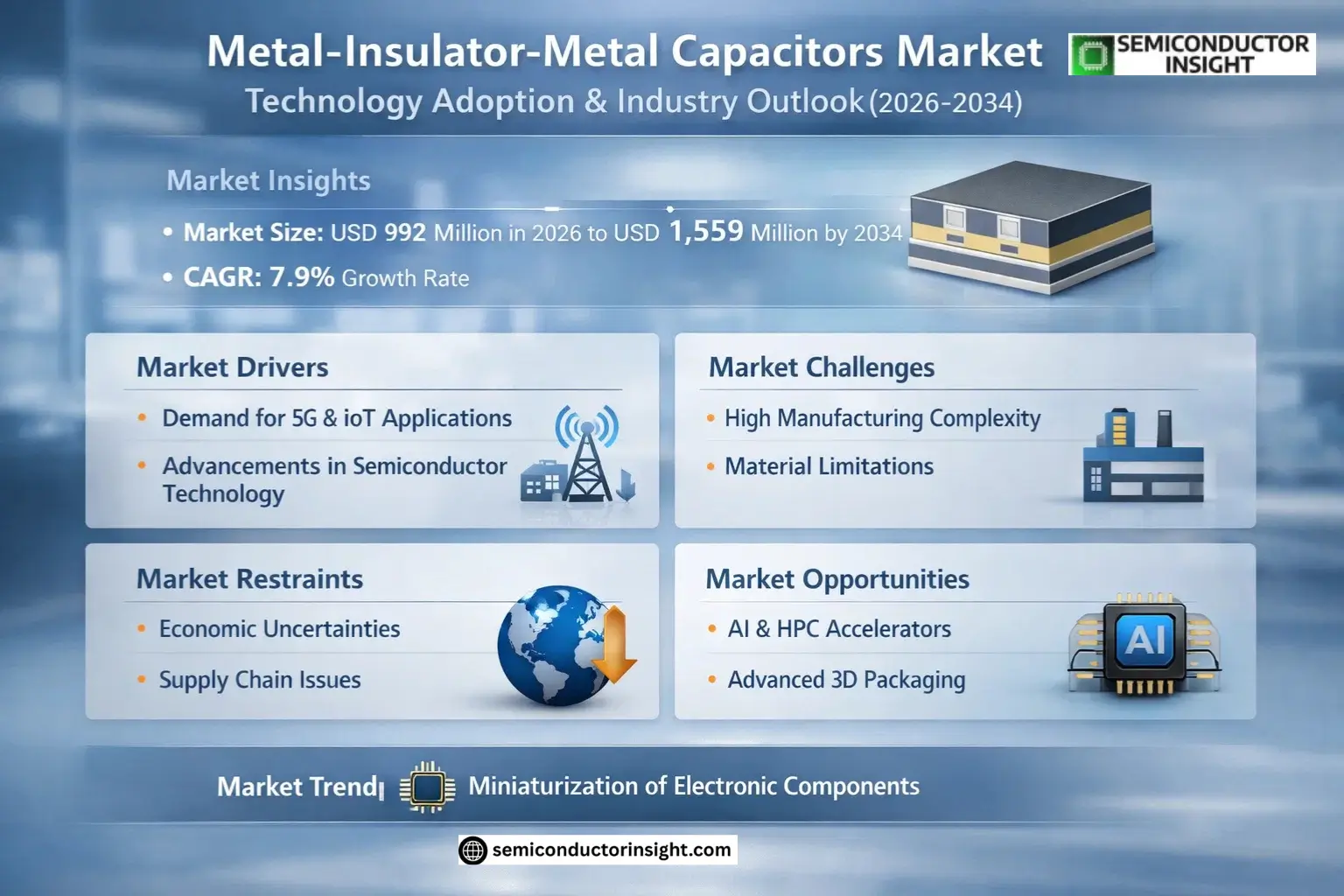
Global Metal-Insulator-Metal Capacitors Market size was valued at USD 925 million in 2025. The market is projected to grow from USD 992 million in 2026 to USD 1,559 million by 2034, exhibiting a CAGR of 7.9% during the forecast period.
Metal-Insulator-Metal capacitors are passive electronic components that store energy in an electric field between two metal electrodes separated by a thin insulating layer. These capacitors are widely used in high-frequency applications such as RF filters, power amplifiers, and analog/mixed-signal ICs due to their superior linearity, low leakage current, and temperature stability. Key variants include MOS (Metal-Oxide-Semiconductor) and MIS (Metal-Insulator-Semiconductor) capacitors, with materials like silicon nitride and aluminum oxide commonly used as dielectrics.
The market growth is driven by increasing demand for miniaturized electronic components in 5G infrastructure, IoT devices, and automotive electronics. Leading manufacturers such as Murata Manufacturing and KYOCERA AVX are investing in advanced deposition techniques to improve capacitance density, while emerging applications in medical implants and aerospace systems present new opportunities. However, challenges like material limitations at nanometer scales and competition from alternative technologies may restrain growth in niche segments.
MARKET DRIVERS
Growing Demand for High-Frequency Applications
Metal-Insulator-Metal Capacitors Market is experiencing significant growth due to increasing demand for high-frequency applications in 5G networks, IoT devices, and RF components. These capacitors offer superior performance in high-frequency ranges, making them indispensable in modern communication systems. The market is projected to grow at 8.2% CAGR over the next five years.
Advancements in Semiconductor Technology
With semiconductor nodes shrinking below 7nm, Metal-Insulator-Metal Capacitors are becoming critical for maintaining signal integrity and power delivery in advanced IC designs. Their high capacitance density (up to 20fF/μm²) and low leakage current make them preferred over traditional options.
Miniaturization trends across electronics are further propelling adoption, with Metal-Insulator-Metal Capacitors enabling compact, high-performance solutions in space-constrained applications.
MARKET CHALLENGES
High Manufacturing Complexity
Fabrication of Metal-Insulator-Metal Capacitors requires precise deposition techniques and specialized materials, leading to higher production costs compared to traditional capacitors. Yield management remains a key challenge, particularly at advanced nodes below 10nm.
Other Challenges
Material Limitations
Finding dielectric materials that maintain stability at high frequencies while meeting leakage current specifications continues to constrain Metal-Insulator-Metal Capacitors performance in extreme environments.
MARKET RESTRAINTS
Economic Uncertainties Impacting Semiconductor Investments
Global semiconductor capex fluctuations and trade restrictions are creating supply chain uncertainties for Metal-Insulator-Metal Capacitors. Foundries are cautiously evaluating new capacity additions, potentially slowing market growth in the short term.
MARKET OPPORTUNITIES
Emerging Applications in AI Hardware
Metal-Insulator-Metal Capacitors Market stands to benefit from booming demand in AI accelerators and high-performance computing, where these components enable efficient power delivery networks for GPU and TPU architectures. The AI hardware segment is expected to drive 35% of new Metal-Insulator-Metal Capacitors adoption by 2027.
Advanced Packaging Innovations
3D packaging technologies like chiplet designs and silicon interposers are creating new implementation opportunities for Metal-Insulator-Metal Capacitors as essential decoupling components in heterogeneous integration solutions.
Metal-Insulator-Metal Capacitors Market Trends
Miniaturization Driving Demand for Advanced Capacitors
Metal-Insulator-Metal Capacitors Market is witnessing increased demand due to the ongoing trend of electronic component miniaturization. These capacitors offer superior performance in compact form factors, making them ideal for modern applications requiring high capacitance density. The telecommunication and medical sectors are early adopters of these advanced components.
Other Trends
Growing Adoption in Automotive Electronics
Automotive applications are emerging as a significant growth area for Metal-Insulator-Metal Capacitors, particularly in electric vehicle power systems and advanced driver-assistance systems (ADAS). The need for reliable, high-temperature performance components is pushing manufacturers to develop specialized automotive-grade solutions.
Material Innovation Enhancing Performance
Key manufacturers are investing in advanced dielectric materials to improve the thermal stability and frequency response of Metal-Insulator-Metal Capacitors. This trend is particularly evident in industrial applications where components must maintain performance under extreme operating conditions. The development of novel insulator materials is enabling capacitors to handle higher voltages while maintaining compact sizes.
Regional Manufacturing Shifts
Asia-Pacific is emerging as a manufacturing hub for Metal-Insulator-Metal Capacitors, with China, Japan, and South Korea leading production. This geographic shift reflects both cost advantages and proximity to key electronics manufacturing centers in the region.
Industry Consolidation and Strategic Partnerships
The market is witnessing consolidation among key players, with leading semiconductor manufacturers acquiring specialized capacitor producers to strengthen their product portfolios. These strategic moves are improving supply chain efficiency and accelerating innovation in Metal-Insulator-Metal Capacitor technology.
COMPETITIVE LANDSCAPE
Key Industry Players
Strategic Positioning in the $1.5 Billion MIM Capacitors Sector
Murata Manufacturing leads Global Metal-Insulator-Metal Capacitors Market with dominant 22% revenue share, leveraging its advanced thin-film deposition technologies and extensive R&D capabilities. The industry exhibits consolidated competition, with the top five players collectively controlling over 60% market share through technological differentiation in MOS and MIS capacitor segments. KYOCERA AVX and Vishay Intertechnology maintain strong positions through vertically integrated manufacturing and strategic partnerships with automotive and telecom clients.
Emerging players like Empower Semiconductor are gaining traction with silicon-integrated MIM capacitor solutions for 5G applications. Niche specialists such as Elohim focus on high-temperature industrial applications, while Taiwanese manufacturers are expanding their footprint through cost-competitive offerings for consumer electronics. The market sees increasing competition in ultra-miniaturized capacitors for medical implants and IoT devices.
List of Key Metal-Insulator-Metal Capacitors Companies Profiled
- Murata Manufacturing
- ROHM Semiconductor
- KYOCERA AVX
- Vishay Intertechnology
- MACOM
- Microchip Technology
- Skyworks Solutions
- Empower Semiconductor
- Elohim
- Taiyo Yuden
- Nippon Chemi-Con
- TDK Corporation
- Kemet (Yageo Corporation)
- Walsin Technology
- Samwha Capacitor
Segment Analysis:
| Segment Category | Sub-Segments | Key Insights |
| By Type |
|
MOS Capacitor segment dominates due to:
|
| By Application |
|
Telecommunication application shows strongest growth potential:
|
| By End User |
|
OEMs represent the most significant demand:
|
| By Dielectric Material |
|
High-k Dielectrics gaining prominence due to:
|
| By Voltage Range |
|
Low Voltage capacitors show strongest adoption because:
|
Regional Analysis: Asia-Pacific Metal-Insulator-Metal Capacitors Market
Japan’s integrated semiconductor value chain enables seamless adoption of Metal-Insulator-Metal Capacitors, with material suppliers, fabless designers, and OEMs collaborating on customized solutions for high-frequency applications.
The thriving automotive semiconductor sector drives demand for reliable MIM capacitors in ADAS and powertrain systems, with Japanese automakers specifying high-temperature tolerant components for electric vehicles.
Consumer electronics manufacturers increasingly adopt Metal-Insulator-Metal Capacitors for their superior capacitance density, enabling thinner smartphones and wearable devices with extended battery life.
Deployment of 5G base stations across Japan creates strong need for high-Q MIM capacitors in RF front-end modules and millimeter wave applications, with domestic suppliers leading in quality benchmarks.
South Korea
South Korea emerges as a formidable competitor in the Metal-Insulator-Metal Capacitors Market, leveraging its leadership in memory semiconductors and display technologies. The region benefits from concentrated electronics manufacturing clusters that require precision passive components. Major conglomerates vertically integrate MIM capacitor production for internal consumption in smartphones and OLED displays, while simultaneously supplying global markets. Government-backed semiconductor initiatives focus on next-generation packaging technologies that incorporate advanced Metal-Insulator-Metal Capacitors for AI hardware acceleration.
China
China’s rapidly expanding foundry capabilities drive adoption of Metal-Insulator-Metal Capacitors across consumer electronics and industrial applications. Domestic manufacturers focus on cost-competitive solutions while improving technical specifications to meet international standards. The region shows particular strength in mid-range MIM capacitors for IoT devices and power management ICs, with increasing R&D into novel dielectric materials. Local supply chain development reduces dependence on imported high-end components.
Taiwan
Taiwan’s semiconductor foundries create substantial demand for Metal-Insulator-Metal Capacitors in advanced logic and analog ICs. The region specializes in high-mix production of MIM capacitors tailored for specific foundry processes, with strong capabilities in multi-layer thin-film configurations. Close collaboration between OSAT providers and IC design houses enables rapid implementation of Metal-Insulator-Metal Capacitors in new product designs, particularly for computing and communications applications.
Southeast Asia
Emerging as an important manufacturing hub, Southeast Asia sees growing adoption of Metal-Insulator-Metal Capacitors in automotive electronics and industrial equipment. The region benefits from increasing semiconductor back-end operations and final assembly plants requiring reliable passive components. While currently dependent on imported high-end MIM capacitors, local joint ventures are establishing production capabilities to serve regional demand from consumer electronics manufacturers.
Report Scope
This market research report provides a comprehensive analysis of the Metal-Insulator-Metal Capacitors Market, covering the forecast period 2025–2034. It offers detailed insights into market dynamics, technological advancements, competitive landscape, and key trends shaping the industry.
Key focus areas of the report include:
- Market Overview: The report begins with an overview outlining its current market scenario, key growth indicators, and industry transformation drivers. It discusses macroeconomic factors, demand–supply balance, regulatory landscape, and the strategic role of semiconductors in powering advancements across industries such as automotive, telecommunications, medical, and industrial applications.
- Market Size & Forecast: Historical data and future projections for revenue, unit shipments, and market value across major regions and segments.
- Segmentation Analysis: Detailed breakdown by product type, technology, application, and end-user industry to identify high-growth segments and investment opportunities.
- Regional Insights: Insights into market performance across North America, Europe, Asia-Pacific, Latin America, and the Middle East & Africa, including country-level analysis where relevant.
- Competitive Landscape: Profiles of leading market participants, including their product offerings, R&D focus, manufacturing capacity, pricing strategies, and recent developments such as mergers, acquisitions, and partnerships.
- Technology Trends & Innovation: Assessment of emerging technologies, integration of AI/IoT, semiconductor design trends, fabrication techniques, and evolving industry standards.
- Market Drivers & Restraints: Evaluation of factors driving market growth along with challenges, supply chain constraints, regulatory issues, and market-entry barriers.
- Stakeholder Insights: Insights for component suppliers, OEMs, system integrators, investors, and policymakers regarding the evolving ecosystem and strategic opportunities.
Primary and secondary research methods are employed, including interviews with industry experts, data from verified sources, and real-time market intelligence to ensure the accuracy and reliability of the insights presented.
FREQUENTLY ASKED QUESTIONS:
What is the current market size of Metal-Insulator-Metal Capacitors Market?
-> Metal-Insulator-Metal Capacitors Market size was valued at USD 925 million in 2025. The market is projected to grow from USD 992 million in 2026 to USD 1,559 million by 2034, exhibiting a CAGR of 7.9% during the forecast period.
Which key companies operate in Metal-Insulator-Metal Capacitors Market?
-> Key players include Murata Manufacturing, ROHM Semiconductor, KYOCERA AVX, Vishay Intertechnology, MACOM, Microchip Technology, Skyworks, Empower Semiconductor, and Elohim, among others.
What are the key growth drivers?
-> Key growth drivers include rising demand from automotive and telecommunication sectors, technological advancements in semiconductor fabrication, and increasing industrial automation.
Which region dominates the market?
-> Asia is a key growth region, with China showing significant market potential, while North America remains a prominent market.
What are the emerging trends?
-> Emerging trends include increased adoption of MOS Capacitors, advancements in MIS Capacitor technology, and integration of AI/IoT in semiconductor applications.
Get Sample Report PDF for Exclusive Insights
Report Sample Includes
- Table of Contents
- List of Tables & Figures
- Charts, Research Methodology, and more...
 Download Sample Report PDF