
Market Insights
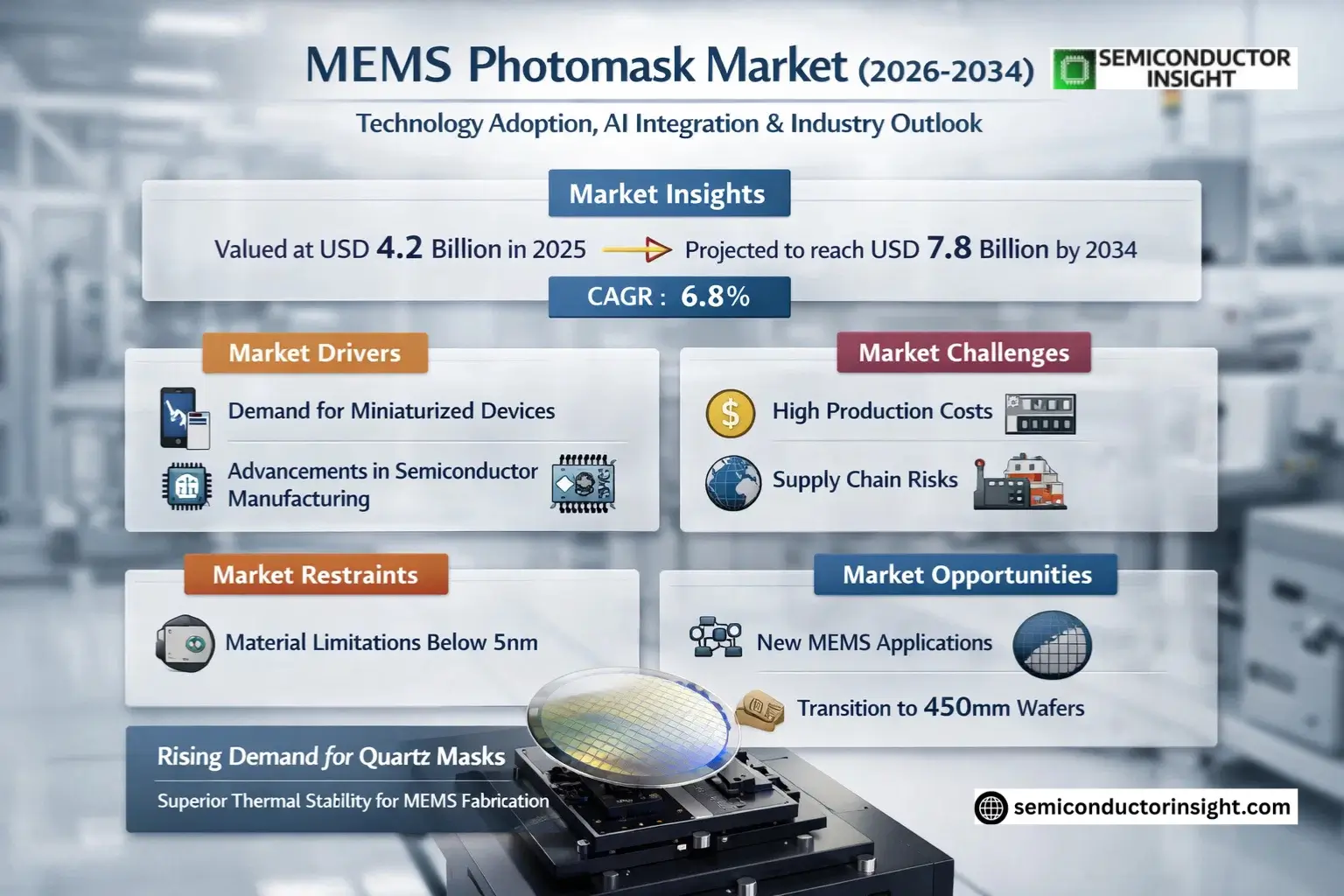
Global MEMS Photomask Market size was valued at USD 4.2 billion in 2025. The market is projected to grow from USD 4.6 billion in 2026 to USD 7.8 billion by 2034, exhibiting a CAGR of 6.8% during the forecast period.
MEMS photomasks are critical components in microfabrication, used to transfer intricate patterns onto semiconductor wafers during the manufacturing of microelectromechanical systems (MEMS). These masks are typically made from quartz or soda-lime glass and are essential for producing sensors, actuators, and other miniaturized devices found in consumer electronics, automotive systems, and medical equipment.
The market growth is driven by increasing demand for MEMS-based sensors in smartphones, wearables, and IoT devices, alongside advancements in semiconductor manufacturing technologies. However, challenges such as high production costs and stringent quality requirements may restrain expansion. Key players like Photronics and Toppan are investing in advanced lithography solutions to enhance precision and efficiency in MEMS fabrication.
MARKET DRIVERS
Growing Demand for Miniaturized Electronic Devices
The increasing adoption of MEMS technology in consumer electronics, healthcare, and automotive sectors is driving the MEMS Photomask Market . With smartphones, wearables, and IoT devices requiring smaller, more precise components, photomasks play a critical role in MEMS fabrication. Global MEMS market is projected to grow at 9.2% CAGR through 2028, creating parallel demand for high-quality photomasks.
Advancements in Semiconductor Manufacturing
Next-generation semiconductor nodes below 7nm require extremely precise photomasks with sub-nanometer accuracy. MEMS photomask technology enables the production of complex microstructures needed for advanced MEMS sensors and actuators. Semiconductor foundries worldwide are investing over USD 120 billion annually in new fabrication facilities, requiring state-of-the-art photomask solutions.
Additionally, emerging applications in 5G infrastructure and biomedical devices are creating new growth avenues for MEMS photomask manufacturers.
MARKET CHALLENGES
High Production Complexity and Costs
MEMS photomask fabrication involves extremely precise patterning processes with defect rates below 0.1 defects/cm². The capital-intensive nature of photomask production limits market entry to only well-established semiconductor equipment manufacturers. A single advanced EUV photomask for MEMS can cost over USD 250,000 to produce.
Other Challenges
Supply Chain Vulnerabilities
The concentrated nature of photomask production in specific geographic regions creates supply chain risks. Over 65% of global MEMS photomask capacity is located in just three countries, making the market sensitive to geopolitical and trade uncertainties.
MARKET RESTRAINTS
Technical Limitations in Mask Materials
Current photomask substrates face physical constraints when scaling below 5nm features. Chromium-based masks experience line-edge roughness issues, while quartz substrates have thermal stability limitations. These material challenges are delaying the adoption of MEMS technology in some cutting-edge applications, temporarily restraining market growth.
MARKET OPPORTUNITIES
Emergence of New MEMS Applications
The development of MEMS-based optical switches for quantum computing and ultra-sensitive environmental sensors is creating new requirements for specialized photomasks. MEMS Photomask Market is expected to gain USD 380 million in new revenue from these emerging applications by 2027. Additionally, the transition to larger 450mm wafer sizes in MEMS production will necessitate new photomask formats and technologies.
MEMS Photomask Market Trends
Rising Demand for Quartz Masks in MEMS Fabrication
MEMS Photomask Market is witnessing significant growth in quartz mask adoption, as these offer superior thermal stability and durability compared to traditional soda masks. With MEMS devices requiring precise patterning at nanoscale levels, quartz photomasks provide the necessary resolution for inertial sensors, pressure sensors, and MEMS microphones.
Other Trends
Asia-Pacific Dominates MEMS Photomask Production
China, Japan, and South Korea collectively account for over 65% of global MEMS Photomask manufacturing capacity. Leading suppliers like Toppan, DNP, and Taiwan Mask have established advanced production facilities in the region to serve both local MEMS foundries and international customers.
Growing Applications in Automotive MEMS Sensors
The automotive sector’s increasing adoption of MEMS-based accelerometers, gyroscopes, and pressure sensors is driving photomask demand. Stringent safety regulations worldwide are accelerating the integration of MEMS devices in advanced driver assistance systems (ADAS), creating steady growth opportunities for photomask suppliers.
Technological Advancements in Mask Writing
Recent developments in electron beam lithography systems have enabled more precise photomask patterning for sub-micron MEMS structures. Market leaders are investing in multi-beam mask writers to reduce production time while maintaining the accuracy required for complex MEMS designs.
Supply Chain Optimization Efforts
Major MEMS Photomask manufacturers are establishing regional hubs to minimize logistics delays. This trend is particularly evident in North America and Europe, where local production helps MEMS foundries maintain consistent supply chains for critical components.
COMPETITIVE LANDSCAPE
Key Industry Players
Global MEMS Photomask Market Dominated by Semiconductor Mask Specialists
MEMS Photomask Market is characterized by concentrated competition with Photronics, Toppan, and DNP collectively commanding significant market share. These leaders specialize in high-precision quartz masks for advanced MEMS applications like accelerometers and gyroscopes. The market exhibits tiered competition, where global players dominate cutting-edge technologies while regional specialists like Taiwan Mask and ShenZheng QingVi cater to localized demand with cost-effective solutions.
Niche operators including Nippon Filcon and Compugraphics focus on specialty masks for emerging MEMS applications such as biomedical sensors and RF MEMS. Chinese manufacturers like SMIC-Mask Service are gaining traction through government-supported semiconductor initiatives, while foundry-affiliated players including Wuxi Zhongwei Mask Electronics benefit from integrated supply chains. The competitive intensity remains high with continuous R&D investments in nanoimprint and EUV-compatible photomasks.
List of Key MEMS Photomask Companies Profiled
- Photronics Inc.
- Toppan Printing Co., Ltd.
- Dai Nippon Printing Co., Ltd. (DNP)
- ShenZheng QingVi Photomask
- Taiwan Mask Corporation
- Nippon Filcon Co., Ltd.
- Compugraphics International Ltd.
- Newway Photomask
- Shenzhen Longtu Photomask Technology
- Wuxi Zhongwei Mask Electronics Co., Ltd.
- CR Micro
- SMIC-Mask Service
- Hoya Corporation
- Advanced Mask Technology Center (AMTC)
- Applied Materials (through acquisition of Etec Systems)
Segment Analysis:
| Segment Category | Sub-Segments | Key Insights |
| By Type |
|
Quartz Mask
|
| By Application |
|
MEMS Microphone
|
| By End User |
|
Consumer Electronics
|
| By Mask Complexity |
|
Multi-Layer
|
| By Pattern Technology |
|
Electron Beam Lithography
|
Regional Analysis: Asia-Pacific MEMS Photomask Market
China’s national semiconductor fund and tax incentives specifically support MEMS photomask development, creating favorable conditions for both domestic producers and multinational corporations establishing local mask shops to serve regional foundries.
The dense concentration of MEMS fabs, packaging facilities, and material suppliers within Chinese technology hubs enables just-in-time photomask delivery and rapid design iterations critical for prototyping emerging MEMS applications in consumer electronics.
Leading Chinese MEMS manufacturers are early adopters of multi-beam mask writers and EUV-compatible photomasks, driven by requirements for finer feature sizes in MEMS pressure sensors and advanced microphone arrays.
Specialized MEMS photomask engineering programs at major Chinese universities coupled with reverse migration of experienced diaspora professionals are creating a skilled workforce for advanced mask pattern generation and verification.
South Korea
South Korea’s MEMS Photomask Market benefits from the country’s leadership in display technologies and MEMS-based sensors. The presence of global semiconductor giants drives demand for high-quality photomasks with tight dimensional control. Korean manufacturers show particular expertise in photomasks for MEMS microphone arrays and environmental sensors, leveraging their experience in consumer electronics miniaturization. The market is experiencing growing adoption of computational lithography techniques to compensate for optical proximity effects in complex MEMS patterns.
Japan
Japan maintains a strong position in high-end MEMS photomasks through its specialty chemical suppliers and advanced equipment manufacturers. Japanese firms lead in developing ultra-flat mask substrates and next-generation pellicle technologies crucial for defect-free MEMS production. The market demonstrates increasing integration of AI-based mask defect classification systems, building on Japan’s strengths in industrial automation. Photomask solutions for automotive MEMS applications represent a particularly dynamic segment, supported by Japan’s automotive electronics cluster.
Taiwan
Taiwan’s foundry-centric semiconductor model creates robust demand for MEMS photomasks, particularly for Internet of Things (IoT) applications. The region excels in turnaround time optimization for MEMS prototyping masks, serving both international customers and local fabless design houses. Taiwanese mask shops are implementing digital twin technologies for virtual mask qualification, reducing time-to-market for new MEMS products. The market shows growing specialization in photomasks for microbolometers and other thermal sensing MEMS devices.
India & Southeast Asia
Emerging MEMS photomask demand in India and Southeast Asia stems from new semiconductor initiatives and growing electronics manufacturing. While currently dependent on imports for advanced masks, the region shows increasing capability in basic MEMS mask production. Government incentives are encouraging localization of mask blank processing and inspection capabilities. The market is particularly focused on cost-effective photomask solutions for MEMS applications in affordable consumer devices and automotive components.
Report Scope
This market research report provides a comprehensive analysis of the MEMS Photomask Market , covering the forecast period 2025–2034. It offers detailed insights into market dynamics, technological advancements, competitive landscape, and key trends shaping the industry.
Key focus areas of the report include:
- Market Overview: The report begins with an overview outlining its current market scenario, key growth indicators, and industry transformation drivers. It discusses macroeconomic factors, demand–supply balance, regulatory landscape, and the strategic role of semiconductors in powering advancements across industries such as automotive, telecommunications, consumer electronics, and industrial automation.
- Market Size & Forecast: Historical data and future projections for revenue, unit shipments, and market value across major regions and segments.
- Segmentation Analysis: Detailed breakdown by product type, technology, application, and end-user industry to identify high-growth segments and investment opportunities.
- Regional Insights: Insights into market performance across North America, Europe, Asia-Pacific, Latin America, and the Middle East & Africa, including country-level analysis where relevant.
- Competitive Landscape: Profiles of leading market participants, including their product offerings, R&D focus, manufacturing capacity, pricing strategies, and recent developments such as mergers, acquisitions, and partnerships.
- Technology Trends & Innovation: Assessment of emerging technologies, integration of AI/IoT, semiconductor design trends, fabrication techniques, and evolving industry standards.
- Market Drivers & Restraints: Evaluation of factors driving market growth along with challenges, supply chain constraints, regulatory issues, and market-entry barriers.
- Stakeholder Insights: Insights for component suppliers, OEMs, system integrators, investors, and policymakers regarding the evolving ecosystem and strategic opportunities.
Primary and secondary research methods are employed, including interviews with industry experts, data from verified sources, and real-time market intelligence to ensure the accuracy and reliability of the insights presented.
FREQUENTLY ASKED QUESTIONS:
What is the current market size of MEMS Photomask Market?
-> MEMS Photomask Market size was valued at USD 4.2 billion in 2025. The market is projected to grow from USD 4.6 billion in 2026 to USD 7.8 billion by 2034, exhibiting a CAGR of 6.8% during the forecast period.
Which key companies operate in MEMS Photomask Market?
-> Key players include Photronics, Toppan, DNP, ShenZheng QingVi, Taiwan Mask, Nippon Filcon, Compugraphics, Newway Photomask, Shenzhen Longtu Photomask, Wuxi Zhongwei Mask Electronics, among others.
What are the key growth drivers?
-> Key growth drivers include advancements in semiconductor manufacturing, increasing demand for MEMS devices, and technological innovations in photomask fabrication.
Which region dominates the market?
-> Asia is the fastest-growing region, with significant contributions from China and Japan, while North America remains a key market.
What are the emerging trends?
-> Emerging trends include miniaturization of MEMS devices, advanced photomask materials, and increasing adoption of quartz masks.
Get Sample Report PDF for Exclusive Insights
Report Sample Includes
- Table of Contents
- List of Tables & Figures
- Charts, Research Methodology, and more...
 Download Sample Report PDF