MEMS IMU Sensor Market Insights
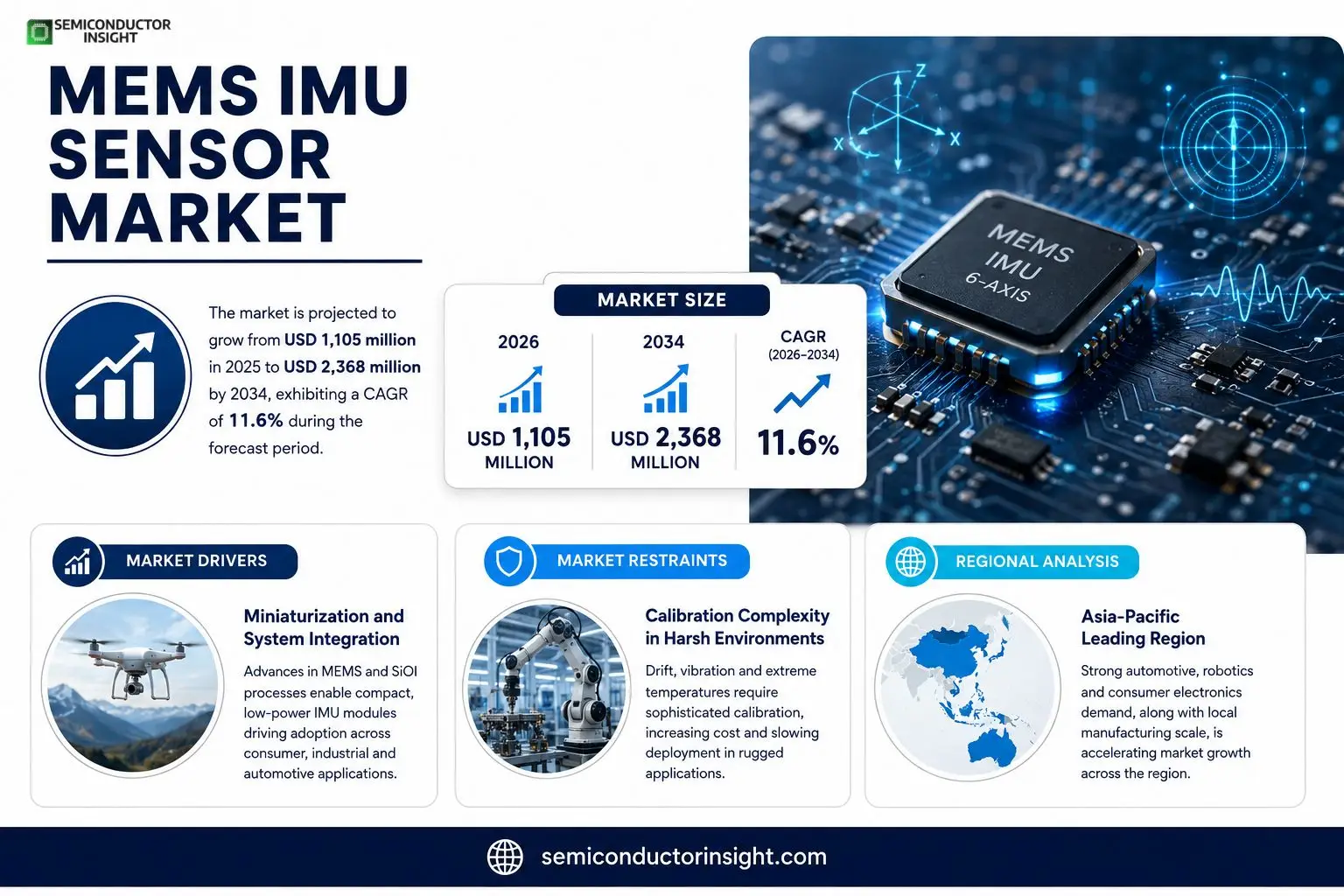
MEMS IMU Sensor market size was valued at USD 1,105 million in 2025. The market is projected to grow from USD 1,105 million in 2025 to USD 2,368 million by 2034, exhibiting a CAGR of 11.6% during the forecast period.
MEMS IMU sensors are motion‑sensing devices built on micro‑electro‑mechanical systems technology that integrate a three‑axis accelerometer and a three‑axis gyroscope; many variants also incorporate magnetometers, temperature compensation, embedded algorithms or sensor‑fusion capabilities within chip‑level, system‑in‑package or module‑level inertial measurement units. Their core function is to continuously deliver angular rate, linear acceleration and derived attitude information when external positioning signals are weak or real‑time response is critical, thereby supporting action recognition, attitude stabilization, navigation assistance and safety redundancy across consumer electronics, automotive electronics, industrial robotics and defense platforms.
MARKET DRIVERS
Miniaturization and System Integration
MEMS IMU Sensor Market benefits from relentless pressure to shrink device footprints while preserving functionality. Advances in silicon‑on‑insulator processes enable sensors that occupy a fraction of the space previously required, making them attractive to wearable health monitors and compact autonomous drones. This size reduction reduces material costs and simplifies mechanical design, encouraging OEMs to adopt MEMS IMU modules across new product families.
Demand for Real‑Time Navigation
Industries such as robotics, logistics, and precision agriculture are increasingly reliant on instantaneous attitude and motion data. The ability of MEMS IMUs to deliver sub‑degree orientation accuracy at high refresh rates is reshaping supply‑chain automation and autonomous vehicle guidance. Companies that integrate these sensors can differentiate their platforms by offering smoother trajectory control and reduced latency in decision loops.
➤ “The convergence of edge‑AI processing and low‑power MEMS IMU chips is creating a feedback loop that drives both hardware efficiency and algorithmic sophistication.”
In addition, regulatory incentives for low‑emission transportation are channeling public funding toward electric‑vehicle platforms that rely heavily on inertial navigation. By embedding MEMS IMUs, manufacturers meet performance standards while complying with emissions targets, reinforcing demand across the automotive segment.
MARKET CHALLENGES
Calibration Complexity in Harsh Environments
Deploying MEMS IMU sensors in extreme temperature or vibration zones introduces drift that can compromise data fidelity. End‑users must invest in sophisticated calibration routines, which raises total cost of ownership and hampers rapid time‑to‑market for rugged applications such as oil‑field equipment.
Other Challenges
Supply‑Chain Volatility
Fluctuations in raw‑silicon pricing and limited fab capacity create bottlenecks that ripple through the MEMS IMU value chain. Companies that lack diversified sourcing strategies may experience lead‑time extensions that disrupt product launch schedules.
MARKET RESTRAINTS
Cost Sensitivity in Consumer Segments
While high‑end industrial users can absorb premium pricing for superior performance, mass‑market consumer electronics remain highly price‑driven. The incremental cost of adding a MEMS IMU to a smartwatch or fitness band must be offset by clear value, otherwise manufacturers risk margin erosion. This price pressure limits the pace at which the most advanced sensor specifications penetrate low‑cost devices.
MARKET OPPORTUNITIES
Integration with Edge‑AI Platforms
Emerging edge‑AI processors are designed to fuse inertial data with vision and lidar inputs directly on the device. Partnerships that co‑design MEMS IMU firmware for these processors open pathways to ultra‑low‑latency perception stacks, a capability prized by autonomous robotics firms. Early movers can capture a share of the growing market for intelligent edge sensors.
Expansion into Augmented Reality (AR)
AR headsets require precise head‑tracking to avoid motion sickness and to maintain visual stability. The lightweight nature of MEMS IMU sensors aligns perfectly with the ergonomic constraints of wearable displays. As enterprise AR adoption accelerates, the demand for high‑bandwidth inertial measurement units is set to expand, offering a lucrative niche for specialized sensor developers.
MEMS IMU Sensor Market Trends
Shift Toward Integrated High‑Performance Modules
MEMS IMU Sensor Market has moved beyond its original consumer‑electronics niche. While smartphones and wearables still generate the highest shipment volumes, manufacturers are now bundling accelerometers, gyroscopes, magnetometers and on‑chip calibration algorithms into single‑chip or system‑in‑package (SiP) formats. This integration reduces board space and power draw, a combination that resonates with automotive electronics seeking to embed inertial data directly into control units. The higher‑level intelligence embedded in the chips also supports real‑time motion classification, allowing end‑devices to react without relying on external processors. As a result, product value per unit is rising, and customers are less likely to switch suppliers once a calibrated module is qualified for safety‑critical functions.
Other Trends
Industrial Robotics and Autonomous Equipment
Robotic arms on assembly lines, autonomous tractors, and drone‑based surveying platforms all require inertial sensors that can tolerate harsh vibration and temperature swings. Recent releases from leading vendors demonstrate drift specifications approaching those of traditional fiber‑optic gyroscopes, yet they retain the cost advantage of silicon MEMS fabrication. By delivering factory‑calibrated, ruggedized modules, suppliers are capturing a larger share of the equipment‑maker budget that previously went to separate navigation subsystems. This trend shifts the market focus from pure volume to the depth of application, encouraging OEMs to negotiate longer‑term agreements that include firmware updates and algorithm licensing.
Regional Supply‑Chain Diversification
Geographically, the ecosystem is becoming more balanced. Europe and the United States continue to dominate high‑end aerospace and defense contracts, leveraging mature process know‑how and stringent certification pathways. Meanwhile, Chinese manufacturers are expanding their footprint by aligning product roadmaps with domestic automotive‑intelligence programs and by investing in local silicon‑on‑insulator fabs. The resulting mix of low‑cost volume production and boutique high‑reliability lines gives system integrators a broader set of sourcing options. This diversification mitigates risk from geopolitical tensions and creates competitive pressure that should drive further improvements in performance‑per‑dollar across all segments of MEMS IMU Sensor Market.
COMPETITIVE LANDSCAPE
Key Industry Players
MEMS IMU Sensor Market – Competitive Overview
The segment is dominated by a handful of multinational firms that have leveraged long‑standing MEMS process expertise and extensive automotive or consumer‑electronics supply chains. Bosch, STMicroelectronics, and Analog Devices command the bulk of high‑volume shipments, primarily because their SiP‑based 6‑axis devices combine low power consumption with integrated sensor‑fusion algorithms that appeal to smartphone, wear‑able, and entry‑level automotive applications. Their product road‑maps emphasize incremental integration, allowing OEMs to source a single package that replaces separate accelerometer, gyroscope, and sometimes magnetometer blocks. This consolidation raises the barrier for new entrants, as achieving comparable fab yields and calibration infrastructure demands considerable capital. Meanwhile, these incumbents are expanding into mid‑tier automotive ADAS and robotics by offering calibrated modules that simplify system‑level validation, reinforcing their position as both component and platform providers.Beyond the tier‑one cluster, a vibrant ecosystem of specialist manufacturers supplies high‑performance or niche‑focused IMUs. Companies such as Safran Electronics & Defense, Movella, ACEINNA, and SBG Systems target aerospace, defense, and precision‑navigation markets where drift rates below 0.01°/s and ruggedized packaging are mandatory. Parallel to this, firms like Memsense, Inertial Labs, Murata, TDK, Seiko Epson, and Tamagawa Seiki deliver calibrated industrial modules that cater to construction machinery, drones, and agricultural autopilots, often embedding temperature‑compensated algorithms at the module level. Chinese playersincluding MEMSIC Semiconductor, Hebei MT Electronic, and Sea Land Technologyhave accelerated product introductions aimed at domestic automotive‑intelligence projects, leveraging cost advantages to capture market share in emerging regions. This layered competitive structure creates a landscape where differentiation hinges not only on raw sensor specifications but also on calibration services, software toolchains, and the ability to certify devices for safety‑critical deployments.
List of Key MEMS IMU Sensor Companies Profiled
- Bosch
- STMicroelectronics
- Analog Devices
- Safran Electronics & Defense
- Movella Inc.
- ACEINNA, Inc.
- SBG Systems
- Memsense LLC
- Inertial Labs, Inc.
- Murata Manufacturing Co., Ltd.
- TDK Corporation
- Seiko Epson Corporation
- Tamagawa Seiki Co., Ltd.
- MEMSIC Semiconductor Co., Ltd.
- Hebei MT Electronic Technology Co., Ltd.
Segment Analysis:
| Segment Category | Sub-Segments | Key Insights |
| By Type |
|
High‑Performance Sensor drives differentiation through advanced calibration, low drift and robust environmental tolerance.
|
| By Application |
|
Robotics emerges as a focal application where continuous attitude feedback and vibration resilience are paramount.
|
| By End User |
|
Industrial & Defense Platforms leverage the sensor’s reliability and integrated intelligence for mission‑critical operations.
|
| By Integration Level |
|
Ruggedized Tactical Unit addresses the needs of high‑reliability deployments where environmental extremes dominate design choices.
|
| By Performance Tier |
|
Sensor‑Fusion Enabled IMU exemplifies the strategic shift toward embedded intelligence within the inertial platform.
|
Regional Analysis: MEMS IMU Sensor Market
North America
Tier‑1 suppliers are integrating MEMS IMU sensors into advanced driver‑assistance systems, leveraging the devices’ compact footprint to meet packaging constraints while delivering sub‑degree yaw rate accuracy for lane‑keeping functions.
Manufacturing plants are standardising on inertial measurement units for collaborative robot arms, where real‑time orientation feedback reduces cycle times and improves repeatability on high‑speed assembly lines.
Premium smartwatch makers are favouring low‑power MEMS IMU chips to deliver precise step counting and gesture recognition without compromising battery life, positioning the devices as health‑monitoring platforms.
Defense contracts increasingly specify MEMS‑based inertial navigation for unmanned aerial systems, citing the sensors’ resilience to shock and ability to operate across extreme temperature ranges.
Europe
European automotive manufacturers are prioritising sensor redundancy to satisfy stringent functional safety directives, prompting a shift toward multi‑axis MEMS IMU solutions that can tolerate component failures. Simultaneously, German industrial equipment firms are embedding these sensors into predictive maintenance platforms, where vibration signatures aid in early fault detection. The region’s emphasis on carbon‑neutral logistics also spurs adoption in electric delivery fleets, as precise motion tracking supports energy‑efficient routing algorithms. This confluence of safety, efficiency, and sustainability considerations reinforces Europe’s strategic relevance in MEMS IMU Sensor Market.
Asia‑Pacific
In Asia‑Pacific, rapid urbanisation fuels demand for autonomous public transport, and local chip houses are scaling production of cost‑effective MEMS IMU devices to meet price‑sensitive contracts. China’s emphasis on “Made in China 2025” catalyses joint ventures between sensor manufacturers and smartphone producers, accelerating integration of inertial measurement units into next‑generation mobile devices. Meanwhile, India’s burgeoning drone industry seeks compact, low‑drift sensors to enhance flight stability for agricultural monitoring applications, creating a niche that encourages bespoke sensor designs tailored to tropical environments.
South America
South American markets are experiencing a modest but steady uptake of MEMS IMU sensors within agritech solutions, where precise positioning data improves autonomous tractor guidance across diverse terrains. Brazil’s push for smart‑city initiatives incorporates inertial measurement units into traffic‑management infrastructure, enabling real‑time vehicle flow analytics. Although overall volume remains limited, the region’s focus on improving logistics efficiency and expanding renewable‑energy installations presents incremental growth opportunities for sensor suppliers willing to navigate local distribution channels.
Middle East & Africa
In the Middle East, oil‑field automation projects integrate MEMS IMU sensors into drilling equipment to monitor orientation under extreme stress, enhancing safety and reducing non‑productive time. African telecom operators are piloting low‑cost inertial navigation modules to support off‑grid connectivity solutions where GPS signals are unreliable. Across both sub‑regions, the prevailing theme is the alignment of sensor capabilities with infrastructure resilience goals, prompting selective but strategically important deployments of MEMS IMU technology.
Report Scope
This market research report provides a comprehensive analysis of the MEMS IMU Sensor Market , covering the forecast period 2026–2034. It offers detailed insights into market dynamics, technological advancements, competitive landscape, and key trends shaping the industry.
Key focus areas of the report include:
- Market Overview: The report begins with an overview outlining its current market scenario, key growth indicators, and industry transformation drivers. It discusses macroeconomic factors, demand–supply balance, regulatory landscape, and the strategic role of semiconductors in powering advancements across industries such as automotive, telecommunications, consumer electronics, and industrial automation.
- Market Size & Forecast: Historical data and future projections for revenue, unit shipments, and market value across major regions and segments.
- Segmentation Analysis: Detailed breakdown by product type, technology, application, and end-user industry to identify high-growth segments and investment opportunities.
- Regional Insights: Insights into market performance across North America, Europe, Asia-Pacific, Latin America, and the Middle East & Africa, including country-level analysis where relevant.
- Competitive Landscape: Profiles of leading market participants, including their product offerings, R&D focus, manufacturing capacity, pricing strategies, and recent developments such as mergers, acquisitions, and partnerships.
- Technology Trends & Innovation: Assessment of emerging technologies, integration of AI/IoT, semiconductor design trends, fabrication techniques, and evolving industry standards.
- Market Drivers & Restraints: Evaluation of factors driving market growth along with challenges, supply chain constraints, regulatory issues, and market-entry barriers.
- Stakeholder Insights: Insights for component suppliers, OEMs, system integrators, investors, and policymakers regarding the evolving ecosystem and strategic opportunities.
Primary and secondary research methods are employed, including interviews with industry experts, data from verified sources, and real-time market intelligence to ensure the accuracy and reliability of the insights presented.
FREQUENTLY ASKED QUESTIONS:
What is the current market size of MEMS IMU Sensor Market?
-> MEMS IMU Sensor Market was valued at USD 1,105 million in 2025 and is expected to reach USD 2,368 million by 2034, growing at a CAGR of 11.6% during the forecast period.
Which key companies operate in MEMS IMU Sensor Market?
-> Key players include Bosch, STMicroelectronics, Analog Devices Inc. (ADI), Honeywell International Inc., Silicon Sensing Systems Ltd, Safran Electronics & Defense, Movella Inc., ACEINNA, Inc., SBG Systems, Memsense LLC, Inertial Labs, Inc., Murata Manufacturing Co., Ltd., TDK Corporation, Seiko Epson Corporation, Tamagawa Seiki Co., Ltd., Japan Aviation Electronics Industry, Ltd., MICROINFINITY Co., Ltd., QST Corporation, Senodia Technologies (Shaoxing) Co., Ltd., Forsense (Shanghai) Technology Co., Ltd., MEMSIC Semiconductor Co., Ltd., Hebei MT Electronic Technology Co., Ltd., Guangzhou ASENSING Electronics Technology Co., Ltd., Sea Land Technology Co., Ltd.
What are the key growth drivers?
-> Key growth drivers include expansion of industrial robotics and automation, rising demand for drones and unmanned systems, increasing integration of MEMS IMUs in automotive safety and ADAS, need for high‑precision navigation in GNSS‑denied environments, and advancements toward higher integration, lower power consumption, and embedded intelligence.
Which region dominates the market?
-> Asia-Pacific is the fastest‑growing region due to strong automotive, robotics, and consumer electronics adoption, while Europe remains a dominant market for high‑end industrial, aerospace, and defense applications.
What are the emerging trends?
-> Emerging trends include greater system‑in‑package (SiP) integration, incorporation of AI‑enabled sensor‑fusion algorithms at the chip level, development of low‑drift quartz‑based MEMS IMUs for tactical use, and migration toward fully calibrated, plug‑and‑play modules for rapid OEM deployment.
Get Sample Report PDF for Exclusive Insights
Report Sample Includes
- Table of Contents
- List of Tables & Figures
- Charts, Research Methodology, and more...