MARKET INSIGHTS
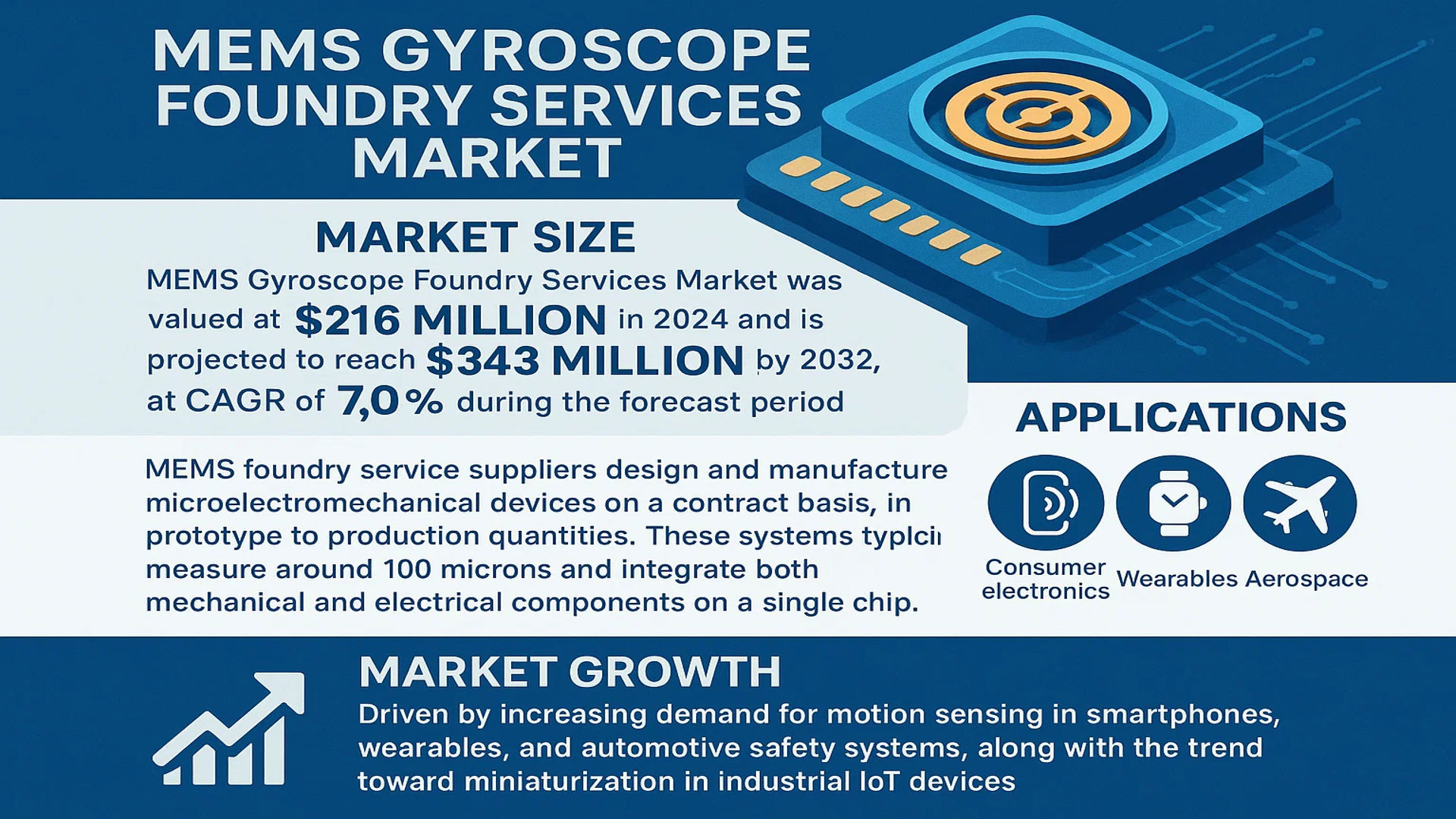
The global MEMS Gyroscope Foundry Services Market was valued at 216 million in 2024 and is projected to reach US$ 343 million by 2032, at a CAGR of 7.0% during the forecast period.
MEMS foundry service suppliers design and manufacture microelectromechanical devices on a contract basis, in prototype to production quantities. These systems typically measure around 100 microns and integrate both mechanical and electrical components on a single chip. MEMS gyroscopes specifically detect and measure angular velocity, enabling precise motion sensing in applications ranging from consumer electronics to aerospace.
The market growth is driven by increasing demand for motion sensing in smartphones, wearables, and automotive safety systems, along with the trend toward miniaturization in industrial IoT devices. While North America currently leads in technological innovation, Asia Pacific is emerging as a manufacturing hub, with China projected to show significant growth. Key players like Silex Microsystems and TSMC dominate the market, collectively holding substantial market share through advanced fabrication technologies and strategic partnerships.
MARKET DYNAMICS
MARKET DRIVERS
Expanding Applications in Consumer Electronics Accelerate Demand for MEMS Gyroscopes
The proliferation of smart devices with advanced motion sensing capabilities is driving significant growth in MEMS gyroscope foundry services. Modern smartphones now incorporate 3-axis gyroscopes for augmented reality (AR), gaming, and navigation enhancements. The average smartphone now contains 3-5 MEMS sensors, with gyroscopes representing over 20% of this component mix. Furthermore, wearable devices for fitness tracking and health monitoring increasingly rely on high-performance MEMS gyroscopes to deliver accurate motion data. Leading OEMs are ramping up production of these devices, subsequently increasing demand for MEMS foundry services that can deliver high-volume, cost-effective manufacturing solutions.
Autonomous Vehicle Development Spurs Growth in Automotive MEMS Solutions
The automotive industry’s rapid transition toward autonomous driving systems is creating unparalleled opportunities for MEMS gyroscope foundries. Modern vehicles now integrate multiple MEMS gyroscopes for electronic stability control, navigation, and advanced driver assistance systems (ADAS). The average premium vehicle now contains over 10 MEMS inertial sensors, with this number expected to double as level 3+ autonomous features become mainstream. Tier 1 automotive suppliers are increasingly outsourcing MEMS production to pure-play foundries that can meet stringent automotive quality standards while delivering the required production volumes.
MARKET RESTRAINTS
High Development Costs and Long Lead Times Constrain Market Expansion
While demand for MEMS gyroscopes grows, the specialized nature of MEMS fabrication creates significant barriers to market entry and expansion. Developing a new MEMS process typically requires 12-18 months and capital investments ranging from $50 million to $100 million for a production-ready MEMS line. These substantial costs deter many potential market entrants and limit the expansion capacity of existing players. The complexity of MEMS design verification and qualification processes further extends time-to-market, particularly for automotive and industrial applications where reliability requirements are most stringent.
Technical Challenges in Miniaturization and Performance Present Ongoing Hurdles
The relentless drive toward smaller, more power-efficient MEMS gyroscopes creates persistent technical challenges for foundries. As device sizes shrink below 2mm x 2mm, maintaining performance characteristics such as bias stability and noise floor becomes increasingly difficult. Foundries must continuously invest in advanced packaging technologies and process innovations to meet evolving performance requirements. The thermal and mechanical stress challenges associated with multi-die integration in advanced MEMS packages further complicate manufacturing yield and reliability.
MARKET OPPORTUNITIES
Emerging IoT Applications Create New Growth Frontiers for MEMS Foundries
The rapid expansion of industrial and consumer IoT ecosystems presents significant opportunities for MEMS gyroscope foundry services. Smart city infrastructure, industrial equipment monitoring, and precision agriculture systems are increasingly incorporating MEMS inertial sensors. These applications demand rugged, low-power gyroscopes that can operate for years on battery power. Foundries that can deliver specialized MEMS processes optimized for extreme environments and ultra-low power consumption will capture substantial market share in this emerging segment.
Advancements in MEMS-ASIC Integration Open New Design Possibilities
The growing trend toward 3D integration of MEMS and ASICs creates opportunities for foundries to offer more value-added services. By combining sensing elements with signal conditioning electronics in compact system-in-package (SiP) solutions, foundries can address the needs of space-constrained applications. Leading providers are now offering through-silicon via (TSV) technology and wafer-level packaging options that enable higher levels of integration while improving performance and reducing footprint. These advanced integration capabilities are becoming key differentiators in competitive bidding for high-volume contracts.
MARKET CHALLENGES
Global Supply Chain Disruptions Impact MEMS Manufacturing Capacity
The MEMS foundry industry continues to face challenges from ongoing semiconductor supply chain constraints. Specialty materials, substrates, and equipment lead times have extended significantly, affecting production planning and capacity expansion. Wafer fabrication equipment deliveries now average 9-12 months, delaying the ramp-up of new MEMS production lines. Additionally, geopolitical factors are forcing foundries to reevaluate their supply chain strategies, potentially increasing production costs as they establish more resilient but less optimized supply networks.
Talent Shortage in MEMS Engineering Threatens Innovation Pace
The specialized nature of MEMS technology has created a critical shortage of qualified engineers capable of developing next-generation gyroscope solutions. The interdisciplinary skills required—spanning mechanical engineering, materials science, and semiconductor physics—are in particularly short supply. Industry surveys indicate a 30% shortage in qualified MEMS process engineers, with the gap expected to widen as experienced professionals retire. This talent crunch threatens to slow the pace of innovation just as market demands for improved performance and reduced costs are intensifying.
MEMS GYROSCOPE FOUNDRY SERVICES MARKET TRENDS
Miniaturization and Enhanced Precision Driving Demand for MEMS Gyroscopes
The MEMS gyroscope foundry services market is witnessing robust growth, propelled by advancements in microelectromechanical systems (MEMS) technology and increasing demand across industries such as consumer electronics, automotive, and industrial automation. With a projected market value of $343 million by 2032, growing at a 7.0% CAGR, the sector is benefiting from innovations in miniaturization and precision engineering. Foundries specializing in MEMS gyroscopes are increasingly leveraging multilayer structures and high-aspect-ratio fabrication techniques to improve sensor accuracy while reducing size. The automotive sector, particularly autonomous vehicle development, relies heavily on these high-performance gyroscopes for stability control and navigation systems.
Other Trends
Rise of Pure-Play Foundry Models
The shift toward pure-play foundry models is reshaping the competitive landscape, with specialized MEMS manufacturers like Silex Microsystems and X-Fab gaining prominence. These foundries focus exclusively on MEMS production, offering cost-effective, scalable solutions for fabless semiconductor companies. The pure-play segment is projected to grow steadily, fueled by demand from consumer electronics manufacturers requiring high-volume, low-cost gyroscopes for smartphones, wearables, and gaming devices. Advanced packaging technologies, including wafer-level packaging, further enhance the appeal of these services by improving yield rates and reducing production timelines.
Expanding Applications in Industrial IoT and Defense
The growing adoption of Industrial Internet of Things (IIoT) solutions is driving demand for ruggedized MEMS gyroscopes capable of withstanding harsh environments. These sensors play a critical role in predictive maintenance, equipment monitoring, and robotic automation. Meanwhile, defense and aerospace applications increasingly rely on high-reliability gyroscopes for navigation and stabilization in unmanned aerial vehicles (UAVs) and missile guidance systems. The Asia-Pacific region, led by China and Japan, has emerged as a key manufacturing hub, accounting for a significant share of global MEMS production due to strong government support and a mature semiconductor ecosystem.
COMPETITIVE LANDSCAPE
Key Industry Players
Foundry Providers Invest in Advanced MEMS Processes to Meet Growing Demand
The MEMS gyroscope foundry services market exhibits a moderately competitive landscape with strong participation from both pure-play foundries and integrated device manufacturers (IDMs). Silex Microsystems, a Swedish-based company, leads the market with its specialized MEMS fabrication services, leveraging high-volume production capabilities for consumer and automotive applications.
Teledyne Technologies and TSMC have emerged as key competitors, driven by their investments in wafer-level packaging and 3D integration technologies. While Teledyne focuses on defense and aerospace applications, TSMC has expanded its MEMS foundry services to address the growing demand from smartphone manufacturers requiring compact gyroscope solutions.
Market dynamics show increasing competition in Asia-Pacific, where Asia Pacific Microsystems, Inc. (APM) and VIS (Vanguard International Semiconductor) are gaining traction through cost-effective manufacturing solutions. These regional players are closing the technology gap with European and American competitors through strategic partnerships.
Recent developments include Sony Corporation’s expansion of its 300mm MEMS production line, targeting high-performance gyroscopes for AR/VR devices. Meanwhile, X-Fab continues to strengthen its position through specialized SOI (Silicon-on-Insulator) MEMS processes that offer improved gyroscope performance in harsh environments.
List of Key MEMS Gyroscope Foundry Service Providers
- Silex Microsystems (Sweden)
- Teledyne Technologies (U.S.)
- Taiwan Semiconductor Manufacturing Company (TSMC) (Taiwan)
- Sony Corporation (Japan)
- X-Fab Silicon Foundries (Germany)
- Asia Pacific Microsystems, Inc. (APM) (Taiwan)
- Atomica Corp. (U.S.)
- IMEC (Belgium)
- Vanguard International Semiconductor (VIS) (Taiwan)
- Semefab (U.K.)
Segment Analysis:
By Type
Pure Play Model (MEMS) Segment Leads Due to Specialized Manufacturing Capabilities
The MEMS Gyroscope Foundry Services market is segmented based on business model into:
- Pure Play Model (MEMS)
- Subtypes: Surface micromachining, Bulk micromachining, CMOS-MEMS integration
- IDM Model
By Application
Consumer Electronics Segment Dominates Due to Widespread Use in Smart Devices
The market is segmented based on application into:
- Consumer Electronics
- Subtypes: Smartphones, Wearables, Gaming controllers
- Industrial Electronics
- Automotive
- Subtypes: ADAS, Navigation systems, Vehicle stabilization
- Others
By Technology Node
200mm Wafer Technology Holds Significant Share Due to Cost-Effectiveness
The market is segmented based on technology node into:
- 200mm wafer
- 300mm wafer
- Specialty nodes (SOI, advanced packaging)
By Service Type
Volume Production Services Show Strong Growth for Mass-Market Applications
The market is segmented based on service type into:
- Prototyping Services
- Low-volume Production
- Volume Production
Regional Analysis: MEMS Gyroscope Foundry Services Market
Asia-Pacific
The Asia-Pacific (APAC) region dominates the global MEMS gyroscope foundry services market, accounting for over 45% of the revenue share in 2024. This leadership stems from the concentration of semiconductor giants like TSMC, Sony Corporation, and Asia Pacific Microsystems in Taiwan, Japan, and China. The region benefits from robust government initiatives such as China’s Made in China 2025 policy, which allocates significant funding for domestic semiconductor manufacturing. South Korea’s foundries are accelerating 3-axis MEMS gyroscope production for smartphone applications, while India’s growing automotive electronics sector presents new opportunities. However, geopolitical tensions and export controls on advanced MEMS technologies pose supply chain risks.
North America
North America remains a high-value innovation hub for MEMS gyroscope foundries, driven by defense and aerospace applications. The U.S. Department of Defense’s investments in inertial navigation systems (estimated at $2.1 billion for FY2024) sustain demand for high-precision gyroscopes from players like Teledyne Technologies and Atomica Corp. The region prioritizes R&D partnerships between academia (e.g., UC Berkeley’s sensor labs) and foundries. Challenges include reliance on offshore manufacturing and tighter export restrictions on dual-use MEMS technologies under recent ITAR amendments.
Europe
Europe’s strength lies in specialized, low-volume production through pure-play foundries such as X-Fab and Silex Microsystems. The EU’s Chips Act, which earmarks €43 billion for semiconductor sovereignty, is driving investments in MEMS manufacturing facilities in Germany and Belgium. Automotive MEMS gyroscopes account for over 60% of regional demand, with stringent vehicular safety regulations accelerating adoption. However, higher production costs compared to Asian foundries and energy price volatility post-Ukraine crisis remain hurdles for market expansion.
Middle East & Africa
This emerging region shows promise through strategic partnerships, such as Saudi Arabia’s $6 billion semiconductor investment plan with IMEC to establish localized MEMS production. Israel’s startup ecosystem is pioneering miniaturized gyroscopes for medical devices, though scale remains limited. Infrastructure gaps and reliance on imports for advanced MEMS IP constrain growth, but sovereign wealth fund investments could catalyze long-term foundry development.
South America
South America lags in MEMS foundry capabilities, with Brazil’s CEITEC being the sole significant player focused on automotive-grade gyroscopes. Economic instability and underdeveloped supply chains deter major investments, though Mexico’s proximity to U.S. markets creates opportunities for near-shoring MEMS packaging and testing services. Regional demand is primarily met through imports from Asia and North America.
Report Scope
This market research report provides a comprehensive analysis of the Global MEMS Gyroscope Foundry Services market, covering the forecast period 2025–2032. It offers detailed insights into market dynamics, technological advancements, competitive landscape, and key trends shaping the industry.
Key focus areas of the report include:
- Market Size & Forecast: Historical data and future projections for revenue, unit shipments, and market value across major regions and segments. The Global MEMS Gyroscope Foundry Services market was valued at USD 216 million in 2024 and is projected to reach USD 343 million by 2032, growing at a CAGR of 7.0%.
- Segmentation Analysis: Detailed breakdown by product type (Pure Play Model and IDM Model), application (Consumer Electronics, Industrial Electronics, Automotive, Others), and end-user industry to identify high-growth segments and investment opportunities.
- Regional Outlook: Insights into market performance across North America, Europe, Asia-Pacific, Latin America, and the Middle East & Africa, including country-level analysis where relevant. The U.S. market is estimated at USD million in 2024, while China is projected to reach USD million.
- Competitive Landscape: Profiles of leading market participants, including their product offerings, R&D focus, manufacturing capacity, pricing strategies, and recent developments such as mergers, acquisitions, and partnerships. Key players include Silex Microsystems, Teledyne Technologies, TSMC, Sony Corporation, and X-Fab.
- Technology Trends & Innovation: Assessment of emerging technologies, integration of AI/IoT, semiconductor design trends, fabrication techniques, and evolving industry standards in MEMS gyroscope manufacturing.
- Market Drivers & Restraints: Evaluation of factors driving market growth along with challenges, supply chain constraints, regulatory issues, and market-entry barriers.
- Stakeholder Analysis: Insights for component suppliers, OEMs, system integrators, investors, and policymakers regarding the evolving ecosystem and strategic opportunities.
Primary and secondary research methods are employed, including interviews with industry experts, data from verified sources, and real-time market intelligence to ensure the accuracy and reliability of the insights presented.
FREQUENTLY ASKED QUESTIONS:
What is the current market size of Global MEMS Gyroscope Foundry Services Market?
-> MEMS Gyroscope Foundry Services Market was valued at 216 million in 2024 and is projected to reach US$ 343 million by 2032, at a CAGR of 7.0% during the forecast period.
Which key companies operate in Global MEMS Gyroscope Foundry Services Market?
-> Key players include Silex Microsystems, Teledyne Technologies, TSMC, Sony Corporation, X-Fab, Asia Pacific Microsystems, Inc., Atomica Corp., IMEC, VIS, and Semefab, among others.
What are the key growth drivers?
-> Key growth drivers include rising demand for MEMS gyroscopes in consumer electronics and automotive applications, technological advancements in MEMS fabrication, and increasing adoption of IoT devices.
Which region dominates the market?
-> Asia-Pacific is the fastest-growing region due to expanding electronics manufacturing in China, Japan, and South Korea, while North America remains a key market with significant technological advancements.
What are the emerging trends?
-> Emerging trends include miniaturization of MEMS devices, integration with AI for smart sensing applications, and development of high-performance gyroscopes for autonomous vehicles.

Get Sample Report PDF for Exclusive Insights
Report Sample Includes
- Table of Contents
- List of Tables & Figures
- Charts, Research Methodology, and more...
 Download Sample Report PDF