
Medical Pump Sensors Market Insights
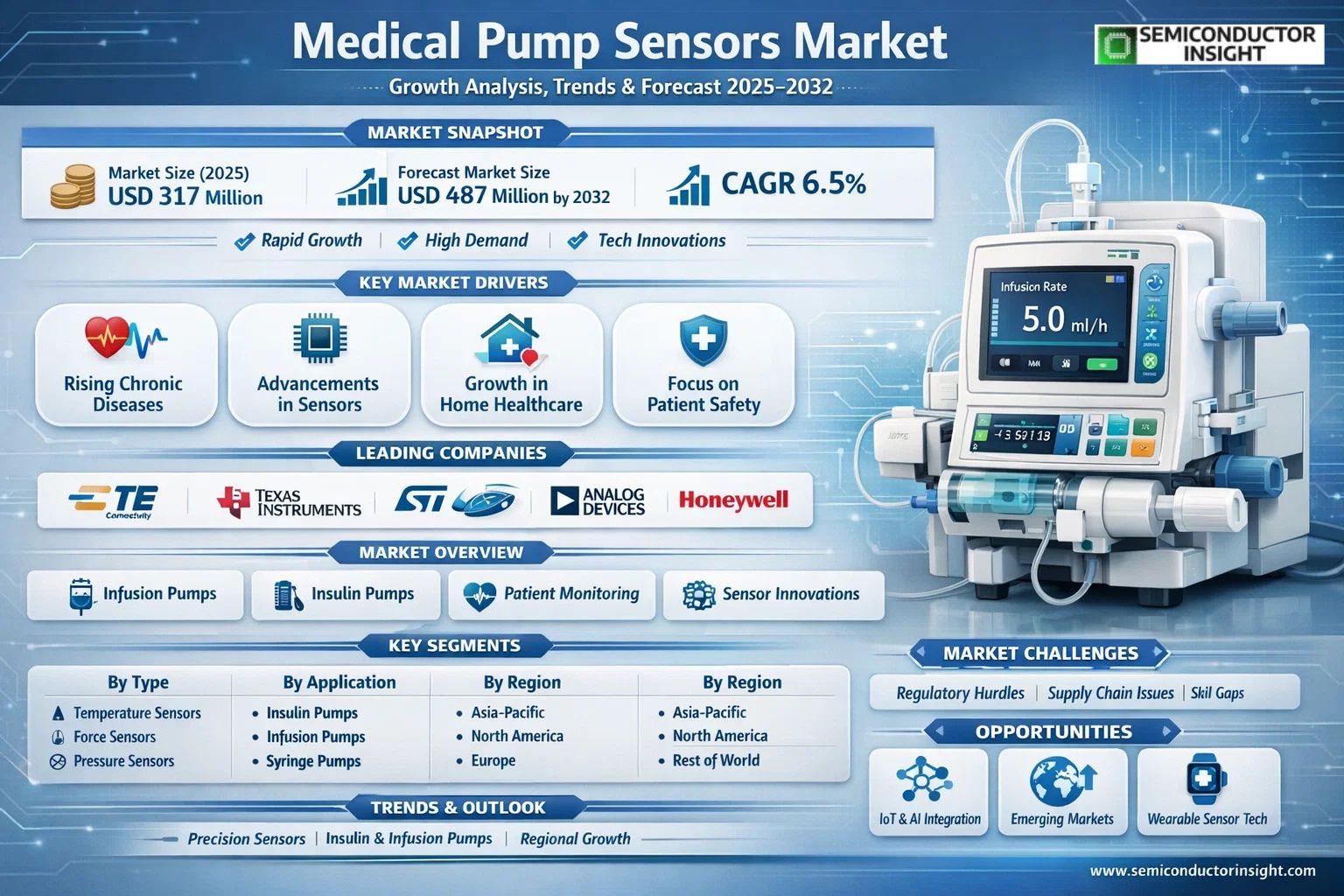
Global Medical Pump Sensors market size was valued at USD 317 million in 2025. The market is projected to reach USD 487 million by 2032, exhibiting a CAGR of 6.5% during the forecast period.
Medical pump sensors are specialized sensors designed for use in pump systems within medical devices. They detect, measure, and convert the operating status of the pump or related physiological parameters into usable output signals. These sensors play a vital role in the medical field. They not only help monitor and control the working status of medical pumps, but also ensure the safety and effectiveness of medical devices. The sensors include Temperature Sensors, Force Sensors, Pressure Sensors, and others.
The market is experiencing strong growth due to several factors, including rising demand for infusion and insulin pumps amid increasing chronic diseases like diabetes, advancements in precise sensor technologies, and expansion of home healthcare. Additionally, regulatory focus on patient safety and drug delivery accuracy contributes to market expansion. Initiatives by key players fuel further growth. For instance, Medtronic continues to integrate advanced sensors in its insulin pump systems for enhanced performance. TE Connectivity, Texas Instruments, STMicroelectronics, Analog Devices, Honeywell, NXP, Sentech, Medtronic, Dexcom, and BD are some of the key players operating in the market with wide-ranging portfolios.
MARKET DRIVERS
Advancements in Sensor Technology
Medical Pump Sensors Market is propelled by rapid innovations in sensor precision and reliability, enabling accurate monitoring of flow rates and pressure in infusion and syringe pumps. These sensors integrate microelectromechanical systems (MEMS) to detect air bubbles and occlusions, reducing medication errors by up to 40%. Rising adoption in critical care settings underscores their role in enhancing patient outcomes.
Growing Prevalence of Chronic Diseases
An aging global population and increasing incidence of chronic conditions like diabetes and cardiovascular diseases drive demand for advanced medical pumps equipped with sophisticated sensors. The market benefits from the need for continuous drug delivery systems, with infusion pump usage projected to rise 6.8% annually through 2030. Integration of wireless connectivity in sensors further supports remote monitoring, aligning with telehealth trends.
➤ Regulatory endorsements and miniaturization efforts are accelerating sensor deployment in portable pumps, fostering market expansion.
Overall, these drivers position Medical Pump Sensors Market for sustained growth, supported by healthcare investments exceeding $10 trillion globally in 2023.
MARKET CHALLENGES
Integration Complexity
Compatibility issues between legacy medical pumps and next-generation sensors pose significant hurdles in Medical Pump Sensors Market. Retrofitting older systems requires substantial engineering, often delaying adoption in under-resourced hospitals. This challenge is compounded by varying international standards, affecting seamless deployment.
Other Challenges
Supply chain disruptions, particularly for semiconductor components, have increased sensor costs by 15-20% post-2022. Additionally, cybersecurity vulnerabilities in connected sensors raise concerns over data breaches in patient monitoring.
Skill Gaps and Training Needs
Healthcare staff require specialized training to interpret sensor data accurately, with only 60% of facilities reporting adequate programs. This gap slows market penetration in emerging regions.
MARKET RESTRAINTS
Stringent Regulatory Approvals
Medical Pump Sensors Market faces constraints from rigorous FDA and EU MDR regulations, which extend validation timelines to 18-24 months. Compliance costs average $2-5 million per sensor type, deterring smaller innovators and favoring established players like TE Connectivity and Honeywell.High development expenses for biocompatibility and durability testing further limit entry, with failure rates in clinical trials reaching 25%. These factors contribute to market consolidation, restricting diverse product offerings.Intellectual property disputes also restrain innovation, as patents on ultrasonic and pressure sensors overlap, leading to litigation that delays commercialization by 12-18 months.
MARKET OPPORTUNITIES
IoT and AI Integration
Opportunities in Medical Pump Sensors Market abound through IoT-enabled real-time analytics, enabling predictive maintenance and reducing downtime by 30%. AI algorithms processing sensor data can optimize drug dosing, particularly in oncology applications where precision is paramount.Expansion into emerging markets like Asia-Pacific, with healthcare spending growing at 8.5% CAGR, offers untapped potential for affordable sensor solutions. Partnerships with pump manufacturers could capture 25% additional share by 2030.Miniaturized sensors for wearable pumps align with home healthcare trends, projected to represent 40% of the market by 2028, driven by post-pandemic shifts.
Medical Pump Sensors Market Trends
Advancements in Precision Sensor Integration
Medical Pump Sensors Market is witnessing significant evolution driven by the need for enhanced precision in monitoring pump operations within medical devices. Sensors designed specifically for medical pumps detect, measure, and convert operational status alongside physiological parameters into reliable signals. This capability ensures optimal control, safety, and efficacy in devices like infusion systems. Key developments include improved sensor accuracy for real-time data, supporting critical applications where even minor discrepancies can impact patient outcomes. Major players such as TE Connectivity, Analog Devices, and Honeywell are leading innovations in sensor design, focusing on compatibility with diverse medical pump architectures.
Other Trends
Expansion in Application Segments
Within Medical Pump Sensors Market, application areas like insulin infusion pumps and general infusion pumps are expanding rapidly. These segments demand sensors that provide continuous feedback on flow rates and delivery accuracy, minimizing risks associated with over- or under-dosing. Temperature and pressure sensors, prominent product types, are increasingly integrated to handle varying operational environments, enhancing device reliability. Industry surveys indicate strong demand from manufacturers prioritizing sensors that align with stringent regulatory standards for medical devices.
Rising Focus on Regional Market Dynamics
Medical Pump Sensors Market shows distinct regional patterns, with North America, particularly the US, maintaining a leadership position due to advanced healthcare infrastructure and high adoption of sensor-equipped pumps. In Asia, countries like China and Japan are accelerating growth through localized production and investments in sensor manufacturing. Europe follows closely, emphasizing quality compliance in segments such as force and pressure sensors. Competitive landscapes reveal top manufacturers holding substantial revenue shares, fostering mergers and developments to address challenges like supply chain disruptions. Overall, the market emphasizes drivers such as technological miniaturization and obstacles including cost pressures, positioning sensors as indispensable for future medical pump innovations.
COMPETITIVE LANDSCAPE
Key Industry Players
Leading Manufacturers in Medical Pump Sensors Market
Medical Pump Sensors Market is dominated by a few semiconductor and sensor technology leaders, with TE Connectivity, Texas Instruments, STMicroelectronics, Analog Devices, and Honeywell commanding the largest shares. These top players collectively hold a substantial portion of the global revenue in 2025, benefiting from their expertise in precision pressure, force, temperature, and other sensors essential for medical pumps like infusion systems and insulin delivery devices. The market structure remains moderately concentrated, characterized by high barriers to entry due to stringent regulatory requirements from bodies like the FDA and ISO 13485 standards. Innovation in miniaturized, biocompatible sensors drives competitive differentiation, as these firms invest heavily in R&D to enhance accuracy, reliability, and integration with IoT-enabled medical devices, supporting the market’s projected growth from $317 million in 2025 to $487 million by 2032 at a 6.5% CAGR.
Beyond the top tier, niche players such as NXP Semiconductors, Sentech, Medtronic, Dexcom, and BD contribute significantly through specialized offerings tailored to applications like insulin infusion pumps and general infusion systems. Medtronic and Dexcom stand out for their end-to-end device integration, embedding advanced sensors for real-time monitoring of physiological parameters, while BD focuses on disposable pump components with robust sensing capabilities. Emerging challengers like Sensirion and Opsens Medical are gaining traction with optical and humidity sensors optimized for biocompatibility. This fragmented yet dynamic landscape fosters mergers, acquisitions, and partnerships, enabling smaller firms to scale amid rising demand in North America and Asia-Pacific regions. Overall, competitive intensity is heightening as manufacturers address challenges like supply chain disruptions and cybersecurity in connected pumps.
List of Key Medical Pump Sensors Companies Profiled
- TE Connectivity
- Texas Instruments
- STMicroelectronics
- Analog Devices
- Honeywell
- NXP Semiconductors
- Sentech
- Medtronic
- Dexcom
- BD
- Sensirion
- Opsens Medical
- First Sensor
- Amphenol Sensors
- Vishay Intertechnology
Segment Analysis:
| Segment Category | Sub-Segments | Key Insights |
| By Type |
|
Pressure Sensors
|
| By Application |
|
Infusion Pumps
|
| By End User |
|
Hospitals
|
| By Pump Type |
|
Peristaltic Pumps
|
| By Output Signal |
|
Digital Sensors
|
Regional Analysis: Medical Pump Sensors Market
North America
North America excels in advancing sensor precision for medical pumps, with R&D hubs pioneering wireless and disposable technologies. This fosters seamless integration into automated infusion systems, reducing clinician workload and improving accuracy in drug delivery.
FDA oversight ensures stringent compliance, promoting high-quality Medical Pump Sensors Market standards. Rapid approval pathways for innovative devices encourage market entry and widespread hospital deployment.
Extensive use in ambulatory and home care settings drives growth, supported by digital health initiatives. Sensor-equipped pumps enhance chronic disease management through real-time alerts and data logging.
Venture capital flows into sensor startups, bolstering supply chains. Partnerships with pharma giants expand applications in specialized therapies, strengthening North America’s Medical Pump Sensors Market position.
Europe
Europe exhibits robust growth in Medical Pump Sensors Market, underpinned by a stringent regulatory environment via CE marking and harmonized standards. Advanced medtech clusters in Germany and the UK drive sensor innovations for precision in IV and peritoneal dialysis pumps. Emphasis on patient-centric designs integrates sensors with telehealth, optimizing fluid management in aging populations. Collaborative EU-funded projects accelerate biocompatibility advancements, while sustainability initiatives favor eco-friendly sensor materials. Strong public healthcare systems promote equitable access, with ambulatory surgery centers increasingly adopting smart pump technologies. Competitive dynamics spur efficiency improvements, positioning Europe as a key innovator in Medical Pump Sensors Market alongside North America.
Asia-Pacific
Asia-Pacific emerges as a dynamic force in Medical Pump Sensors Market, fueled by rapid healthcare modernization and manufacturing prowess. Countries like China, Japan, and India host expansive production facilities, lowering costs and enabling scalable sensor supply for infusion pumps. Urbanization and rising chronic disease burdens intensify demand in hospitals and homecare. Government initiatives enhance medical infrastructure, integrating sensors with digital ecosystems for remote monitoring. Local R&D gains momentum, focusing on affordable, durable technologies suited to diverse climates. Export-oriented strategies amplify regional influence, bridging traditional and smart Medical Pump Sensors Market applications effectively.
South America
South America shows promising evolution in Medical Pump Sensors Market, driven by healthcare investments and expanding access. Brazil and Mexico lead adoption of sensor-enabled pumps in public and private facilities, supporting critical care amid growing populations. Localization efforts reduce import dependencies, tailoring sensors for regional needs like portable dialysis solutions. Partnerships with global firms introduce advanced monitoring features, improving outcomes in underserved areas. Economic stabilization fosters private sector involvement, gradually elevating standards in Medical Pump Sensors Market.
Middle East & Africa
The Middle East & Africa region presents untapped potential in Medical Pump Sensors Market, with Gulf states investing heavily in world-class hospitals equipped with cutting-edge pumps. Sensor technologies address arid climate challenges through robust designs for IV and nutrition delivery. Africa focuses on scalable, low-maintenance solutions amid infrastructure builds. International aid and public-private ties introduce IoT-enabled sensors, enhancing epidemic response and chronic care. Gradual regulatory maturation supports market penetration, positioning the region for accelerated Medical Pump Sensors Market growth.
Report Scope
This market research report provides a comprehensive analysis of Medical Pump Sensors Market, covering the forecast period 2025–2032. It offers detailed insights into market dynamics, technological advancements, competitive landscape, and key trends shaping the industry.
Key focus areas of the report include:
- Market Overview: The report begins with an overview outlining its current market scenario, key growth indicators, and industry transformation drivers. It discusses macroeconomic factors, demand–supply balance, regulatory landscape, and the strategic role of medical pump sensors in powering advancements across industries such as infusion pumps, insulin infusion pumps, patient monitoring, and medical devices.
- Market Size & Forecast: Historical data and future projections for revenue, unit shipments, and market value across major regions and segments.
- Segmentation Analysis: Detailed breakdown by product type, technology, application, and end-user industry to identify high-growth segments and investment opportunities.
- Regional Insights: Insights into market performance across North America, Europe, Asia-Pacific, Latin America, and the Middle East & Africa, including country-level analysis where relevant.
- Competitive Landscape: Profiles of leading market participants, including their product offerings, R&D focus, manufacturing capacity, pricing strategies, and recent developments such as mergers, acquisitions, and partnerships.
- Technology Trends & Innovation: Assessment of emerging technologies, integration of AI/IoT, sensor design trends, fabrication techniques, and evolving industry standards.
- Market Drivers & Restraints: Evaluation of factors driving market growth along with challenges, supply chain constraints, regulatory issues, and market-entry barriers.
- Stakeholder Insights: Insights for component suppliers, OEMs, system integrators, investors, and policymakers regarding the evolving ecosystem and strategic opportunities.
Primary and secondary research methods are employed, including interviews with industry experts, data from verified sources, and real-time market intelligence to ensure the accuracy and reliability of the insights presented.
FREQUENTLY ASKED QUESTIONS:
What is the current market size of Medical Pump Sensors Market?
-> Medical Pump Sensors Market was valued at USD 317 million in 2025 and is expected to reach USD 487 million by 2032, at a CAGR of 6.5% during the forecast period.
Which key companies operate in Medical Pump Sensors Market?
-> Key players include TE Connectivity, Texas Instruments, STMicroelectronics, Analog Devices, Honeywell, NXP, Sentech, Medtronic, Dexcom, BD, among others.
What are the key growth drivers?
-> Key growth drivers include demand for precise monitoring and control of medical pumps, ensuring safety and effectiveness of medical devices, and rising adoption of infusion and insulin pumps.
Which region dominates the market?
-> North America is the dominant region, while Asia remains the fastest-growing market.
What are the emerging trends?
-> Emerging trends include advancements in temperature, force, and pressure sensors, integration in insulin infusion and infusion pumps, and focus on industry trends and recent developments.

Get Sample Report PDF for Exclusive Insights
Report Sample Includes
- Table of Contents
- List of Tables & Figures
- Charts, Research Methodology, and more...
 Download Sample Report PDF




