MARKET INSIGHTS
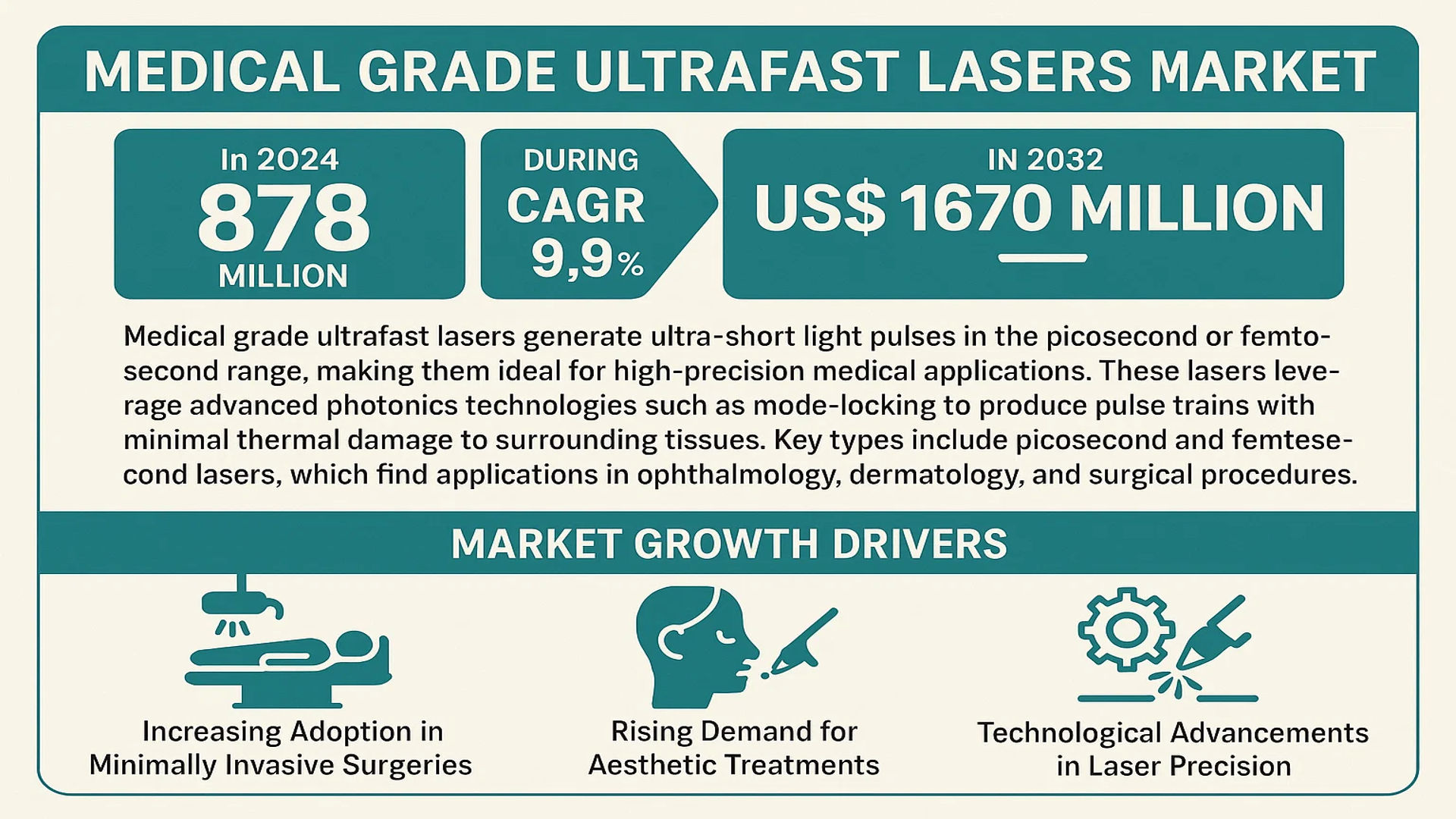
The global Medical Grade Ultrafast Lasers market was valued at 878 million in 2024 and is projected to reach US$ 1670 million by 2032, at a CAGR of 9.9% during the forecast period.
Medical grade ultrafast lasers generate ultra-short light pulses in the picosecond or femtosecond range, making them ideal for high-precision medical applications. These lasers leverage advanced photonics technologies such as mode-locking to produce pulse trains with minimal thermal damage to surrounding tissues. Key types include picosecond and femtosecond lasers, which find applications in ophthalmology, dermatology, and surgical procedures.
Market growth is driven by increasing adoption in minimally invasive surgeries, rising demand for aesthetic treatments, and technological advancements in laser precision. Additionally, expanding applications in ophthalmology—particularly for cataract and refractive surgeries—are accelerating market expansion. Key players like Coherent, Trumpf, and IPG Photonics dominate the competitive landscape through innovation and strategic partnerships, further propelling industry growth.
MARKET DYNAMICS
MARKET DRIVERS
Expanding Applications in Minimally Invasive Surgeries to Fuel Market Demand
The global medical grade ultrafast lasers market is experiencing significant growth, driven by their increasing adoption in minimally invasive surgical procedures. These lasers offer superior precision with minimal thermal damage to surrounding tissues, making them ideal for delicate ophthalmic and dermatological applications. Growth in refractive eye surgeries has been particularly notable, with femtosecond lasers now used in over 80% of LASIK procedures worldwide. The ability to perform precise tissue ablation with sub-micron accuracy while preserving adjacent structures makes ultrafast lasers indispensable in modern surgical applications.
Rising Cosmetic Procedures to Accelerate Market Expansion
The aesthetics industry’s rapid expansion is creating substantial demand for medical grade ultrafast lasers, particularly in skin resurfacing, tattoo removal, and scar revision treatments. Picosecond lasers have revolutionized tattoo removal, reducing treatment sessions by 50-70% compared to traditional methods. The global medical aesthetics market, valued at nearly $15 billion in 2024, continues to grow at approximately 12% annually, with laser-based treatments accounting for a significant portion. This growth is further supported by increasing disposable incomes and the growing cultural acceptance of cosmetic enhancements.
Technological advancements in laser systems are proving crucial, with newer models offering enhanced safety profiles and reduced downtime for patients. Manufacturers continue to invest heavily in R&D, focusing on wavelength versatility and pulse control to expand treatment indications.
➤ Recent developments include the introduction of dual-wavelength picosecond systems that combine 532nm and 1064nm outputs, allowing clinicians to treat a broader range of skin types and pigment colors.
Furthermore, the integration of ultrafast lasers with advanced imaging systems is creating new opportunities in precision medicine, particularly in oncology where these tools enable real-time tumor margin assessment during surgical procedures.
MARKET CHALLENGES
High Equipment Costs and Maintenance Requirements Limit Adoption
While medical grade ultrafast lasers offer unparalleled clinical benefits, their adoption faces significant economic barriers. The average price point for a clinical femtosecond laser system exceeds $250,000, with annual maintenance contracts adding substantial operational costs. Smaller clinics and facilities in emerging markets often find these financial requirements prohibitive, limiting market penetration. Moreover, the specialized nature of these systems necessitates regular calibration by trained technicians, creating additional logistical and cost challenges.
Other Challenges
Limited Reimbursement Policies
Reimbursement frameworks in many countries have not kept pace with technological advancements, creating financial uncertainty for healthcare providers. Unlike well-established laser therapies, many cutting-edge ultrafast laser applications lack standardized billing codes, forcing providers to either absorb costs or pass them directly to patients.
Safety and Regulatory Compliance
Stringent regulatory requirements for medical laser devices create lengthy approval processes that delay market entry for innovative systems. Changes in laser safety standards, such as updated IEC classifications, can require expensive system modifications, further impacting profitability.
MARKET RESTRAINTS
Technical Complexity and Training Requirements Hinder Widespread Adoption
The sophisticated nature of medical grade ultrafast laser systems presents operational challenges that restrain market growth. These systems require specialized knowledge of photophysics and tissue interactions that extend beyond traditional medical laser training. A recent industry survey revealed that 60% of first-time users require at least 40 hours of hands-on training before achieving clinical proficiency. This steep learning curve discourages some healthcare providers from transitioning to ultrafast technologies.
Additionally, the need for precise parameter optimization based on tissue type and treatment objectives necessitates experienced operators. The limited availability of standardized protocols for newer applications further complicates clinical adoption, particularly in community healthcare settings where resources for extensive training may be scarce.
Integration challenges with existing clinical workflows create additional barriers. Many facilities struggle to efficiently incorporate ultrafast laser procedures into busy practice schedules due to longer setup times and the need for specialized ancillary equipment.
MARKET OPPORTUNITIES
Emerging Therapeutic Applications to Drive Future Market Expansion
The medical grade ultrafast lasers market stands at the threshold of significant growth opportunities through novel therapeutic applications. Promising research in neurology indicates potential for femtosecond lasers in noninvasive neural stimulation, offering alternatives to traditional deep brain stimulation techniques. Early clinical trials demonstrate the ability to modulate neuronal activity without physical electrode implantation, opening possibilities for treating movement disorders and chronic pain.
The dental sector presents another high-growth avenue, with picosecond lasers showing remarkable efficacy in restorative procedures. Research indicates these systems can prepare tooth surfaces for bonding with 70% less enamel removal compared to conventional drills while simultaneously disinfecting the treatment area. As clinical evidence accumulates, adoption in digital dentistry workflows is expected to accelerate dramatically.
Ongoing developments in compact, fiber-based ultrafast laser systems are lowering barriers to entry across multiple medical specialties. New bench-top models now offer clinical-grade performance at significantly reduced footprints, enabling integration into settings previously constrained by space limitations.
MEDICAL GRADE ULTRAFAST LASERS MARKET TRENDS
Expanding Applications in Minimally Invasive Surgery to Drive Market Growth
The global medical grade ultrafast lasers market is experiencing robust growth, primarily driven by their increasing adoption in ophthalmology, dermatology, and minimally invasive surgical procedures. With the shift towards precision medicine, femtosecond and picosecond lasers have become indispensable tools for high-accuracy tissue ablation and cellular-level modifications. Recent advancements in laser technology have enhanced pulse stability, beam quality, and energy efficiency, making them suitable for delicate procedures like LASIK eye surgery and tattoo removal. The market is projected to grow at a CAGR of 9.9%, reaching $1.67 billion by 2032. This expansion is largely attributed to medical professionals leveraging ultrafast lasers for safer and more effective clinical outcomes.
Other Trends
Rising Demand for Aesthetic and Dermatological Treatments
The aesthetic medicine sector is witnessing a surge in demand for laser-based treatments due to their non-invasive nature and faster recovery times. Femtosecond lasers, in particular, are widely used for skin rejuvenation, scar reduction, and pigmentation correction. The increasing awareness about cosmetic procedures, coupled with technological advancements such as fractional laser systems, has significantly boosted market adoption. Another key driver is the growing preference for outpatient treatments, where ultrafast lasers offer precision without the need for lengthy hospital stays.
Technological Innovations in Laser Imaging and Therapeutic Solutions
Recent innovations in ultrafast laser systems are focused on improving real-time imaging and targeted therapy. Companies are integrating AI-driven automation to enhance beam control and reduce procedure times. For instance, developments in multiphoton microscopy enable high-resolution imaging for early cancer detection, while refined ablation techniques minimize thermal damage to surrounding tissues. The introduction of portable laser devices also opens new opportunities in telemedicine, allowing remote diagnostics and treatments. Furthermore, collaborations between medical institutions and laser manufacturers are accelerating the development of next-generation laser systems that combine diagnostics and therapy in a single platform.
COMPETITIVE LANDSCAPE
Key Industry Players
Technological Innovation and Strategic Expansion Define Market Competition
The medical grade ultrafast lasers market exhibits a moderately fragmented competitive landscape, characterized by established global players and emerging specialized manufacturers. Trumpf and Coherent dominate the industry with their extensive product portfolios and strong healthcare sector partnerships, collectively accounting for over 30% of the global market share in 2024.
IPG Photonics has gained significant traction through its high-power picosecond laser systems, particularly in ophthalmic applications, while Amplitude Laser Group has strengthened its position through continuous innovation in femtosecond laser technology for precision surgical applications.
The market is witnessing increased consolidation as major players acquire specialized laser manufacturers to expand their technological capabilities. For instance, Coherent’s 2023 acquisition of a French laser startup has significantly enhanced its dermatology-focused product line.
Meanwhile, Asian manufacturers like Huaray Precision Laser and Yangtze Soton Laser (YSL) are expanding their global footprint through competitive pricing strategies and localized service networks, particularly in emerging markets where healthcare infrastructure is rapidly developing.
List of Key Medical Grade Ultrafast Laser Companies Profiled
- Trumpf (Germany)
- Coherent (U.S.)
- IPG Photonics (U.S.)
- Newport (U.S.)
- Amplitude Laser Group (France)
- Laser Quantum (UK)
- Lumentum (U.S.)
- IMRA America (U.S.)
- NKT Photonics (Denmark)
- Clark-MXR (U.S.)
- EKSPLA (Lithuania)
- Huaray Precision Laser (China)
- Yangtze Soton Laser (YSL) (China)
- Bellin Laser (U.S.)
- NPI Lasers (Germany)
Segment Analysis:
By Type
Femtosecond Lasers Dominate the Market Due to High Precision in Medical Applications
The market is segmented based on type into:
- Picosecond Lasers
- Femtosecond Lasers
By Application
Hospitals Lead the Market, Driven by Rising Demand for Minimally Invasive Surgeries and Eye Surgeries
The market is segmented based on application into:
- Hospital
- Beauty Salon
By End User
Surgical Specialties Show High Adoption Due to Ultrafast Laser Precision in Delicate Procedures
The market is segmented based on end user into:
- Ophthalmology Clinics
- Dermatology Clinics
- Dental Clinics
- Research Institutes
- Others
By Technology
Mode-Locked Lasers Gain Traction for Their Ability to Generate Ultra-Short Pulses
The market is segmented based on technology into:
- Titanium-Sapphire Lasers
- Fiber Lasers
- Diode-Pumped Lasers
- Others
Regional Analysis: Medical Grade Ultrafast Lasers Market
North America
North America leads the global medical-grade ultrafast lasers market, driven by advanced healthcare infrastructure, high R&D investments, and stringent FDA approvals for laser-based medical devices. The U.S. alone accounts for over 60% of the regional market share, with rising demand for non-invasive surgical procedures such as LASIK and dermatological treatments. Key players like IPG Photonics and Coherent dominate the region, leveraging their strong technological advancements. However, high equipment costs remain a barrier for smaller clinics. The growing adoption of femtosecond lasers in ophthalmology and cosmetic surgery underscores the region’s leadership in medical innovation.
Europe
Europe is a close contender, with Germany and France at the forefront due to their robust medical device manufacturing sectors. The region benefits from EU-wide medical device regulations (MDR) that ensure product safety and efficacy, fostering trust in ultrafast laser technologies. A surge in aesthetic procedures and cataract surgeries using picosecond lasers is propelling market growth. Despite this, reimbursement challenges and budget constraints in public healthcare systems slightly hinder market expansion. Collaborative research initiatives between universities and laser manufacturers continue to drive innovation, particularly in applications like cancer treatment.
Asia-Pacific
The Asia-Pacific market is the fastest-growing, fueled by China’s aggressive healthcare modernization and Japan’s aging population requiring advanced medical interventions. India and South Korea are emerging hotspots, with rising disposable incomes boosting demand for cosmetic and ophthalmic laser treatments. Local manufacturers such as Huaray Precision Laser and Yangtze Soton Laser are gaining traction, offering cost-effective alternatives to Western brands. However, regulatory disparities across countries and limited awareness in rural areas slow down broader adoption. The region is expected to surpass Europe in market size by 2030 due to its untapped potential.
South America
South America’s market is nascent but promising, with Brazil leading due to its well-developed private healthcare sector. Increasing medical tourism for laser-based procedures, particularly in Argentina and Colombia, supports regional growth. However, economic instability, currency fluctuations, and underdeveloped healthcare infrastructure in remote areas limit market penetration. Governments are gradually increasing investments in medical technology, but progress remains slow compared to other regions. Local suppliers face competition from imported devices, though partnerships with global players could bridge this gap.
Middle East & Africa
The Middle East & Africa market is unevenly developed, with affluent Gulf nations (UAE, Saudi Arabia) driving demand through premium healthcare services. Israel stands out for its cutting-edge laser research, particularly in dermatology and dentistry. In contrast, Africa faces significant challenges, including a lack of skilled professionals and inadequate funding for advanced medical equipment. While growth is steady in urban centers, widespread adoption is unlikely in the short term. Nevertheless, medical tourism hubs like Dubai and Riyadh present lucrative opportunities for high-end laser device suppliers.
Report Scope
This market research report provides a comprehensive analysis of the global Medical Grade Ultrafast Lasers market, covering the forecast period 2024–2032. It offers detailed insights into market dynamics, technological advancements, competitive landscape, and key trends shaping the industry.
Key focus areas of the report include:
- Market Size & Forecast: Historical data and future projections for revenue, unit shipments, and market value across major regions and segments. The market was valued at USD 878 million in 2024 and is projected to reach USD 1670 million by 2032 at a CAGR of 9.9%.
- Segmentation Analysis: Detailed breakdown by product type (Picosecond Lasers, Femtosecond Lasers), application (Hospital, Beauty Salon), and end-user industry to identify high-growth segments.
- Regional Outlook: Insights into market performance across North America, Europe, Asia-Pacific, Latin America, and Middle East & Africa, with country-level analysis for key markets.
- Competitive Landscape: Profiles of 15 leading market participants including Trumpf, Coherent, IPG Photonics, and Lumentum, covering their market share, product portfolios, and strategic developments.
- Technology Trends: Assessment of emerging laser technologies, precision applications in medical fields, and integration with advanced medical devices.
- Market Drivers & Restraints: Evaluation of factors such as increasing demand for minimally invasive surgeries, cosmetic procedures, and technological barriers.
- Stakeholder Analysis: Strategic insights for medical device manufacturers, healthcare providers, investors, and policymakers.
The research employs both primary and secondary methodologies, including interviews with industry experts and analysis of verified market data to ensure accuracy and reliability.
FREQUENTLY ASKED QUESTIONS:
What is the current market size of Global Medical Grade Ultrafast Lasers Market?
-> Medical Grade Ultrafast Lasers market was valued at 878 million in 2024 and is projected to reach US$ 1670 million by 2032, at a CAGR of 9.9% during the forecast period.
Which key companies operate in Global Medical Grade Ultrafast Lasers Market?
-> Key players include Trumpf, Coherent, IPG Photonics, Newport, Amplitude Laser Group, Laser Quantum, and Lumentum, among others.
What are the key growth drivers?
-> Key growth drivers include rising demand for precision medical procedures, increasing cosmetic treatments, and technological advancements in laser systems.
Which region dominates the market?
-> North America currently leads the market, while Asia-Pacific is expected to show the highest growth rate during the forecast period.
What are the emerging trends?
-> Emerging trends include development of portable laser systems, integration with robotic surgery platforms, and expansion into new medical applications.

Get Sample Report PDF for Exclusive Insights
Report Sample Includes
- Table of Contents
- List of Tables & Figures
- Charts, Research Methodology, and more...
 Download Sample Report PDF