Massage Chair Controller Market Insights
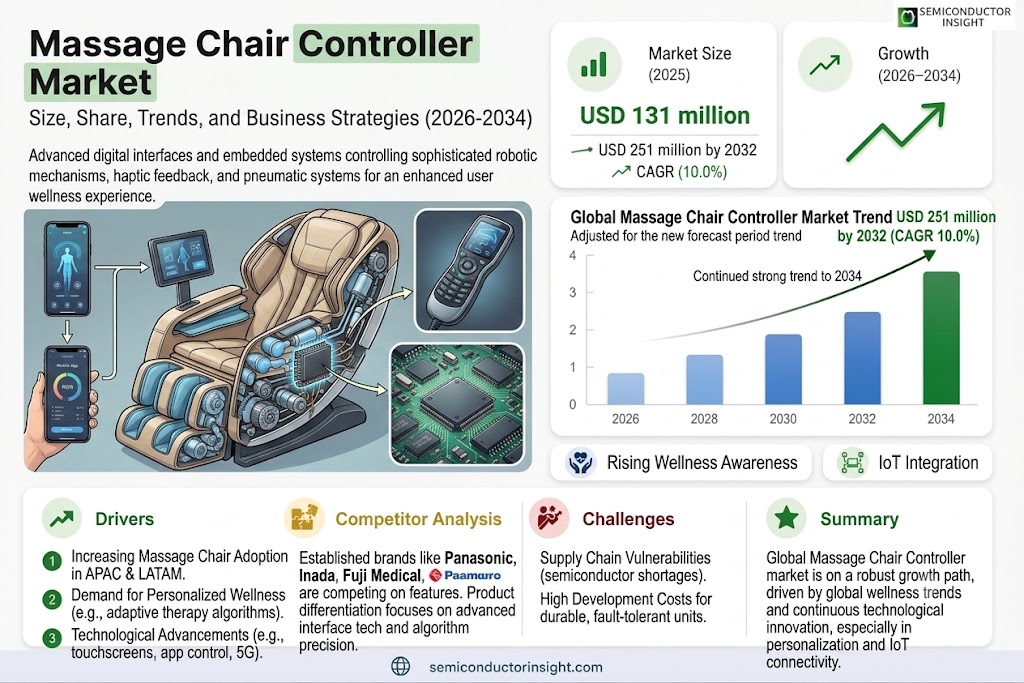
Global Massage Chair Controller market size was valued at USD 131 million in 2025. The market is projected to reach USD 251 million by 2032, exhibiting a CAGR of 10.0% during the forecast period.
The massage chair controller refers to a device that can control the operation of various parts of the massage chair. It receives user instructions such as massage mode, intensity, time, etc., and controls the motor, heating system, vibration system and other components of the massage chair to achieve corresponding functions.
The market is experiencing rapid growth due to several factors, including surging demand for home wellness products, rising health consciousness amid busy lifestyles, and integration of smart technologies like IoT and voice controls. Furthermore, the expanding massage chair industry, driven by an aging population and post-pandemic focus on relaxation, fuels this expansion. Key players such as NXP, LX Semicon, STMicroelectronics, Infineon, Texas Instruments, Silicon Labs, Nuvoton, Holtek, GigaDevice, and Jiangxi Lianchuang Opto-Electronic Science and Technology lead with advanced microcontroller solutions tailored for precise control and energy efficiency.
MARKET DRIVERS
Rising Demand for Advanced Home Wellness Devices
Massage Chair Controller Market is propelled by increasing consumer interest in at-home relaxation solutions, with global massage chair sales expanding at a compound annual growth rate (CAGR) of approximately 8.2% through 2028. Sophisticated controllers featuring touchscreens and programmable settings enhance user experience, making them essential components in premium models adopted by health-conscious households.
Integration of Smart Technologies
Advancements in IoT and AI integration within massage chair controllers allow for personalized massage programs and remote monitoring via smartphone apps, driving market growth. Manufacturers are embedding voice control and biometric sensors, aligning with the smart home ecosystem valued at over $150 billion globally.
➤ Population aging boosts demand, as controllers enable customized therapy for seniors, with 1 in 6 people worldwide projected to be over 65 by 2050.
Health and wellness trends post-pandemic further accelerate adoption, positioning Massage Chair Controller Market for sustained expansion through innovative, user-centric designs.
MARKET CHALLENGES
Supply Chain Vulnerabilities and Component Shortages
Massage Chair Controller Market faces hurdles from volatile semiconductor supplies, critical for microprocessors and displays, leading to production delays amid global chip shortages that impacted electronics by up to 20% in recent years. Reliance on Asian suppliers exposes firms to geopolitical tensions and logistics disruptions.
Other Challenges
High Development Costs
Investing in R&D for durable, waterproof controllers increases expenses, straining smaller players in a competitive landscape dominated by established brands holding over 60% market share.Intense competition from low-cost alternatives challenges premium controller differentiation, requiring continuous innovation to maintain margins in the evolving Massage Chair Controller Market.
MARKET RESTRAINTS
Regulatory and Safety Compliance Hurdles
Stringent electrical safety standards, such as UL and CE certifications, impose significant restraints on Massage Chair Controller Market, with compliance costs rising 15% annually due to evolving EMC regulations. Non-compliance risks product recalls, deterring market entry for new entrants.High initial manufacturing expenses for robust, fault-tolerant controllers limit scalability, particularly in price-sensitive segments where consumers prioritize affordability over advanced features.Intellectual property disputes over patented control algorithms further constrain innovation, slowing the pace of new product launches in Massage Chair Controller Market.
MARKET OPPORTUNITIES
Expansion into Emerging Wellness Markets
Massage Chair Controller Market holds strong potential in Asia-Pacific and Latin America, where rising disposable incomes and wellness awareness drive massage chair penetration, forecasted to grow at 9.5% CAGR in these regions.Development of affordable, modular controllers for mid-range chairs opens doors for mass-market adoption, with opportunities in customization for fitness centers and spas comprising 30% of demand.Leveraging 5G connectivity for real-time therapy adjustments presents untapped growth, enhancing Massage Chair Controller Market through partnerships with telehealth providers.
Massage Chair Controller Market Trends
Advancements in Controller Technology
Massage Chair Controller Market is experiencing significant evolution through the distinction between basic and advanced controllers. Basic controllers handle essential functions like motor control for massage modes and intensity, while advanced controllers integrate sophisticated features such as precise heating system management and vibration synchronization. Key manufacturers including NXP, STMicroelectronics, and Infineon are driving this shift by enhancing microcontroller capabilities tailored for massage chair operations, enabling more responsive user interfaces and reliable performance across global applications.
Other Trends
Product Type Segmentation
In Massage Chair Controller Market, the transition from basic to advanced controllers reflects growing demand for feature-rich devices. Advanced controllers support complex instructions for multi-zone massages and customizable programs, appealing to premium massage chair models. This segmentation highlights manufacturers’ focus on upgrading from simple relay-based systems to semiconductor-driven solutions, with players like Texas Instruments and Silicon Labs contributing to higher efficiency and reduced power consumption in controller designs.
Application-Driven Innovations
Demand in Massage Chair Controller Market is bifurcated between home and commercial massage chairs. Home applications prioritize compact, user-friendly controllers for personal wellness routines, while commercial settings require robust units for high-usage durability. Suppliers like LX Semicon and Nuvoton are adapting controllers to meet these needs, incorporating safety features and remote control compatibility that align with varying installation environments worldwide.
Regional Market Dynamics
The global Massage Chair Controller Market shows varied regional patterns, with strong manufacturing presence in Asia, particularly China, featuring companies such as Jiangxi Lianchuang Opto-Electronic Science and Technology and GigaDevice. North America and Europe emphasize integration with premium massage chairs, while emerging markets in Southeast Asia and Latin America drive volume growth. Industry surveys indicate that leading players hold substantial shares, fostering competition through innovations in controller reliability and compatibility with diverse massage chair components.
COMPETITIVE LANDSCAPE
Key Industry Players
Leading Manufacturers and Market Share Analysis in Massage Chair Controller Sector
Massage Chair Controller Market exhibits a moderately concentrated structure dominated by established semiconductor leaders such as NXP, STMicroelectronics, Infineon Technologies, Texas Instruments, and LX Semicon. These top-tier players command a significant revenue share, with the global top five accounting for a substantial portion of the market as of 2025, driven by their expertise in microcontrollers, power management ICs, and sensor integration essential for precise control of massage functions like motor operation, heating, vibration, and user interfaces. Their robust R&D capabilities and global supply chains enable them to cater to both basic and advanced controllers, supporting the sector’s projected growth from US$131 million in 2025 to US$251 million by 2032 at a 10.0% CAGR, particularly in applications for home and commercial massage chairs.
Beyond these frontrunners, a roster of specialized and emerging competitors contributes to market dynamism, including Silicon Labs, Nuvoton Technology, Holtek Semiconductor, and GigaDevice, which focus on cost-efficient solutions for basic controllers prevalent in consumer segments. Chinese innovators like Jiangxi Lianchuang Opto-Electronic Science and Technology, Xiamen Hualian Electronics, Xiamen Xinyang Technology, Shenzhen Fandou Technology, Hirain Technologies, and Hangzhou Hopechart IoT Technology are carving niches in advanced IoT-enabled controllers, emphasizing smart connectivity and customization for commercial applications. This diverse competitive landscape fosters innovation amid rising demand in regions like Asia-Pacific and North America, where industry surveys highlight ongoing mergers, product developments, and shifts toward energy-efficient designs.
List of Key Massage Chair Controller Companies Profiled
- NXP
- STMicroelectronics
- LX Semicon
- Infineon Technologies
- Texas Instruments
- Silicon Labs
- Nuvoton Technology
- Holtek Semiconductor
- GigaDevice
- Jiangxi Lianchuang Opto-Electronic Science and Technology
- Xiamen Hualian Electronics
- Xiamen Xinyang Technology
- Shenzhen Fandou Technology
- Hirain Technologies
- Hangzhou Hopechart IoT Technology
Segment Analysis:
| Segment Category | Sub-Segments | Key Insights |
| By Type |
|
Advanced Controller
|
| By Application |
|
Home Massage Chair
|
| By End User |
|
Households
|
| By Distribution Channel |
|
OEM Supply
|
| By Technology |
|
Microcontroller-based (MCU)
|
Regional Analysis: Massage Chair Controller Market
Asia-Pacific
Asia-Pacific excels in R&D for Massage Chair Controller Market, with Japan pioneering AI and sensor fusion for adaptive massages. South Korea advances wireless controls, while China’s fabs produce high-volume microcontrollers optimized for vibration and heat regulation.
Integrated ecosystems from component sourcing to assembly streamline production in Massage Chair Controller Market. Proximity of semiconductor makers and assemblers minimizes delays, enabling quick iterations and scalability for diverse chair models.
Urban professionals seek advanced controllers for stress relief in Massage Chair Controller Market. Wellness trends and aging populations drive adoption of app-linked systems, boosting aftermarket upgrades and premium segment expansion.
Asia-Pacific controllers dominate global shipments in Massage Chair Controller Market, supported by trade agreements and quality certifications. OEM partnerships with Western brands amplify reach, solidifying the region’s pivotal role.
North America
North America exhibits strong growth in Massage Chair Controller Market, propelled by affluent consumers prioritizing home wellness solutions. The U.S. leads with demand for high-end controllers featuring app integration and voice commands, catering to tech-savvy users seeking personalized therapy. Canadian markets emphasize durable, user-friendly designs amid harsh climates. Key players innovate in ergonomic interfaces, focusing on accessibility for elderly demographics. Retail channels like specialty stores and e-commerce platforms accelerate adoption. Wellness spas and chiropractic clinics integrate advanced controllers, enhancing service offerings. Supply chains rely on Asian imports but see rising local assembly to cut tariffs. Regulatory focus on safety standards ensures reliable performance, while consumer privacy concerns drive secure data handling in connected devices. Emerging trends include subscription-based software updates for controllers, extending product lifecycles. North America’s market dynamics reflect a blend of premium pricing and innovation, positioning it as a lucrative hub for sophisticated Massage Chair Controller solutions.
Europe
Europe’s Massage Chair Controller Market thrives on a culture of health and relaxation, with strong contributions from Germany, Italy, and the UK. Emphasis on quality and sustainability shapes controller designs, incorporating eco-friendly materials and energy-efficient operations. EU regulations enforce stringent safety and EMC standards, fostering trust among discerning buyers. Wellness tourism bolsters demand in spa-centric nations like France, where multifunctional controllers enhance therapeutic experiences. Customization for diverse body types prevails, driven by aging populations. Local manufacturers collaborate with Asian suppliers for components, balancing cost and innovation. E-commerce growth and omnichannel strategies expand access to advanced models with Bluetooth and remote diagnostics. Challenges include fragmented markets, addressed through pan-European distribution networks. Future outlook highlights integration with smart furniture ecosystems, reinforcing Europe’s role as a refined segment in Massage Chair Controller Market.
South America
South America emerges as a promising arena in Massage Chair Controller Market, led by Brazil and Mexico’s urbanizing economies. Rising disposable incomes fuel interest in affordable, feature-packed controllers for home use. Brazilian consumers favor robust designs resilient to tropical conditions, while Mexico benefits from NAFTA-like trade facilitating imports. Local assembly initiatives reduce costs, stimulating job creation and market penetration. Wellness awareness grows via fitness trends and corporate wellness programs, integrating chairs in offices. E-commerce platforms democratize access to global brands’ controllers. Infrastructure challenges are offset by portable, battery-backed models. Partnerships with regional furniture makers customize offerings. The market’s vibrancy stems from youthful demographics seeking stress-relief tech, paving the way for accelerated expansion in the Massage Chair Controller landscape.
Middle East & Africa
The Middle East & Africa region shows nascent yet accelerating dynamics in Massage Chair Controller Market, with UAE and South Africa at the forefront. Luxury segments in Gulf nations drive premium controllers with opulent interfaces for high-end residences and hotels. South Africa’s middle class embraces wellness tech amid health consciousness post-pandemic. Harsh environments necessitate durable, heat-resistant designs. Import dependencies persist, but local distribution networks grow via e-commerce and malls. Cultural emphasis on family relaxation boosts household adoption. Investments in hospitality infrastructure amplify commercial demand. Challenges like power instability spur solar-compatible controllers. Regional collaborations introduce affordable variants, broadening appeal. This market’s trajectory reflects untapped potential, blending tradition with modern Massage Chair Controller innovations for holistic well-being.
Report Scope
This market research report provides a comprehensive analysis of Massage Chair Controller Market, covering the forecast period 2025–2032. It offers detailed insights into market dynamics, technological advancements, competitive landscape, and key trends shaping the industry.
Key focus areas of the report include:
- Market Overview: The report begins with an overview outlining its current market scenario, key growth indicators, and industry transformation drivers. It discusses macroeconomic factors, demand–supply balance, regulatory landscape, and the strategic role of Massage Chair Controllers in powering advancements across industries such as home wellness, commercial spas, healthcare, and consumer electronics.
- Market Size & Forecast: Historical data and future projections for revenue, unit shipments, and market value across major regions and segments.
- Segmentation Analysis: Detailed breakdown by product type, technology, application, and end-user industry to identify high-growth segments and investment opportunities.
- Regional Insights: Insights into market performance across North America, Europe, Asia-Pacific, Latin America, and the Middle East & Africa, including country-level analysis where relevant.
- Competitive Landscape: Profiles of leading market participants, including their product offerings, R&D focus, manufacturing capacity, pricing strategies, and recent developments such as mergers, acquisitions, and partnerships.
- Technology Trends & Innovation: Assessment of emerging technologies, integration of AI/IoT, semiconductor design trends, fabrication techniques, and evolving industry standards.
- Market Drivers & Restraints: Evaluation of factors driving market growth along with challenges, supply chain constraints, regulatory issues, and market-entry barriers.
- Stakeholder Insights: Insights for component suppliers, OEMs, system integrators, investors, and policymakers regarding the evolving ecosystem and strategic opportunities.
Primary and secondary research methods are employed, including interviews with industry experts, data from verified sources, and real-time market intelligence to ensure the accuracy and reliability of the insights presented.
FREQUENTLY ASKED QUESTIONS:
What is the current market size of Massage Chair Controller Market?
-> Global Massage Chair Controller market was valued at USD 131 million in 2025 and is projected to reach USD 251 million by 2032, at a CAGR of 10.0% during the forecast period.
Which key companies operate in Massage Chair Controller Market?
-> Key players include NXP, LX Semicon, STMicroelectronics, Infineon, Texas Instruments, Silicon Labs, among others.
What are the key growth drivers?
-> Key growth drivers include rising demand for home and commercial massage chairs, technological advancements in controllers, industry trends, and wellness consumer preferences.
Which region dominates the market?
-> Asia is a key region with China highlighted, while North America including the U.S. holds significant market share.
What are the emerging trends?
-> Emerging trends include advanced controllers over basic, integration in home massage chairs, smart features for motors, heating, and vibration systems.

Get Sample Report PDF for Exclusive Insights
Report Sample Includes
- Table of Contents
- List of Tables & Figures
- Charts, Research Methodology, and more...
 Download Sample Report PDF