Malaysia AI Advanced Packaging Substrate Manufacturing Market Insights
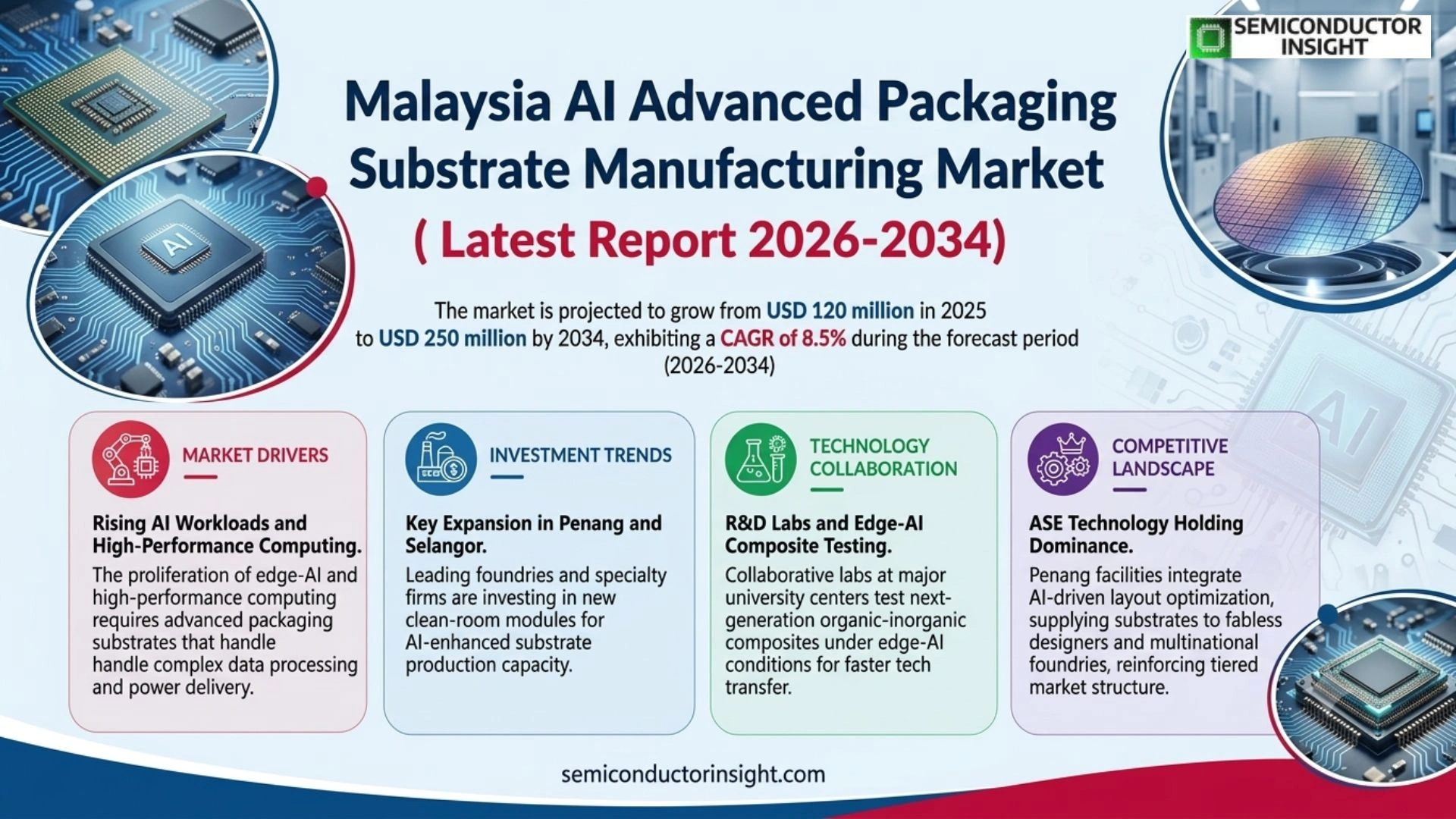
Global Malaysia AI Advanced Packaging Substrate Manufacturing Market size is projected to grow from USD 120 million in 2025 to USD 250 million by 2034, exhibiting a CAGR of 8.5% during the forecast period.
AI‑driven advanced packaging substrates are engineered interposer and fan‑out wafer‑level platforms that incorporate artificial‑intelligence algorithms for layout optimisation, thermal management and signal‑integrity enhancement. These substrates combine high‑density copper traces with epoxy‑glass laminates or organic‑inorganic composites and embed sensors that enable real‑time process control during fabrication.
The market is experiencing rapid growth because semiconductor manufacturers are scaling demand for high‑performance computing, automotive electronics and edge‑AI devices that require compact yet powerful packaging solutions. Furthermore, Malaysia’s strategic incentives for semiconductor R&D together with rising foreign direct investment in fabless design houses are accelerating adoption of AI‑optimised substrate technologies. Leading foundries and specialty packaging firms are expanding capacity in Penang and Selangor, further fuelling market expansion.
MARKET DRIVERS
Rising Demand for AI‑Enabled Devices
The proliferation of artificial‑intelligence workloads across automotive, healthcare and industrial sectors is prompting OEMs to adopt advanced packaging substrates that can support higher interconnect density. In Malaysia, local system integrators are increasingly specifying AI‑optimized substrates to meet performance targets, which directly expands Malaysia AI Advanced Packaging Substrate Manufacturing Market.
Government Incentives and Infrastructure Development
Targeted fiscal incentives, such as tax allowances for high‑tech manufacturing, coupled with the expansion of the Malaysia Digital Economy Blueprint, are lowering entry barriers for new substrate fabs. These policy measures create a favorable investment climate and accelerate capacity growth.
➤ “Strategic public‑private partnerships are expected to lift substrate production capacity by up to 30 % over the next five years.”
Collectively, the market is being driven by a blend of demand‑side pressure and supply‑side support, positioning Malaysia as a regional hub for AI‑centric advanced packaging solutions.
MARKET CHALLENGES
High Capital Expenditure Requirements
State‑of‑the‑art substrate lines require multi‑billion ring‑fence investments in photolithography, wafer‑level packaging and AI‑optimized process control. For many mid‑size players, securing financing at competitive rates remains a significant hurdle.
Other Challenges
Talent Shortage
The specialized skill set needed for AI‑focused substrate design and manufacturing exceeds the current supply of trained engineers in Malaysia, leading to longer ramp‑up times and higher recruitment costs.
MARKET RESTRAINTS
Supply Chain Vulnerabilities
Reliance on imported high‑purity chemicals and specialized equipment exposes Malaysia AI Advanced Packaging Substrate Manufacturing Market to geopolitical fluctuations and logistic bottlenecks, which can delay fab commissioning and increase operational costs.
MARKET OPPORTUNITIES
Growth of Edge‑AI Applications
Edge computing devices demand substrates with low latency and high thermal performance. Malaysia’s evolving ecosystem of AI chip designers and system houses creates a niche for locally produced, AI‑optimized substrates, offering a clear growth corridor for new entrants and existing players alike.
Malaysia AI Advanced Packaging Substrate Manufacturing Market Trends
AI‑Optimized Substrate Design Accelerates Performance
Malaysia AI Advanced Packaging Substrate Manufacturing Market is witnessing a rapid shift toward AI‑driven design methodologies that integrate layout optimisation, thermal management and signal‑integrity enhancement within a single workflow. By embedding machine‑learning algorithms into the substrate engineering stage, manufacturers can predict copper trace congestion and adjust interposer geometry before silicon wafers are processed. This predictive capability reduces trial‑and‑error cycles, shortens time‑to‑market for high‑performance computing devices, and improves overall yield. In parallel, the incorporation of epoxy‑glass laminates and organic‑inorganic composites, enriched with embedded sensors, enables real‑time process control, further stabilising production tolerances. The convergence of these technologies positions Malaysia as a hub where AI‑enabled substrate platforms meet the growing demand for compact, power‑dense solutions in automotive electronics and edge‑AI applications.
Other Trends
Supply‑Chain Localization and Skill Development
Another notable trend within Malaysia AI Advanced Packaging Substrate Manufacturing Market is the deliberate localisation of critical supply‑chain components. Government incentives encourage domestic production of high‑purity copper foils, advanced dielectric materials and precision lithography equipment. At the same time, specialised training programmes collaborate with technical universities to up‑skill engineers in AI‑based process analytics and substrate reliability testing. This dual focus on material self‑sufficiency and human capital reduces reliance on overseas vendors, mitigates geopolitical risk, and creates a more resilient manufacturing ecosystem capable of supporting the rapid scaling of AI‑optimised packaging solutions.
Strategic Investment in Penang and Selangor Facilities
Investment momentum is concentrating in Penang and Selangor, where leading foundries and specialty packaging firms have announced expansion projects aimed at increasing capacity for AI‑enhanced substrate production. New clean‑room modules are being equipped with advanced AI‑controlled deposition tools that monitor temperature gradients and layer uniformity in real time. These facilities also host collaborative R&D labs that test next‑generation organic‑inorganic composites under edge‑AI workload conditions. The strategic placement of these assets near major university research centres accelerates technology transfer, shortens development cycles, and reinforces Malaysia’s reputation as a preferred destination for high‑value semiconductor packaging activities.
COMPETITIVE LANDSCAPE
Key Industry Players
Malaysia AI‑Driven Advanced Packaging Substrate Market – Competitive Overview
ASE Technology Holding remains the principal driver of Malaysia’s AI‑enhanced advanced packaging substrate market. Its Penang‑based facilities integrate AI‑based layout optimisation and real‑time thermal monitoring across high‑density interposer and fan‑out wafer‑level platforms. By aligning its R&D centre with local semiconductor incentives, ASE supplies the majority of substrate capacity to both domestic fabless designers and multinational foundries, reinforcing a tiered market where a few large OEMs command most volume while a vibrant ecosystem of specialty suppliers supports niche applications such as automotive edge‑AI and high‑performance computing.
Beyond ASE, a cohort of established and emerging players contributes depth to the substrate value chain. Amkor Technology and JCET Group (through the former STATS ChipPAC) operate dedicated AI‑optimised lines in Selangor, focusing on mixed‑signal and high‑frequency modules. Silterra, Unimicron, and Intel’s Malaysia R&D hub specialise in organic‑inorganic composites and sensor‑embedded laminates for next‑generation devices. Regional manufacturers including Infineon, Micron, NXP, Broadcom, Qualcomm, Samsung Electronics, and TSMC augment capacity through joint‑venture projects and technology transfer, creating a competitive landscape that blends global scale with localised innovation.
List of Key AI Advanced Packaging Substrate Companies Profiled
- ASE Technology Holding
- Amkor Technology
- JCET Group (STATS ChipPAC)
- Silterra Malaysia
- Unimicron Technology Corp.
- Intel Malaysia
- TSMC Malaysia
- Infineon Technologies Malaysia
- Micron Technology Malaysia
- NXP Semiconductors Malaysia
- Broadcom Malaysia
- Qualcomm Malaysia
- Samsung Electronics Malaysia
- JCET Group
- Panasonic Semiconductor Malaysia
Segment Analysis:
| Segment Category | Sub-Segments | Key Insights |
| By Type |
|
Fan‑out Wafer‑Level Packaging Substrates
|
| By Application |
|
High‑Performance Computing
|
| By End User |
|
Semiconductor Foundries
|
| By Process Stage |
|
Design & Layout Optimisation
|
| By Customer Need |
|
Thermal Management
|
Regional Analysis: Malaysia AI Advanced Packaging Substrate Manufacturing Market
Asia‑Pacific
Robust demand for high‑density interconnects, propelled by 5G rollout and automotive electronics, drives AI‑enabled substrate design. Government subsidies in Malaysia further amplify investment confidence across the Asia‑Pacific.
Regional standards increasingly require AI‑assisted quality control, encouraging manufacturers to adopt predictive analytics. Malaysia’s alignment with IEC and JEDEC guidelines streamlines market entry.
Close ties with silicon wafer producers and local component distributors reduce lead times. AI‑based demand forecasting improves inventory turnover, mitigating traditional bottlenecks.
Established players and fast‑growing start‑ups are leveraging joint‑venture models, combining AI expertise with manufacturing know‑how to secure market share in the region.
North America
North America offers a mature technology ecosystem but presents higher operational costs compared with Asia‑Pacific. The market here focuses on niche applications such as aerospace and high‑performance computing, where AI‑driven substrate customization adds measurable value. Partnerships between U.S. AI firms and Malaysian manufacturers enable technology transfer, yet regulatory scrutiny and supply‑chain resilience remain key challenges for market participants seeking to expand into this geography.
Europe
European demand for advanced packaging substrates is driven by stringent environmental standards and a strong emphasis on reliability in automotive and industrial sectors. AI integration is viewed as a pathway to meet emission targets while maintaining high product quality. Collaborative research programs between EU research institutions and Malaysian suppliers are fostering innovative AI algorithms for defect detection, positioning Europe as a strategic, though secondary, market for Malaysia AI Advanced Packaging Substrate Manufacturing Market.
South America
In South America, market growth is nascent, largely anchored by emerging consumer electronics manufacturing clusters in Brazil and Chile. AI‑enabled process optimization is still in early adoption phases, but local governments are beginning to offer incentives for high‑tech manufacturing. The region’s potential lies in cost‑effective scaling of AI solutions, which could attract Malaysian firms looking to diversify export destinations.
Middle East & Africa
The Middle East & Africa region exhibits modest demand, primarily driven by telecommunications infrastructure upgrades and data‑center expansions. AI applications are leveraged to enhance substrate reliability under high‑temperature operating conditions. While investment levels are lower, strategic partnerships with Saudi and UAE technology parks present opportunities for Malaysian manufacturers to establish footholds and contribute expertise in AI‑augmented packaging processes.
Report Scope
This market research report provides a comprehensive analysis of the Malaysia AI Advanced Packaging Substrate Manufacturing Market , covering the forecast period 2026–2034. It offers detailed insights into market dynamics, technological advancements, competitive landscape, and key trends shaping the industry.
Key focus areas of the report include:
- Market Overview: The report begins with an overview outlining its current market scenario, key growth indicators, and industry transformation drivers. It discusses macroeconomic factors, demand–supply balance, regulatory landscape, and the strategic role of semiconductors in powering advancements across industries such as automotive, telecommunications, consumer electronics, and industrial automation.
- Market Size & Forecast: Historical data and future projections for revenue, unit shipments, and market value across major regions and segments.
- Segmentation Analysis: Detailed breakdown by product type, technology, application, and end-user industry to identify high-growth segments and investment opportunities.
- Regional Insights: Insights into market performance across North America, Europe, Asia-Pacific, Latin America, and the Middle East & Africa, including country-level analysis where relevant.
- Competitive Landscape: Profiles of leading market participants, including their product offerings, R&D focus, manufacturing capacity, pricing strategies, and recent developments such as mergers, acquisitions, and partnerships.
- Technology Trends & Innovation: Assessment of emerging technologies, integration of AI/IoT, semiconductor design trends, fabrication techniques, and evolving industry standards.
- Market Drivers & Restraints: Evaluation of factors driving market growth along with challenges, supply chain constraints, regulatory issues, and market-entry barriers.
- Stakeholder Insights: Insights for component suppliers, OEMs, system integrators, investors, and policymakers regarding the evolving ecosystem and strategic opportunities.
Primary and secondary research methods are employed, including interviews with industry experts, data from verified sources, and real-time market intelligence to ensure the accuracy and reliability of the insights presented.
FREQUENTLY ASKED QUESTIONS:
What is the current market size of Malaysia AI Advanced Packaging Substrate Manufacturing Market?
-> Malaysia AI Advanced Packaging Substrate Manufacturing Market size is projected to grow from USD 120 million in 2025 to USD 250 million by 2034.
Which key companies operate in Malaysia AI Advanced Packaging Substrate Manufacturing Market?
-> Key players include Axalta Coating Systems, AkzoNobel, BASF SE, PPG, Sherwin-Williams, and 3M, among others.
What are the key growth drivers?
-> Key growth drivers include railway infrastructure investments, urbanization, and demand for durable coatings.
Which region dominates the market?
-> Asia-Pacific is the fastest-growing region, while Europe remains a dominant market.
What are the emerging trends?
-> Emerging trends include bio-based coatings, smart coatings, and sustainable rail solutions.
Get Sample Report PDF for Exclusive Insights
Report Sample Includes
- Table of Contents
- List of Tables & Figures
- Charts, Research Methodology, and more...
 Download Sample Report PDF