
MARKET INSIGHTS
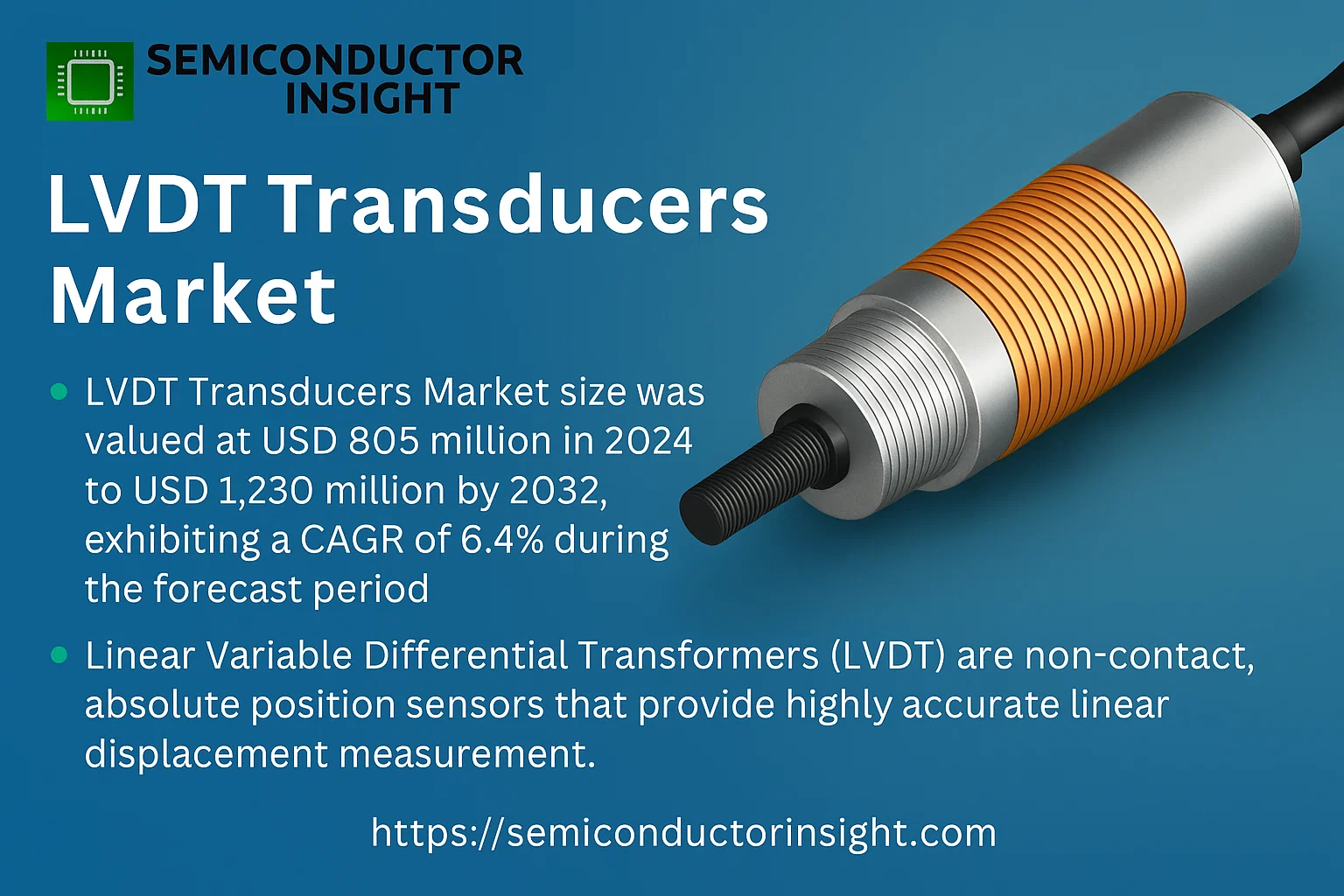
Global LVDT Transducers Market size was valued at USD 805 million in 2024 to USD 1,230 million by 2032, exhibiting a CAGR of 6.4% during the forecast period.
Linear Variable Differential Transformers (LVDT) are non-contact, absolute position sensors that provide highly accurate linear displacement measurement. These devices consist of a transformer assembly with primary and secondary windings, and a separate ferromagnetic core that moves freely along the transducer’s axis. LVDTs operate on electromagnetic principles to convert mechanical position into proportional electrical signals without physical contact between moving parts.
The market growth is primarily driven by increasing automation across industrial sectors, stringent quality control requirements in manufacturing, and growing adoption in aerospace and defense applications. While Europe currently dominates with over 30% market share, Asia-Pacific shows strong growth potential due to expanding industrial infrastructure. DC-type LVDTs account for approximately 60% of the market due to their simplified signal conditioning requirements. Key players including TE Connectivity, Honeywell, and Sensata Technologies collectively hold significant market share through continuous product innovation and strategic partnerships.
MARKET DRIVERS
Increasing Industrial Automation and Quality Control Demands
Global push towards Industry 4.0 and smart manufacturing is a primary driver for the LVDT Transducers Market. These devices are essential for high-precision position sensing and feedback in automated assembly lines, robotics, and CNC machinery. The need for stringent quality control and real-time monitoring in sectors like automotive and aerospace is fueling demand, as LVDTs offer reliable, repeatable measurements critical for maintaining production standards.
Expansion in Aerospace and Defense Applications
The aerospace and defense sector relies heavily on LVDT transducers for flight control systems, landing gear positioning, and actuator feedback due to their robustness and ability to operate in extreme environments. Increased defense spending globally and the development of new commercial aircraft programs are creating sustained demand. The high-reliability requirements in these applications make LVDTs the preferred choice over other sensor technologies.
➤ LVDT transducers are increasingly specified in safety-critical applications, which locks in their use for the long term and drives replacement and upgrade markets.
Furthermore, the superior performance characteristics of LVDTs, including infinite resolution, frictionless operation, and long-term reliability, continue to make them indispensable in applications where other sensor types fail. This inherent technical advantage ensures their continued adoption in mature and emerging markets alike.
Growth in Material Testing and Metrology
The material testing and metrology sector represents a significant growth area. LVDTs are widely used in universal testing machines to measure displacement and deformation with high accuracy. The expansion of construction, infrastructure development, and advanced material research globally is directly contributing to the increased procurement of testing equipment that incorporates LVDT transducers.
MARKET CHALLENGES
Competition from Alternative Sensor Technologies
A significant challenge for the LVDT transducer market is the growing competition from newer, often lower-cost, non-contact sensor technologies like laser displacement sensors, capacitive sensors, and magnetostrictive transducers. While LVDTs offer distinct advantages in certain environments, price sensitivity in cost-driven industries can lead to substitution, especially in applications where ultimate precision is not the primary concern.
Other Challenges
Technical Complexity and Calibration Requirements
The proper installation and calibration of LVDT systems require skilled technicians. Misalignment or improper setup can lead to measurement errors, potentially discouraging adoption in settings lacking specialized expertise. This creates a barrier to entry for some end-users and adds to the total cost of ownership.
High Initial Cost for High-Performance Models
While standard LVDTs are competitively priced, high-performance versions designed for extreme temperatures, high radiation, or miniature sizes carry a significant cost premium. This can limit their adoption in budget-constrained projects, despite their technical suitability.
MARKET RESTRAINTS
Maturation of Key End-Use Industries
The LVDT market is closely tied to capital investment in traditional heavy industries like automotive manufacturing and industrial machinery. Periods of economic uncertainty or slowdown in these mature sectors can lead to deferred capital expenditures, directly restraining the market growth for LVDT transducers, which are often part of large equipment purchases.
Supply Chain Vulnerabilities for Specialized Materials
The production of high-quality LVDTs relies on specific grades of magnetic alloys, precision-wound coils, and advanced electronics. Disruptions in the supply chain for these specialized materials, as witnessed during global events, can lead to increased lead times and component costs, acting as a restraint on market expansion and profitability for manufacturers.
MARKET OPPORTUNITIES
Adoption in Renewable Energy Systems
The renewable energy sector presents a substantial growth opportunity. LVDT transducers are used in hydraulic pitch control systems for wind turbines and in positioning systems for solar tracking arrays. Global acceleration in wind and solar power installation is driving demand for the reliable, durable sensors needed to maximize energy capture and ensure operational safety.
Development of Miniaturized and Wireless LVDTs
There is growing demand for miniature LVDTs for applications in medical devices, precision instrumentation, and compact machinery. Furthermore, the integration of wireless communication capabilities into LVDT systems opens up new applications in remote monitoring and hard-to-reach locations, such as subsea equipment and structural health monitoring of bridges and buildings.
Emergence of Predictive Maintenance
The rise of Industrial IoT (IIoT) and predictive maintenance strategies creates a significant opportunity. Integrating LVDT transducers with IIoT platforms allows for continuous condition monitoring of critical machinery. This enables the prediction of failures before they occur, reducing downtime and maintenance costs, which is a high-value proposition for industrial operators.
LVDT Transducers Market Trends
Steady Growth Driven by Key Industrial Applications
Global LVDT Transducers Market is on a trajectory of consistent expansion, with a valuation of USD805 million in 2024 projected to reach USD1230 million by 2032, representing a compound annual growth rate (CAGR) of 6.4%. This robust growth is fundamentally underpinned by the sensor’s reliable non-contact measurement capabilities for absolute position sensing. The demand is concentrated in industries requiring high precision and durability, such as Military/Aerospace, which represents the largest application segment. The market structure is consolidated, with the top three manufacturers—TE Connectivity, Honeywell, and Sensata Technologies (Kavlico)—collectively holding over 35% of Global market share, indicating a competitive landscape dominated by established, technologically advanced players.
Other Trends
Dominance of DC-Type LVDTs and Regional Market Leaders
A significant product trend is the clear dominance of DC-type LVDT transducers, which account for approximately 60% of the market. These sensors incorporate integrated signal conditioning electronics, offering a more straightforward interface and ease of use compared to AC-type variants. Geographically, Europe is the largest regional market, holding over 30% share, attributed to its strong industrial base and advanced manufacturing sectors. North America and China follow closely, together constituting about 45% of Global market. This regional concentration highlights the correlation between market maturity, industrial automation levels, and the adoption of high-precision measurement technologies.
Application-Specific Demand and Future Prospects
Beyond the leading Military/Aerospace sector, other critical applications like Power Generation and Petrochemical industries are key drivers. In power generation, LVDTs are essential for monitoring turbine and valve positions, while in petrochemical applications, they ensure the safe and precise operation of machinery in harsh environments. The automotive industry also represents a growing application area, utilizing LVDTs in testing and precision assembly. The continued focus on industrial automation, quality control, and safety across these diverse sectors ensures a positive long-term outlook for the LVDT Transducers Market, with innovation focused on enhancing accuracy, miniaturization, and integration capabilities.
COMPETITIVE LANDSCAPE
Key Industry Players
Market Dominated by Global Industrial and Sensing Giants
Global LVDT Transducers Market is characterized by the presence of several established international players, with the top three manufacturers collectively holding over 35% of the market share. TE Connectivity, Honeywell, and Sensata Technologies (through its Kavlico brand) are recognized as the dominant forces, leveraging their extensive global distribution networks, strong brand recognition, and significant investment in research and development. These companies offer a wide portfolio of high-precision LVDT sensors catering to demanding applications in military/aerospace and industrial sectors. The market structure is moderately consolidated, with competition primarily based on product precision, reliability, long-term stability, and the ability to provide customized solutions for specific client needs, particularly in critical measurement applications.
Beyond the market leaders, a tier of significant niche and specialized manufacturers also holds considerable sway. Companies such as AMETEK, Curtiss-Wright, and Micro-Epsilon have carved out strong positions by focusing on high-performance segments, offering LVDTs with exceptional accuracy, ruggedness, or miniaturization. Regional players and specialists like WayCon Positionsmesstechnik in Europe and Sensonics in the UK serve specific geographic or application-specific markets, often competing on superior customer service and technical support. The competitive environment is further intensified by technological advancements, with manufacturers continuously innovating to integrate advanced electronics for improved signal conditioning and digital output capabilities.
List of Key LVDT Transducers Companies Profiled
- TE Connectivity
- Honeywell
- Sensata Technologies (Kavlico)
- AMETEK
- Curtiss-Wright
- Micro-Epsilon
- Meggitt (Sensorex)
- Hoffmann + Krippner (Inelta)
- G.W. Lisk Company
- OMEGA (Spectris)
- Sensonics
- Monitran
- WayCon Positionsmesstechnik
- Active Sensors
- LORD Corporation
Segment Analysis:
| Segment Category | Sub-Segments | Key Insights |
| By Type |
|
DC Type is the unequivocal market leader due to its integrated signal conditioning electronics, which simplifies system integration and reduces the external component count for end-users. The self-contained nature of DC LVDTs provides superior ease of installation and operational reliability, making them the preferred choice across a wide array of industrial applications. In contrast, AC Type transducers, while still valued for specific high-performance scenarios requiring external signal processing, face relative constraints in adoption due to their more complex implementation requirements, which can involve additional hardware and expertise. |
| By Application |
|
Military/Aerospace represents the dominant application segment, driven by the uncompromising demand for high-precision, rugged, and reliable position sensing in critical systems such as flight control actuators, landing gear, and engine controls. The stringent performance and safety standards inherent to this sector create a sustained and high-value market for LVDT transducers. Other segments, including Power Generation and Petrochemical, also demonstrate significant demand, particularly for monitoring and control in harsh operational environments, while the Automotive Industry leverages LVDTs for advanced testing, validation, and manufacturing processes. |
| By End User |
|
OEMs (Original Equipment Manufacturers) constitute the most significant end-user segment, as they integrate LVDT transducers directly into new machinery, industrial equipment, and high-tech systems during the production phase. Their demand is characterized by high volume purchases and long-term supply partnerships, focusing on consistency, quality, and technical support. System Integrators play a crucial role in creating custom solutions for specific applications, while Maintenance & Service providers drive the aftermarket through replacement and upgrade cycles, ensuring the longevity and performance of existing systems that rely on these precision sensors. |
| By Technology Integration |
|
Standalone LVDT Sensors currently lead the market, serving as the fundamental component for a vast range of position measurement tasks due to their proven reliability and straightforward analog output. However, there is a clear and accelerating trend towards more integrated solutions. LVDT-based Measurement Systems, which bundle the transducer with signal conditioners and displays, offer a complete, ready-to-use package. The emergence of Smart LVDTs with Digital Interfaces represents a pivotal growth frontier, providing features like digital communication protocols (e.g., IO-Link, CANopen) that enable enhanced diagnostics, easier integration with industrial networks, and improved data accessibility for modern smart factories. |
| By Performance Specification |
|
Standard Precision LVDTs form the bulk of the market, adequately meeting the requirements for general industrial automation and control applications where extreme accuracy is not the primary concern. Nevertheless, the High Precision segment commands significant value and attention, driven by needs in metrology, scientific research, and critical aerospace components where sub-micron resolution and exceptional linearity are non-negotiable. The Ruggedized/High-Temperature segment is essential for deployment in extreme environments like turbine monitoring, downhole drilling, and heavy industrial processes, where sensors must maintain performance under intense vibration, shock, and thermal stress, creating a specialized and high-barrier niche. |
Regional Analysis: LVDT Transducers Market
The region is a hub for R&D, with companies continuously developing next-generation LVDTs with improved accuracy, miniaturization, and compatibility with Industry 4.0 protocols like IoT connectivity. This focus on innovation keeps North American products at the forefront of global standards and creates demand for upgrades.
Demand from leading aerospace OEMs and defense contractors for applications in aircraft actuation, landing gear testing, and satellite component positioning provides a stable, high-value market segment. This sector’s rigorous quality requirements favor established, high-reliability LVDT suppliers concentrated in the region.
Widespread adoption of automated manufacturing processes across automotive, electronics, and heavy machinery industries creates consistent demand for LVDTs in quality control, robotics, and process monitoring. This mature market understands the value of precision measurement for efficiency and product quality.
Strict regulations in nuclear power, medical devices, and other critical industries mandate the use of certified and highly accurate sensors. North American standard-setting bodies influence global specifications, giving local manufacturers a first-mover advantage in developing compliant LVDT solutions.
Europe
Europe represents a highly sophisticated and diverse market for LVDT transducers, characterized by a strong manufacturing base, particularly in Germany, and a focus on high-precision engineering. The automotive industry is a major consumer, with German automakers leading in the integration of LVDTs for engine testing, suspension systems, and crash test analysis. The region’s burgeoning renewable energy sector, especially wind power, relies on LVDTs for monitoring blade pitch and structural health of turbines. Furthermore, a well-established aerospace sector in countries like France and the UK provides significant demand. The market is influenced by stringent EU-wide regulations and a strong emphasis on quality and durability, which aligns perfectly with the inherent strengths of LVDT technology. Competition is intense, with several specialized manufacturers catering to niche, high-value applications.
Asia-Pacific
The Asia-Pacific region is the fastest-growing market for LVDT transducers, propelled by rapid industrialization, expansive manufacturing capabilities, and significant infrastructure development. China is the dominant force, with its massive industrial output creating substantial demand for displacement sensors in factory automation, metal forming, and machinery. Japan and South Korea contribute with their advanced automotive and electronics sectors, requiring high-precision LVDTs for quality control and R&D. The region is also witnessing growth in new application areas such as electric vehicle manufacturing and semiconductor production equipment. While price sensitivity is higher compared to Western markets, the sheer scale of industrial activity and government initiatives promoting smart manufacturing ensure robust growth, making it a critical region for future market expansion.
South America
The LVDT transducer market in South America is more niche and developing, with growth heavily tied to specific industrial and resource-based sectors. Brazil is the largest market, where demand is primarily driven by the automotive industry, agricultural machinery manufacturing, and the oil & gas sector for downhole tool positioning and refinery processes. Mining operations in Chile and Peru also utilize LVDTs for equipment monitoring. The market faces challenges such as economic volatility and lower rates of industrial automation adoption compared to other regions. However, potential for growth exists in modernization projects and the gradual uptake of advanced manufacturing technologies, though the market remains significantly smaller and less diversified than its global counterparts.
Middle East & Africa
The Middle East & Africa region presents a mixed but emerging landscape for the LVDT Transducers Market. The Gulf Cooperation Council (GCC) countries, particularly those with economic diversification plans like Saudi Arabia and the UAE, are seeing increased demand driven by growing manufacturing sectors, aerospace MRO (Maintenance, Repair, and Overhaul) activities, and large-scale infrastructure projects. The oil & gas industry remains a consistent, though traditional, user of LVDTs for drilling and extraction equipment. In Africa, the market is nascent, with limited industrial bases, though South Africa shows some activity in mining and heavy engineering. Overall, the region’s market is characterized by high growth potential linked to economic diversification, but it currently represents a smaller portion of Global total.
Report Scope
This market research report provides a comprehensive analysis of the LVDT Transducers Market, covering the forecast period 2025–2032. It offers detailed insights into market dynamics, technological advancements, competitive landscape, and key trends shaping the industry.
Key focus areas of the report include:
- Market Overview: The report begins with an overview outlining its current market scenario, key growth indicators, and industry transformation drivers. It discusses macroeconomic factors, demand–supply balance, regulatory landscape, and the strategic role of semiconductors in powering advancements across industries such as automotive, telecommunications, consumer electronics, and industrial automation.
- Market Size & Forecast: Historical data and future projections for revenue, unit shipments, and market value across major regions and segments.
- Segmentation Analysis: Detailed breakdown by product type, technology, application, and end-user industry to identify high-growth segments and investment opportunities.
- Regional Insights: Insights into market performance across North America, Europe, Asia-Pacific, Latin America, and the Middle East & Africa, including country-level analysis where relevant.
- Competitive Landscape: Profiles of leading market participants, including their product offerings, R&D focus, manufacturing capacity, pricing strategies, and recent developments such as mergers, acquisitions, and partnerships.
- Technology Trends & Innovation: Assessment of emerging technologies, integration of AI/IoT, semiconductor design trends, fabrication techniques, and evolving industry standards.
- Market Drivers & Restraints: Evaluation of factors driving market growth along with challenges, supply chain constraints, regulatory issues, and market-entry barriers.
- Stakeholder Insights: Insights for component suppliers, OEMs, system integrators, investors, and policymakers regarding the evolving ecosystem and strategic opportunities.
Primary and secondary research methods are employed, including interviews with industry experts, data from verified sources, and real-time market intelligence to ensure the accuracy and reliability of the insights presented.
FREQUENTLY ASKED QUESTIONS:
What is the current market size of LVDT Transducers Market?
-> Global LVDT Transducers Market was valued at USD 805 million in 2024 and is projected to reach USD 1230 million by 2032, exhibiting a CAGR of 6.4% during the forecast period.
Which key companies operate in LVDT Transducers Market?
-> Key players include TE Connectivity, Honeywell, Sensata Technologies (Kavlico), AMETEK, and Curtiss-Wright, among others. Global top three manufacturers hold a share over 35%.
What are the key growth drivers?
-> Key growth is driven by demand from key applications such as Military/Aerospace, Power Generation, and Petrochemical industries, alongside technological advancements in sensor technology.
Which region dominates the market?
-> Europe is the largest market, with a share over 30%, followed by North America and China, which together hold about a 45% share.
What are the emerging trends?
-> Emerging trends include the continued dominance of DC Type LVDTs, which hold about a 60% market share, and increasing integration of signal conditioning electronics within sensor designs.

Get Sample Report PDF for Exclusive Insights
Report Sample Includes
- Table of Contents
- List of Tables & Figures
- Charts, Research Methodology, and more...


