Low Power Radar Sensor Market, Trends, Business Strategies 2025-2032

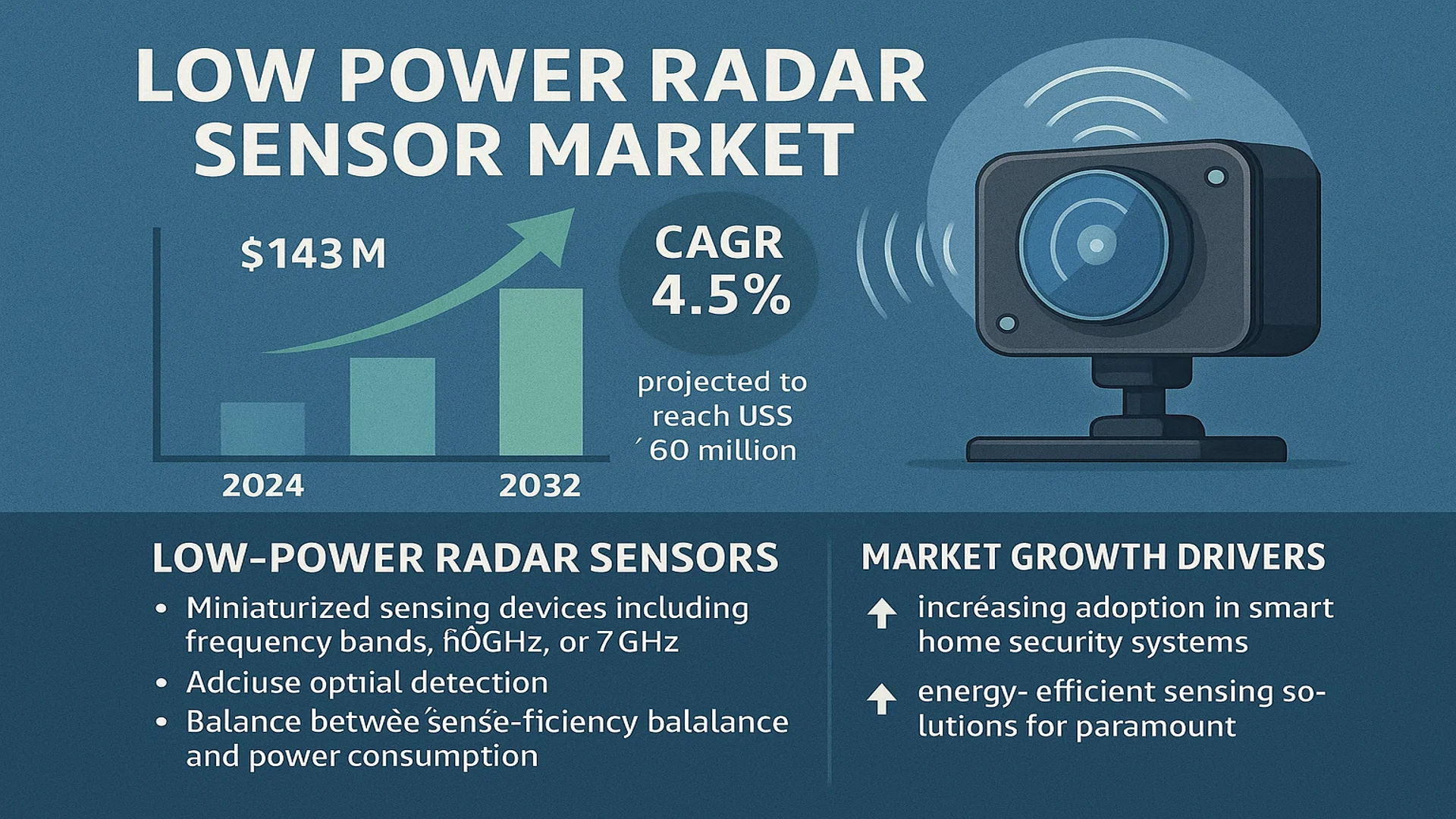
Low Power Radar Sensor market was valued at 143 million in 2024 and is projected to reach US$ 200 million by 2032, at a CAGR of 4.5% during the forecast period

PDF Icon Download Sample Report PDF
  • Quick Dispatch

    All Orders

  • Secure Payment

    100% Secure Payment

Price range: $1,500.00 through $4,250.00

Clear

MARKET INSIGHTS

The global Low Power Radar Sensor market was valued at 143 million in 2024 and is projected to reach US$ 200 million by 2032, at a CAGR of 4.5% during the forecast period.

Low-power radar sensors are miniaturized sensing devices that use electromagnetic waves for target detection while maintaining energy efficiency. These sensors operate across frequency bands including 24GHz, 60GHz, and 77GHz, offering advantages such as non-contact detection, environmental robustness, and privacy preservation. Their core value lies in achieving optimal balance between sensing accuracy and power consumption, making them ideal for IoT applications, smart homes, industrial automation, and autonomous vehicles.

The market growth is driven by increasing adoption in smart home security systems and industrial IoT applications, where energy-efficient sensing solutions are paramount. While North America currently leads in market share, Asia-Pacific shows the highest growth potential due to rapid industrialization and smart city initiatives. Key players like Infineon, NXP, and Texas Instruments are driving innovation through compact, low-power radar solutions, with the millimeter wave radar segment expected to dominate through 2032.
Low Power Radar Sensor market

MARKET DYNAMICS

MARKET DRIVERS

Rising Adoption of IoT and Smart Devices to Accelerate Market Expansion

The proliferation of Internet of Things (IoT) applications across industries is creating substantial demand for low-power radar sensors. These sensors play a pivotal role in enabling real-time object detection and motion sensing while maintaining energy efficiency—a critical requirement for battery-operated IoT devices. Markets like smart homes, industrial automation, and healthcare extensively utilize 24GHz and 60GHz radar sensors for applications ranging from occupancy detection to gesture recognition. With the global IoT market growing rapidly, this trend is expected to drive sensor adoption further.

Advancements in Autonomous Driving Technologies Fuel Market Demand

Autonomous vehicles rely heavily on radar sensors for obstacle detection, collision avoidance, and adaptive cruise control—particularly 77GHz millimeter-wave radar. Given regulatory pushes worldwide for autonomous vehicle testing and deployment, automakers are integrating low-power, high-precision radar systems to meet safety standards while optimizing energy consumption. Major automotive manufacturers are collaborating with radar sensor providers to develop next-gen solutions, reinforcing market growth prospects over the forecast period.

Government Regulations Promoting Energy Efficiency Bolster Adoption

Stringent government policies mandating energy-efficient technologies across electronics and automotive sectors are compelling manufacturers to adopt low-power radar sensors. Regulatory frameworks in regions like the European Union and North America emphasize minimizing power consumption in consumer and industrial devices without compromising functionality. This regulatory alignment not only accelerates innovation but also drives market penetration as companies strive to comply with sustainability targets. Consequently, sensor manufacturers are focusing on optimizing power efficiency to align with these global standards.

MARKET RESTRAINTS

High Development Costs and Complexity Limit Widespread Adoption

Despite their advantages, low-power radar sensors face barriers due to high R&D expenditures and intricate design requirements. Developing sensors that balance power efficiency, accuracy, and affordability demands substantial investment in semiconductor technologies and signal processing algorithms. Smaller enterprises often struggle with these financial and technical hurdles, which slows down broader market penetration.

Product Integration Challenges
Integrating radar sensors into existing systems can be complex due to electromagnetic interference and calibration issues. Achieving seamless compatibility with diverse IoT and automotive platforms requires meticulous engineering, which increases time-to-market and overall costs. These integration complexities pose significant challenges for manufacturers and end-users alike.

MARKET CHALLENGES

Shortage of Skilled Workforce Impacts Innovation and Production

The rapid evolution of radar sensor technology has led to a growing demand for specialized engineers proficient in RF design and embedded systems. However, the industry faces a shortage of skilled professionals, particularly in emerging economies. This talent gap hampers innovation and scalability, limiting manufacturers’ ability to meet surging demand.

Supply Chain Vulnerabilities
Geopolitical tensions and semiconductor shortages have exposed vulnerabilities in the radar sensor supply chain. Dependence on limited sources for critical components like MMICs (Monolithic Microwave Integrated Circuits) disrupts production timelines, creating bottlenecks for market growth.

MARKET OPPORTUNITIES

Expansion into Emerging Markets Offers Untapped Potential

Developing economies in Asia-Pacific and Latin America present lucrative opportunities due to rising investments in smart infrastructure and Industry 4.0 initiatives. Governments in these regions are increasingly supporting local manufacturing of sensor technologies, providing growth avenues for global players through partnerships and collaborations.

Innovations in Healthcare Applications Open New Revenue Streams

Healthcare applications such as remote patient monitoring and fall detection systems are emerging as promising sectors for low-power radar sensors. Non-invasive sensing capabilities enable continuous health tracking without compromising patient privacy—a key advantage over traditional camera-based systems.

LOW POWER RADAR SENSOR MARKET TRENDS

Rising Demand in IoT and Smart Home Applications Fuels Market Growth

The integration of low-power radar sensors into IoT and smart home applications is a primary driver for market expansion. With the global smart home market expected to grow at a CAGR of over 10% between 2024 and 2032, the demand for energy-efficient sensing solutions has surged. These sensors enable precise motion detection, presence sensing, and gesture recognition while consuming minimal power – critical for battery-operated IoT devices. Advancements in 60GHz millimeter-wave radar technology have improved detection accuracy to sub-millimeter levels while reducing false triggers, making them ideal for security systems, lighting automation, and elderly care monitoring.

Other Trends

Autonomous Driving Adoption Accelerates

The automotive sector is increasingly adopting low-power radar sensors for autonomous driving applications, particularly in short-range detection. With over 30 million vehicles expected to feature some level of autonomy by 2025, 77GHz radar sensors are becoming essential for blind spot detection, parking assistance, and low-speed collision avoidance systems. The combination of reduced power consumption (often below 100mW) and high environmental resistance makes these sensors preferable to camera-based alternatives in adverse weather conditions.

Energy Efficiency Becomes Critical Design Factor

Manufacturers are prioritizing ultra-low power consumption designs to extend battery life in portable and wireless applications. Recent innovations have reduced average power consumption below 1mW for intermittent sensing applications, a 60% improvement since 2020. This aligns with global sustainability initiatives and the need for maintenance-free operation in industrial IoT deployments. The medical sector particularly benefits from these advancements, utilizing low-power radar for contactless vital sign monitoring with unprecedented 98% accuracy in clinical trials.

Miniaturization and Chip Integration Drive Innovation

The market is witnessing rapid miniaturization, with leading manufacturers introducing single-chip radar solutions that combine RF, mixed-signal processing and microcontroller functions. This integration has reduced device footprints by 75% compared to 2019 solutions while improving performance. Such advancements are enabling new use cases in wearable devices and augmented reality systems where space constraints previously limited radar technology adoption. The growing demand for mmWave radar in 5G infrastructure and industrial automation further demonstrates the expanding applications across frequency bands.

COMPETITIVE LANDSCAPE

Key Industry Players

Market Leaders Address Rising Demand for AIoT Applications Through Innovation

The global low power radar sensor market exhibits a competitive yet dynamic structure with a mix of established semiconductor giants and specialized sensor manufacturers. As the industry shifts toward energy-efficient sensing solutions for smart applications, companies are aggressively expanding their technical capabilities and product portfolios. Infineon Technologies leads the market with its comprehensive 24GHz and 60GHz radar chip solutions, capturing a significant share due to early adoption in automotive and industrial IoT sectors.

Texas Instruments (TI) and NXP Semiconductors follow closely, leveraging their analog expertise to deliver radar sensors with sub-1mW power consumption. These players dominate the North American and European markets, where stringent energy regulations drive demand for ultra-low-power devices. Their strength lies in high-precision millimeter-wave radar solutions that balance performance with power efficiency—a critical requirement for battery-operated IoT edge devices.

Recent developments highlight strategic moves by mid-tier competitors: Acconeer recently launched the A111 pulsed radar sensor with 70% lower energy consumption than previous generations, while Socionext partnered with key Japanese automakers to develop 77GHz radar modules for L2+ autonomous vehicles. Such innovations are reshaping competitive dynamics as companies vie for leadership in niche applications.

Meanwhile, Chinese manufacturers like Calterah and Hisilicon are gaining traction through cost-optimized solutions tailored for smart home and surveillance markets. Their focus on localized production and government-backed R&D initiatives positions them strongly in the Asia-Pacific region, where demand grows at nearly 7% CAGR—outpacing global averages.

List of Key Low Power Radar Sensor Companies Profiled

Segment Analysis:

By Type

Millimeter Wave Radar Segment Leads the Market Due to Enhanced Accuracy in Short-Range Detection

The market is segmented based on type into:

  • Millimeter Wave Radar
  • Ultra-wideband Radar
  • Others

By Application

Smart Home Segment Gains Traction Due to Increasing Demand for Contactless Sensing Solutions

The market is segmented based on application into:

  • Medical
  • Industrial Internet of Things
  • Smart Home
  • Autonomous Driving
  • Others

By Frequency Band

24GHz Band Remains Popular Due to Cost-Effectiveness and Wide Industry Adoption

The market is segmented based on frequency band into:

  • 24GHz
  • 60GHz
  • 77GHz

By Detection Range

Short-Range Sensors Dominate the Market for Smart Home and IoT Applications

The market is segmented based on detection range into:

  • Short-range (less than 10m)
  • Medium-range (10m-50m)
  • Long-range (above 50m)

Regional Analysis: Low Power Radar Sensor Market

Asia-Pacific
The Asia-Pacific region dominates the low-power radar sensor market, driven by China’s rapid IoT adoption, smart city initiatives, and India’s growing industrial automation sector. China accounted for over 40% of regional demand in 2024, with millimeter-wave radar sensors gaining traction in autonomous vehicle trials and smart home applications. Japan and South Korea contribute through advanced manufacturing ecosystems, particularly in 60GHz sensor development for contactless healthcare monitoring. While cost sensitivity remains a factor, government mandates for intelligent transportation systems and factory automation are accelerating market penetration. However, uneven regulatory standards across Southeast Asian nations create fragmented adoption patterns.

North America
North America leads in high-value radar sensor applications, particularly in medical devices and premium smart home systems. The U.S. accounts for 85% of regional market share, fueled by FDA-approved radar-based patient monitoring solutions and robust R&D investments from semiconductor giants like Texas Instruments. Automotive testbeds in Michigan and California are driving 77GHz sensor innovation for L2+ autonomous vehicles. Stringent FCC frequency regulations ensure product reliability, though compliance costs limit SME participation. Canada’s emerging mining and logistics automation sectors present new opportunities for ultra-wideband radar deployment in harsh environments.

Europe
Europe maintains strong positions in privacy-centric radar solutions, with German and French manufacturers pioneering 24GHz sensors for GDPR-compliant occupancy detection. The region’s focus on industrial IoT sees widespread radar adoption in predictive maintenance systems, particularly in Benelux manufacturing hubs. EU funding programs like Horizon Europe support next-gen sensor research, with automotive-tier suppliers integrating low-power radar into Euro NCAP safety systems. However, spectrum allocation disputes between 24GHz and 77GHz bands create temporary market uncertainties. The Nordic countries excel in energy-efficient radar designs for smart building applications, leveraging their leadership in wireless technologies.

Middle East & Africa
The MEA market shows nascent but strategic growth, with smart city projects in UAE and Saudi Arabia deploying radar sensors for traffic management and infrastructure monitoring. Israel’s thriving defense sector is adapting military-grade radar tech for commercial low-power applications. While market penetration remains below 10% of global volumes, mega-projects like NEOM are creating demand for environmental sensing solutions. Africa’s market growth is hindered by limited local manufacturing capabilities, though South Africa’s mining sector demonstrates increasing adoption of radar-based equipment monitoring systems. Regional players face challenges in balancing cost constraints with the need for dust-resistant and high-temperature sensor variants.

South America
South America represents an emerging opportunity, with Brazil’s agritech sector utilizing radar sensors for precision farming and grain silo monitoring. Argentina shows potential in industrial safety applications, where non-contact sensors prevent equipment accidents. The region suffers from import dependency for advanced sensor modules, though local assembly partnerships are gradually forming. Economic instabilities in key markets delay large-scale deployments, while lack of standardized frequency allocations complicates cross-border product development. Nonetheless, growing smart meter installations and mining automation investments are driving steady demand for basic motion detection sensors across the region.

Report Scope

This market research report provides a comprehensive analysis of the Global Low Power Radar Sensor Market, covering the forecast period 2024–2032. It offers detailed insights into market dynamics, technological advancements, competitive landscape, and key trends shaping the industry.

Key focus areas of the report include:

  • Market Size & Forecast: Historical data and future projections for revenue, unit shipments, and market value across major regions and segments. The market was valued at USD 143 million in 2024 and is projected to reach USD 200 million by 2032, growing at a CAGR of 4.5%.
  • Segmentation Analysis: Detailed breakdown by product type (Millimeter Wave Radar, Ultra-wideband Radar, Others), application (Medical, Industrial IoT, Smart Home, Autonomous Driving), and end-user industry to identify high-growth segments.
  • Regional Outlook: Insights into market performance across North America, Europe, Asia-Pacific, Latin America, and Middle East & Africa. The U.S. and China are key markets with significant growth potential.
  • Competitive Landscape: Profiles of leading market participants including Infineon, TI, NXP, Acconeer, and Socionext, covering their product portfolios, R&D investments, and strategic initiatives.
  • Technology Trends: Assessment of emerging radar technologies across 24GHz, 60GHz, and 77GHz frequency bands, AI integration, and miniaturization trends.
  • Market Drivers & Restraints: Analysis of factors such as IoT adoption, smart home demand, and industrial automation growth versus challenges like regulatory constraints and supply chain complexities.
  • Stakeholder Analysis: Strategic insights for sensor manufacturers, OEMs, system integrators, and investors regarding market opportunities and competitive positioning.

The research employs primary and secondary methodologies, including expert interviews, manufacturer surveys, and analysis of verified market data to ensure accuracy and reliability.

FREQUENTLY ASKED QUESTIONS:

What is the current market size of Global Low Power Radar Sensor Market?

-> Low Power Radar Sensor market was valued at 143 million in 2024 and is projected to reach US$ 200 million by 2032, at a CAGR of 4.5% during the forecast period.

Which companies lead the Low Power Radar Sensor Market?

-> Key players include Infineon, Texas Instruments, NXP Semiconductors, Acconeer, and Socionext, collectively holding significant market share.

What are the primary growth drivers?

-> Major drivers include rising IoT adoption, smart home automation trends, industrial 4.0 implementations, and autonomous vehicle development.

Which region shows strongest growth potential?

-> Asia-Pacific exhibits the highest growth rate, driven by China’s manufacturing expansion and IoT deployment, while North America leads in technological innovation.

What are the emerging technology trends?

-> Emerging trends include 77GHz radar adoption, AI-enhanced signal processing, ultra-low power designs, and multi-sensor fusion technologies.

Low Power Radar Sensor Market, Trends, Business Strategies 2025-2032

Get Sample Report PDF for Exclusive Insights

Report Sample Includes

  • Table of Contents
  • List of Tables & Figures
  • Charts, Research Methodology, and more...

PDF Icon Download Sample Report PDF
SKU: aaa009a7aab9
Category:

Download Sample Report

Table of Content

1 Introduction to Research & Analysis Reports
1.1 Low Power Radar Sensor Market Definition
1.2 Market Segments
1.2.1 Segment by Type
1.2.2 Segment by Application
1.3 Global Low Power Radar Sensor Market Overview
1.4 Features & Benefits of This Report
1.5 Methodology & Sources of Information
1.5.1 Research Methodology
1.5.2 Research Process
1.5.3 Base Year
1.5.4 Report Assumptions & Caveats
2 Global Low Power Radar Sensor Overall Market Size
2.1 Global Low Power Radar Sensor Market Size: 2024 VS 2032
2.2 Global Low Power Radar Sensor Market Size, Prospects & Forecasts: 2020-2032
2.3 Global Low Power Radar Sensor Sales: 2020-2032
3 Company Landscape
3.1 Top Low Power Radar Sensor Players in Global Market
3.2 Top Global Low Power Radar Sensor Companies Ranked by Revenue
3.3 Global Low Power Radar Sensor Revenue by Companies
3.4 Global Low Power Radar Sensor Sales by Companies
3.5 Global Low Power Radar Sensor Price by Manufacturer (2020-2025)
3.6 Top 3 and Top 5 Low Power Radar Sensor Companies in Global Market, by Revenue in 2024
3.7 Global Manufacturers Low Power Radar Sensor Product Type
3.8 Tier 1, Tier 2, and Tier 3 Low Power Radar Sensor Players in Global Market
3.8.1 List of Global Tier 1 Low Power Radar Sensor Companies
3.8.2 List of Global Tier 2 and Tier 3 Low Power Radar Sensor Companies
4 Sights by Product
4.1 Overview
4.1.1 Segment by Type – Global Low Power Radar Sensor Market Size Markets, 2024 & 2032
4.1.2 Millimeter Wave Radar
4.1.3 Ultra-wideband Radar
4.1.4 Other
4.2 Segment by Type – Global Low Power Radar Sensor Revenue & Forecasts
4.2.1 Segment by Type – Global Low Power Radar Sensor Revenue, 2020-2025
4.2.2 Segment by Type – Global Low Power Radar Sensor Revenue, 2026-2032
4.2.3 Segment by Type – Global Low Power Radar Sensor Revenue Market Share, 2020-2032
4.3 Segment by Type – Global Low Power Radar Sensor Sales & Forecasts
4.3.1 Segment by Type – Global Low Power Radar Sensor Sales, 2020-2025
4.3.2 Segment by Type – Global Low Power Radar Sensor Sales, 2026-2032
4.3.3 Segment by Type – Global Low Power Radar Sensor Sales Market Share, 2020-2032
4.4 Segment by Type – Global Low Power Radar Sensor Price (Manufacturers Selling Prices), 2020-2032
5 Sights by Application
5.1 Overview
5.1.1 Segment by Application – Global Low Power Radar Sensor Market Size, 2024 & 2032
5.1.2 Medical
5.1.3 Industrial Internet of Things
5.1.4 Smart Home
5.1.5 Autonomous Driving
5.1.6 Other
5.2 Segment by Application – Global Low Power Radar Sensor Revenue & Forecasts
5.2.1 Segment by Application – Global Low Power Radar Sensor Revenue, 2020-2025
5.2.2 Segment by Application – Global Low Power Radar Sensor Revenue, 2026-2032
5.2.3 Segment by Application – Global Low Power Radar Sensor Revenue Market Share, 2020-2032
5.3 Segment by Application – Global Low Power Radar Sensor Sales & Forecasts
5.3.1 Segment by Application – Global Low Power Radar Sensor Sales, 2020-2025
5.3.2 Segment by Application – Global Low Power Radar Sensor Sales, 2026-2032
5.3.3 Segment by Application – Global Low Power Radar Sensor Sales Market Share, 2020-2032
5.4 Segment by Application – Global Low Power Radar Sensor Price (Manufacturers Selling Prices), 2020-2032
6 Sights by Region
6.1 By Region – Global Low Power Radar Sensor Market Size, 2024 & 2032
6.2 By Region – Global Low Power Radar Sensor Revenue & Forecasts
6.2.1 By Region – Global Low Power Radar Sensor Revenue, 2020-2025
6.2.2 By Region – Global Low Power Radar Sensor Revenue, 2026-2032
6.2.3 By Region – Global Low Power Radar Sensor Revenue Market Share, 2020-2032
6.3 By Region – Global Low Power Radar Sensor Sales & Forecasts
6.3.1 By Region – Global Low Power Radar Sensor Sales, 2020-2025
6.3.2 By Region – Global Low Power Radar Sensor Sales, 2026-2032
6.3.3 By Region – Global Low Power Radar Sensor Sales Market Share, 2020-2032
6.4 North America
6.4.1 By Country – North America Low Power Radar Sensor Revenue, 2020-2032
6.4.2 By Country – North America Low Power Radar Sensor Sales, 2020-2032
6.4.3 United States Low Power Radar Sensor Market Size, 2020-2032
6.4.4 Canada Low Power Radar Sensor Market Size, 2020-2032
6.4.5 Mexico Low Power Radar Sensor Market Size, 2020-2032
6.5 Europe
6.5.1 By Country – Europe Low Power Radar Sensor Revenue, 2020-2032
6.5.2 By Country – Europe Low Power Radar Sensor Sales, 2020-2032
6.5.3 Germany Low Power Radar Sensor Market Size, 2020-2032
6.5.4 France Low Power Radar Sensor Market Size, 2020-2032
6.5.5 U.K. Low Power Radar Sensor Market Size, 2020-2032
6.5.6 Italy Low Power Radar Sensor Market Size, 2020-2032
6.5.7 Russia Low Power Radar Sensor Market Size, 2020-2032
6.5.8 Nordic Countries Low Power Radar Sensor Market Size, 2020-2032
6.5.9 Benelux Low Power Radar Sensor Market Size, 2020-2032
6.6 Asia
6.6.1 By Region – Asia Low Power Radar Sensor Revenue, 2020-2032
6.6.2 By Region – Asia Low Power Radar Sensor Sales, 2020-2032
6.6.3 China Low Power Radar Sensor Market Size, 2020-2032
6.6.4 Japan Low Power Radar Sensor Market Size, 2020-2032
6.6.5 South Korea Low Power Radar Sensor Market Size, 2020-2032
6.6.6 Southeast Asia Low Power Radar Sensor Market Size, 2020-2032
6.6.7 India Low Power Radar Sensor Market Size, 2020-2032
6.7 South America
6.7.1 By Country – South America Low Power Radar Sensor Revenue, 2020-2032
6.7.2 By Country – South America Low Power Radar Sensor Sales, 2020-2032
6.7.3 Brazil Low Power Radar Sensor Market Size, 2020-2032
6.7.4 Argentina Low Power Radar Sensor Market Size, 2020-2032
6.8 Middle East & Africa
6.8.1 By Country – Middle East & Africa Low Power Radar Sensor Revenue, 2020-2032
6.8.2 By Country – Middle East & Africa Low Power Radar Sensor Sales, 2020-2032
6.8.3 Turkey Low Power Radar Sensor Market Size, 2020-2032
6.8.4 Israel Low Power Radar Sensor Market Size, 2020-2032
6.8.5 Saudi Arabia Low Power Radar Sensor Market Size, 2020-2032
6.8.6 UAE Low Power Radar Sensor Market Size, 2020-2032
7 Manufacturers & Brands Profiles
7.1 Infineon
7.1.1 Infineon Company Summary
7.1.2 Infineon Business Overview
7.1.3 Infineon Low Power Radar Sensor Major Product Offerings
7.1.4 Infineon Low Power Radar Sensor Sales and Revenue in Global (2020-2025)
7.1.5 Infineon Key News & Latest Developments
7.2 TI
7.2.1 TI Company Summary
7.2.2 TI Business Overview
7.2.3 TI Low Power Radar Sensor Major Product Offerings
7.2.4 TI Low Power Radar Sensor Sales and Revenue in Global (2020-2025)
7.2.5 TI Key News & Latest Developments
7.3 Acconeer
7.3.1 Acconeer Company Summary
7.3.2 Acconeer Business Overview
7.3.3 Acconeer Low Power Radar Sensor Major Product Offerings
7.3.4 Acconeer Low Power Radar Sensor Sales and Revenue in Global (2020-2025)
7.3.5 Acconeer Key News & Latest Developments
7.4 Socionext
7.4.1 Socionext Company Summary
7.4.2 Socionext Business Overview
7.4.3 Socionext Low Power Radar Sensor Major Product Offerings
7.4.4 Socionext Low Power Radar Sensor Sales and Revenue in Global (2020-2025)
7.4.5 Socionext Key News & Latest Developments
7.5 NXP
7.5.1 NXP Company Summary
7.5.2 NXP Business Overview
7.5.3 NXP Low Power Radar Sensor Major Product Offerings
7.5.4 NXP Low Power Radar Sensor Sales and Revenue in Global (2020-2025)
7.5.5 NXP Key News & Latest Developments
7.6 Calterah
7.6.1 Calterah Company Summary
7.6.2 Calterah Business Overview
7.6.3 Calterah Low Power Radar Sensor Major Product Offerings
7.6.4 Calterah Low Power Radar Sensor Sales and Revenue in Global (2020-2025)
7.6.5 Calterah Key News & Latest Developments
7.7 KaiKuTeK
7.7.1 KaiKuTeK Company Summary
7.7.2 KaiKuTeK Business Overview
7.7.3 KaiKuTeK Low Power Radar Sensor Major Product Offerings
7.7.4 KaiKuTeK Low Power Radar Sensor Sales and Revenue in Global (2020-2025)
7.7.5 KaiKuTeK Key News & Latest Developments
7.8 AIRTOUCH
7.8.1 AIRTOUCH Company Summary
7.8.2 AIRTOUCH Business Overview
7.8.3 AIRTOUCH Low Power Radar Sensor Major Product Offerings
7.8.4 AIRTOUCH Low Power Radar Sensor Sales and Revenue in Global (2020-2025)
7.8.5 AIRTOUCH Key News & Latest Developments
7.9 Hisilicon
7.9.1 Hisilicon Company Summary
7.9.2 Hisilicon Business Overview
7.9.3 Hisilicon Low Power Radar Sensor Major Product Offerings
7.9.4 Hisilicon Low Power Radar Sensor Sales and Revenue in Global (2020-2025)
7.9.5 Hisilicon Key News & Latest Developments
8 Global Low Power Radar Sensor Production Capacity, Analysis
8.1 Global Low Power Radar Sensor Production Capacity, 2020-2032
8.2 Low Power Radar Sensor Production Capacity of Key Manufacturers in Global Market
8.3 Global Low Power Radar Sensor Production by Region
9 Key Market Trends, Opportunity, Drivers and Restraints
9.1 Market Opportunities & Trends
9.2 Market Drivers
9.3 Market Restraints
10 Low Power Radar Sensor Supply Chain Analysis
10.1 Low Power Radar Sensor Industry Value Chain
10.2 Low Power Radar Sensor Upstream Market
10.3 Low Power Radar Sensor Downstream and Clients
10.4 Marketing Channels Analysis
10.4.1 Marketing Channels
10.4.2 Low Power Radar Sensor Distributors and Sales Agents in Global
11 Conclusion
12 Appendix
12.1 Note
12.2 Examples of Clients
12.3 DisclaimerList of Tables
Table 1. Key Players of Low Power Radar Sensor in Global Market
Table 2. Top Low Power Radar Sensor Players in Global Market, Ranking by Revenue (2024)
Table 3. Global Low Power Radar Sensor Revenue by Companies, (US$, Mn), 2020-2025
Table 4. Global Low Power Radar Sensor Revenue Share by Companies, 2020-2025
Table 5. Global Low Power Radar Sensor Sales by Companies, (K Units), 2020-2025
Table 6. Global Low Power Radar Sensor Sales Share by Companies, 2020-2025
Table 7. Key Manufacturers Low Power Radar Sensor Price (2020-2025) & (US$/Unit)
Table 8. Global Manufacturers Low Power Radar Sensor Product Type
Table 9. List of Global Tier 1 Low Power Radar Sensor Companies, Revenue (US$, Mn) in 2024 and Market Share
Table 10. List of Global Tier 2 and Tier 3 Low Power Radar Sensor Companies, Revenue (US$, Mn) in 2024 and Market Share
Table 11. Segment by Type – Global Low Power Radar Sensor Revenue, (US$, Mn), 2024 & 2032
Table 12. Segment by Type – Global Low Power Radar Sensor Revenue (US$, Mn), 2020-2025
Table 13. Segment by Type – Global Low Power Radar Sensor Revenue (US$, Mn), 2026-2032
Table 14. Segment by Type – Global Low Power Radar Sensor Sales (K Units), 2020-2025
Table 15. Segment by Type – Global Low Power Radar Sensor Sales (K Units), 2026-2032
Table 16. Segment by Application – Global Low Power Radar Sensor Revenue, (US$, Mn), 2024 & 2032
Table 17. Segment by Application – Global Low Power Radar Sensor Revenue, (US$, Mn), 2020-2025
Table 18. Segment by Application – Global Low Power Radar Sensor Revenue, (US$, Mn), 2026-2032
Table 19. Segment by Application – Global Low Power Radar Sensor Sales, (K Units), 2020-2025
Table 20. Segment by Application – Global Low Power Radar Sensor Sales, (K Units), 2026-2032
Table 21. By Region – Global Low Power Radar Sensor Revenue, (US$, Mn), 2025-2032
Table 22. By Region – Global Low Power Radar Sensor Revenue, (US$, Mn), 2020-2025
Table 23. By Region – Global Low Power Radar Sensor Revenue, (US$, Mn), 2026-2032
Table 24. By Region – Global Low Power Radar Sensor Sales, (K Units), 2020-2025
Table 25. By Region – Global Low Power Radar Sensor Sales, (K Units), 2026-2032
Table 26. By Country – North America Low Power Radar Sensor Revenue, (US$, Mn), 2020-2025
Table 27. By Country – North America Low Power Radar Sensor Revenue, (US$, Mn), 2026-2032
Table 28. By Country – North America Low Power Radar Sensor Sales, (K Units), 2020-2025
Table 29. By Country – North America Low Power Radar Sensor Sales, (K Units), 2026-2032
Table 30. By Country – Europe Low Power Radar Sensor Revenue, (US$, Mn), 2020-2025
Table 31. By Country – Europe Low Power Radar Sensor Revenue, (US$, Mn), 2026-2032
Table 32. By Country – Europe Low Power Radar Sensor Sales, (K Units), 2020-2025
Table 33. By Country – Europe Low Power Radar Sensor Sales, (K Units), 2026-2032
Table 34. By Region – Asia Low Power Radar Sensor Revenue, (US$, Mn), 2020-2025
Table 35. By Region – Asia Low Power Radar Sensor Revenue, (US$, Mn), 2026-2032
Table 36. By Region – Asia Low Power Radar Sensor Sales, (K Units), 2020-2025
Table 37. By Region – Asia Low Power Radar Sensor Sales, (K Units), 2026-2032
Table 38. By Country – South America Low Power Radar Sensor Revenue, (US$, Mn), 2020-2025
Table 39. By Country – South America Low Power Radar Sensor Revenue, (US$, Mn), 2026-2032
Table 40. By Country – South America Low Power Radar Sensor Sales, (K Units), 2020-2025
Table 41. By Country – South America Low Power Radar Sensor Sales, (K Units), 2026-2032
Table 42. By Country – Middle East & Africa Low Power Radar Sensor Revenue, (US$, Mn), 2020-2025
Table 43. By Country – Middle East & Africa Low Power Radar Sensor Revenue, (US$, Mn), 2026-2032
Table 44. By Country – Middle East & Africa Low Power Radar Sensor Sales, (K Units), 2020-2025
Table 45. By Country – Middle East & Africa Low Power Radar Sensor Sales, (K Units), 2026-2032
Table 46. Infineon Company Summary
Table 47. Infineon Low Power Radar Sensor Product Offerings
Table 48. Infineon Low Power Radar Sensor Sales (K Units), Revenue (US$, Mn) and Average Price (US$/Unit) & (2020-2025)
Table 49. Infineon Key News & Latest Developments
Table 50. TI Company Summary
Table 51. TI Low Power Radar Sensor Product Offerings
Table 52. TI Low Power Radar Sensor Sales (K Units), Revenue (US$, Mn) and Average Price (US$/Unit) & (2020-2025)
Table 53. TI Key News & Latest Developments
Table 54. Acconeer Company Summary
Table 55. Acconeer Low Power Radar Sensor Product Offerings
Table 56. Acconeer Low Power Radar Sensor Sales (K Units), Revenue (US$, Mn) and Average Price (US$/Unit) & (2020-2025)
Table 57. Acconeer Key News & Latest Developments
Table 58. Socionext Company Summary
Table 59. Socionext Low Power Radar Sensor Product Offerings
Table 60. Socionext Low Power Radar Sensor Sales (K Units), Revenue (US$, Mn) and Average Price (US$/Unit) & (2020-2025)
Table 61. Socionext Key News & Latest Developments
Table 62. NXP Company Summary
Table 63. NXP Low Power Radar Sensor Product Offerings
Table 64. NXP Low Power Radar Sensor Sales (K Units), Revenue (US$, Mn) and Average Price (US$/Unit) & (2020-2025)
Table 65. NXP Key News & Latest Developments
Table 66. Calterah Company Summary
Table 67. Calterah Low Power Radar Sensor Product Offerings
Table 68. Calterah Low Power Radar Sensor Sales (K Units), Revenue (US$, Mn) and Average Price (US$/Unit) & (2020-2025)
Table 69. Calterah Key News & Latest Developments
Table 70. KaiKuTeK Company Summary
Table 71. KaiKuTeK Low Power Radar Sensor Product Offerings
Table 72. KaiKuTeK Low Power Radar Sensor Sales (K Units), Revenue (US$, Mn) and Average Price (US$/Unit) & (2020-2025)
Table 73. KaiKuTeK Key News & Latest Developments
Table 74. AIRTOUCH Company Summary
Table 75. AIRTOUCH Low Power Radar Sensor Product Offerings
Table 76. AIRTOUCH Low Power Radar Sensor Sales (K Units), Revenue (US$, Mn) and Average Price (US$/Unit) & (2020-2025)
Table 77. AIRTOUCH Key News & Latest Developments
Table 78. Hisilicon Company Summary
Table 79. Hisilicon Low Power Radar Sensor Product Offerings
Table 80. Hisilicon Low Power Radar Sensor Sales (K Units), Revenue (US$, Mn) and Average Price (US$/Unit) & (2020-2025)
Table 81. Hisilicon Key News & Latest Developments
Table 82. Low Power Radar Sensor Capacity of Key Manufacturers in Global Market, 2023-2025 (K Units)
Table 83. Global Low Power Radar Sensor Capacity Market Share of Key Manufacturers, 2023-2025
Table 84. Global Low Power Radar Sensor Production by Region, 2020-2025 (K Units)
Table 85. Global Low Power Radar Sensor Production by Region, 2026-2032 (K Units)
Table 86. Low Power Radar Sensor Market Opportunities & Trends in Global Market
Table 87. Low Power Radar Sensor Market Drivers in Global Market
Table 88. Low Power Radar Sensor Market Restraints in Global Market
Table 89. Low Power Radar Sensor Raw Materials
Table 90. Low Power Radar Sensor Raw Materials Suppliers in Global Market
Table 91. Typical Low Power Radar Sensor Downstream
Table 92. Low Power Radar Sensor Downstream Clients in Global Market
Table 93. Low Power Radar Sensor Distributors and Sales Agents in Global Market

List of Figures
Figure 1. Low Power Radar Sensor Product Picture
Figure 2. Low Power Radar Sensor Segment by Type in 2024
Figure 3. Low Power Radar Sensor Segment by Application in 2024
Figure 4. Global Low Power Radar Sensor Market Overview: 2024
Figure 5. Key Caveats
Figure 6. Global Low Power Radar Sensor Market Size: 2024 VS 2032 (US$, Mn)
Figure 7. Global Low Power Radar Sensor Revenue: 2020-2032 (US$, Mn)
Figure 8. Low Power Radar Sensor Sales in Global Market: 2020-2032 (K Units)
Figure 9. The Top 3 and 5 Players Market Share by Low Power Radar Sensor Revenue in 2024
Figure 10. Segment by Type – Global Low Power Radar Sensor Revenue, (US$, Mn), 2024 & 2032
Figure 11. Segment by Type – Global Low Power Radar Sensor Revenue Market Share, 2020-2032
Figure 12. Segment by Type – Global Low Power Radar Sensor Sales Market Share, 2020-2032
Figure 13. Segment by Type – Global Low Power Radar Sensor Price (US$/Unit), 2020-2032
Figure 14. Segment by Application – Global Low Power Radar Sensor Revenue, (US$, Mn), 2024 & 2032
Figure 15. Segment by Application – Global Low Power Radar Sensor Revenue Market Share, 2020-2032
Figure 16. Segment by Application – Global Low Power Radar Sensor Sales Market Share, 2020-2032
Figure 17. Segment by Application -Global Low Power Radar Sensor Price (US$/Unit), 2020-2032
Figure 18. By Region – Global Low Power Radar Sensor Revenue, (US$, Mn), 2025 & 2032
Figure 19. By Region – Global Low Power Radar Sensor Revenue Market Share, 2020 VS 2024 VS 2032
Figure 20. By Region – Global Low Power Radar Sensor Revenue Market Share, 2020-2032
Figure 21. By Region – Global Low Power Radar Sensor Sales Market Share, 2020-2032
Figure 22. By Country – North America Low Power Radar Sensor Revenue Market Share, 2020-2032
Figure 23. By Country – North America Low Power Radar Sensor Sales Market Share, 2020-2032
Figure 24. United States Low Power Radar Sensor Revenue, (US$, Mn), 2020-2032
Figure 25. Canada Low Power Radar Sensor Revenue, (US$, Mn), 2020-2032
Figure 26. Mexico Low Power Radar Sensor Revenue, (US$, Mn), 2020-2032
Figure 27. By Country – Europe Low Power Radar Sensor Revenue Market Share, 2020-2032
Figure 28. By Country – Europe Low Power Radar Sensor Sales Market Share, 2020-2032
Figure 29. Germany Low Power Radar Sensor Revenue, (US$, Mn), 2020-2032
Figure 30. France Low Power Radar Sensor Revenue, (US$, Mn), 2020-2032
Figure 31. U.K. Low Power Radar Sensor Revenue, (US$, Mn), 2020-2032
Figure 32. Italy Low Power Radar Sensor Revenue, (US$, Mn), 2020-2032
Figure 33. Russia Low Power Radar Sensor Revenue, (US$, Mn), 2020-2032
Figure 34. Nordic Countries Low Power Radar Sensor Revenue, (US$, Mn), 2020-2032
Figure 35. Benelux Low Power Radar Sensor Revenue, (US$, Mn), 2020-2032
Figure 36. By Region – Asia Low Power Radar Sensor Revenue Market Share, 2020-2032
Figure 37. By Region – Asia Low Power Radar Sensor Sales Market Share, 2020-2032
Figure 38. China Low Power Radar Sensor Revenue, (US$, Mn), 2020-2032
Figure 39. Japan Low Power Radar Sensor Revenue, (US$, Mn), 2020-2032
Figure 40. South Korea Low Power Radar Sensor Revenue, (US$, Mn), 2020-2032
Figure 41. Southeast Asia Low Power Radar Sensor Revenue, (US$, Mn), 2020-2032
Figure 42. India Low Power Radar Sensor Revenue, (US$, Mn), 2020-2032
Figure 43. By Country – South America Low Power Radar Sensor Revenue Market Share, 2020-2032
Figure 44. By Country – South America Low Power Radar Sensor Sales, Market Share, 2020-2032
Figure 45. Brazil Low Power Radar Sensor Revenue, (US$, Mn), 2020-2032
Figure 46. Argentina Low Power Radar Sensor Revenue, (US$, Mn), 2020-2032
Figure 47. By Country – Middle East & Africa Low Power Radar Sensor Revenue, Market Share, 2020-2032
Figure 48. By Country – Middle East & Africa Low Power Radar Sensor Sales, Market Share, 2020-2032
Figure 49. Turkey Low Power Radar Sensor Revenue, (US$, Mn), 2020-2032
Figure 50. Israel Low Power Radar Sensor Revenue, (US$, Mn), 2020-2032
Figure 51. Saudi Arabia Low Power Radar Sensor Revenue, (US$, Mn), 2020-2032
Figure 52. UAE Low Power Radar Sensor Revenue, (US$, Mn), 2020-2032
Figure 53. Global Low Power Radar Sensor Production Capacity (K Units), 2020-2032
Figure 54. The Percentage of Production Low Power Radar Sensor by Region, 2024 VS 2032
Figure 55. Low Power Radar Sensor Industry Value Chain
Figure 56. Marketing Channels