
Logic Level Shifters Market MARKET INSIGHTS
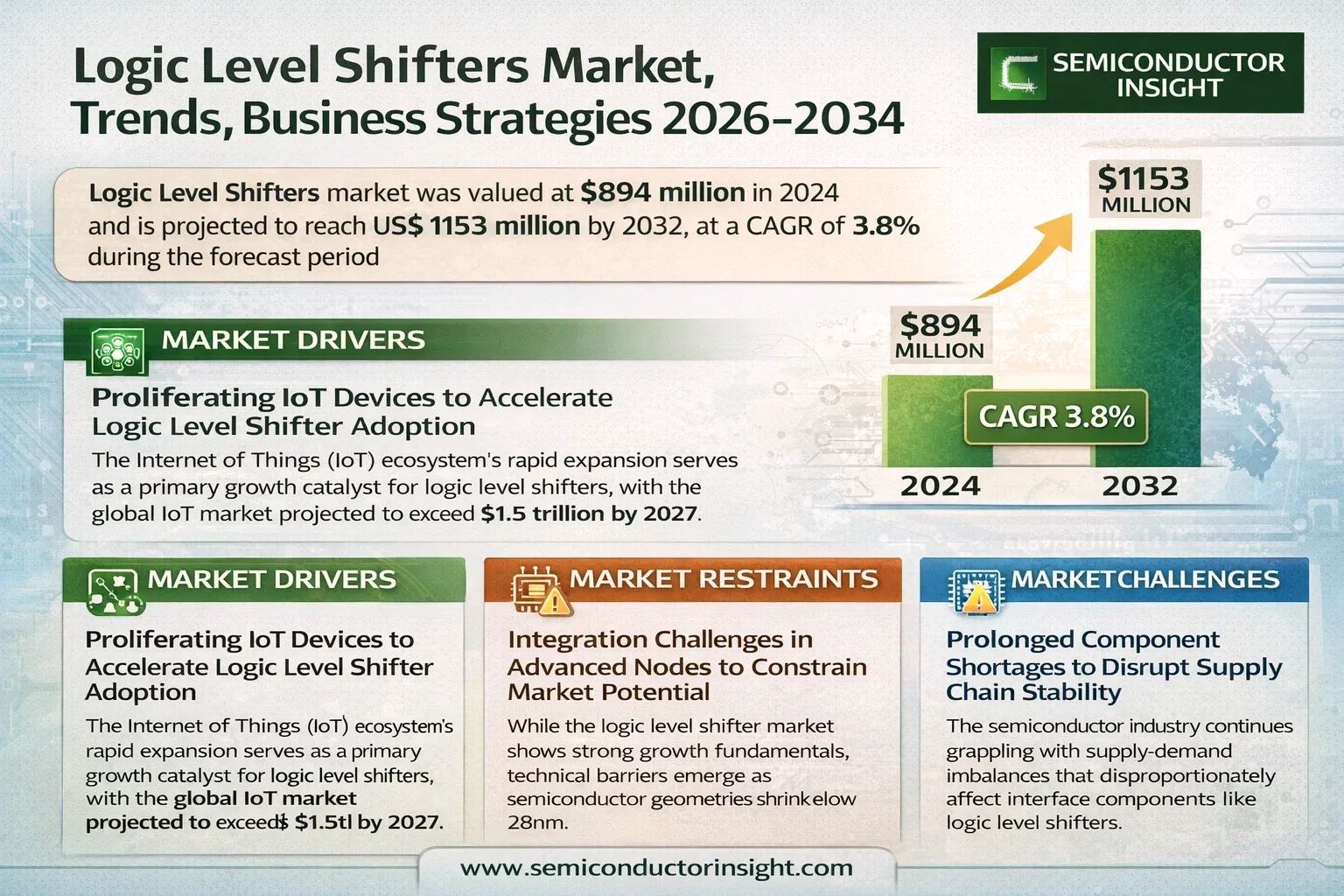
Global Logic Level Shifters Market was valued at 894 million in 2024 and is projected to reach USD 1153 million by 2032, at a CAGR of 3.8% during the forecast period.
While growth appears moderate compared to adjacent semiconductor markets, steady adoption across industrial and consumer applications ensures consistent expansion.
Logic level shifters are essential interface components that enable communication between devices operating at different voltage levels. These circuits perform voltage translation for digital signals, ensuring compatibility between integrated circuits with mismatched logic thresholds. Common applications include microcontroller interfaces, sensor networks, and memory systems where 1.8V, 3.3V and 5V devices must interact seamlessly.
The market growth is primarily driven by proliferation of IoT devices requiring mixed-voltage interfacing, with consumer electronics accounting for over 35% of 2024 demand. However, automotive applications are emerging as the fastest-growing segment due to increasing electronic content in vehicles. Recent developments include Texas Instruments’ introduction of ultra-low-power bidirectional shifters in Q1 2024, reflecting industry focus on energy-efficient solutions. Key players like NXP, Toshiba and STMicroelectronics dominate the competitive landscape through continuous product innovation and strategic partnerships.
Logic Level Shifters Market MARKET DYNAMICS
Logic Level Shifters Market MARKET DRIVERS
Proliferating IoT Devices to Accelerate Logic Level Shifter Adoption
The Internet of Things (IoT) ecosystem’s rapid expansion serves as a primary growth catalyst for logic level shifters, with the global IoT market projected to exceed D 1.5 trillion by 2027. As billions of smart devices require seamless voltage translation between components, demand for reliable level shifting solutions intensifies. Modern IoT applications demand ultra-low power consumption, creating opportunities for innovative shifter designs that minimize energy waste during signal conversion. The automotive IoT segment alone is expected to grow at over 20% CAGR through 2030, further validating the critical role of these components in next-generation connectivity solutions.
Automotive Electronics Revolution to Fuel Market Expansion
Vehicle electrification represents one of the strongest growth vectors, with the automotive electronics market anticipated to surpass D 600 billion by 2030. Modern vehicles now incorporate over 3,000 semiconductor components requiring voltage translation – from infotainment systems to ADAS modules. The transition to 48V architectures in electric vehicles creates particularly strong demand for bidirectional shifters capable of interfacing between legacy 12V systems and higher voltage domains. Leading manufacturers continue introducing automotive-grade shifters meeting stringent AEC-Q100 qualifications, with production volumes increasing 38% year-over-year in the premium vehicle segment.
Furthermore, the push toward autonomous driving capability continues to drive innovation in high-speed signal conditioning solutions, with level shifters playing a crucial role in sensor fusion architectures. The ADAS market alone is projected to require over 200 million high-performance level translation units annually by 2025 to support growing camera, radar and LiDAR integration needs.
Logic Level Shifters Market MARKET RESTRAINTS
Integration Challenges in Advanced Nodes to Constrain Market Potential
While the Logic Level Shifters Market shows strong growth fundamentals, technical barriers emerge as semiconductor geometries shrink below 28nm. Advanced nodes introduce complex parasitics that degrade signal integrity during voltage translation, with signal attenuation exceeding 30% in some sub-10nm applications. This creates significant design challenges for maintaining adequate noise margins while meeting power budgets below 0.9V. Foundry data indicates nearly 25% of mixed-voltage SoC designs experience re-spins due to level shifting failures, adding considerable development costs and time-to-market delays.
The industry also faces mounting signal integrity complications as data rates exceed 5Gbps in modern interfaces. Jitter introduced during level translation can consume over 60% of the timing budget in high-speed SerDes applications, forcing design teams to implement complex equalization schemes. These technical hurdles are particularly pronounced in memory interfaces, where DDR5 implementations require sub-picosecond jitter performance during voltage domain crossing.
Logic Level Shifters Market MARKET CHALLENGES
Prolonged Component Shortages to Disrupt Supply Chain Stability
The semiconductor industry continues grappling with supply-demand imbalances that disproportionately affect interface components like logic level shifters. Allocation conditions remain tight for legacy 180nm and 130nm nodes where many basic translators are manufactured, with lead times extending beyond 52 weeks for some automotive-qualified parts. This creates significant production bottlenecks, particularly for industrial and automotive customers facing 20-30% order fulfillment rates despite growing demand.
Material cost inflation compounds these challenges, with wafer prices increasing 8-12% annually and substrate costs rising nearly 15% year-over-year. These economic pressures force difficult tradeoffs between maintaining margin profiles and securing adequate supply commitments, particularly for smaller manufacturers lacking long-term foundry agreements.
Other Challenges
Design Complexity Escalation
Emerging applications demand shifters supporting wider voltage ranges (0.5V to 5.5V) while maintaining sub-nanosecond propagation delays. This requires sophisticated circuit techniques like adaptive body biasing and charge pump voltage generation, increasing development costs by 20-30% compared to conventional designs.
Thermal Management Issues
High-density level shifter arrays in AI accelerator chips can generate local hot spots exceeding 125°C, requiring advanced packaging solutions that increase unit costs by 15-20%. These thermal challenges become particularly acute in automotive and industrial applications requiring -40°C to 125°C operation.
LOGIC LEVEL SHIFTERS MARKET TRENDS
Rising Demand for IoT and Smart Devices Drives Logic Level Shifter Adoption
The proliferation of IoT (Internet of Things) and smart devices is accelerating the demand for logic level shifters globally. With over 23 billion connected IoT devices expected to be in operation by 2024, the need for voltage translation between low-power sensors and processing units has become critical. Logic level shifters enable seamless communication between components operating at different voltage levels – a fundamental requirement in modern electronics. The consumer electronics segment accounts for approximately 38% of total logic level shifter usage, driven by smartphones, wearables, and smart home devices requiring multi-voltage domain support.
Other Trends
Automotive Electronics Expansion
The automotive industry’s rapid electrification and ADAS (Advanced Driver Assistance Systems) adoption are creating substantial growth opportunities for logic level shifters. Modern vehicles integrate over 100 Electronic Control Units (ECUs) operating at various voltage levels, from legacy 5V systems to modern 1.8V components. Logic level shifters play a vital role in ensuring reliable communication across these mixed-voltage architectures. The automotive segment is projected to grow at a CAGR of 4.5% through 2032, driven by increasing vehicle electrification and autonomous driving technologies.
Miniaturization and Power Efficiency Innovations
Semiconductor manufacturers are focusing heavily on developing compact, low-power logic level shifters to meet the demands of portable and battery-powered applications. Recent advancements include ultra-low quiescent current (IQ) designs below 1µA and package sizes shrinking to 0.8mm × 0.8mm WLCSP (Wafer-Level Chip Scale Packaging). This trend is particularly important for medical wearables and industrial IoT devices where space and power constraints are critical. The introduction of auto-direction sensing bidirectional shifters has further simplified PCB design, reducing component count and board space requirements in modern electronics.
COMPETITIVE LANDSCAPE
Key Industry Players
Semiconductor Giants and Emerging Innovators Drive Market Dynamics
Global Logic Level Shifters Market exhibits a competitive yet moderately fragmented landscape, dominated by established semiconductor manufacturers while accommodating specialized IC designers. Texas Instruments leads the segment, capturing approximately 18% revenue share in 2024, primarily due to its extensive portfolio of bidirectional voltage translators for automotive and industrial applications. The company’s recent launch of the TXB0108-Q1 automotive-grade level shifter has further solidified its market position.
NXP Semiconductors and STMicroelectronics collectively account for nearly 25% of the market, with strong penetration in European and Asian consumer electronics sectors. Their growth stems from patented auto-direction sensing technology that reduces system complexity in IoT devices – a sector projected to require 28 billion level shifters annually by 2027.
While the top five players (including Analog Devices and ON Semiconductor) control about 52% of the market, emerging innovators like SGMICRO are gaining traction through cost-optimized solutions for mid-range applications. These companies leverage Chinese manufacturing capabilities to offer competitive pricing, currently disrupting traditional supply chains with 15-20% lower ASPs than Western counterparts.
Strategic movements in the sector include Microchip Technology’s 2023 acquisition of Advanced Linear Devices’ level shifter IP portfolio, and Infineon’s partnership with Lattice Semiconductor to co-develop automotive-grade voltage translators. Such collaborations aim to address growing demand for 3.3V-5V conversion in electric vehicle battery management systems, where component reliability requirements exceed industrial standards by 40%.
List of Key Logic Level Shifter Companies Profiled
- NXP Semiconductors (Netherlands)
- Texas Instruments (U.S.)
- Renesas Electronics (Japan)
- ABB Ltd. (Switzerland)
- Toshiba Electronic Devices (Japan)
- Analog Devices (U.S.)
- Diodes Incorporated (U.S.)
- Lattice Semiconductor (U.S.)
- Infineon Technologies (Germany)
- Advanced Linear Devices (U.S.)
- Microchip Technology (U.S.)
- Kübler Group (Germany)
- ON Semiconductor (U.S.)
- STMicroelectronics (Switzerland)
- Maxim Integrated (U.S.)
- SGMICRO (China)
Segment Analysis:
By Type
Bidirectional Converters Lead the Market Due to Increasing Demand for Seamless Interface Communication
The market is segmented based on type into:
- Unidirectional Converter
- Bidirectional Converter
By Application
Consumer Electronics Segment Dominates Owing to Proliferation of Smart Devices
The market is segmented based on application into:
- Automobile
- Healthcare
- Consumer Electronics
- Others
By Voltage Level
Low-Voltage Shifters Hold Major Share for IoT and Wearable Applications
The market is segmented based on voltage level compatibility into:
- Low-Voltage Level Shifters (Below 5V)
- Medium-Voltage Level Shifters (5V-12V)
- High-Voltage Level Shifters (Above 12V)
By Channel Configuration
Multi-Channel Shifters Gain Traction for Complex System Integration Requirements
The market is segmented based on channel configuration into:
- Single-Channel
- Dual-Channel
- Multi-Channel (4+ channels)
Regional Analysis: Logic Level Shifters Market
North America
The North American Logic Level Shifters Market benefits from robust demand in automotive electronics, IoT devices, and industrial automation applications, with the U.S. contributing over 75% of regional revenue in 2024. This dominance stems from high R&D investments by semiconductor giants like Texas Instruments and NXP, supported by strict signal integrity standards in sectors such as 5G infrastructure and electric vehicles. However, supply chain disruptions continue to challenge lead times for high-performance bidirectional converters used in advanced driver-assistance systems (ADAS). A notable trend is the accelerating adoption of low-power, high-speed voltage translators for next-gen wearable devices and AI edge computing solutions.
Europe
Europe’s market thrives on its precision manufacturing base, particularly in Germany and France, where industrial IoT and automotive sectors consume 30% of regional logic shifter volumes. The EU’s EN 50155 standard for railway applications mandates ruggedized level shifters, creating a €28 million niche market for rail-compatible solutions. While renewable energy projects drive demand for smart grid-compatible ICs, the region faces pricing pressures from Asian manufacturers. Recent developments include Infineon’s 2024 launch of automotive-grade bidirectional shifters capable of operating at 200MHz, addressing the bandwidth needs of in-vehicle networks.
Asia-Pacific
As the fastest-growing region (projected 4.9% CAGR through 2032), APAC leverages its electronics manufacturing dominance, with China producing 60% of global consumer electronics requiring logic shifters. The proliferation of low-cost unidirectional converters in smartphones and IoT nodes contrasts with Japan’s premium market for automotive-grade components in hybrid vehicles. India’s expanding telecom infrastructure creates opportunities for 3.3V-to-5V translators in base stations, though counterfeit components remain a persistent challenge in Southeast Asia’s price-sensitive markets. Taiwan’s foundries are pivotal in supplying wafer-level packaging solutions for space-constrained applications.
South America
This emerging market shows potential in Brazil’s automotive sector and Argentina’s industrial automation push, though economic instability limits investments in advanced ICs. Most demand centers on basic 8-bit microcontroller interfaces, with imports satisfying 85% of regional needs due to limited local semiconductor manufacturing. The lack of standardized voltage protocols across legacy industrial equipment necessitates customized solutions, creating niche opportunities for modular shifter designs. Political uncertainties in key markets continue to deter major suppliers from establishing local distribution hubs.
Middle East & Africa
The MEA market, though small, shows focused growth in smart city projects across UAE and Saudi Arabia, where 3.3V-1.8V shifters enable sensor networks for infrastructure monitoring. South Africa’s mining sector utilizes ruggedized shifters for industrial automation, while North African nations increasingly import consumer electronics components. The region’s lack of component testing facilities necessitates reliance on international certifications, slowing adoption of cutting-edge solutions. Long-term potential lies in oil/gas automation projects, currently constrained by budget cycles in OPEC nations.
Report Scope
This market research report provides a comprehensive analysis of the global and regional Logic Level Shifters Market, covering the forecast period 2025–2032. It offers detailed insights into market dynamics, technological advancements, competitive landscape, and key trends shaping the industry.
Key focus areas of the report include:
- Market Size & Forecast: Historical data and future projections for revenue, unit shipments, and market value across major regions and segments. Global Logic Level Shifters Market was valued at USD 894 million in 2024 and is projected to reach USD 1,153 million by 2032, growing at a CAGR of 3.8%.
- Segmentation Analysis: Detailed breakdown by product type (Unidirectional Converter, Bidirectional Converter), application (Automobile, Healthcare, Consumer Electronics, Others), and end-user industry to identify high-growth segments.
- Regional Outlook: Insights into market performance across North America, Europe, Asia-Pacific, Latin America, and the Middle East & Africa, including country-level analysis of key markets like the US, China, Germany, and Japan.
- Competitive Landscape: Profiles of 15+ leading market participants including NXP, Texas Instruments, Renesas, and Infineon Technologies, covering their product portfolios, market share (top 5 companies held over 35% share in 2024), and strategic developments.
- Technology Trends & Innovation: Assessment of emerging semiconductor design trends, integration with IoT devices, and advancements in voltage translation technologies for 5G and automotive applications.
- Market Drivers & Restraints: Evaluation of factors including rising demand for consumer electronics (global shipments exceeding 2.5 billion units annually) and automotive electronics, along with supply chain challenges and material cost fluctuations.
- Stakeholder Analysis: Strategic insights for component manufacturers, OEMs, system integrators, and investors regarding emerging opportunities in electric vehicles and industrial automation sectors.
Research methodology combines primary interviews with industry experts and analysis of verified market data from regulatory filings, trade associations, and financial reports to ensure accuracy.
FREQUENTLY ASKED QUESTIONS:
What is the current market size of Global Logic Level Shifters Market?
-> Logic Level Shifters Market was valued at 894 million in 2024 and is projected to reach USD 1153 million by 2032, at a CAGR of 3.8% during the forecast period.
Which key companies operate in Global Logic Level Shifters Market?
-> Key players include NXP, Texas Instruments, Renesas, ABB, Toshiba, Analog Devices, and Infineon Technologies, among others.
What are the key growth drivers?
-> Key growth drivers include rising adoption of IoT devices (projected 29 billion connected devices by 2030), automotive electronics expansion, and 5G infrastructure development.
Which region dominates the market?
-> Asia-Pacific holds the largest market share (over 45% in 2024), driven by electronics manufacturing in China, South Korea, and Japan.
What are the emerging trends?
-> Emerging trends include integration of level shifters in advanced driver-assistance systems (ADAS), ultra-low-power designs for wearable devices, and multi-voltage domain SoC interfaces.

Get Sample Report PDF for Exclusive Insights
Report Sample Includes
- Table of Contents
- List of Tables & Figures
- Charts, Research Methodology, and more...
 Download Sample Report PDF


