Lock-in amplifier for fluorescence detection in lab-on-chip Market Insights
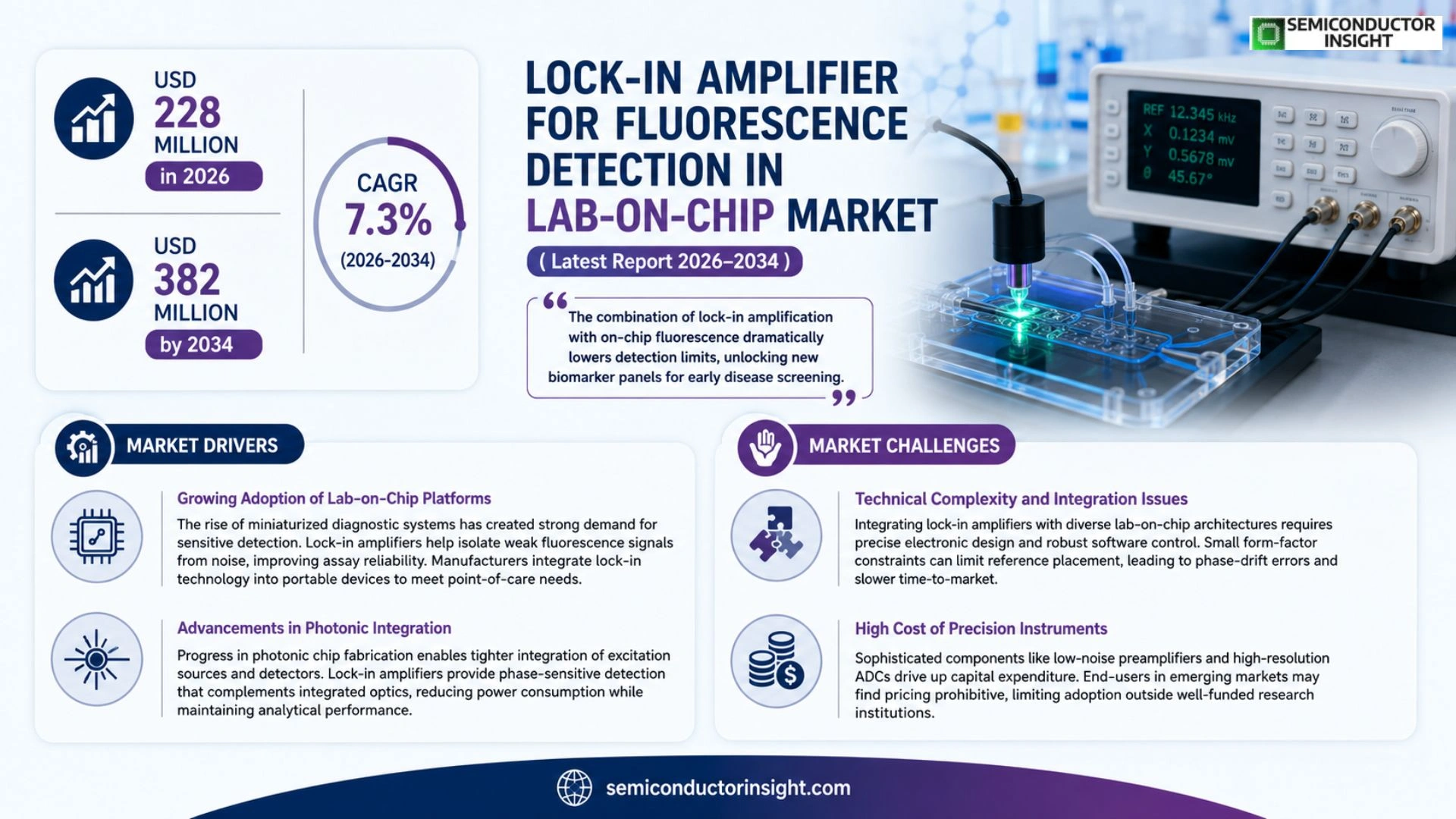
Global Lock-in amplifier for fluorescence detection in lab-on-chip market size was valued at USD 215 million in 2025. The market is projected to grow from USD 228 million in 2026 to USD 382 million by 2034, exhibiting a CAGR of 7.3% during the forecast period.
Lock‑in amplifiers designed for fluorescence detection on lab‑on‑chip platforms provide phase‑sensitive signal extraction that isolates weak optical emissions from background noise. By synchronizing with the excitation source’s modulation frequency, these instruments enable sub‑nanowatt sensitivity essential for single‑molecule assays and multiplexed biomarker panels.
The market is accelerating because point‑of‑care diagnostics and wearable biosensors increasingly rely on microfluidic integration, demanding compact yet high‑performance amplifiers. Furthermore, rising funding for personalized medicine drives adoption of ultra‑low‑noise detection solutions. Key players such as Zurich Instruments, Stanford Research Systems, Thorlabs, and Hamamatsu Photonics are expanding their portfolios through miniaturized designs and AI‑assisted signal processing.
MARKET DRIVERS
Growing Adoption of Lab‑on‑Chip Platforms
The rise of miniaturized diagnostic systems has created a strong demand for highly sensitive detection techniques. Lock‑in amplifier for fluorescence detection in lab‑on‑chip Market players benefit from the need to isolate weak fluorescence signals from background noise, which directly improves assay reliability. Manufacturers are integrating lock‑in technology into portable devices to meet point‑of‑care requirements.
Advancements in Photonic Integration
Recent progress in photonic chip fabrication enables tighter integration of excitation sources and detectors, making lock‑in amplification more scalable. Lock‑in amplifiers provide phase‑sensitive detection that complements these integrated optics, reducing power consumption while maintaining analytical performance. This technical synergy accelerates market penetration across biomedical and environmental sensing applications.
➤ “The combination of lock‑in amplification with on‑chip fluorescence dramatically lowers detection limits, unlocking new biomarker panels for early disease screening.”
Regulatory encouragement for rapid, low‑volume testing further fuels investment in lock‑in based fluorescence systems. Stakeholders are allocating capital to R&D projects that focus on reducing instrument size and cost, which in turn expands the addressable market for lock‑in amplifier for fluorescence detection in lab‑on‑chip solutions.
MARKET CHALLENGES
Technical Complexity and Integration Issues
Integrating lock‑in amplifiers with diverse lab‑on‑chip architectures requires precise electronic design and robust software control. Small form‑factor constraints often limit the placement of reference signals, leading to potential phase‑drift errors. Companies must balance performance with manufacturability, which can slow time‑to‑market.
Other Challenges
High Cost of Precision Instruments
The sophisticated components needed for accurate lock‑in detection,such as low‑noise preamplifiers and high‑resolution digital converters,drive up capital expenditure. End‑users in emerging markets may find pricing prohibitive, limiting adoption outside well‑funded research institutions.
MARKET RESTRAINTS
Limited Skilled Workforce
The specialized knowledge required to design, calibrate, and maintain lock‑in based fluorescence detection systems creates a talent bottleneck. Training programs are still nascent, and the scarcity of experts can delay deployment and increase operational costs for manufacturers.
Stringent Validation Protocols
Regulatory bodies demand extensive validation for analytical devices that employ lock‑in amplification, especially in clinical diagnostics. Meeting these rigorous standards adds layers of documentation and testing, which can restrain rapid market entry for new entrants.
MARKET OPPORTUNITIES
Emerging Applications in Single‑Cell Analysis
Single‑cell fluorescence assays require detection of ultra‑low signal levels, a niche where lock‑in amplifiers excel. Developing dedicated lock‑in modules optimized for single‑cell platforms presents a lucrative growth avenue, especially as personalized medicine expands.
Expansion into Environmental Monitoring
Portable lab‑on‑chip devices equipped with lock‑in amplification are gaining traction for on‑site detection of pollutants and pathogens. Leveraging this trend can open new revenue streams beyond traditional biomedical markets, driving diversification for system integrators.
Lock-in amplifier for fluorescence detection in lab-on-chip Market Trends
Growth of Integrated Point‑of‑Care Diagnostics
The integration of lock‑in amplifiers into lab‑on‑chip platforms is becoming a decisive factor for next‑generation point‑of‑care diagnostics. By locking to the modulation frequency of the excitation source, these amplifiers extract weak fluorescence signals while rejecting ambient and electronic noise. This capability enables sub‑nanowatt sensitivity that supports single‑molecule assays and multiplexed biomarker panels, which are essential for rapid disease screening in decentralized settings. The trend is reinforced by growing investment in personalized medicine, where clinicians require accurate, low‑volume testing that can be performed at the bedside or in community health centers. Consequently, manufacturers are prioritising compact, low‑power designs that can be embedded directly within microfluidic cartridges, reducing overall system footprint and simplifying thermal management.
Other Trends
Miniaturization and AI‑Assisted Signal Processing
Leading vendors such as Zurich Instruments, Stanford Research Systems, Thorlabs, and Hamamatsu Photonics are accelerating product road‑maps that combine hardware miniaturization with advanced software algorithms. The reduced form factor stems from the adoption of CMOS‑based detection stages and integrated photodiode arrays, allowing devices to fit within the limited space of a handheld cartridge. Simultaneously, AI‑driven signal‑processing modules perform real‑time baseline correction, frequency drift compensation, and adaptive filtering, which improve reproducibility across variable sample matrices. These dual advancements not only streamline user workflows but also lower the barrier to entry for laboratories that lack extensive expertise in optical instrumentation.
Emerging Applications in Wearable Biosensing
Wearable health monitors are increasingly incorporating lab‑on‑chip technologies to deliver continuous biochemical feedback. The lock‑in amplifier’s ability to isolate modulated fluorescence from motion‑induced artifacts makes it uniquely suited for such applications. Early prototypes demonstrate real‑time tracking of metabolites such as lactate and cortisol through microfluidic skin‑interfaced patches. As power‑efficiency improves, these devices are moving toward battery‑free operation powered by energy‑harvesting mechanisms. The convergence of ultra‑low‑noise amplification, on‑chip microfluidics, and wireless data transmission is poised to create new market segments that blend diagnostics with lifestyle monitoring, expanding the overall reach of lock‑in amplifier solutions beyond traditional laboratory environments.
COMPETITIVE LANDSCAPE
Key Industry Players
Lock‑in Amplifier for Fluorescence Detection in Lab‑on‑Chip Market Competitive Overview
The market is anchored by a few large, vertically integrated firms that combine precision analog front‑ends with advanced digital signal‑processing. Zurich Instruments commands a premium position by offering miniaturized, FPGA‑based lock‑in platforms that integrate directly with microfluidic chips, delivering sub‑nanowatt sensitivity crucial for single‑molecule assays. Their portfolio expansion into AI‑assisted baseline correction has accelerated adoption in point‑of‑care diagnostics, contributing to the market’s projected CAGR of 7.3 % through 2034. Stanford Research Systems (SRS) follows closely, leveraging a legacy of low‑noise hardware to supply modular lock‑in units that can be customized for high‑throughput chip arrays. These flagship players shape a tiered structure where high‑volume, cost‑effective devices serve broader biomedical research, while niche, high‑performance instruments target specialized clinical and wearable biosensor applications.
Beyond the incumbents, a cohort of specialist manufacturers is expanding the competitive frontier. Thorlabs and Hamamatsu Photonics have introduced compact, photonic‑optimized lock‑in amplifiers designed for seamless integration with on‑chip excitation sources. European firms such as Femto and Toptica focus on ultra‑low‑noise analog front‑ends, emphasizing spectral purity for multiplexed biomarker panels. Emerging innovators,including PicoQuant, Menlo Systems, Radiant Technologies, RedStone, and Bruker Nano,are differentiating through modular software ecosystems, rapid prototyping kits, and application‑specific firmware that address niche assay formats like droplet microfluidics and wearable epidermal sensors. Collectively, these players deepen the supply chain, foster technology diffusion, and intensify pressure on price-performance trade‑offs across the lock‑in amplifier landscape.
List of Key Lock‑in Amplifier for Fluorescence Detection in Lab‑on‑Chip Companies Profiled
- Zurich Instruments
- Stanford Research Systems
- Thorlabs
- Hamamatsu Photonics
- Femto
- Toptica
- PicoQuant
- Menlo Systems
- Radiant Technologies
- RedStone
- Bruker Nano
- Advanced Scientific Instruments
- Analog Devices
- Keysight Technologies
- National Instruments
Segment Analysis:
| Segment Category | Sub-Segments | Key Insights |
| By Type |
|
Digital lock‑in amplifiers
|
| By Application |
|
Point‑of‑care diagnostics
|
| By End User |
|
Research laboratories
|
| By Integration Approach |
|
Monolithic integration
|
| By Signal Processing |
|
AI‑enhanced adaptive filtering
|
Regional Analysis: Lock-in amplifier for fluorescence detection in lab-on-chip Market
Strong demand for rapid point‑of‑care diagnostics, combined with federal R&D incentives, fuels investment in lock‑in amplifiers that enhance fluorescence detection sensitivity on chip‑based platforms.
The FDA’s streamlined review process for lab‑on‑chip devices promotes quicker market entry, encouraging manufacturers to embed advanced lock‑in technology in compliant solutions.
Established firms such as Stanford Research Systems and emerging startups from Boston specialize in low‑noise lock‑in amplifiers, driving competitive differentiation through miniaturization.
Novel uses in environmental monitoring and wearable biosensors are expanding the addressable market, leveraging the high precision of lock‑in amplification for fluorescence readouts.
Europe
European research consortia are leveraging lock‑in amplifiers to improve fluorescence detection in lab‑on‑chip systems for personalized medicine. Funding programs such as Horizon Europe encourage cross‑border collaborations, while stringent CE marking requirements ensure high product reliability. Market growth is driven by strong academic‑industry ties, especially in Germany and the United Kingdom, where integrated photonics platforms are gaining traction.
Asia‑Pacific
The Asia‑Pacific region demonstrates rapid adoption of lock‑in amplification technology, propelled by large-scale manufacturing capabilities in China, Japan, and South Korea. Government initiatives supporting smart health diagnostics and rising demand for compact analytical devices in emerging economies stimulate market expansion, despite varied regulatory maturity across the sub‑region.
South America
In South America, Brazil and Argentina lead development efforts, focusing on affordable lab‑on‑chip solutions for infectious disease testing. Collaborative projects between local universities and multinational firms aim to tailor lock‑in amplifier designs to regional cost constraints, fostering gradual market penetration.
Middle East & Africa
The Middle East & Africa region is exploring lock‑in amplifier integration within lab‑on‑chip platforms to address healthcare accessibility challenges. Strategic investments in biotech hubs, particularly in the United Arab Emirates and South Africa, are laying the groundwork for future demand, although market size remains modest at present.
Report Scope
This market research report provides a comprehensive analysis of the Lock-in amplifier for fluorescence detection in lab-on-chip Market , covering the forecast period 2026–2034. It offers detailed insights into market dynamics, technological advancements, competitive landscape, and key trends shaping the industry.
Key focus areas of the report include:
- Market Overview: The report begins with an overview outlining its current market scenario, key growth indicators, and industry transformation drivers. It discusses macroeconomic factors, demand–supply balance, regulatory landscape, and the strategic role of semiconductors in powering advancements across industries such as automotive, telecommunications, consumer electronics, and industrial automation.
- Market Size & Forecast: Historical data and future projections for revenue, unit shipments, and market value across major regions and segments.
- Segmentation Analysis: Detailed breakdown by product type, technology, application, and end-user industry to identify high-growth segments and investment opportunities.
- Regional Insights: Insights into market performance across North America, Europe, Asia-Pacific, Latin America, and the Middle East & Africa, including country-level analysis where relevant.
- Competitive Landscape: Profiles of leading market participants, including their product offerings, R&D focus, manufacturing capacity, pricing strategies, and recent developments such as mergers, acquisitions, and partnerships.
- Technology Trends & Innovation: Assessment of emerging technologies, integration of AI/IoT, semiconductor design trends, fabrication techniques, and evolving industry standards.
- Market Drivers & Restraints: Evaluation of factors driving market growth along with challenges, supply chain constraints, regulatory issues, and market-entry barriers.
- Stakeholder Insights: Insights for component suppliers, OEMs, system integrators, investors, and policymakers regarding the evolving ecosystem and strategic opportunities.
Primary and secondary research methods are employed, including interviews with industry experts, data from verified sources, and real-time market intelligence to ensure the accuracy and reliability of the insights presented.
FREQUENTLY ASKED QUESTIONS:
What is the current market size of Lock-in amplifier for fluorescence detection in lab-on-chip Market?
-> Lock-in amplifier for fluorescence detection in lab-on-chip market is projected to grow from USD 228 million in 2026 to USD 382 million by 2034
Which key companies operate in Lock-in amplifier for fluorescence detection in lab-on-chip Market?
-> Key players include Zurich Instruments, Stanford Research Systems, Thorlabs, and Hamamatsu Photonics, among others.
What are the key growth drivers?
-> Key growth drivers include point‑of‑care diagnostics, wearable biosensors, microfluidic integration, personalized‑medicine funding, and demand for ultra‑low‑noise detection solutions.
Which region dominates the market?
-> Asia-Pacific is the fastest‑growing region, while North America remains a dominant market.
What are the emerging trends?
-> Emerging trends include miniaturized lock‑in designs, AI‑assisted signal processing, and integration with IoT platforms for real‑time health monitoring.
Get Sample Report PDF for Exclusive Insights
Report Sample Includes
- Table of Contents
- List of Tables & Figures
- Charts, Research Methodology, and more...