MARKET INSIGHTS
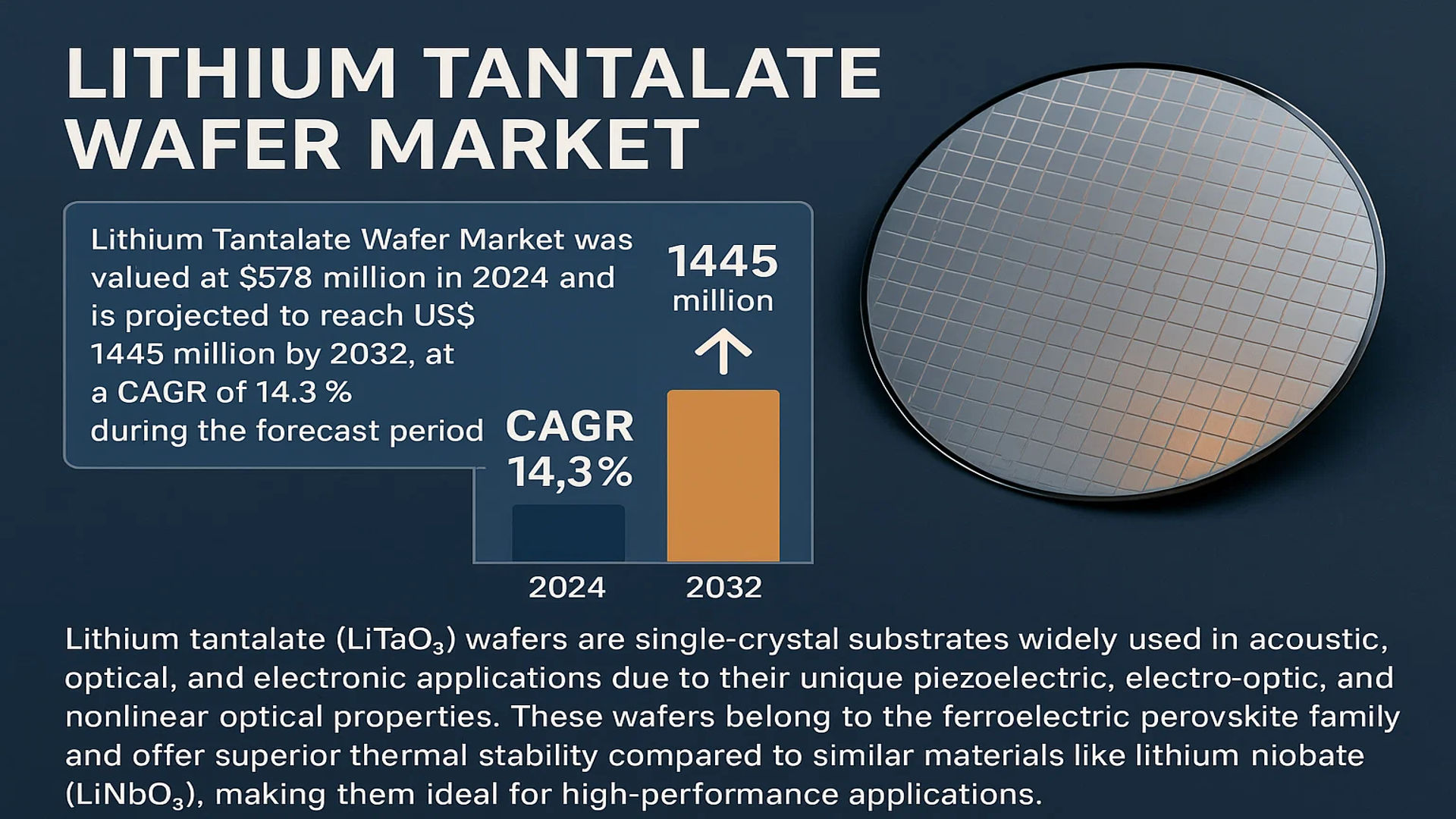
The global Lithium Tantalate Wafer Market was valued at 578 million in 2024 and is projected to reach US$ 1445 million by 2032, at a CAGR of 14.3% during the forecast period.
Lithium tantalate (LiTaO3) wafers are single-crystal substrates widely used in acoustic, optical, and electronic applications due to their unique piezoelectric, electro-optic, and nonlinear optical properties. These wafers belong to the ferroelectric perovskite family and offer superior thermal stability compared to similar materials like lithium niobate (LiNbO3), making them ideal for high-performance applications.
The market growth is driven by increasing demand for 5G communication devices, optical modulators, and surface acoustic wave (SAW) filters. Asia-Pacific currently dominates the market, with China accounting for approximately 45% of global production capacity. Key players like Sumitomo Metal Mining and Shin-Etsu Chemical are investing in capacity expansion to meet the growing demand from telecommunications and defense sectors.
MARKET DYNAMICS
MARKET DRIVERS
Expansion of 5G Technology and Optical Communication to Fuel Market Growth
The global rollout of 5G networks is creating substantial demand for lithium tantalate wafers due to their exceptional electro-optic properties. These wafers are critical components in surface acoustic wave (SAW) filters used in mobile devices and base stations, where they enable high-frequency signal processing with minimal loss. With over 350 commercial 5G networks deployed worldwide as of latest data and smartphone manufacturers increasingly integrating 5G capabilities, the requirement for high-quality lithium tantalate substrates has surged by approximately 28% annually in the telecom sector alone. This growth trajectory is expected to continue as countries intensify their 5G infrastructure investments.
Advancements in Photonic Integrated Circuits Creating New Applications
The photonics industry is undergoing a transformation with lithium tantalate emerging as a preferred material for integrated optical devices. Its high electro-optic coefficient—nearly three times that of lithium niobate—makes it ideal for modulators in data centers and high-speed optical communications. Recent breakthroughs have demonstrated lithium tantalate’s capability to handle data rates exceeding 100 Gbps per channel, addressing the bandwidth demands of cloud computing and AI infrastructure. The optical devices segment currently accounts for over 40% of lithium tantalate wafer consumption, with projections indicating this share will grow substantially as hyperscale data centers continue their global expansion.
Military and Aerospace Applications Driving Specialized Demand
Defense sectors worldwide are increasingly adopting lithium tantalate-based devices for their superior performance in harsh environments. The material’s thermal stability up to 1,200°C and radiation resistance make it invaluable for avionics, missile guidance systems, and satellite communications. With global defense spending surpassing $2 trillion annually and space programs accelerating, specialized 6-inch lithium tantalate wafers for these applications command premium prices—often 35-50% higher than standard industrial grades. This niche segment is becoming increasingly important for wafer manufacturers seeking higher margin opportunities.
MARKET RESTRAINTS
High Production Costs and Raw Material Constraints Limit Market Penetration
The crystalline perfection required for lithium tantalate wafers results in exceptionally complex manufacturing processes, with typical yields below 60% for 6-inch diameter substrates. The specialized Czochralski crystal growth method requires precise control of temperature gradients and rotation speeds over growth periods exceeding two weeks. These technical challenges, combined with the limited global supply of high-purity tantalum—only five countries produce over 90% of the world’s tantalum ore—create significant cost pressures. Average wafer prices remain 20-30% higher than comparable lithium niobate products, restricting adoption in price-sensitive applications.
Competition from Alternative Materials Threatens Market Position
While lithium tantalate offers superior performance in many applications, emerging materials are challenging its dominance in key sectors. Silicon-based photonic devices, though less efficient, benefit from established semiconductor manufacturing infrastructure and significantly lower costs—often 70-80% less than lithium tantalate solutions. In the RF filter market, aluminum nitride and gallium nitride technologies are gaining traction for certain frequency ranges. The material’s market position depends increasingly on maintaining performance advantages that justify its cost premium, particularly as alternative technologies continue to mature.
MARKET CHALLENGES
Crystal Defects and Quality Control Issues Impact Yield
Maintaining consistent wafer quality remains an ongoing challenge in lithium tantalate production. Even minor variations in crystal growth conditions can introduce defects such as dislocations, inclusions, or compositional inhomogeneities that degrade device performance. These defects are particularly problematic for advanced applications requiring strict specifications, where rejection rates can exceed 40% during quality inspection. The industry’s reliance on manual polishing and inspection processes further compounds these yield challenges, with only a handful of facilities worldwide capable of producing wafers meeting the most stringent military specifications.
Technological Specialization Creates Workforce Shortages
The highly specialized nature of lithium tantalate crystal growth and processing has resulted in acute shortages of skilled personnel. With fewer than a dozen academic programs worldwide offering dedicated crystal growth training, manufacturers face difficulties in recruiting and retaining experts capable of optimizing production processes. This skills gap is particularly pronounced in Western markets where experienced crystal growers average over 25 years in the field with limited succession planning. The talent shortage is estimated to constrain production capacity growth by 15-20% annually for major manufacturers.
MARKET OPPORTUNITIES
Emerging Quantum Technologies Creating New Demand Verticals
Quantum computing and communication systems are emerging as promising new applications for lithium tantalate wafers. The material’s strong nonlinear optical properties make it ideal for quantum light sources and frequency conversion in photonic quantum systems. With governments and technology companies investing over $30 billion collectively in quantum research, specialized lithium tantalate components for quantum applications are commanding prices up to ten times higher than conventional wafers. This high-value niche represents one of the most significant growth opportunities for manufacturers able to meet the extreme purity and uniformity requirements of quantum devices.
Automotive LiDAR Adoption Driving Volume Growth
The rapid development of autonomous vehicle technologies is creating substantial new demand for lithium tantalate in optical beam steering systems. Automotive-grade LiDAR systems increasingly utilize the material’s electro-optic properties for solid-state scanning solutions that outperform mechanical alternatives in reliability and form factor. With projections suggesting over 25 million vehicles will incorporate LiDAR by 2030, automotive applications could account for nearly 15% of the lithium tantalate wafer market within the next five years. This represents a significant volume opportunity, though it requires wafer producers to adapt to the automotive industry’s stringent qualification processes and cost targets.
LITHIUM TANTALATE WAFER MARKET TRENDS
Rising Demand for 5G and Photonics Applications Drives Market Growth
The global lithium tantalate (LiTaO?) wafer market is experiencing significant growth, largely propelled by the increasing adoption of 5G technology and photonics-based applications. Due to their superior piezoelectric and electro-optic properties, lithium tantalate wafers are widely used in surface acoustic wave (SAW) filters for mobile communications and optical modulators for high-speed data transmission. The expanding 5G network infrastructure, which is projected to reach $47.78 billion by 2027, has accelerated demand for SAW filters that rely on lithium tantalate substrates. Additionally, the growing demand for LiTaO? in optical modulators supports telecommunications and data center advancements, reinforcing its position as a critical enabling material.
Other Trends
Expansion in Infrared and Sensing Applications
Lithium tantalate wafers are increasingly being deployed in infrared detectors, pyroelectric sensors, and optical waveguides, particularly in defense and industrial applications. The material’s high thermal stability and nonlinear optical characteristics make it an ideal substrate for thermal imaging systems used in aerospace and security. The global infrared detector market is expected to surpass $10 billion by 2030, with LiTaO? wafers playing a key role in improving sensor performance. Additionally, advancements in ferroelectric memory devices leveraging lithium tantalate are opening new avenues in non-volatile storage solutions.
Shift Toward Larger Wafer Diameters Enhances Manufacturing Efficiency
Manufacturers in the lithium tantalate wafer market are increasingly transitioning from 3-inch and 4-inch wafers to 6-inch diameters to reduce production costs and improve yield efficiency. While 3-inch wafers currently dominate the market, 6-inch wafers are expected to witness the highest growth due to economies of scale in semiconductor fabrication. The higher uniformity of larger wafers also improves device performance, particularly in high-frequency SAW filters and optical applications. Strategic investments by key players such as Shin-Etsu Chemical and Sumitomo Metal Mining in scaling up production capacities are further solidifying this transition.
COMPETITIVE LANDSCAPE
Key Industry Players
Market Leaders Leverage Technical Expertise to Secure Competitive Edge
The global Lithium Tantalate Wafer market exhibits a fragmented competitive structure, dominated by specialized material science companies and diversified chemical manufacturers. Sumitomo Metal Mining Co., Ltd. emerges as a frontrunner, controlling significant market share through its vertically integrated supply chain and extensive R&D investments in crystal growth technologies. The company’s leadership stems from decades of experience in rare metal processing and its ability to deliver high-purity wafers for demanding optical applications.
Japanese firms Shin-Etsu Chemical and YAMAJU CERAMICS CO.,LTD. maintain strong positions through technological differentiation, particularly in precision polishing and orientation control capabilities that enable superior surface quality. Their dominance in the Asian markets, which accounted for over 60% of global demand in 2024, positions these players for continued growth as regional electronics manufacturing expands.
While established players focus on process optimization, emerging Chinese manufacturers like Hangzhou Freqcontrol Electronic Technology are disrupting the market through cost-efficient production methods. These agile competitors have captured 15-20% of the mid-range wafer segment by tailoring products for mass-produced acoustic wave filters in consumer electronics.
The competitive intensity is further heightened by strategic movements across the value chain. TDG Holding Co., LTD. recently expanded its production capacity by 40% to meet rising demand from 5G infrastructure projects, while KOIKE CO.,LTD. diversified into engineered substrates with customized electro-optic properties for quantum computing applications.
List of Key Lithium Tantalate Wafer Manufacturers
- Sumitomo Metal Mining Co., Ltd. (Japan)
- YAMAJU CERAMICS CO.,LTD. (Japan)
- Shin-Etsu Chemical (Japan)
- KOIKE CO.,LTD. (Japan)
- TDG Holding Co., LTD. (China)
- Hangzhou Freqcontrol Electronic Technology (China)
- Timemaker (South Korea)
- Shanghai Institute of Optics and Fine Mechanics (China)
- Shanghai BonTek Optoelectronics (China)
- CNMNC (China)
Segment Analysis:
By Type
6 Inches Segment Dominates Due to High Demand in Optical and Acoustic Applications
The market is segmented based on type into:
- 3 inches
- 4 inches
- 6 inches
- Other
By Application
Optical Devices Segment Leads Owing to Growing Utilization in Telecommunications and Photonics
The market is segmented based on application into:
- Acoustic devices
- Subtypes: Surface acoustic wave (SAW) filters, Bulk acoustic wave (BAW) resonators, and others
- Optical devices
- Subtypes: Electro-optic modulators, Optical waveguides, Nonlinear optical devices, and others
By End User
Telecommunications Sector Accounts for Significant Demand Due to 5G and Optical Network Expansion
The market is segmented based on end user into:
- Telecommunications
- Defense and aerospace
- Medical devices
- Research institutions
- Others
Regional Analysis: Lithium Tantalate Wafer Market
The Asia-Pacific region dominates the global Lithium Tantalate Wafer market, accounting for over 45% of the total demand in 2024. This leadership position stems from China’s robust semiconductor and optoelectronics manufacturing sector, where lithium tantalate wafers are extensively used in surface acoustic wave (SAW) filters for 5G devices. Japan follows closely with leading manufacturers like Shin-Etsu Chemical and Sumitomo Metal Mining Co., Ltd. driving both production and innovation. South Korea’s expanding telecommunications infrastructure and India’s growing electronics industry further contribute to regional demand. While cost-competitive production remains a key advantage, there’s increasing investment in R&D to improve wafer quality and application diversity.
North America
North America represents the second-largest market for Lithium Tantalate Wafers, with strong demand from both the defense sector and telecommunications industries. The United States maintains technological superiority in specialized applications such as quantum computing and advanced optical modulators, where lithium tantalate’s unique properties are irreplaceable. Recent government initiatives like the CHIPS Act are expected to bolster domestic semiconductor manufacturing, indirectly supporting the wafer market. However, limited local production capacity means the region relies heavily on imports, primarily from Japanese suppliers, creating opportunities for supply chain optimization.
Europe
Europe’s market is characterized by specialized, high-value applications in precision optics and scientific instrumentation. Germany leads regional consumption, with its strong photonics industry requiring lithium tantalate wafers for nonlinear optical devices. The EU’s focus on technological sovereignty has prompted increased investment in advanced material research, including alternative piezoelectric materials that could impact future demand patterns. Strict environmental regulations governing tantalum sourcing present both challenges and opportunities for suppliers committed to sustainable practices. Collaboration between research institutions and industry players remains a distinctive feature of the European market landscape.
South America
The South American market shows emerging potential with Brazil as the primary consumer, though current volumes remain modest. Growth is primarily driven by telecommunications infrastructure upgrades and some specialized industrial applications. Economic volatility affects capital-intensive projects that might otherwise drive wafer adoption, while limited local expertise in advanced materials processing constrains market expansion. However, the region’s increasing focus on renewable energy systems could open new application areas for lithium tantalate in sensors and monitoring devices over the long term.
Middle East & Africa
This region represents the smallest but fastest-growing market segment for Lithium Tantalate Wafers, with Israel and the UAE leading adoption. Israel’s thriving defense electronics sector and the UAE’s smart city initiatives create targeted demand for acoustic wave devices. While infrastructure limitations hinder widespread market penetration, strategic investments in 5G networks and optical communication systems are expected to drive steady growth. The lack of local manufacturing means all wafers are imported, primarily from Asian suppliers, resulting in longer lead times and higher costs that somewhat limit market expansion.
Report Scope
This market research report provides a comprehensive analysis of the global and regional Lithium Tantalate Wafer markets, covering the forecast period 2024–2032. It offers detailed insights into market dynamics, technological advancements, competitive landscape, and key trends shaping the industry.
Key focus areas of the report include:
- Market Size & Forecast: Historical data and future projections for revenue, unit shipments, and market value across major regions and segments. The global Lithium Tantalate Wafer market was valued at USD 578 million in 2024 and is projected to reach USD 1445 million by 2032, at a CAGR of 14.3%.
- Segmentation Analysis: Detailed breakdown by product type (3 inches, 4 inches, 6 inches, Other), technology, application (Acoustic Devices, Optical Devices), and end-user industry to identify high-growth segments and investment opportunities.
- Regional Outlook: Insights into market performance across North America, Europe, Asia-Pacific, Latin America, and the Middle East & Africa, including country-level analysis where relevant. The U.S. market size is estimated at USD million in 2024, while China is expected to reach USD million.
- Competitive Landscape: Profiles of leading market participants, including Sumitomo Metal Mining Co., Ltd., YAMAJU CERAMICS CO.,LTD., Shin-Etsu Chemical, KOIKE CO.,LTD., TDG Holding Co., LTD., and others, covering their product offerings, R&D focus, manufacturing capacity, pricing strategies, and recent developments.
- Technology Trends & Innovation: Assessment of emerging technologies, fabrication techniques, and evolving industry standards in piezoelectric and electro-optic applications.
- Market Drivers & Restraints: Evaluation of factors driving market growth along with challenges, supply chain constraints, regulatory issues, and market-entry barriers.
- Stakeholder Analysis: Insights for component suppliers, OEMs, system integrators, investors, and policymakers regarding the evolving ecosystem and strategic opportunities.
Primary and secondary research methods are employed, including interviews with industry experts, data from verified sources, and real-time market intelligence to ensure the accuracy and reliability of the insights presented.
FREQUENTLY ASKED QUESTIONS:
What is the current market size of Global Lithium Tantalate Wafer Market?
-> Lithium Tantalate Wafer Market was valued at 578 million in 2024 and is projected to reach US$ 1445 million by 2032, at a CAGR of 14.3% during the forecast period.
Which key companies operate in Global Lithium Tantalate Wafer Market?
-> Key players include Sumitomo Metal Mining Co., Ltd., YAMAJU CERAMICS CO.,LTD., Shin-Etsu Chemical, KOIKE CO.,LTD., TDG Holding Co., LTD., Hangzhou Freqcontrol Electronic Technology, and Shanghai Institute of Optics and Fine Mechanics, among others.
What are the key growth drivers?
-> Key growth drivers include rising demand for acoustic and optical devices, advancements in piezoelectric technology, and increasing adoption in telecommunications and semiconductor industries.
Which region dominates the market?
-> Asia-Pacific leads the market due to strong semiconductor manufacturing capabilities, while North America shows significant growth in advanced optical applications.
What are the emerging trends?
-> Emerging trends include development of larger wafer sizes (6 inches+), integration in 5G infrastructure, and innovations in thin-film lithium tantalate technology.

Get Sample Report PDF for Exclusive Insights
Report Sample Includes
- Table of Contents
- List of Tables & Figures
- Charts, Research Methodology, and more...
 Download Sample Report PDF