Liquid-Cooled AI Server Rack System Market Insights
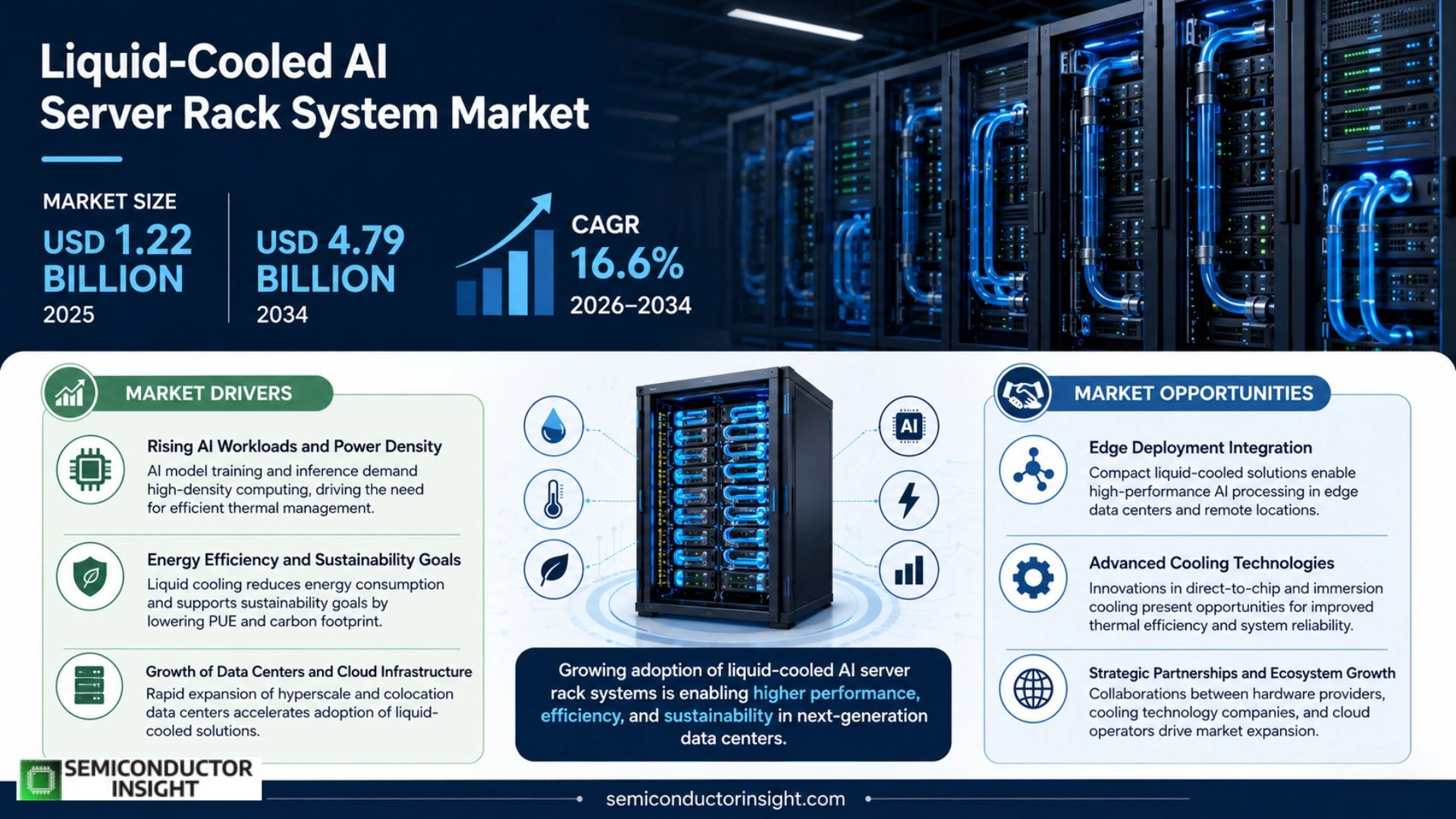
Global Liquid-Cooled AI Server Rack System Market size was valued at USD 1.22 billion in 2025. The market will increase from USD 1.22 billion in 2025 to USD 4.79 billion by 2034, reflecting a CAGR of approximately 16.6% over the forecast horizon.
Liquid‑cooled AI server rack systems integrate high‑density compute modules with closed‑loop coolant circulation that removes heat directly from processors and accelerators, bypassing traditional air‑based cooling constraints. By embedding micro‑channel cold plates and pump assemblies within the rack enclosure, these solutions sustain peak performance of GPUs and TPUs while reducing power usage effectiveness (PUE) below 1.2.
The sector is expanding because enterprises are scaling generative‑AI workloads that exceed the thermal limits of conventional racks; meanwhile, sustainability targets push data‑center operators toward technologies that cut energy consumption and carbon footprints. Recent collaborations such as Nvidia’s partnership with Dell Technologies on an integrated liquid‑cooled DGX chassis illustrate how OEMs are accelerating adoption across hyperscale clouds and research institutions.
MARKET DRIVERS
Thermal Efficiency Gains
Enterprises deploying large‑scale AI models are confronting escalating power‑density challenges. By routing heat directly to a liquid medium, systems can achieve up to 40 % reduction in cooling‑related energy consumption, which translates into lower operating costs and a smaller carbon footprint. This technical advantage is reshaping data‑center budgeting decisions.
Scalability for Dense AI Workloads
Modern transformer architectures demand densely packed GPU clusters. Liquid‑cooled rack designs enable rack‑level power densities exceeding 30 kW, a threshold unattainable with conventional air‑cooling. Operators can therefore squeeze more inference capacity into existing footprints, accelerating time‑to‑value for AI initiatives.
➤ Clients that transition to liquid‑cooled racks often report a 15‑20 % uplift in computational throughput owing to sustained thermal headroom.
Beyond cost and capacity, the reliability benefits,steady temperature control and reduced fan failures,drive procurement teams to favor these solutions, reinforcing the upward momentum of Liquid-Cooled AI Server Rack System Market.
MARKET CHALLENGES
Capital Expenditure Hurdles
The upfront outlay for liquid‑cooling infrastructure remains substantially higher than legacy air‑cooled equivalents. While lifecycle savings are compelling, many mid‑size operators struggle to secure the necessary capital, especially when budgeting cycles are constrained by short‑term ROI expectations.
Other Challenges
Supply Chain Constraints
Component shortages,particularly for high‑performance pumps and sealed coolant loops,have elongated lead times by 30 % on average. The bottleneck forces planners to adopt longer forecasting horizons, which can dampen market velocity.
Installation complexity adds another layer of risk; tight integration with existing power‑distribution units demands skilled engineering talent, a resource pool that many data‑center firms find scarce.
MARKET RESTRAINTS
Regulatory Energy Standards
Emerging regional energy‑efficiency directives require detailed reporting of cooling‑related power draw. Companies that cannot demonstrate compliance may face penalties, prompting hesitation among adopters who lack robust monitoring tools for liquid‑cooled racks.
MARKET OPPORTUNITIES
Edge Deployment Integration
Edge data centers, particularly those supporting autonomous vehicles and real‑time video analytics, are seeking compact cooling solutions. Liquid‑cooled rack systems can deliver high compute density within a reduced physical envelope, meeting the spatial constraints of edge sites while maintaining performance.
Additionally, sustainability programs sponsored by several governments are providing incentives for technologies that lower PUE (Power Usage Effectiveness). This policy environment creates a financing lever that can offset the initial cost premium, opening a pathway for broader adoption across Liquid-Cooled AI Server Rack System Market.
Liquid-Cooled AI Server Rack System Market Trends
Surge in High‑Density AI Deployments
Enterprises handling generative‑AI models are encountering thermal ceilings that traditional air‑cooled racks cannot sustain. By routing coolant directly to GPUs, TPUs and other accelerators, liquid‑cooled racks keep silicon within optimal temperature windows, allowing sustained clock speeds without throttling. The architectural shift also drives Power Usage Effectiveness (PUE) below 1.2, translating into measurable reductions in electricity bills and cooling‑plant footprints. Operators that prioritize both performance and sustainability see a clear business case: higher compute throughput per rack unit, lower operational expenditure, and alignment with corporate carbon‑reduction targets. Consequently, capital allocation toward liquid‑cooled infrastructure is moving from pilot projects to core data‑center expansions.
Other Trends
OEM Alliances Strengthen Market Momentum
Recent collaborations, such as Nvidia’s joint effort with Dell Technologies to deliver an integrated liquid‑cooled DGX chassis, illustrate how original equipment manufacturers are pooling expertise to lower integration risk for buyers. These alliances bundle micro‑channel cold plates, high‑efficiency pumps and custom firmware, delivering a turnkey solution that mitigates the engineering burden on hyperscale clouds and research labs. The market response has been a noticeable uptick in order volumes from organizations that previously hesitated due to perceived implementation complexity. As more OEMs announce similar partnerships, the ecosystem matures, encouraging smaller system integrators to adopt the technology with confidence.
Energy Efficiency Becomes a Differentiator
Beyond raw performance, the ability to shrink the data‑center’s carbon intensity is reshaping procurement criteria. Facilities that replace air‑cooled racks with liquid‑cooled alternatives report a 20‑30 % drop in overall energy consumption, a figure that directly improves net‑present‑value calculations for large‑scale deployments. This efficiency edge is increasingly cited in RFPs, where vendors must demonstrate tangible sustainability metrics. As utility tariffs rise and regulatory pressures intensify, the Liquid‑Cooled AI Server Rack System Market is likely to see buying decisions anchored more on total cost of ownership than on upfront hardware pricing.
COMPETITIVE LANDSCAPE
Key Industry Players
Competitive Landscape of Liquid‑Cooled AI Server Rack Systems
Dell Technologies, bolstered by its long‑standing relationship with Nvidia, dominates the high‑performance segment where integrated liquid‑cooled DGX chassis are becoming baseline equipment for hyperscale clouds. The firm’s ability to bundle hardware, firmware, and service contracts gives it leverage over pure‑play integrators, allowing Dell to set pricing benchmarks and dictate early‑stage design standards. Consolidation among component suppliers,pump manufacturers, coolant‑fluid specialists, and micro‑channel plate fabricators,has created a tiered ecosystem in which Dell orchestrates downstream value while relying on a narrow set of vetted partners to maintain reliability at scale. This arrangement means that any shift in Dell’s roadmap reverberates through the supply chain, pressuring smaller OEMs to either align with Dell’s specifications or carve out differentiated niches.
Beyond the Dell‑Nvidia axis, a cluster of specialised vendors is gaining traction by targeting verticals that demand bespoke thermal solutions. Supermicro leverages its modular chassis expertise to offer a menu of liquid‑cooled racks that can be retro‑fitted into existing data‑center footprints, appealing to research institutions with budget constraints. Lenovo and HPE focus on large‑enterprise contracts, embedding proprietary coolant distribution networks that promise sub‑1.2 PUE performance while preserving warranty simplicity. Companies such as Inspur, Quanta, and Atos emphasise regional manufacturing hubs in Asia‑Pacific and Europe, reducing lead times and logistics costs for local cloud providers. Niche players including Penguin Computing, Exxact Corp., GIGABYTE, and ASUS differentiate themselves through aggressive pricing or deep integration with specific AI accelerators, creating pockets of competition that keep the overall market agile.
List of Key Liquid‑Cooled AI Server Rack System Companies Profiled
- Dell Technologies
- Supermicro
- Lenovo
- HPE
- Inspur
- Quanta Computer
- Atos
- Penguin Computing
- Exxact Corp.
- GIGABYTE
- ASUS
- Huawei
- Intel
- AMD
- Broadcom
Segment Analysis:
| Segment Category | Sub-Segments | Key Insights |
| By Type |
|
Closed‑loop liquid cooling is emerging as the dominant architecture because it integrates precise coolant pathways directly to processors, enabling sustained high‑density workloads. • It preserves peak GPU and TPU performance while keeping power usage effectiveness below 1.2. • The modular pump and heat‑exchanger packages simplify retrofits in existing racks, accelerating adoption among forward‑looking data‑center operators. • Reliability is enhanced through sealed loops that reduce dust ingress and minimize routine maintenance cycles. |
| By Application |
|
Generative AI training drives the most intense cooling demands, prompting organizations to prioritize liquid‑cooled rack solutions. • The ability to sustain continuous, high‑throughput GPU cycles without thermal throttling accelerates model iteration cycles. • Sustainability initiatives favor liquid cooling because it sharply lowers overall energy consumption compared with traditional air‑based racks. • Strategic OEM collaborations, such as Nvidia‑Dell integrated chassis, showcase the market’s focus on turnkey, application‑specific platforms. |
| By End User |
|
Hyperscale cloud providers are the leading adopters, attracted by the ability to densify compute capacity while meeting aggressive sustainability goals. • Their massive scale justifies investments in advanced coolant distribution networks that can be standardized across global data‑center footprints. • Integration with orchestration software enables dynamic thermal management, aligning cooling effort directly with workload demand. • Partnerships with leading AI hardware vendors create ecosystem lock‑in, reinforcing the preference for liquid‑cooled racks. |
| By Cooling Architecture |
|
Micro‑channel cold plates command attention due to their superior heat‑transfer efficiency and compact form factor. • The fine‑scale channels maximize coolant contact area, extracting heat more rapidly than conventional plates. • Their integration into standard rack chassis allows seamless upgrades without redesigning the entire enclosure. • Vendors emphasize the reduced acoustic footprint, a benefit for facilities with strict noise constraints. |
| By Deployment Scale |
|
Full data‑center pods are gaining momentum as organizations look to standardize entire cooled environments. • Pods deliver an end‑to‑end liquid‑cooling solution that includes power distribution, networking, and thermal monitoring as a single consumable unit. • This approach shortens deployment cycles and reduces engineering overhead, appealing to both new builds and large‑scale upgrades. • The holistic design also simplifies sustainability reporting by providing clear metrics for coolant usage and energy savings. |
Regional Analysis: Liquid-Cooled AI Server Rack System Market
North America
Leading hyperscale operators allocate substantial capex toward retrofitting legacy aisles with liquid‑cooled racks, recognizing the direct link between thermal headroom and compute density. This investment pattern encourages equipment vendors to certify new AI processors on liquid‑cooled platforms, creating a virtuous cycle of technology adoption.
A concentration of thermal‑engineering talent in research hubs such as Silicon Valley and Toronto fuels rapid prototyping. Start‑ups focusing on micro‑channel heat exchangers benefit from venture funding, translating academic breakthroughs into commercial rack modules within months.
Energy‑efficiency incentives at federal and state levels reward data‑center operators that achieve lower Power Usage Effectiveness (PUE). Liquid‑cooling solutions, by cutting the need for large‑scale CRAC units, often qualify for these rebates, reinforcing market momentum.
Enterprise AI teams cite reduced thermal throttling as a decisive factor for selecting liquid‑cooled racks. The ability to sustain higher clock speeds without compromising reliability shortens model‑training cycles, delivering tangible business value.
Europe
European data‑center operators are advancing toward sustainability goals set by the EU Green Deal, and liquid‑cooled rack systems are positioned as a key enabler. In Germany and the Nordics, operators prioritize modular designs that can be integrated into existing facilities with minimal civil works. Collaboration between chassis manufacturers and fluid‑dynamics specialists yields solutions tailored to the higher ambient temperatures typical of Southern Europe, where cooling load spikes during summer months. While the market remains fragmented, the emergence of regional standards around coolant safety and recyclability is harmonizing procurement criteria, allowing larger vendors to scale across borders more efficiently.
Asia-Pacific
The Asia‑Pacific region exhibits a diverse landscape, with China and Japan spearheading large‑scale AI deployments while emerging economies such as India and Vietnam begin to explore liquid‑cooling to offset rising electricity costs. In Japan, data‑center operators leverage a cultural emphasis on reliability, prompting rigorous testing of rack seal integrity and leak detection systems. Chinese cloud providers, driven by the need to accommodate massive transformer‑level AI clusters, are investing in high‑density liquid‑cooled chassis that can fit within constrained footprints. The combination of aggressive capacity expansion and a growing emphasis on carbon‑neutral operations creates a fertile environment for Liquid-Cooled AI Server Rack System Market to mature across the sub‑region.
South America
South American markets are transitioning from traditional air‑cooled installations to more efficient liquid solutions as regional power grids experience volatility. Brazil’s leading telco operators, for instance, have piloted liquid‑cooled racks to stabilize thermal performance during peak demand periods. The region’s relatively nascent AI ecosystem benefits from technology transfer agreements that bring expertise from North American partners, accelerating the learning curve for local engineering teams. As governments introduce incentives for energy‑efficient infrastructure, providers that can demonstrate measurable PUE improvements are gaining a competitive edge.
Middle East & Africa
In the Middle East, extreme ambient temperatures make conventional air‑cooled designs costly to operate, prompting data‑center operators in the United Arab Emirates and Saudi Arabia to evaluate liquid‑cooled racks as a cost‑controlling measure. The high level of capital availability in the Gulf enables early adoption of cutting‑edge cooling modules, often bundled with AI‑optimized compute nodes. Africa, meanwhile, is witnessing an incremental rollout of edge data centers to support growing digital services; liquid‑cooled solutions are attractive for these sites due to their compact footprint and reduced reliance on large‑scale HVAC infrastructure. Partnerships with European cooling specialists are facilitating knowledge transfer, laying the groundwork for broader market acceptance.
Report Scope
This market research report provides a comprehensive analysis of the Liquid-Cooled AI Server Rack System Market , covering the forecast period 2026–2034. It offers detailed insights into market dynamics, technological advancements, competitive landscape, and key trends shaping the industry.
Key focus areas of the report include:
- Market Overview: The report begins with an overview outlining its current market scenario, key growth indicators, and industry transformation drivers. It discusses macroeconomic factors, demand–supply balance, regulatory landscape, and the strategic role of semiconductors in powering advancements across industries such as automotive, telecommunications, consumer electronics, and industrial automation.
- Market Size & Forecast: Historical data and future projections for revenue, unit shipments, and market value across major regions and segments.
- Segmentation Analysis: Detailed breakdown by product type, technology, application, and end-user industry to identify high-growth segments and investment opportunities.
- Regional Insights: Insights into market performance across North America, Europe, Asia-Pacific, Latin America, and the Middle East & Africa, including country-level analysis where relevant.
- Competitive Landscape: Profiles of leading market participants, including their product offerings, R&D focus, manufacturing capacity, pricing strategies, and recent developments such as mergers, acquisitions, and partnerships.
- Technology Trends & Innovation: Assessment of emerging technologies, integration of AI/IoT, semiconductor design trends, fabrication techniques, and evolving industry standards.
- Market Drivers & Restraints: Evaluation of factors driving market growth along with challenges, supply chain constraints, regulatory issues, and market-entry barriers.
- Stakeholder Insights: Insights for component suppliers, OEMs, system integrators, investors, and policymakers regarding the evolving ecosystem and strategic opportunities.
Primary and secondary research methods are employed, including interviews with industry experts, data from verified sources, and real-time market intelligence to ensure the accuracy and reliability of the insights presented.
FREQUENTLY ASKED QUESTIONS:
What is the current market size of Liquid-Cooled AI Server Rack System Market?
-> Liquid-Cooled AI Server Rack System Market was valued at USD 1.22 billion in 2025 and is expected to reach USD 4.79 billion by 2034.
Which key companies operate in Liquid-Cooled AI Server Rack System Market?
-> Key players include Axalta Coating Systems, AkzoNobel, BASF SE, PPG, Sherwin-Williams, and 3M, among others.
What are the key growth drivers?
-> Key growth drivers include railway infrastructure investments, urbanization, and demand for durable coatings.
Which region dominates the market?
-> Asia-Pacific is the fastest-growing region, while Europe remains a dominant market.
What are the emerging trends?
-> Emerging trends include bio-based coatings, smart coatings, and sustainable rail solutions.
Get Sample Report PDF for Exclusive Insights
Report Sample Includes
- Table of Contents
- List of Tables & Figures
- Charts, Research Methodology, and more...
 Download Sample Report PDF