Light Refraction Shaped Prism Market Insights
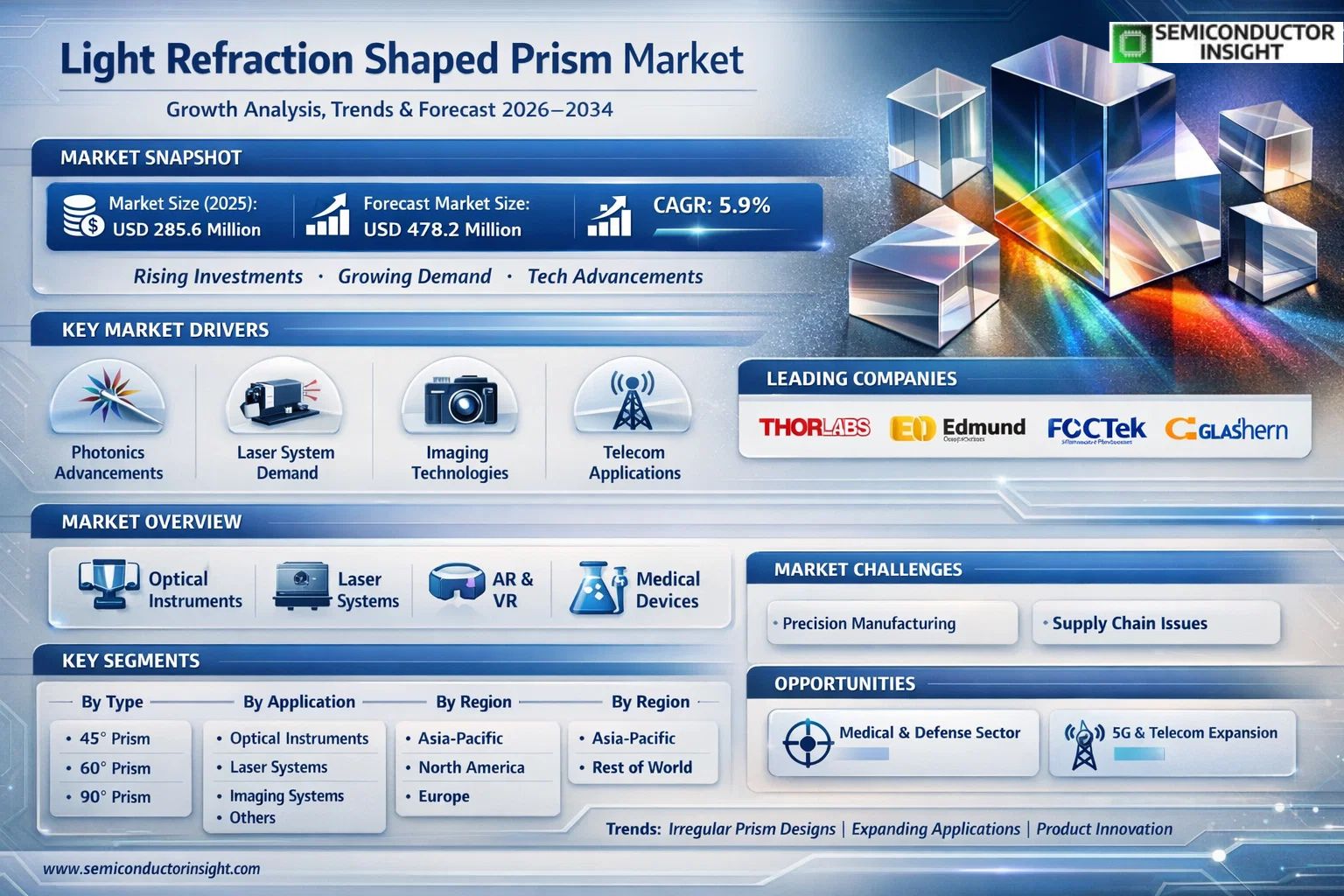
Global Light Refraction Shaped Prism market size was valued at USD 285.6 million in 2025. The market is projected to grow from USD 302.1 million in 2026 to USD 478.2 million by 2034, exhibiting a CAGR of 5.9% during the forecast period.
Light Refraction Shaped Prism is a specially designed optical element that can change the propagation path of light, achieve light folding (reflection) and change the propagation direction. Unlike traditional prisms, light refraction shaped prisms typically have asymmetric or irregular shapes to meet specific optical design requirements. The prisms include 45°Prism, 60°Prism, 90°Prism, and others.
The market is experiencing steady growth due to several factors, including increased investment in photonics, rising demand in laser systems, and growing applications in imaging technologies. Additionally, advancements in precision optics manufacturing and expanding use in sectors like telecommunications and medical devices contribute to market expansion. Initiatives by key players further fuel this momentum. Thorlabs, GLAShern, Wikioptics, Standa Photonics, FOCTek Photonics, Optocity, Edmund Optics, Crysmit Photonics, Mloptic, and Lante Optics are some of the key players operating in the market with wide-ranging portfolios.
MARKET DRIVERS
Advancements in Photonics and Laser Applications
Light Refraction Shaped Prism Market benefits from rapid innovations in photonics, where high-precision prisms are essential for beam steering and spectral analysis. Industries like telecommunications and scientific research increasingly rely on these components to enhance signal processing efficiency.
Growth in AR/VR and Semiconductor Sectors
Demand surges from augmented reality devices and semiconductor lithography, where shaped prisms enable precise light manipulation. Global adoption has propelled market expansion, with projections indicating a 6.5% CAGR through 2030 driven by these sectors.
➤ Key players report over 25% revenue growth from custom prism orders in high-tech applications
Overall, integration into emerging technologies continues to fuel sustained growth in Light Refraction Shaped Prism Market.
MARKET CHALLENGES
Precision Manufacturing Complexities
Achieving sub-micron tolerances in light refraction shaped prisms remains technically demanding, leading to higher defect rates and production delays. This impacts scalability for mass-market applications.
Other Challenges
Supply Chain Vulnerabilities
Fluctuations in optical glass availability disrupt manufacturing, with recent global events causing 15-20% cost increases for raw materials.
Competition from Alternative Optics
Fiber optic solutions offer cost advantages, challenging traditional prism dominance in certain segments and pressuring market share.
MARKET RESTRAINTS
Stringent Quality and Regulatory Standards
Light Refraction Shaped Prism Market faces constraints from rigorous ISO and industry-specific certifications, which extend development cycles and elevate compliance costs for manufacturers.
High-purity material requirements limit supplier options, contributing to price volatility amid geopolitical tensions affecting rare earth elements used in coatings.
Additionally, environmental regulations on chemical polishing processes add operational hurdles, slowing innovation pace in key regions.
These factors collectively temper market growth despite strong demand signals.
MARKET OPPORTUNITIES
Expansion in Medical Imaging and Defense
Opportunities abound in medical endoscopy and defense optics, where advanced light refraction shaped prisms improve imaging resolution and targeting accuracy.
Asia-Pacific’s manufacturing boom, coupled with R&D investments, positions the region for 40% of global market share by 2028.
Innovations like hybrid prism designs for 5G infrastructure further unlock potential, with analysts forecasting doubled adoption rates in telecom by mid-decade.
Sustainable sourcing initiatives also open doors for eco-friendly variants, appealing to green technology buyers.
Light Refraction Shaped Prism Market Trends
Advancements in Irregular Prism Designs
Light refraction shaped prisms represent specialized optical elements designed to alter light propagation paths, enabling light folding and direction changes through asymmetric or irregular shapes. These differ from traditional prisms by addressing unique optical requirements in precision applications. Industry surveys highlight ongoing innovations where manufacturers focus on customizing shapes for enhanced performance in complex systems, driving adoption across sectors requiring precise light manipulation.
Other Trends
Growth Across Product Types
Light Refraction Shaped Prism Market shows segmentation by product types including 45° prisms, 60° prisms, and 90° prisms, each tailored for specific refraction needs. Surveys of manufacturers and suppliers indicate varying demand patterns, with 45° prisms noted for applications needing moderate deviation angles, while 90° variants support right-angle deviations in compact setups. This diversification allows suppliers to meet diverse optical design specifications, fostering market adaptability.
Expansion in Application Segments
Demand in Light Refraction Shaped Prism Market is propelled by applications in optical instruments, laser systems, imaging systems, and others. Laser systems emerge as a key driver, leveraging these prisms for beam steering and path correction in high-power setups. Imaging systems benefit from irregular shapes that minimize aberrations, while optical instruments integrate them for enhanced resolution. Industry experts report steady integration trends, supported by developments in product customization to align with evolving technological demands in these areas.
Regionally, Light Refraction Shaped Prism Market exhibits potential across North America, Europe, Asia, South America, and Middle East & Africa, with key countries like the U.S., China, Germany, and Japan leading. North America emphasizes innovation in laser and imaging applications, while Asia, particularly China, sees rising production and demand due to expanding manufacturing capabilities. Competitive dynamics feature prominent players such as Thorlabs, Edmund Optics, FOCTek Photonics, and others, who hold significant revenue shares through strategic developments, mergers, and tailored offerings. Challenges include supply chain obstacles and restrictive factors, yet drivers like upstream material advancements and downstream integration propel sustained growth. Overall, these trends underscore a market oriented toward precision optics evolution.
COMPETITIVE LANDSCAPE
Key Industry Players
Top Light Refraction Shaped Prism Manufacturers by Revenue Share
Light Refraction Shaped Prism Market features a competitive landscape dominated by specialized optical manufacturers with strong expertise in custom prism fabrication. Leading players such as Thorlabs and Edmund Optics hold prominent positions, leveraging advanced precision engineering and global distribution networks to capture significant market share. The market structure is moderately concentrated, where the global top five players accounted for a substantial revenue portion in 2025. These frontrunners excel in producing irregular prisms for light folding and direction alteration, serving high-demand sectors like laser systems and imaging applications. Their competitive edge stems from in-house R&D, scalable production, and compliance with stringent optical tolerances, enabling them to address the needs of optical instruments and specialized designs.
Beyond the market leaders, a cadre of niche and regional players contributes to innovation and segmentation in the Light Refraction Shaped Prism sector. Companies like FOCTek Photonics, Standa Photonics, and Crysmit Photonics specialize in high-volume custom solutions, particularly for 45° and 90° prism variants, gaining ground in Asia-Pacific markets. Other significant entities, including Wikioptics, Optocity, Mloptic, and Lante Optics, focus on cost-effective alternatives and rapid prototyping, appealing to emerging applications in research and industrial optics. Galaxy Optics and additional specialists further diversify the ecosystem by targeting underserved niches such as 60° prisms for unique light refraction needs. This mix of established giants and agile innovators fosters ongoing technological advancements amid growing demand in North America, Europe, and Asia.
List of Key Light Refraction Shaped Prism Companies Profiled
- Thorlabs
- Edmund Optics
- FOCTek Photonics
- Standa Photonics
- GLAShern
- Wikioptics
- Optocity
- Crysmit Photonics
- Mloptic
- Lante Optics
- Galaxy Optics
- Precision Optics Corporation
- Knight Optical
Segment Analysis:
| Segment Category | Sub-Segments | Key Insights |
| By Type |
|
45° Prism
|
| By Application |
|
Laser Systems
|
| By End User |
|
Research Laboratories
|
| By Material |
|
BK7 Glass
|
| By Spectrum Range |
|
Visible
|
Regional Analysis: Light Refraction Shaped Prism Market
Asia-Pacific
Asia-Pacific excels in scalable production of Light Refraction Shaped Prisms, leveraging automated precision grinding and polishing techniques. Clusters in Shenzhen and Tokyo streamline operations, reducing lead times and ensuring high-volume output for global OEMs in optics and telecom, fostering market dominance through efficiency.
Leading research centers in the region pioneer novel prism geometries for enhanced light dispersion. Collaborations with universities yield breakthroughs in coatings that minimize aberrations, supporting applications in medical endoscopy and display technologies pivotal to Light Refraction Shaped Prism Market trends.
Surging adoption in consumer electronics and photonics drives prism integration for compact designs. Regional smartphone and laser projector manufacturers prioritize customized shapes, bolstering supply-demand synergy and strategic positioning in the competitive Light Refraction Shaped Prism landscape.
Diversified sourcing and localized raw material access mitigate disruptions, ensuring steady prism availability. Business strategies emphasize vertical integration, enhancing reliability for international clients and reinforcing Asia-Pacific’s role as a cornerstone in Light Refraction Shaped Prism Market.
North America
North America thrives in Light Refraction Shaped Prism Market through its focus on cutting-edge innovation and premium applications. The United States and Canada host advanced research labs developing specialized prisms for aerospace, defense, and scientific instruments, where precision light refraction is paramount. Tech giants integrate these components into lidar systems and high-resolution cameras, driving demand. A culture of entrepreneurship spurs startups to explore novel prism configurations for quantum computing and biotech imaging. Stringent quality standards and robust intellectual property frameworks encourage investment in sustainable manufacturing practices. Business strategies emphasize customization and rapid prototyping, catering to niche high-value segments. As trends evolve toward 2034, North America’s emphasis on R&D integration positions it for steady expansion, particularly in next-generation optical technologies.
Europe
Europe maintains a strong foothold in Light Refraction Shaped Prism Market, distinguished by its commitment to quality and regulatory compliance. Germany, France, and the UK lead with facilities producing prisms for automotive sensors, medical lasers, and environmental monitoring devices. Emphasis on eco-friendly materials aligns with EU directives, enhancing prism longevity and performance in light manipulation tasks. Collaborative ecosystems involving automakers and optics firms accelerate adoption in advanced driver-assistance systems. Strategic partnerships foster cross-border innovation, refining prism designs for broadband spectroscopy. Market dynamics favor premium, low-volume production, supporting diverse industrial needs. Looking to 2034, Europe’s balanced approach to sustainability and precision engineering ensures resilient growth in the Light Refraction Shaped Prism sector.
South America
South America emerges as a promising player in Light Refraction Shaped Prism Market, fueled by industrial diversification and infrastructure upgrades. Brazil and Mexico spearhead local assembly of prisms for renewable energy projects and agricultural optics. Growing telecommunications investments stimulate demand for cost-effective light refraction solutions in fiber networks. Regional manufacturers adapt global designs to tropical conditions, improving heat resistance. Capacity-building initiatives enhance workforce skills, bridging technology gaps. Business strategies prioritize affordability and partnerships with Asian suppliers for technology transfer. By 2034, rising urbanization and agrotech applications are set to elevate South America’s contribution to Light Refraction Shaped Prism Market dynamics.
Middle East & Africa
The Middle East & Africa region navigates Light Refraction Shaped Prism Market with niche strengths in energy and defense sectors. UAE and South Africa develop prisms for oil exploration imaging and satellite communications, leveraging light refraction for harsh-environment durability. Visionary diversification plans invest in optics hubs, attracting expertise. Custom prisms support solar concentrators and surveillance systems, aligning with infrastructure booms. Strategic imports complement emerging local production, building self-reliance. Market trends toward 2034 highlight potential in smart cities and resource management, where precise light control proves invaluable, gradually strengthening regional presence.
Report Scope
This market research report provides a comprehensive analysis of Light Refraction Shaped Prism Market, covering the forecast period 2026–2034. It offers detailed insights into market dynamics, technological advancements, competitive landscape, and key trends shaping the industry.
Key focus areas of the report include:
- Market Overview: The report begins with an overview outlining its current market scenario, key growth indicators, and industry transformation drivers. It discusses macroeconomic factors, demand–supply balance, regulatory landscape, and the strategic role of light refraction shaped prisms in powering advancements across industries such as optical instruments, laser systems, imaging systems, and others.
- Market Size & Forecast: Historical data and future projections for revenue, unit shipments, and market value across major regions and segments.
- Segmentation Analysis: Detailed breakdown by product type, technology, application, and end-user industry to identify high-growth segments and investment opportunities.
- Regional Insights: Insights into market performance across North America, Europe, Asia-Pacific, Latin America, and the Middle East & Africa, including country-level analysis where relevant.
- Competitive Landscape: Profiles of leading market participants, including their product offerings, R&D focus, manufacturing capacity, pricing strategies, and recent developments such as mergers, acquisitions, and partnerships.
- Technology Trends & Innovation: Assessment of emerging technologies, integration of AI/IoT, semiconductor design trends, fabrication techniques, and evolving industry standards.
- Market Drivers & Restraints: Evaluation of factors driving market growth along with challenges, supply chain constraints, regulatory issues, and market-entry barriers.
- Stakeholder Insights: Insights for component suppliers, OEMs, system integrators, investors, and policymakers regarding the evolving ecosystem and strategic opportunities.
Primary and secondary research methods are employed, including interviews with industry experts, data from verified sources, and real-time market intelligence to ensure the accuracy and reliability of the insights presented.
FREQUENTLY ASKED QUESTIONS:
What is the current market size of Light Refraction Shaped Prism Market?
-> Light Refraction Shaped Prism Market was valued at USD 285.6 million in 2025 and is expected to reach USD 478.2 million by 2034, at a CAGR of 5.9% during the forecast period.
Which key companies operate in Light Refraction Shaped Prism Market?
-> Key players include Thorlabs, GLAShern, Wikioptics, Standa Photonics, FOCTek Photonics, Optocity, Edmund Optics, Crysmit Photonics, Mloptic, Lante Optics, among others. In 2025, the global top five players had a share approximately % in terms of revenue.
What are the key growth drivers?
-> Key growth drivers include demand for specially designed optical elements to change light propagation paths, light folding, and direction alteration in applications like optical instruments, laser systems, and imaging systems.
Which region dominates the market?
-> North America, with the U.S. market estimated at USD million in 2025, while Asia, particularly China projected to reach USD million, shows strong potential.
What are the emerging trends?
-> Emerging trends include asymmetric or irregular shapes for specific optical designs, growth in 45° Prism segment to USD million by 2034 at a % CAGR, and expanding applications in laser and imaging systems.

Get Sample Report PDF for Exclusive Insights
Report Sample Includes
- Table of Contents
- List of Tables & Figures
- Charts, Research Methodology, and more...
 Download Sample Report PDF