MARKET INSIGHTS
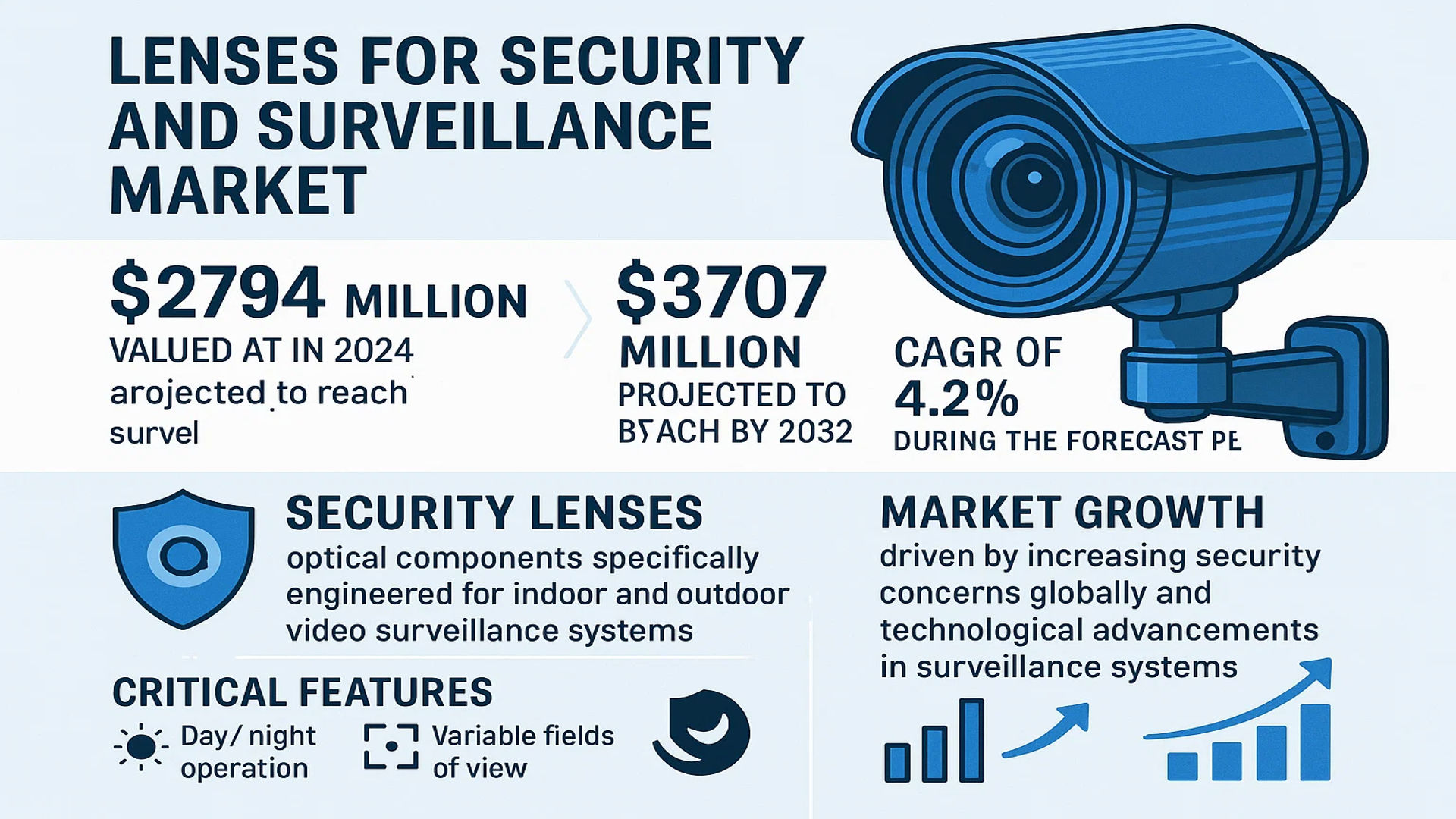
The global Lenses for Security and Surveillance Market was valued at 2794 million in 2024 and is projected to reach US$ 3707 million by 2032, at a CAGR of 4.2% during the forecast period.
Security lenses are optical components specifically engineered for indoor and outdoor video surveillance systems. These lenses offer critical features such as day/night operation, variable fields of view, superior low-light performance, and durability. Their compact design allows seamless integration into CCTV installations across various environments.
The market growth is driven by increasing security concerns globally and technological advancements in surveillance systems. The rising adoption of IP cameras and AI-powered video analytics further propels demand for high-performance lenses. Key industry players like Hikvision, Dahua Technology, and Axis Communications are investing in innovative lens technologies to enhance image clarity and wide-area coverage, creating significant growth opportunities.
MARKET DYNAMICS
MARKET DRIVERS
Rising Security Concerns and Smart City Initiatives Boost Demand for Surveillance Lenses
The global security landscape has witnessed heightened threats from terrorism, organized crime, and public safety incidents, driving governments and private entities to invest heavily in surveillance infrastructure. The global video surveillance market is projected to grow at over 10% annually, with lenses being a critical component for high-quality image capture. Urbanization trends paired with smart city development programs across Asia, Europe and North America are mandating advanced CCTV networks with superior optical capabilities. For instance, China’s ‘Safe Cities’ initiative has deployed over 200 million surveillance cameras as part of its public security modernization program, creating massive demand for precision lenses.
Technological Advancements in Imaging Systems Accelerate Market Adoption
Breakthroughs in lens manufacturing technologies have significantly improved low-light performance, zoom capabilities and durability – key requirements for 24/7 surveillance operations. The shift from analog to IP cameras with resolutions exceeding 4K has necessitated compatible high-performance lenses. Thermal imaging lenses capable of operating in complete darkness now represent one of the fastest growing segments, with military and critical infrastructure applications driving adoption. Leading manufacturers are integrating AI-powered autofocus and object tracking features directly into lens systems, enhancing their value proposition. These innovations have expanded use cases beyond traditional security into traffic management, retail analytics and industrial automation.
➤ The commercial sector accounts for approximately 38% of surveillance lens deployments globally, driven by retail chains, corporate campuses and hospitality venues prioritizing asset protection and customer behavior analysis.
Additionally, the development of compact panoramic lenses that eliminate blind spots while reducing installation costs is gaining traction across verticals. As security systems become more sophisticated, the demand for specialized lenses with enhanced optical characteristics will continue its upward trajectory.
MARKET RESTRAINTS
High Development Costs and Technical Complexity Limit Market Penetration
While demand grows, the surveillance lens market faces significant barriers in manufacturing complexity and R&D investment requirements. Precision optics manufacturing demands specialized materials, coating technologies and calibration processes that require capital-intensive production facilities. The average development cost for a new surveillance lens series can exceed $2 million, with lead times stretching over 18 months from design to mass production. This creates substantial entry barriers for new competitors and limits product iterations even for established players.
Other Constraints
Environmental Durability Challenges
Outdoor surveillance applications subject lenses to extreme weather conditions, requiring ruggedized designs with protective coatings. Maintaining optical clarity through temperature fluctuations from -40°C to +60°C while resisting moisture, dust and corrosion significantly increases production costs. These technical challenges particularly impact adoption in harsh climate regions despite growing security needs.
Compatibility Issues
The lack of standardization across camera manufacturers creates interoperability challenges, forcing lens producers to maintain extensive SKUs for different mounting systems and sensor sizes. This inventory complexity strains profit margins across the value chain while delaying system integration for end-users.
MARKET OPPORTUNITIES
Emerging Applications in Industrial IoT and Autonomous Systems Open New Growth Frontiers
Beyond traditional security use cases, industrial environments are increasingly deploying vision systems for quality control, equipment monitoring and process automation – applications demanding specialized optical solutions. The industrial lens segment is forecast to grow at nearly 12% annually as manufacturers implement Industry 4.0 initiatives. Machine vision lenses capable of micron-level precision and continuous operation in manufacturing environments represent a high-margin niche for specialized providers.
Strategic Partnerships Across Ecosystem Accelerate Innovation Cycles
Leading lens manufacturers are forming technology alliances with camera makers, AI software developers and system integrators to create optimized surveillance solutions. Such collaborations reduce time-to-market for advanced products while ensuring seamless integration across components. Joint development agreements also allow cost-sharing for next-generation technologies like multispectral imaging and 360° surveillance systems. These partnerships create competitive differentiation while expanding addressable markets through integrated offerings rather than standalone components.
MARKET CHALLENGES
Privacy Regulations and Public Acceptance Hinder Market Expansion
While security needs drive adoption, increasing privacy concerns and regulatory restrictions create headwinds for surveillance technology providers. The European Union’s General Data Protection Regulation (GDPR) imposes strict limitations on facial recognition and personal data collection, affecting lens system specifications. Public resistance to pervasive monitoring has led several municipalities to ban certain surveillance technologies, creating a patchwork of compliance requirements. These dynamics force manufacturers to balance performance capabilities with privacy-by-design principles, often requiring costly product modifications.
Supply Chain Vulnerabilities
The surveillance lens industry relies on specialized optical glass and rare earth elements predominantly sourced from limited geographical regions. Recent trade tensions and pandemic-induced disruptions exposed vulnerabilities in this concentrated supply chain. Price volatility for key materials like optical-grade silica and germanium compounds directly impacts production costs and product availability.
LENSES FOR SECURITY AND SURVEILLANCE MARKET TRENDS
High-Resolution Imaging and AI Integration Driving Market Growth
The global security and surveillance lens market is experiencing rapid advancements in high-resolution imaging capabilities, fueled by the rising demand for 4K and 8K lenses. With increasing security threats, the adoption of intelligent surveillance systems has surged, leading to a projected market valuation of US$ 3707 million by 2032. The integration of Artificial Intelligence (AI) in lens technology has significantly enhanced functions such as facial recognition, motion detection, and low-light performance, further boosting market demand. Additionally, advancements in thermal imaging and infrared lenses have expanded applications in military and critical infrastructure security.
Other Trends
Shift Towards Compact and Multi-Functional Lenses
Manufacturers are increasingly focusing on developing compact, lightweight lenses with improved optical performance to cater to modern surveillance systems. Multi-functional lenses with adjustable focal lengths and auto-iris capabilities are gaining traction, particularly in smart city projects. The commercial sector, including retail and transportation, has shown significant adoption of these lenses due to their ability to capture wide-angle, high-definition footage with minimal distortion. Furthermore, the rise of IoT-driven surveillance has accelerated the need for energy-efficient and durable lenses suitable for 24/7 monitoring in diverse environmental conditions.
Rising Demand for Industrial and Critical Infrastructure Security
The industrial segment is witnessing heightened demand for ruggedized lenses capable of withstanding extreme conditions, including high temperatures, dust, and vibrations. With industrial automation and stringent regulatory requirements, companies are investing in advanced surveillance systems to ensure operational safety and asset protection. Meanwhile, critical infrastructure sectors such as oil & gas and power plants are increasingly adopting pan-tilt-zoom (PTZ) lenses for real-time monitoring. The Asia-Pacific region is leading this growth, driven by rapid urbanization and government initiatives to enhance public safety.
COMPETITIVE LANDSCAPE
Key Industry Players
Leading Manufacturers Expand Surveillance Lens Capabilities Amid Rising Security Demands
The global security and surveillance lens market features a mix of established optical specialists and emerging technology providers, with competition intensifying as advancements in AI-powered surveillance systems drive demand for higher-performance lenses. Fujifilm and Tamron currently dominate the high-end segment, leveraging decades of optical engineering expertise to produce lenses with superior low-light performance and distortion correction. According to industry analysis, these two companies collectively held over 30% of the professional surveillance lens market share in 2024.
The competitive landscape is evolving rapidly as Chinese manufacturers like Hikvision and Dahua Technology expand their optical component capabilities. These vertically integrated security solution providers have been gaining market share through competitive pricing and domestic supply chain advantages, particularly in the Asia-Pacific region where urban security infrastructure expansions are accelerating. Meanwhile, European players such as MOBOTIX and Axis Communications are differentiating themselves through specialized lenses for harsh environments and advanced thermal imaging applications.
Recent industry trends show increasing investment in multi-sensor panoramic lenses and 4K/8K resolution capabilities, with companies like Hanwha Techwin and VIVOTEK launching innovative product lines featuring enhanced digital zoom preservation and wider dynamic range. The commercial segment, particularly in retail and transportation applications, has emerged as a key battleground for lens manufacturers, accounting for approximately 42% of total market revenue according to recent estimates.
List of Key Security and Surveillance Lens Manufacturers
- Fujifilm (Japan)
- Hikvision (China)
- Dahua Technology (China)
- VIVOTEK (Taiwan)
- MOBOTIX (Germany)
- Hanwha Techwin (South Korea)
- AV Costar (U.S.)
- Tamron (Japan)
- Fujinon (Japan)
- United Optoelectronics (China)
- Honeywell Security (U.S.)
- Axis Communications (Sweden)
- American Dynamics (U.S.)
Segment Analysis:
By Type
Zoom Lens Segment Holds Significant Share Due to Growing Demand for Flexible Surveillance Solutions
The market is segmented based on type into:
- Fixed Focus Lens
- Subtypes: Standard fixed, Wide-angle fixed, Telephoto fixed
- Zoom Lens
- Subtypes: Motorized zoom, Manual zoom, Vari-focal
By Application
Commercial Use Dominates Market Owing to Rising Security Needs in Business Establishments
The market is segmented based on application into:
- Military Use
- Industrial Use
- Commercial Use
- Subtypes: Retail, Banking, Office buildings, Hospitality
- Others
By Technology
Day/Night Cameras Lead the Market with Their Enhanced Low-Light Capabilities
The market is segmented based on technology into:
- Day/Night Cameras
- Thermal Imaging
- Infrared (IR) Cameras
By Mounting Type
Dome Cameras Gain Traction Due to Their Discreet Nature and Vandal-Proof Design
The market is segmented based on mounting type into:
- Box Cameras
- Dome Cameras
- PTZ Cameras
- Bullet Cameras
Regional Analysis: Lenses for Security and Surveillance Market
Asia-Pacific
The Asia-Pacific region dominates the global security and surveillance lenses market, accounting for over 40% of revenue share in 2024. China leads adoption due to massive smart city initiatives, including the installation of over 200 million CCTV cameras nationwide by 2025. Japan and South Korea drive demand for high-resolution, low-light lenses with advanced optical technologies. India shows rapid growth due to increasing security spending in public infrastructure and retail sectors. While pricing pressures exist in emerging markets, manufacturers are focusing on cost-effective solutions without compromising quality.
North America
North America remains a key innovation hub for high-performance surveillance lenses, particularly in the U.S. where the commercial sector accounts for nearly 60% of demand. Stringent homeland security regulations and rising investment in AI-powered surveillance systems (projected to reach $15 billion by 2027) are accelerating adoption of advanced varifocal and thermal imaging lenses. The region favors premium, durable products with advanced features like fog penetration and vandal-resistant designs, creating opportunities for specialized manufacturers.
Europe
European demand focuses on compliance with strict GDPR regulations and the need for privacy-conscious surveillance solutions. Germany and the U.K. lead in adopting 4K and ultra-HD lenses for critical infrastructure protection. The region shows increasing preference for compact, energy-efficient designs compatible with smart building systems. Western Europe accounts for over 70% of regional market value, though Eastern Europe is emerging as a growth area with modernization of urban surveillance networks in Poland and Czech Republic.
Middle East & Africa
The MEA market is driven by security-focused infrastructure projects in the GCC countries, particularly UAE and Saudi Arabia where cities like Dubai deploy advanced surveillance for urban safety. Market growth is supported by government initiatives like Saudi Vision 2030, which includes $20 billion smart city investments. However, adoption faces challenges in Africa due to budget constraints, leading to demand for refurbished and lower-cost lens solutions. Thermal imaging lenses see growing use in border security applications across the region.
South America
Brazil represents nearly half of South America’s surveillance lens demand, driven by rising crime rates and upcoming mega-events requiring temporary security solutions. While economic instability slows market growth, there’s increasing interest in long-range PTZ (pan-tilt-zoom) lenses for critical facility protection. Price sensitivity remains a key factor, with local governments often opting for mid-range products from Asian manufacturers. Colombia and Chile show steady growth in commercial surveillance, particularly for retail banking applications.
Technology Trends Influencing Regional Markets
Across all regions, there’s notable shift toward AI-optimized lenses capable of edge processing, with Asia-Pacific leading in adoption due to large-scale smart city deployments. Night vision capabilities show strongest growth in Middle East and African markets where infrastructure limitations exist. Manufacturers are increasingly customizing lens specifications to meet regional regulatory requirements and environmental conditions.
Report Scope
This market research report provides a comprehensive analysis of the global and regional Lenses for Security and Surveillance markets, covering the forecast period 2025–2032. It offers detailed insights into market dynamics, technological advancements, competitive landscape, and key trends shaping the industry.
Key focus areas of the report include:
- Market Size & Forecast: Historical data and future projections for revenue, unit shipments, and market value across major regions and segments. The global market was valued at USD 2,794 million in 2024 and is projected to reach USD 3,707 million by 2032, growing at a CAGR of 4.2%.
- Segmentation Analysis: Detailed breakdown by product type (Fixed Focus Lens, Zoom Lens), application (Military, Industrial, Commercial, Others), and end-user industry to identify high-growth segments and investment opportunities.
- Regional Outlook: Insights into market performance across North America, Europe, Asia-Pacific, Latin America, and the Middle East & Africa, including country-level analysis where relevant. Asia-Pacific dominates due to rapid urbanization and security infrastructure development.
- Competitive Landscape: Profiles of leading market participants, including Fujifilm, Hikvision, Dahua Technology, VIVOTEK, and MOBOTIX, their product offerings, R&D focus, manufacturing capacity, pricing strategies, and recent developments such as mergers, acquisitions, and partnerships.
- Technology Trends & Innovation: Assessment of emerging technologies like AI-powered surveillance, thermal imaging integration, and advanced low-light performance enhancements in security lenses.
- Market Drivers & Restraints: Evaluation of factors driving market growth such as increasing security concerns, smart city initiatives, and government regulations, along with challenges like high costs and supply chain disruptions.
- Stakeholder Analysis: Insights for component suppliers, OEMs, system integrators, investors, and policymakers regarding the evolving ecosystem and strategic opportunities in the security surveillance market.
Primary and secondary research methods are employed, including interviews with industry experts, data from verified sources, and real-time market intelligence to ensure the accuracy and reliability of the insights presented.
FREQUENTLY ASKED QUESTIONS:
What is the current market size of Global Lenses for Security and Surveillance Market?
-> Lenses for Security and Surveillance Market was valued at 2794 million in 2024 and is projected to reach US$ 3707 million by 2032, at a CAGR of 4.2% during the forecast period.
Which key companies operate in Global Lenses for Security and Surveillance Market?
-> Key players include Fujifilm, Hikvision, Dahua Technology, VIVOTEK, MOBOTIX, Hanwha Techwin, and Tamron, among others.
What are the key growth drivers?
-> Key growth drivers include rising security concerns, smart city projects, and technological advancements in surveillance systems.
Which region dominates the market?
-> Asia-Pacific leads the market, driven by China’s extensive surveillance infrastructure, while North America remains a significant market due to high security investments.
What are the emerging trends?
-> Emerging trends include AI-powered analytics, 4K/8K resolution lenses, and thermal imaging integration for enhanced security surveillance.

Get Sample Report PDF for Exclusive Insights
Report Sample Includes
- Table of Contents
- List of Tables & Figures
- Charts, Research Methodology, and more...
 Download Sample Report PDF