
LED Display Screen MARKET INSIGHTS
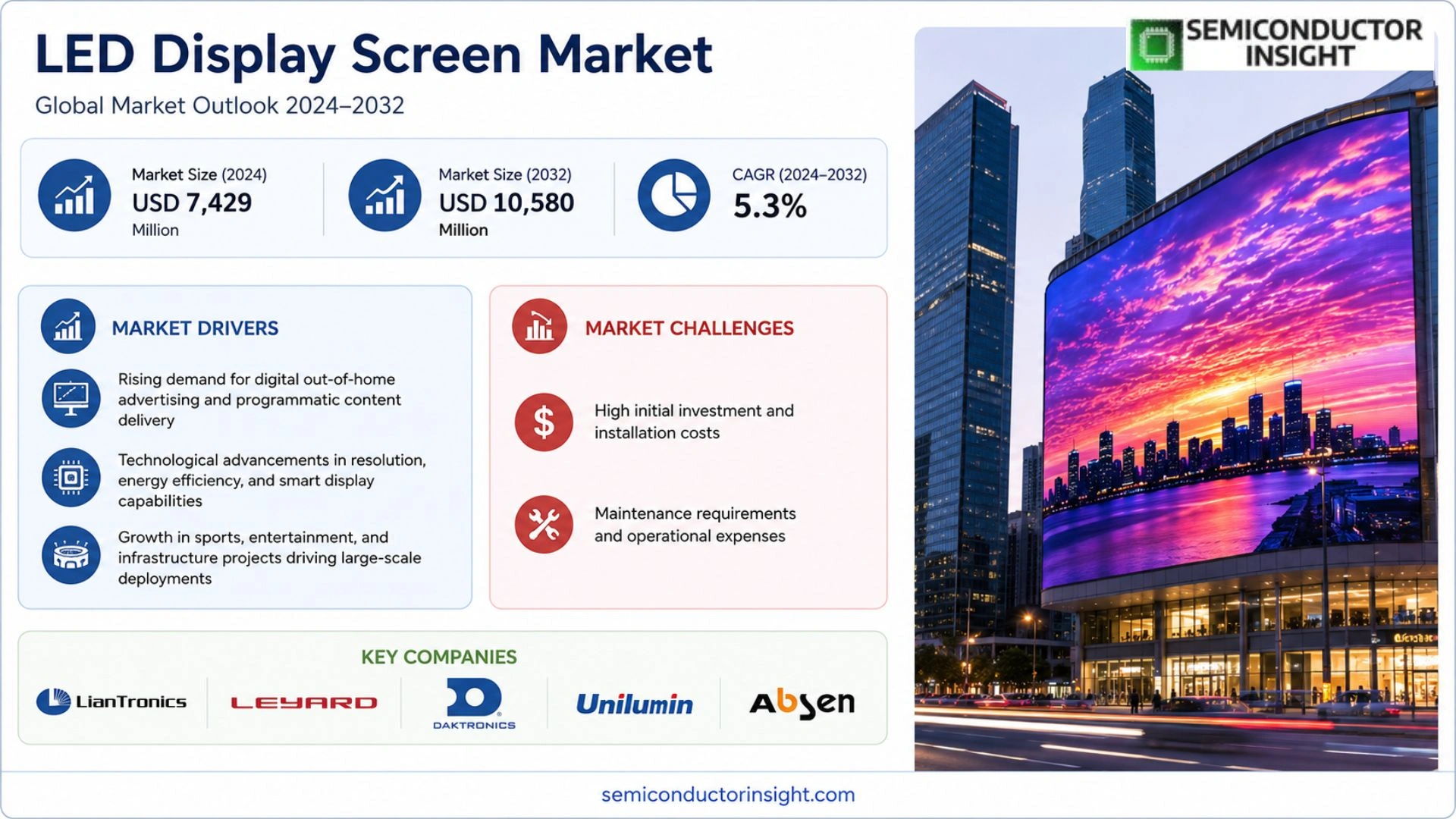
Global LED Display Screen Market was valued at 7429 million in 2024 and is projected to reach USD 10580 million by 2032, at a CAGR of 5.3% during the forecast period.
A Light Emitting Diode (LED) Display Screen is a flat panel display technology that utilizes an array of light-emitting diodes as pixels for a video display. These screens are renowned for their high brightness, energy efficiency, and long lifespan, making them suitable for a wide range of applications from small indoor panels to massive outdoor billboards. They are fundamentally changing visual communication by offering superior image quality and flexibility in size and shape compared to traditional display technologies.
The market’s steady growth is driven by several key factors, including the increasing adoption of digital out-of-home (DOOH) advertising, the proliferation of large-scale events and sports venues, and the declining cost of LED technology. Furthermore, the rising demand for high-resolution and fine-pitch displays for indoor corporate and retail environments is a significant contributor to market expansion. The competitive landscape is intense, with the top three players Liantronics, Leyard, and Daktronics collectively holding a 26% market share. Geographically, the Asia-Pacific region dominates, accounting for 49% of global sales, largely because it is a major manufacturing hub and has high infrastructure development spending.
LED Display Screen MARKET DYNAMICS
LED Display Screen MARKET DRIVERS
Rising Demand for Digital Out-of-Home Advertising to Accelerate Market Expansion
Global shift towards digital advertising is significantly driving LED Display Screen Market, with digital out-of-home (DOOH) advertising emerging as a dominant force. Traditional static billboards are rapidly being replaced by dynamic, high-resolution LED displays that offer superior visibility, engagement, and content flexibility. Global DOOH advertising market is projected to grow substantially, with expenditures increasing by over 15% annually as brands seek more impactful ways to reach consumers. Major urban centers worldwide are witnessing a surge in installations, particularly in high-traffic areas such as Times Square in New York and Shibuya Crossing in Tokyo, where advertisers pay premium rates for prime digital real estate. This transition is not merely aesthetic; it is driven by data showing that digital displays can increase brand recall by up to 18% compared to static alternatives. Furthermore, programmatic advertising capabilities allow for real-time content updates and targeted messaging based on time of day, weather, or audience demographics, making LED displays an indispensable tool for modern marketers.
Technological Advancements in Display Capabilities to Fuel Adoption
Continuous innovation in LED technology is a primary catalyst for market growth, with manufacturers consistently pushing the boundaries of resolution, brightness, and energy efficiency. The development of fine-pitch and micro-LED displays has unlocked new applications in indoor settings such as corporate lobbies, retail stores, and control rooms, where closer viewing distances demand higher pixel densities. These advancements have reduced pixel pitches to below 1.0mm, enabling crystal-clear images even at close range. Energy consumption has decreased by approximately 40% over the past five years due to improved diode efficiency and intelligent power management systems, addressing one of the historical drawbacks of large-format displays. Additionally, the integration of smart technologies such as IoT sensors for real-time performance monitoring and automated brightness adjustment based on ambient light conditions has enhanced operational reliability and reduced maintenance costs. These innovations are expanding the total addressable market beyond traditional outdoor applications into sectors requiring high-quality visual solutions.
Growth in Sports and Entertainment Infrastructure to Drive Large-Scale Deployments
Global expansion and modernization of sports arenas, concert venues, and entertainment complexes are creating sustained demand for large-scale LED display solutions. Stadiums worldwide are investing in high-definition video screens, ribbon displays, and perimeter boards to enhance spectator experiences and generate additional advertising revenue. The recent trend of constructing multifunctional venues capable of hosting diverse events necessitates versatile display systems that can accommodate various content formats. Major sporting events such as the FIFA World Cup and the Olympics often catalyze significant investments in display technology, with host cities upgrading infrastructure to meet international standards. Beyond sports, the live events industry is rebounding strongly, with concert tours and festivals incorporating increasingly sophisticated visual displays as integral components of production design. This sector’s growth is complemented by rising consumer expectations for immersive experiences, ensuring continued investment in cutting-edge display technologies.
LED Display Screen MARKET CHALLENGES
High Initial Investment and Operational Costs to Impede Widespread Adoption
Despite declining component prices, the substantial capital expenditure required for high-quality LED display installations remains a significant barrier to entry for many potential users. A large-format outdoor display can cost several hundred thousand dollars, with additional expenses for structural support, content management systems, and installation. Maintenance costs also present an ongoing challenge, as displays require regular servicing to address issues such as dead pixels, power supply failures, and environmental damage. In regions with extreme weather conditions, protective measures against moisture, temperature fluctuations, and physical impacts add to the total cost of ownership. These financial considerations are particularly impactful for small and medium-sized businesses that may lack the budget for such investments, limiting market penetration in certain segments. While total cost of ownership has improved over time, the perception of high upfront costs continues to influence purchasing decisions across various end-user categories.
Other Challenges
Technical Complexity and Reliability Concerns
The sophisticated nature of modern LED displays introduces technical challenges related to system integration, calibration, and long-term reliability. Achieving uniform brightness and color consistency across large display areas requires precise manufacturing and careful installation, with even minor variations potentially creating visible imperfections. Complex control systems and networking infrastructure must be meticulously configured to ensure seamless operation, requiring specialized expertise that may not be readily available in all markets. Reliability remains a critical concern, particularly for mission-critical applications where display failure could result in significant operational disruptions or revenue loss. While manufacturers have made substantial progress in improving product longevity and failure rates, the perception of technical risk continues to influence purchasing decisions, especially among customers with limited technical support capabilities.
Environmental and Regulatory Compliance Pressures
Increasing environmental awareness and regulatory requirements present additional challenges for market participants. Energy consumption regulations in various jurisdictions mandate efficiency standards that products must meet, potentially limiting the use of certain technologies or designs. Restrictions on light pollution in urban areas may limit installation locations or require brightness controls that affect display performance. Additionally, end-of-life management considerations are gaining importance, with regulations regarding electronic waste disposal and recycling becoming more stringent. Compliance with these diverse requirements adds complexity to product development and may increase costs, particularly for manufacturers operating in multiple international markets with differing regulatory frameworks.
MARKET RESTRAINTS
Limited Content Creation Capabilities to Hinder Market Potential
The effectiveness of LED display installations is fundamentally dependent on the quality and quantity of available content, creating a significant restraint for market growth. Many organizations invest in display technology without fully considering the ongoing content creation requirements, leading to underutilized assets that fail to deliver expected returns. Professional content production for large-format displays requires specialized skills and software tools, with costs that can rival the hardware investment itself. This challenge is particularly acute for digital signage applications where content must be frequently refreshed to maintain audience engagement. The shortage of skilled content creators familiar with the unique requirements of LED displays exacerbates this issue, especially in emerging markets where digital media expertise may be limited. Without a steady stream of high-quality content, even the most technologically advanced displays can become ineffective, reducing the perceived value proposition and potentially discouraging future investments.
MARKET OPPORTUNITIES
Emerging Applications in Retail and Corporate Environments to Create New Growth Avenues
The retail sector presents substantial growth opportunities as merchants increasingly recognize the value of digital displays for enhancing customer experiences and driving sales. Interactive LED displays capable of integrating with mobile devices and inventory systems enable personalized shopping experiences that blend physical and digital retail elements. Corporate applications are also expanding rapidly, with enterprises using LED video walls for data visualization, conference room presentations, and brand reinforcement in reception areas. The declining cost of indoor displays with finer pixel pitches is making these applications economically viable for a broader range of organizations. Additionally, the integration of artificial intelligence for content optimization and audience analytics is creating new value propositions that extend beyond mere visual presentation. These emerging applications represent a significant expansion of the addressable market beyond traditional outdoor advertising and sports venue uses.
Advancements in Transparent and Flexible Display Technologies to Enable Novel Applications
Recent developments in transparent LED technology are creating opportunities for innovative applications in retail storefronts, museum exhibits, and architectural integration. These displays maintain visibility through the screen while presenting digital content, enabling creative implementations that were previously impossible. Flexible LED panels that can conform to curved surfaces expand design possibilities for architects and interior designers, allowing displays to be incorporated into non-traditional shapes and spaces. The automotive industry is exploring these technologies for augmented reality windshields and interactive surfaces within vehicles. While these applications currently represent a small segment of the overall market, they demonstrate the potential for technology-driven market expansion into entirely new categories. As manufacturing processes improve and costs decrease, these innovative display formats are expected to account for an increasing proportion of overall market revenue.
Infrastructure Development in Emerging Economies to Drive Future Growth
Rapid urbanization and economic development in emerging markets, particularly across Asia and the Middle East, are creating substantial opportunities for LED display implementations. New commercial developments, transportation hubs, and public spaces in these regions often incorporate digital displays as elements of modern infrastructure. Government initiatives promoting smart city development frequently include digital signage components for public information dissemination and wayfinding. The comparatively lower penetration of display technology in these markets presents significant growth potential, particularly as disposable incomes rise and digital advertising becomes more established. International manufacturers are increasingly focusing on these regions, developing products specifically tailored to local requirements and environmental conditions. This geographical expansion represents a crucial growth vector that may help offset saturation in more developed markets.
LED DISPLAY SCREEN MARKET TRENDS
Rising Demand for High-Resolution Outdoor Advertising to Drive Market Growth
Global LED Display Screen Market is experiencing substantial growth, primarily fueled by the escalating demand for high-resolution outdoor advertising solutions. With the outdoor segment accounting for over 60% of the total market revenue, advertisers are increasingly adopting LED technology for its superior brightness, weather resistance, and energy efficiency compared to traditional display methods. The transition from conventional billboards to digital LED displays has accelerated, particularly in urban centers and high-traffic areas, where their dynamic content capabilities offer greater engagement and higher return on investment. Furthermore, technological advancements have enabled finer pixel pitches, allowing for clearer images even at close viewing distances, which has expanded their application beyond large-scale billboards to more detailed retail and informational displays. This trend is further supported by decreasing manufacturing costs and improved durability, making LED displays a more accessible and long-term solution for outdoor advertising needs.
Other Trends
Integration with Smart City Infrastructure
The integration of LED display screens into smart city infrastructure represents a significant trend, enhancing urban communication and public information systems. Municipalities worldwide are deploying these displays for real-time traffic updates, public safety announcements, and event information, contributing to more efficient and informed urban environments. The adoption rate in smart city projects has increased by approximately 25% annually over the past three years, reflecting their growing importance in urban planning. These displays are not only used for informational purposes but also for enhancing civic engagement through interactive features and connectivity with IoT devices. The synergy between LED technology and smart city initiatives is driving innovation, leading to more versatile and multifunctional display solutions that support a wide range of public services and communications.
Advancements in Mini-LED and Micro-LED Technologies
Technological advancements in Mini-LED and Micro-LED are revolutionizing the display market by offering enhanced contrast ratios, higher brightness levels, and improved energy efficiency. Mini-LED displays, which utilize LEDs that are 100-200 micrometers in size, provide superior backlighting control, resulting in deeper blacks and more vibrant colors compared to conventional LCDs. Micro-LED technology, with LEDs smaller than 50 micrometers, enables self-emissive displays that do not require backlighting, offering even greater contrast and energy savings. These innovations are particularly impactful in the indoor display segment, where high image quality is critical for applications such as control rooms, broadcast studios, and luxury retail environments. The development of these technologies is driving down costs and increasing adoption rates, making high-performance displays more accessible across various sectors.
COMPETITIVE LANDSCAPE
Key Industry Players
Companies Strive to Strengthen their Product Portfolio to Sustain Competition
Global LED Display Screen Market exhibits a semi-consolidated competitive structure, characterized by a dynamic mix of multinational corporations, established regional leaders, and emerging specialized manufacturers. This landscape is intensely competitive, driven by technological innovation, pricing strategies, and the ability to secure large-scale commercial and infrastructure projects. The market’s top three players Liantronics, Leyard, and Daktronics collectively commanded a significant 26% market share in 2024, underscoring their dominant position. Their leadership is primarily attributed to extensive R&D investments, robust global distribution networks, and a proven track record in delivering high-reliability solutions for demanding applications like sports arenas and large-format outdoor advertising.
Leyard, a global leader, maintains its stronghold through continuous innovation in fine-pitch LED technology and virtual production (VP) walls, catering to the booming film and broadcast industry. Similarly, Daktronics leverages its deep-rooted presence in North American sports venues and digital billboards, benefiting from long-term maintenance and service contracts that provide recurring revenue. Meanwhile, Chinese manufacturers like Liantronics and Unilumin have aggressively expanded their global footprint, competing effectively on cost-efficiency and scalability, particularly in the high-volume advertising media and information display segments. Their growth is further propelled by strong governmental support for the electronics manufacturing sector within the Asia-Pacific region, which itself accounted for 49% of global sales in 2024.
Furthermore, these leading companies are actively pursuing growth through strategic initiatives. Geographical expansion into emerging markets, strategic mergers and acquisitions to acquire complementary technologies or market access, and a relentless stream of new product launches featuring higher resolutions, improved energy efficiency, and novel form factors like transparent displays are common tactics. These efforts are crucial not only for capturing additional market share but also for defending existing territories from encroaching competitors.
Meanwhile, other significant players like Barco and Mitsubishi Electric are strengthening their market positions by focusing on high-value, specialized niches. Barco, for instance, emphasizes its expertise in control room and mission-critical visualization solutions, often integrating advanced software with its hardware. Mitsubishi Electric leverages its strong brand reputation for quality and reliability in the corporate and public infrastructure sectors. These companies, along with others, are making significant investments in R&D to develop next-generation MicroLED and COB (Chip-on-Board) technologies, ensuring their continued relevance and growth in an increasingly innovation-driven competitive landscape.
List of Key LED Display Screen Companies Profiled
- Liantronics (China)
- Leyard (China)
- Daktronics (U.S.)
- Unilumin (China)
- Absen (China)
- Barco (Belgium)
- Lighthouse (China)
- Sansitech (China)
- Ledman (China)
- Mitsubishi Electric (Japan)
- AOTO (China)
Segment Analysis:
By Type
Outdoor LED Display Screen Segment Dominates the Market Due to High Demand for Digital Billboards and Large-Scale Public Infrastructures
The market is segmented based on type into:
- Indoor LED Display Screen
- Subtypes: Fine Pitch LED, Standard LED, and others
- Outdoor LED Display Screen
- Subtypes: Billboards, Perimeter LED Boards, and others
- Transparent LED Display Screen
- Flexible LED Display Screen
- Rental LED Display Screen
- Others
By Application
Advertising Media Segment Leads Due to Extensive Use in Digital Out-of-Home (DOOH) Advertising and Brand Promotion
The market is segmented based on application into:
- Advertising Media
- Information Display
- Sports Arena
- Stage Performance
- Traffic & Security
- Others
By End User
Commercial End User Segment Holds Significant Share Driven by Retail, Hospitality, and Corporate Sectors
The market is segmented based on end user into:
- Commercial
- Subtypes: Retail, Hospitality, Corporate, and others
- Government & Public Sector
- Entertainment & Events
- Sports & Recreation
- Transportation
- Others
By Technology
Surface-Mounted Device (SMD) Technology is Prevalent Due to Superior Brightness, Resolution, and Energy Efficiency
The market is segmented based on technology into:
- Surface-Mounted Device (SMD)
- Direct-View LED
- Conventional LED
- Others
Regional Analysis: LED Display Screen Market
Asia-Pacific
Asia-Pacific dominates the global LED Display Screen Market, accounting for approximately 49% of total sales. This leadership is primarily driven by massive manufacturing capabilities and extensive domestic consumption in China, which is home to industry giants like Liantronics, Leyard, and Unilumin. The region benefits from aggressive infrastructure development, rapid urbanization, and significant investments in smart city projects across major economies including India, Japan, and South Korea. High demand from the advertising media sector, coupled with widespread adoption in sports arenas and public information displays, fuels consistent growth. However, intense local competition places pressure on pricing and margins, while environmental regulations are gradually becoming more stringent, influencing production practices.
North America
North America holds the second-largest market share at 27%, characterized by high adoption of advanced, high-resolution LED displays across diverse applications. The United States is the key contributor, with robust demand from the sports and entertainment industries, digital out-of-home (DOOH) advertising, and corporate sectors. Technological innovation is a major driver, with a strong focus on fine-pitch indoor displays and transparent LED solutions. Major players like Daktronics have a significant presence, catering to a quality-conscious market that values reliability and cutting-edge features. High consumer spending power and the presence of numerous global brands support steady market expansion, though competition from cost-effective Asian imports remains a challenge.
Europe
Europe represents a mature yet steadily growing market for LED display screens, with emphasis on product quality, energy efficiency, and compliance with stringent environmental standards. Countries like Germany, the UK, and France are key markets, driven by demand from retail advertising, transportation hubs, and live event venues. The region shows a strong preference for sustainable and high-durability products, aligning with EU regulations on electronic waste and energy consumption. While the market is advanced, growth is tempered by economic fluctuations and high competition from both local and international suppliers. Innovation in areas such as interactive displays and rental solutions continues to provide new opportunities.
South America
LED Display Screen Market in South America is emerging, with growth potential concentrated in countries like Brazil and Argentina. Increasing urbanization, rising investments in retail infrastructure, and growing adoption in sports and entertainment applications are key drivers. However, the market faces challenges such as economic volatility, currency fluctuations, and limited technical expertise, which slow down the adoption of high-end products. Cost sensitivity leads to higher demand for budget-friendly displays, though there is a gradual shift towards more advanced solutions as digital advertising expands. The market remains fragmented, with opportunities for international brands that can navigate the complex economic landscape.
Middle East & Africa
The Middle East & Africa region shows promising growth opportunities, particularly in Gulf Cooperation Council (GCC) countries like the UAE and Saudi Arabia, where investments in smart cities, luxury retail, and entertainment venues are driving demand for high-quality LED displays. The market is still developing, with a focus on outdoor advertising and large-scale installations. Challenges include limited local manufacturing, reliance on imports, and varying economic conditions across the region. However, the willingness to adopt cutting-edge technology and the push towards digital transformation in urban centers provide a solid foundation for long-term growth, making it an attractive region for international suppliers.
Report Scope
This market research report provides a comprehensive analysis of the global and regional LED Display Screen Markets, covering the forecast period 2025–2032. It offers detailed insights into market dynamics, technological advancements, competitive landscape, and key trends shaping the industry.
Key focus areas of the report include:
- Market Size & Forecast: Historical data and future projections for revenue, unit shipments, and market value across major regions and segments.
- Segmentation Analysis: Detailed breakdown by product type, technology, application, and end-user industry to identify high-growth segments and investment opportunities.
- Regional Outlook: Insights into market performance across North America, Europe, Asia-Pacific, Latin America, and the Middle East & Africa, including country-level analysis where relevant.
- Competitive Landscape: Profiles of leading market participants, including their product offerings, R&D focus, manufacturing capacity, pricing strategies, and recent developments such as mergers, acquisitions, and partnerships.
- Technology Trends & Innovation: Assessment of emerging technologies, integration of AI/IoT, semiconductor design trends, fabrication techniques, and evolving industry standards.
- Market Drivers & Restraints: Evaluation of factors driving market growth along with challenges, supply chain constraints, regulatory issues, and market-entry barriers.
- Stakeholder Analysis: Insights for component suppliers, OEMs, system integrators, investors, and policymakers regarding the evolving ecosystem and strategic opportunities.
Primary and secondary research methods are employed, including interviews with industry experts, data from verified sources, and real-time market intelligence to ensure the accuracy and reliability of the insights presented.
FREQUENTLY ASKED QUESTIONS:
What is the current market size of Global LED Display Screen Market?
-> LED Display Screen Market was valued at 7429 million in 2024 and is projected to reach USD 10580 million by 2032, at a CAGR of 5.3% during the forecast period.
Which key companies operate in Global LED Display Screen Market?
-> Key players include Liantronics, Leyard, Daktronics, Unilumin, Absen, Barco, and Lighthouse, among others.
What are the key growth drivers?
-> Key growth drivers include increasing demand for digital advertising, rising adoption in sports arenas and events, urbanization, and technological advancements in display resolution and energy efficiency.
Which region dominates the market?
-> Asia-Pacific is the dominant region, capturing 49% of the global market share, followed by North America with 27%.
What are the emerging trends?
-> Emerging trends include transparent LED screens, fine-pitch LED technology, integration with IoT and AI for smart displays, and the development of energy-efficient and sustainable solutions.
Get Sample Report PDF for Exclusive Insights
Report Sample Includes
- Table of Contents
- List of Tables & Figures
- Charts, Research Methodology, and more...
 Download Sample Report PDF


