Market Insights
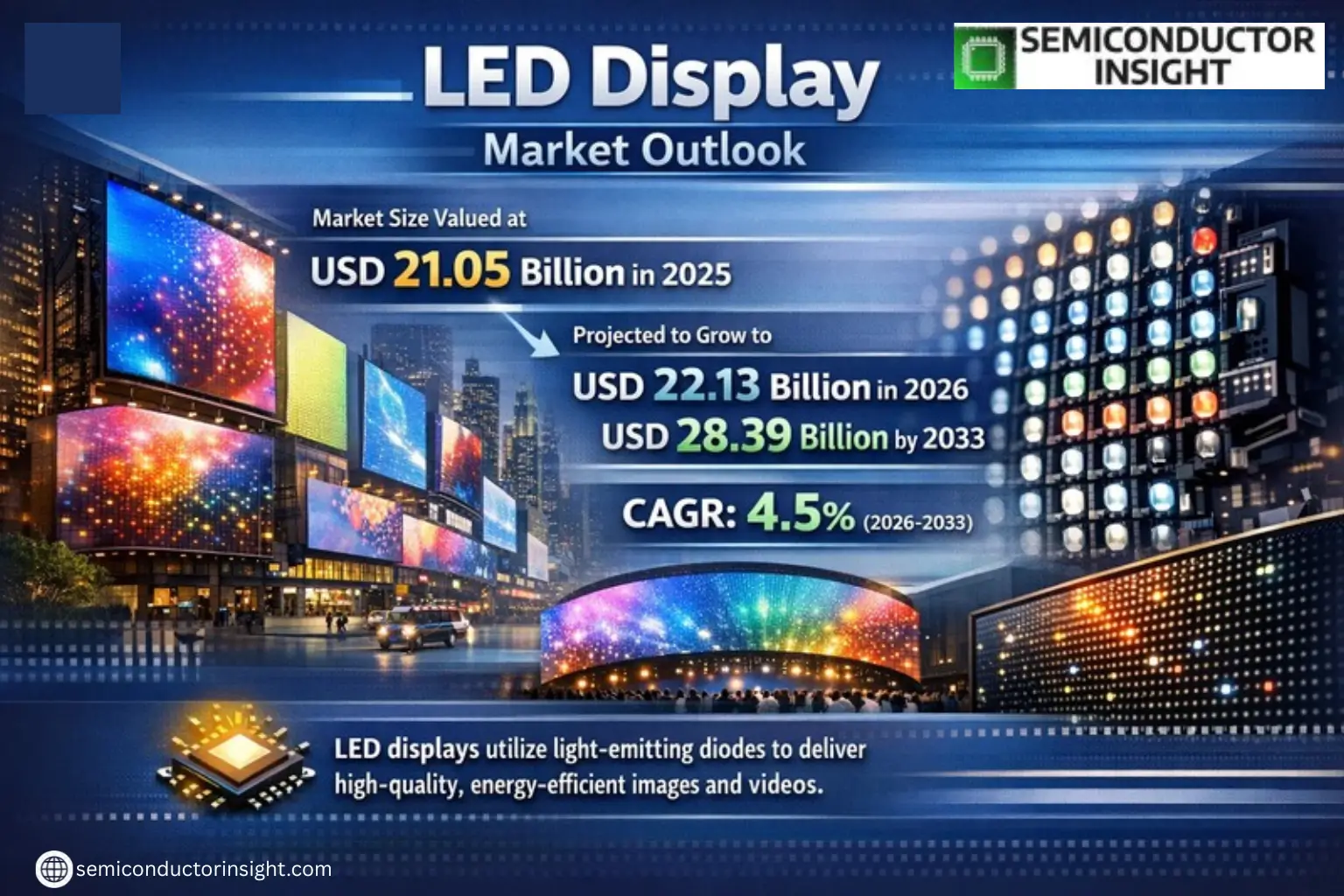
Global LED Display Market size was valued at USD 21.05 billion in 2025 and is projected to grow from USD 22.13 billion in 2026 to USD 28.39 billion by 2033, exhibiting a CAGR of 4.5% during the forecast period.
LED displays are advanced visual technology solutions that utilize light-emitting diodes to produce high-quality, energy-efficient images and videos. These displays are widely used across various applications due to their superior brightness, durability, and flexibility compared to traditional display technologies. The market includes indoor LED displays for commercial and residential use, as well as outdoor LED displays designed for advertising, sports arenas, and public information systems.
The market growth is driven by increasing demand for digital signage in retail and advertising sectors, coupled with technological advancements such as higher resolution (mini-LED and micro-LED) and energy-efficient solutions. Furthermore, the rising adoption of LED displays in sports stadiums, transportation hubs, and smart city projects is accelerating market expansion. Key players like Leyard and Unilumin dominate the industry, collectively holding approximately 50% of the revenue share. Asia-Pacific leads the market with Japan accounting for over 45% of sales, followed closely by China.
MARKET DRIVERS
Growing Demand for Digital Out-of-Home Advertising
LED Display Market is experiencing significant growth due to rising demand for digital advertising solutions. Businesses are increasingly adopting LED displays for high-impact advertising, with the global market for digital out-of-home advertising expected to grow at 10% annually. Energy-efficient LED technology reduces operational costs, making it attractive for long-term installations.
Technological Advancements in LED Displays
Recent innovations such as micro-LED and mini-LED technologies are driving market expansion. These advancements offer superior brightness, contrast ratios, and energy efficiency compared to traditional displays. The market for fine-pitch LED displays is growing at 15% annually, catering to premium retail and corporate applications.
Government initiatives for smart city development are further propelling demand, with LED displays being integrated into traffic management systems and public information displays.
MARKET CHALLENGES
High Initial Investment Costs
LED Display Market faces barriers due to significant upfront costs for high-quality installations. Commercial-grade LED video walls can require investments exceeding USD 100,000 for large-scale deployments, limiting adoption among smaller businesses.
Other Challenges
Technical Complexities
Installation and maintenance of LED displays require specialized expertise, particularly for outdoor installations that must withstand environmental factors. Proper thermal management is critical to prevent premature failure of display components.
Content Management Requirements
Effective utilization of LED displays demands continuous content updates and scheduling systems, creating operational challenges for some businesses.
MARKET RESTRAINTS
Regulatory Constraints on Outdoor Advertising
Stringent regulations in urban areas regarding light pollution and digital signage content are limiting market growth in certain regions. Some municipalities have imposed restrictions on brightness levels and operating hours for outdoor LED displays, particularly in residential areas.
MARKET OPPORTUNITIES
Expansion in Retail and Hospitality Sectors
The retail sector presents significant growth potential for LED displays, with digital signage solutions enabling dynamic pricing and promotional content. Luxury retail brands are adopting curved and transparent LED displays to enhance in-store experiences, driving premium segment growth.
Emerging Applications in Virtual Production
The film and television industry’s adoption of LED walls for virtual production stages creates new revenue streams. This application requires high-end LED displays with superior color accuracy and refresh rates, commanding premium pricing in the market.
LED Display Market Trends
Steady Growth in Global LED Display Market
Global LED Display Market was valued at USD 2,105 million in 2025 and is projected to reach USD 2,839 million by 2033, growing at a CAGR of 4.5%. This growth is driven by increasing demand in advertising, sports arenas, and information display applications. Asia-Pacific dominates the market with Japan and China accounting for over 45% of global sales.
Other Trends
Market Segmentation by Application
Advertising media represents the largest application segment, followed by sports arenas and information displays. The traffic & security sector shows the fastest growth potential due to smart city initiatives worldwide. Stage performance applications are recovering post-pandemic with increased live events.
Technological Advancements Driving Innovation
Manufacturers are focusing on higher resolution micro-LED displays and energy-efficient solutions. The transition to finer pitch LED technology continues, enabling closer viewing distances. Flexible and transparent LED displays are gaining traction for creative installations. The market remains competitive with top 5 players holding about 50% revenue share.
Regional Market Developments
North America and Europe show steady adoption of LED displays for digital signage. Middle East infrastructure projects are boosting demand for large-format outdoor displays. Emerging markets in Southeast Asia demonstrate growing adoption in retail and transportation sectors.
Supply Chain and Pricing Trends
The industry faces challenges from component shortages and logistics constraints. Average selling prices are declining for standard displays but premium for innovative products. Manufacturers are establishing local production facilities to mitigate geopolitical risks and reduce lead times.
COMPETITIVE LANDSCAPE
Key Industry Players
Global LED Display Market Dominated by Top 5 Players Holding 50% Revenue Share
Global LED Display Market features a concentrated competitive landscape with Leyard and Unilumin leading as dominant players. These two companies, along with Samsung, Barco, and Daktronics, collectively control approximately 50% of the market revenue share. The industry exhibits strong regional presence with Japanese and Chinese manufacturers accounting for the largest production capacities, while North American and European firms maintain technological leadership in high-end display solutions.
Specialized manufacturers like Absen, Liantronics, and Lighthouse have carved significant niches in outdoor LED displays and control systems. Emerging Chinese players such as QSTech, AOTO, and Yestech Optoelectronic are rapidly expanding their global footprint through competitive pricing and technological advancements, particularly in the advertising media and sports arena segments.
List of Key LED Display Companies Profiled
- Leyard Optoelectronic
- Unilumin Group
- Samsung Electronics
- Daktronics
- Barco NV
- Absen Optoelectronic
- Sansitech
- Liantronics
- Lighthouse Technologies
- Ledman Optoelectronic
- Mary Photoelectricity
- QSTech
- AOTO Electronics
- Lopu Optoelectronics
- Shenzhen CLT
Segment Analysis:
| Segment Category | Sub-Segments | Key Insights |
| By Type |
|
Outdoor LED Display dominates due to:
|
| By Application |
|
Advertising Media leads with strong drivers:
|
| By End User |
|
Commercial sector shows strongest adoption because:
|
| By Technology |
|
Surface Mounted (SMD) technology leads due to:
|
| By Color Configuration |
|
Full Color (RGB) dominates the market owing to:
|
Regional Analysis: Global LED Display Market
China controls over 60% of global LED display production capacities, with Shenzhen hosting the world’s largest concentration of display manufacturers. The region benefits from mature supply chains covering LED chips, drivers, and assembly.
Japanese and Korean firms pioneer mini/micro-LED technologies, while Chinese manufacturers lead in cost-effective SMD solutions. The region files the majority of global LED display patents annually across fine-pitch and transparent displays.
From Tokyo’s digital billboards to Singapore’s smart city screens, applications span stadiums, retail, transportation hubs, and control rooms. The region shows particular strength in outdoor LED displays with weather-resistant technologies.
National digital transformation initiatives across APAC countries drive LED display adoption. China’s 14th Five-Year Plan prioritizes LED industry growth, while India’s Smart Cities Mission creates new installation opportunities.
North America
The North American LED Display Market thrives on technological innovation and premium applications. The United States leads in high-value installations for sports arenas, broadcasting studios, and enterprise solutions. Canadian markets show strong growth in retail and hospitality sectors. Regional demand focuses on energy-efficient, high-resolution displays with smart connectivity. The proximity to Silicon Valley drives adoption of IoT-integrated display solutions, while strict regulations push development of eco-friendly LED technologies. Market growth comes from upgrading existing display infrastructure to newer LED technologies across advertising, corporate, and public sectors.
Europe
European markets emphasize quality and sustainability in LED display solutions. Germany and the UK lead in commercial applications, while Nordic countries pioneer energy-saving technologies. The region shows strong demand for fine-pitch indoor displays in corporate and retail environments. EU regulations on energy efficiency and recyclability shape product development. Media façades and architectural lighting integrations represent growth segments, particularly in Western Europe. The market balances premium installations with mid-range solutions for smaller businesses, maintaining steady growth through technological differentiation rather than price competition.
Middle East & Africa
The Middle East demonstrates rapid LED display adoption fueled by mega-events and smart city projects. UAE and Saudi Arabia lead with large-scale outdoor installations and control room solutions. African markets show emerging demand concentrated in urban centers, particularly for advertising and information displays. The region presents unique challenges with extreme climate conditions, driving innovation in durable display solutions. While infrastructure limitations exist in some areas, the overall market shows high growth potential as digital transformation accelerates across commercial and government sectors.
South America
Brazil dominates the South American LED Display Market through its thriving advertising and events industries. The region shows strong preference for cost-effective solutions with Argentina and Chile emerging as secondary growth markets. While economic volatility sometimes impacts large projects, the flexibility of LED displays makes them increasingly popular for temporary installations. Government investments in digital signage for transportation and public information create steady demand. The market remains price-sensitive but shows growing sophistication in display applications and content management solutions.
Report Scope
This market research report provides a comprehensive analysis of the LED Display Market, covering the forecast period 2026–2033. It offers detailed insights into market dynamics, technological advancements, competitive landscape, and key trends shaping the industry.
Key focus areas of the report include:
- Market Overview: The report begins with an overview outlining its current market scenario, key growth indicators, and industry transformation drivers. It discusses macroeconomic factors, demand–supply balance, regulatory landscape, and the strategic role of semiconductors in powering advancements across industries such as automotive, telecommunications, consumer electronics, and industrial automation.
- Market Size & Forecast: Historical data and future projections for revenue, unit shipments, and market value across major regions and segments.
- Segmentation Analysis: Detailed breakdown by product type, technology, application, and end-user industry to identify high-growth segments and investment opportunities.
- Regional Insights: Insights into market performance across North America, Europe, Asia-Pacific, Latin America, and the Middle East & Africa, including country-level analysis where relevant.
- Competitive Landscape: Profiles of leading market participants, including their product offerings, R&D focus, manufacturing capacity, pricing strategies, and recent developments such as mergers, acquisitions, and partnerships.
- Technology Trends & Innovation: Assessment of emerging technologies, integration of AI/IoT, semiconductor design trends, fabrication techniques, and evolving industry standards.
- Market Drivers & Restraints: Evaluation of factors driving market growth along with challenges, supply chain constraints, regulatory issues, and market-entry barriers.
- Stakeholder Insights: Insights for component suppliers, OEMs, system integrators, investors, and policymakers regarding the evolving ecosystem and strategic opportunities.
Primary and secondary research methods are employed, including interviews with industry experts, data from verified sources, and real-time market intelligence to ensure the accuracy and reliability of the insights presented.
FREQUENTLY ASKED QUESTIONS:
What is the current market size of LED Display Market?
-> LED Display Market size was valued at USD 21.05 billion in 2025 and is projected to grow from USD 22.13 billion in 2026 to USD 28.39 billion by 2033, exhibiting a CAGR of 4.5% during the forecast period.
Which key companies operate in LED Display Market?
-> Key players include Leyard, Unilumin, Qiangli Jucai Opto-electronic Technology, Daktronics, Samsung, Absen, Sansitech, Barco, Liantronics, and Lighthouse, among others. The top 5 manufacturers hold about 50% of the revenue market share.
What are the key growth drivers?
-> Key growth drivers include increasing demand for advertising media, sports arenas, information displays, and stage performances, along with advancements in LED technology and urbanization.
Which region dominates the market?
-> Asia accounts for the most sales market share, with Japan holding over 45%, followed by China.
What are the emerging trends?
-> Emerging trends include high-resolution displays, energy-efficient technologies, and integration with IoT and AI.

Get Sample Report PDF for Exclusive Insights
Report Sample Includes
- Table of Contents
- List of Tables & Figures
- Charts, Research Methodology, and more...
 Download Sample Report PDF