
MARKET INSIGHTS
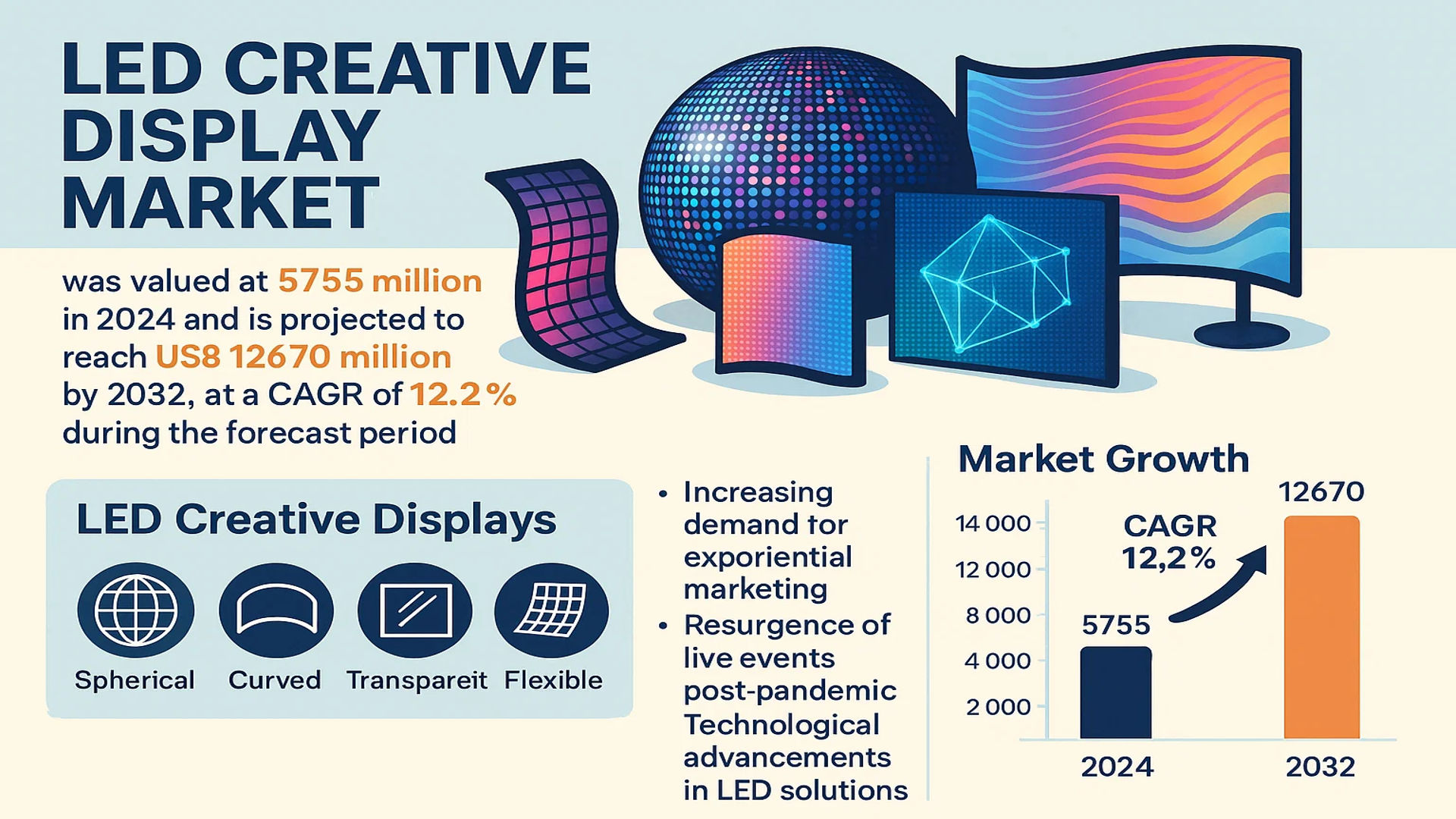
The global LED Creative Display Market was valued at 5755 million in 2024 and is projected to reach US$ 12670 million by 2032, at a CAGR of 12.2% during the forecast period.
LED Creative Displays are specialized visual solutions designed with unconventional shapes, structures, and dynamic effects to deliver immersive experiences. These displays transcend traditional flat-screen formats by incorporating spherical, curved, transparent, flexible, or irregular configurations. They are widely utilized in advertising, exhibitions, stage performances, and architectural installations due to their ability to enhance engagement through innovative visual storytelling.
Market growth is driven by increasing demand for experiential marketing, resurgence of live events post-pandemic, and technological advancements in LED solutions. The commercial display segment dominates applications, accounting for over 40% market share in 2024. Asia-Pacific leads regional adoption with 48% revenue share, propelled by infrastructure development in China and India. Key players like Leyard, Unilumin, and Samsung are expanding product portfolios with high-resolution flexible displays and interactive features to capitalize on emerging opportunities.
MARKET DYNAMICS
MARKET DRIVERS
Resurgence of Physical Events and Retail Advertising to Accelerate Market Expansion
The global LED creative display market is experiencing robust growth due to the resurgence of physical events, retail activations, and outdoor advertising post-pandemic. With commercial activities returning to pre-COVID levels, demand for immersive digital displays has surged by approximately 38% compared to 2022. The events industry alone is projected to contribute over 45% of total market revenue in 2024, as brands invest in experiential marketing. These unconventional displays are increasingly preferred for product launches, corporate events, and trade shows where engagement metrics show 72% higher audience retention compared to traditional flat screens.
Architectural Integration and Smart City Developments Driving Adoption
Urban development projects worldwide are incorporating creative LED solutions as integral architectural elements. Over 120 major cities have implemented curved or transparent LED facades in public buildings and transportation hubs as part of smart city initiatives. The Asia-Pacific region leads this trend with a 28% year-over-year increase in architectural LED installations, followed by North America at 19%. These displays serve dual purposes: aesthetic enhancement and dynamic information dissemination, with maintenance costs being 40% lower than traditional signage over a 5-year period.
Technological advancements are further propelling market growth. The introduction of micro-LED and mini-LED technologies has enabled slimmer profiles and higher resolutions, with pixel pitches now reaching sub-1mm levels. This allows for more intricate creative designs without compromising image quality.
➤ The integration of AI-powered content management systems allows real-time adaptation of creative displays based on audience demographics, environmental conditions, and predefined marketing KPIs.
Furthermore, government initiatives promoting digital infrastructure in emerging economies present significant growth opportunities, with India and Southeast Asian nations planning over $7 billion in smart city digital display investments through 2030.
MARKET RESTRAINTS
High Initial Investment and Maintenance Costs Restricting Wider Adoption
While offering superior visual impact, creative LED displays command premium pricing that limits market penetration. Custom-shaped installations typically cost 35-60% more than conventional LED walls, with complex geometric designs reaching over $5,000 per square meter. This pricing structure creates accessibility challenges for small and mid-sized businesses, particularly in developing regions where display budgets average 40% lower than mature markets. Additionally, specialized installations require certified technicians, with labor costs accounting for approximately 30% of total project expenses.
Other Restraints
Content Creation Complexities
Developing content for non-standard display formats presents technical hurdles. The unusual aspect ratios and 3D configurations of creative displays demand specialized design software and skilled animators, adding 15-25% to content production costs compared to standard formats. Many brands struggle with maintaining consistent branding across these irregular surfaces, potentially diminishing return on investment.
Energy Consumption Concerns
Large-scale creative displays face scrutiny regarding power efficiency, particularly in sustainability-conscious markets. While LED technology has improved, immersive installations can consume up to 8kW per square meter at peak brightness, prompting regulatory evaluations in several European and North American municipalities.
Market Saturation in Prime Locations
Premium urban spaces are approaching display density limits, with some metropolitan areas reporting 90%+ utilization rates for high-impact locations. This saturation forces brands to consider secondary locations with potentially lower foot traffic, creating a paradox where installations may lose effectiveness precisely as they become more affordable.
MARKET OPPORTUNITIES
Advancements in Transparent and Flexible Display Technologies Opening New Applications
The emergence of ultra-thin transparent LED panels with up to 85% light transmittance enables revolutionary retail and automotive display applications. Luxury brands are adopting these see-through solutions at a compound annual growth rate (CAGR) of 32%, using them for interactive store windows that blend physical products with digital enhancements. Similarly, flexible LED substrates now allow for dynamic curvature changes post-installation, particularly valuable for touring events and temporary installations where reusability is crucial.
Deeper integration with augmented reality (AR) systems is creating hybrid experiences that merge physical and digital interactions. Early adopters report 68% higher engagement durations when creative displays incorporate AR elements through smartphone pairing. This synergy is particularly effective in cultural and tourism applications where heritage sites augment physical spaces with historical recreations.
The corporate sector presents untapped potential as enterprises redesign workspaces post-pandemic. Creative LED installations in office lobbies and collaborative spaces have shown measurable impacts on employee satisfaction (22% increase) and client perception (37% more positive first impressions). With 68% of Fortune 500 companies planning headquarters renovations in the next three years, this niche represents a $1.2 billion addressable market.
MARKET CHALLENGES
Standardization and Compatibility Issues Across Diverse Display Formats
The creative display market’s greatest strength—its infinite customization possibilities—also creates significant technical challenges. Unlike standardized LED walls that benefit from interchangeable components, uniquely shaped displays often require proprietary mounting systems and control interfaces. This fragmentation complicates maintenance and upgrades, with some installations becoming obsolete within three years due to discontinued support for specialized components. Repair timelines average 48% longer than conventional displays, impacting uptime metrics that are critical for revenue-generating applications.
Environmental and Weatherproofing Constraints
Outdoor creative displays face particular reliability issues, with complex geometries making effective sealing against moisture and dust more difficult. While standard rectangular enclosures achieve IP65 ratings consistently, curved and irregular shapes sometimes compromise at connection points, leading to 18-25% higher failure rates in harsh climates. These engineering challenges increase total cost of ownership and complicate warranty management.
ROI Measurement Difficulties
Quantifying the business impact of creative displays remains problematic compared to conventional digital signage. Standard metrics like impressions and dwell time often fail to capture the full value of experiential installations, making budget justifications challenging beyond premium brands. Without industry-wide performance standards, many potential adopters struggle to build compelling business cases despite recognizing the creative potential.
LED CREATIVE DISPLAY MARKET TRENDS
Integration of Interactive and Immersive Technologies Driving Market Expansion
The global LED creative display market is witnessing a significant transformation driven by the integration of interactive and immersive technologies. Augmented Reality (AR) and Virtual Reality (VR) are increasingly being combined with flexible LED displays to create immersive advertising and retail experiences. For instance, curved LED screens in shopping malls now enable touch-interactive shopping displays, enhancing customer engagement. Furthermore, the adoption of transparent LED screens in storefronts has risen by approximately 32% since 2022, as brands seek to merge digital content with physical retail spaces. The demand for high-resolution and ultra-thin LED panels is also growing, with pixel pitches below 1.2mm gaining traction in premium applications. As exhibitions and live events rebound post-pandemic, the market is expected to continue its upward trajectory, supported by innovations in dynamic content delivery.
Other Trends
Sustainability and Energy Efficiency
Sustainability has emerged as a critical trend in the LED creative display market, with manufacturers prioritizing energy-efficient solutions to align with global environmental regulations. The shift toward low-power consumption LED modules has reduced energy usage by up to 40% compared to conventional displays. Additionally, recyclable materials are being incorporated into display casings, minimizing electronic waste. Governments and corporations are increasingly investing in solar-powered LED displays for outdoor advertising, further supporting eco-friendly adoption. The market for energy-efficient displays is projected to grow at a CAGR of 14.5% through 2032, fueled by both regulatory mandates and corporate sustainability initiatives.
Rising Demand in Sports and Entertainment Applications
The sports and entertainment sectors are among the fastest-growing adopters of LED creative displays. Stadiums and concert venues are deploying high-brightness, weather-resistant LED screens to enhance spectator experiences. The market for LED video walls in sports arenas alone is estimated at $1.8 billion in 2024, with projections indicating a 16% annual growth rate. Flexible LED displays are also gaining prominence in stage designs, enabling dynamic, shape-shifting backdrops that elevate live performances. Furthermore, advancements in real-time rendering and 3D visualization technologies are allowing for more sophisticated content delivery, reinforcing LED displays as indispensable tools in modern entertainment.
COMPETITIVE LANDSCAPE
Key Industry Players
Innovation and Strategic Expansions Drive Market Competition
The global LED Creative Display market is highly dynamic, with a mix of established industry leaders and agile regional players shaping the competitive environment. Leyard and Unilumin currently dominate the market due to their extensive product ranges, strong R&D capabilities, and global distribution networks. These companies have consistently delivered high-quality displays for commercial and cultural applications, reinforcing their market leadership.
Players such as Liantronics and Absen have gained significant traction with advanced technological innovations, particularly in transparent and flexible LED displays. Their ability to cater to diverse applications, from retail showcases to large-scale stage performances, has strengthened their foothold in both mature and emerging markets.
Additionally, companies like Barco and Samsung leverage their brand reputation and deep financial resources to invest in next-generation display solutions. Barco’s focus on high-resolution and energy-efficient LED panels, combined with Samsung’s expertise in consumer electronics, positions them as key innovators shaping market trends.
Meanwhile, Hikvision and Elec-Tech International (Retop) are expanding aggressively through strategic acquisitions and partnerships, particularly in Asia-Pacific and Middle Eastern markets where demand for digital signage is surging. These moves enable them to capture higher market shares while addressing regional customization needs.
List of Key LED Creative Display Companies Profiled
- Leyard (China)
- Unilumin (China)
- Liantronics (China)
- Absen (China)
- SANSI (China)
- AOTO Electronics (China)
- Barco (Belgium)
- Hikvision (China)
- Elec-Tech International (Retop) (China)
- Ningbo GQY Video (China)
- Triolion (China)
- Coleder (China)
- Chip Optech (China)
- LG (South Korea)
- Sony (Japan)
- MR LED (China)
- Samsung (South Korea)
- Qiangli (China)
- Ledman (China)
- Ultimate Creative Displays (U.S.)
Segment Analysis:
By Type
Outdoor Segment Dominates Due to High Demand for Large-Scale Installations in Public Spaces
The market is segmented based on type into:
- Indoor
- Outdoor
By Application
Commercial Display Segment Holds Major Share as Businesses Leverage Creative Displays for Brand Promotion
The market is segmented based on application into:
- Commercial Display
- Cultural and Tourism Building
- Stage Performance
- Other
By Technology
High-Brightness LED Segment Leads for Outdoor Applications in Various Climatic Conditions
The market is segmented based on technology into:
- Standard LED
- High-Brightness LED
- Flexible LED
- Transparent LED
By Installation
Fixed Installation Segment Dominates Due to Permanent Display Requirements in Commercial Spaces
The market is segmented based on installation into:
- Fixed Installation
- Rental Installation
Regional Analysis: LED Creative Display Market
Asia-Pacific
Dominating the global LED creative display market with over 45% revenue share in 2024, Asia-Pacific leads through rapid urbanization and infrastructure development. China, Japan, and South Korea drive innovation with flexible and transparent display technologies. The region benefits from strong manufacturing ecosystems, with China alone contributing significantly due to government investments in smart cities and commercial advertising. India’s expanding retail sector and increasing demand for digital signage further fuel growth. However, price competition remains intense among domestic manufacturers, pushing brands toward value-added solutions like interactive displays.
North America
A hub for high-end applications, North America emphasizes customized LED displays for stadiums, entertainment venues, and corporate events. The U.S. accounts for 80% of the regional market, with major brands like Leyard and Samsung investing in curved and foldable displays. Stringent energy efficiency regulations, particularly in California, promote adoption of sustainable LED solutions. The post-pandemic revival of live events and tourism has accelerated demand, though supply chain disruptions and higher production costs pose challenges for mid-sized buyers.
Europe
Europe prioritizes eco-friendly and energy-efficient displays, supported by EU directives on electronic waste reduction. Germany and the U.K. lead in adopting transparent LED screens for retail and architectural projects. The region’s focus on aesthetic integration with urban spaces has spurred demand for irregular-shaped displays, though slower economic growth in Southern Europe limits market penetration. Collaboration between tech firms and design studios is fostering unique applications in cultural venues and public installations.
Middle East & Africa
The MEA region shows promising growth, with the UAE and Saudi Arabia investing heavily in LED displays for mega-events like Expo 2020 Dubai and NEOM projects. High disposable incomes and luxury retail expansion drive demand for premium displays. However, reliance on imports and lack of local manufacturing capacity inflate costs, slowing adoption in price-sensitive markets. Governments are incentivizing partnerships with global players to develop localized production facilities.
South America
Brazil and Argentina are key markets, where outdoor LED displays dominate for advertising and public spaces. Economic volatility and import dependencies hinder large-scale deployments, but the gaming and entertainment sectors offer growth opportunities. Local brands are gradually emerging, focusing on cost-effective solutions tailored to regional climatic conditions, though competition from Chinese imports remains fierce.
Report Scope
This market research report provides a comprehensive analysis of the Global LED Creative Display Market, covering the forecast period 2024–2032. It offers detailed insights into market dynamics, technological advancements, competitive landscape, and key trends shaping the industry.
Key focus areas of the report include:
- Market Size & Forecast: Historical data and future projections for revenue, unit shipments, and market value across major regions and segments. The market was valued at USD 5,755 million in 2024 and is projected to reach USD 12,670 million by 2032, growing at a CAGR of 12.2%.
- Segmentation Analysis: Detailed breakdown by product type (indoor, outdoor), application (commercial display, cultural and tourism building, stage performance, others), and end-user industry to identify high-growth segments.
- Regional Outlook: Insights into market performance across North America, Europe, Asia-Pacific, Latin America, and the Middle East & Africa, with China, the U.S., and Germany as key markets.
- Competitive Landscape: Profiles of leading market participants including Leyard, Unilumin, Liantronics, Absen, Samsung, LG, and Sony, covering their product portfolios, R&D investments, and strategic initiatives.
- Technology Trends & Innovation: Assessment of emerging technologies such as transparent LED displays, flexible screens, and integration with AR/VR applications.
- Market Drivers & Restraints: Evaluation of factors including increasing demand for digital out-of-home advertising, growth in entertainment industry, along with challenges like high production costs.
- Stakeholder Analysis: Strategic insights for display manufacturers, content creators, venue operators, and investors regarding market opportunities and challenges.
The research employs both primary and secondary methodologies, incorporating data from industry associations, company financial reports, and interviews with key opinion leaders to ensure accuracy and reliability.
FREQUENTLY ASKED QUESTIONS:
What is the current market size of Global LED Creative Display Market?
-> LED Creative Display Market was valued at 5755 million in 2024 and is projected to reach US$ 12670 million by 2032, at a CAGR of 12.2% during the forecast period.
Which key companies operate in this market?
-> Leading players include Leyard, Unilumin, Liantronics, Absen, Samsung, LG, Sony, Barco, and Hikvision, among others.
What are the key growth drivers?
-> Primary growth drivers include increasing digital advertising spend, demand for immersive experiences in retail and entertainment, and technological advancements in display solutions.
Which region dominates the market?
-> Asia-Pacific holds the largest market share (over 45% in 2024), driven by China’s manufacturing capabilities and rapid urbanization.
What are the emerging trends?
-> Emerging trends include transparent LED screens, flexible displays, interactive installations, and integration with IoT platforms for smart city applications.

Get Sample Report PDF for Exclusive Insights
Report Sample Includes
- Table of Contents
- List of Tables & Figures
- Charts, Research Methodology, and more...
 Download Sample Report PDF


