Key Statistics
Key Takeaways
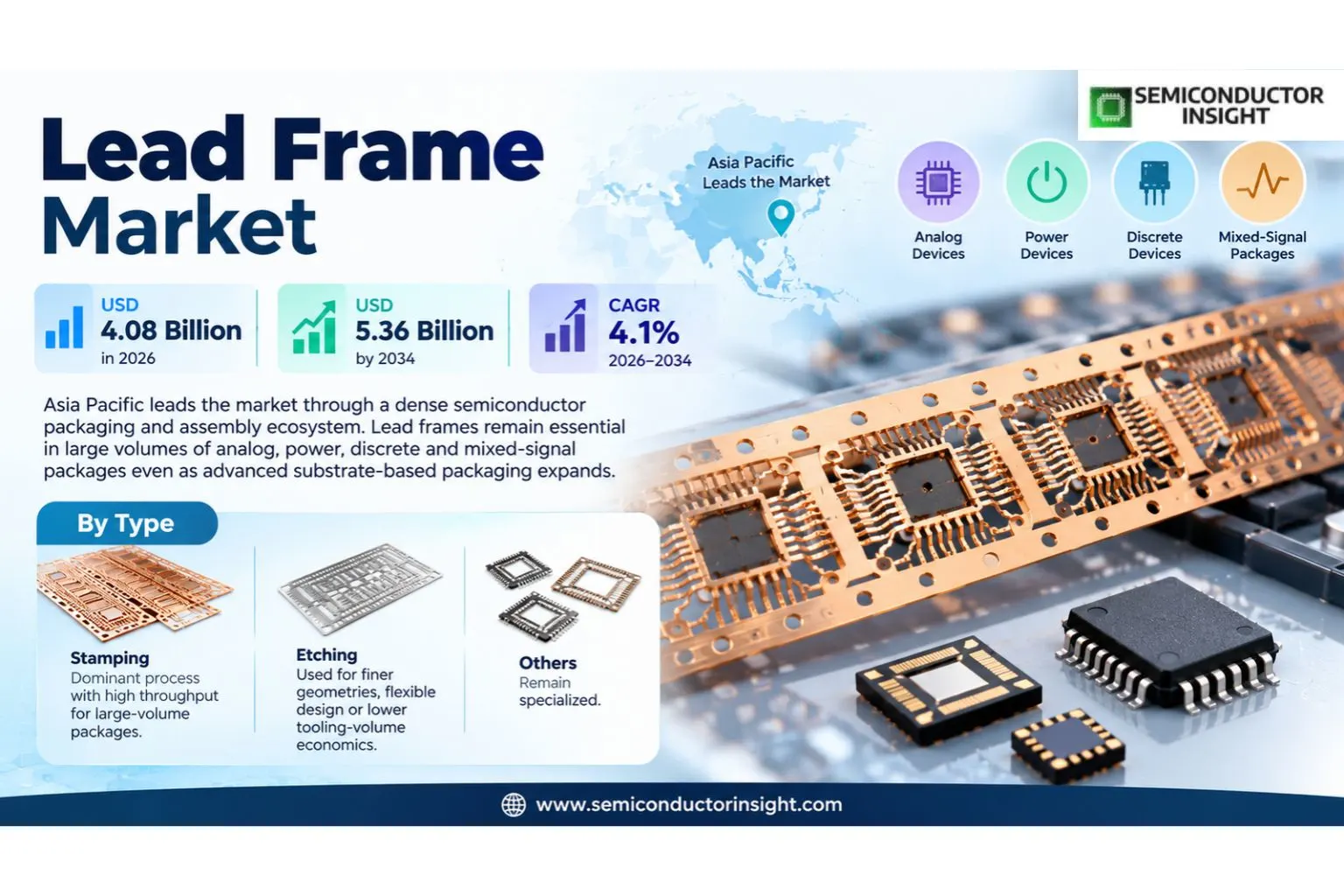
- Market size: The market is valued at USD 3.92 billion in 2025 and is projected to reach USD 5.36 billion by 2034, representing a 4.1% CAGR during 2026–2034.
- Stamping accounts for the majority of production because high-volume standardized packages favor low unit cost and fast throughput.
- Integrated circuits are the largest application, representing the majority of lead-frame demand across consumer, industrial and automotive devices.
- Asia Pacific leads production, with China, Japan, South Korea and Taiwan combining semiconductor assembly, materials and lead-frame manufacturing.
- QFN, DFN and power packages are increasing lead-frame value density as devices require better thermal performance, finer pitch and more complex exposed-pad structures.
Lead Frame Market Overview
lead frame market is valued at USD 3.92 billion in 2025 and is projected to reach USD 5.36 billion by 2034, expanding at a 4.1% CAGR during 2026–2034. The 2026 market level is USD 4.08 billion. Asia Pacific leads the market through a dense semiconductor packaging and assembly ecosystem. Lead frames remain essential in large volumes of analog, power, discrete and mixed-signal packages even as advanced substrate-based packaging expands.
Lead frames are precision metal structures that support semiconductor die and create electrical paths from the chip to external package terminals. They consist of a die pad, leads and temporary tie bars and are manufactured mainly through stamping or chemical etching. Lead frames remain attractive because they provide low cost, good thermal conduction and mature high-volume assembly for QFN, DFN, SOIC, power devices and many automotive packages.
Technology development focuses on finer pitch, exposed-pad structures, surface plating and improved copper alloys. SHINKO manufactures both stamped and etched lead frames and offers pre-plated Ni/Pd/Au structures that eliminate a downstream solder-plating step. This improves fine-pitch solderability and migration resistance while shortening assembly flow, which is valuable in high-volume semiconductor packaging.
Demand is linked directly to packaged semiconductor unit volume rather than wafer starts alone. Automotive electrification, power management and consumer electronics continue to use lead-frame-based packages because their cost and thermal performance remain competitive. Suppliers differentiate through precision tooling, plating quality, material thickness, dimensional control and the ability to support automotive-grade reliability over long production lifecycles.
Segment Analysis: By Type
By type, stamping is the dominant process because it provides high throughput for large-volume packages. Etching is used where finer geometries, flexible design or lower tooling-volume economics are preferred. Other processes remain specialized. The choice depends on pitch, metal thickness, package complexity and expected production volume. For commercial decisions in the Lead Frame market, buyers also weigh qualification evidence, integration effort, operating reliability, lifecycle support, supply continuity and measurable system-level value rather than a single specification.
| Type | Commercial role |
|---|---|
| Stamping Process Lead Frame | High-volume production with low unit cost and strong repeatability. |
| Etching Process Lead Frame | Fine geometry and flexible designs for complex or lower-volume packages. |
| Others | Specialized hybrid or process-specific lead-frame structures. |
Additional Segmentation: By Package Family
Package family is a useful commercial segmentation because lead-frame geometry and value differ substantially between QFN/DFN, conventional leaded IC packages and power/discrete devices. QFN and DFN require fine-pitch exposed pads, while power packages emphasize current carrying and thermal performance. Legacy leaded packages remain important in industrial and automotive systems with long qualification cycles.
| Package Family | Demand characteristics |
|---|---|
| QFN / DFN | Fine-pitch leadless packages with exposed pads and strong thermal performance. |
| SOIC / TSSOP | Mature leaded IC packages for analog, mixed-signal and industrial devices. |
| Power & Discrete | High-current and thermally optimized packages for MOSFETs, diodes and power ICs. |
| Others | Sensors, specialty ICs and application-specific lead-frame package formats. |
Segment Analysis: By Application
By application, integrated circuits represent the largest demand segment, followed by discrete devices and other semiconductor components. Analog, power-management and automotive ICs use lead-frame packages extensively, while discrete MOSFETs and diodes require mechanically robust structures with low electrical and thermal resistance. For commercial decisions in the Lead Frame market, buyers also weigh qualification evidence, integration effort, operating reliability, lifecycle support, supply continuity and measurable system-level value rather than a single specification.
| Application | Demand characteristics |
|---|---|
| Integrated Circuit | Analog, power-management, MCU, mixed-signal and connectivity packages. |
| Discrete Device | MOSFETs, diodes, transistors and other power or signal discretes. |
| Others | Sensors, optoelectronic and specialized semiconductor packages. |
Additional Segmentation: By Material
Copper alloys dominate because they combine electrical and thermal conductivity with suitable mechanical strength. Iron-nickel alloys remain important where thermal expansion matching or dimensional stability is required. Surface finishes such as Ni/Pd/Au or silver are added to support wire bonding, soldering and corrosion resistance without changing the core frame material.
| Material | Commercial relevance |
|---|---|
| Copper Alloy | Dominant material for thermal and electrical performance in high-volume packages. |
| Iron-Nickel Alloy | Used where controlled thermal expansion and mechanical stability are important. |
| Other Materials | Specialty alloys and plated structures for niche reliability requirements. |
Regional Analysis
Asia Pacific leads both production and consumption because semiconductor assembly and test, lead-frame fabrication and electronics manufacturing are heavily concentrated in China, Japan, South Korea, Taiwan and Southeast Asia. North America and Europe are smaller in manufacturing volume but important in automotive, industrial and high-reliability device demand. For commercial decisions in the Lead Frame market, buyers also weigh qualification evidence, integration effort, operating reliability, lifecycle support, supply continuity and measurable system-level value rather than a single specification.
Why does regional demand differ across the Lead Frame market?
Lead-frame supply is geographically linked to OSAT and IDM packaging factories. Asia Pacific therefore has a structural cost and logistics advantage, while North American and European customers influence reliability and automotive specifications. Supplier selection depends on proximity to package assembly, tooling turnaround and the ability to support multi-site semiconductor programs.
| Region | Position | Demand profile | Supplier-selection factor |
|---|---|---|---|
| Asia Pacific | Largest / fastest | Semiconductor assembly, electronics | Packaging ecosystem |
| North America | High-value | Automotive, industrial, analog | Reliability and design |
| Europe | Strategic | Automotive, power semiconductors | Qualification and power devices |
| South America | Emerging | Downstream electronics | Imported packaged devices |
| Middle East & Africa | Emerging | Industrial electronics | Limited local packaging |
Competitive Landscape
Mitsui High-tec, SHINKO, Chang Wah Technology, SDI, POSSEHL, Kangqiang, Enomoto and other suppliers compete through tooling precision, stamping or etching capability, surface treatment and proximity to semiconductor assembly sites. The source analysis indicates the leading three suppliers hold a meaningful combined share, but the wider market remains fragmented. For commercial decisions in the Lead Frame market, buyers also weigh qualification evidence, integration effort, operating reliability, lifecycle support, supply continuity and measurable system-level value rather than a single specification.
SHINKO’s pre-plated lead frames demonstrate how surface treatment can add value beyond the base metal structure. Ni/Pd/Au plating can remove an external solder-plating step and improve fine-pitch assembly reliability. Similar process integration allows suppliers to defend margins as basic stamped frames face pricing pressure. For commercial decisions in the Lead Frame market, buyers also weigh qualification evidence, integration effort, operating reliability, lifecycle support, supply continuity and measurable system-level value rather than a single specification.
Automotive and power packages provide the strongest premium segment because customers demand traceability, long-term supply and tight dimensional control. Once a lead frame and package are qualified, switching suppliers can require revalidation of assembly and reliability performance, creating durable customer relationships. For commercial decisions in the Lead Frame market, buyers also weigh qualification evidence, integration effort, operating reliability, lifecycle support, supply continuity and measurable system-level value rather than a single specification.
| Competitive tier | Representative companies | Primary differentiation |
|---|---|---|
| Global precision leaders | Mitsui High-tec, SHINKO, Chang Wah | High-volume stamping/etching, advanced plating and global OSAT relationships. |
| Regional packaging specialists | POSSEHL, SDI, Enomoto | Automotive, power and application-specific lead-frame capabilities. |
| Cost-focused Asian suppliers | Kangqiang and other regional manufacturers | High-volume standard packages and competitive pricing. |
Key companies profiled
Mitsui High-tec, SHINKO Electric Industries, Chang Wah Technology, POSSEHL, SDI, Enomoto, Kangqiang and other lead-frame manufacturers are included in the competitive scope. Their positions differ by stamping versus etching mix, plating technology, customer base and proximity to semiconductor assembly operations. For commercial decisions in the Lead Frame market, buyers also weigh qualification evidence, integration effort, operating reliability, lifecycle support, supply continuity and measurable system-level value rather than a single specification.
Production Capacity Analysis
Manufacturing capacity depends on precision stamping presses, chemical etching lines, plating equipment, tooling and high-speed inspection. Stamping offers high throughput but requires dedicated dies, while etching can support fine features with lower tooling commitment. Plating capacity can become a bottleneck for premium automotive and QFN products. For commercial decisions in the Lead Frame market, buyers also weigh qualification evidence, integration effort, operating reliability, lifecycle support, supply continuity and measurable system-level value rather than a single specification.
Effective capacity is closely linked to OSAT locations because lead frames are bulky relative to their unit value and are consumed at very high volume. Suppliers therefore operate multiple plants near packaging clusters. Tooling turnaround and yield are important because a new package design can require dedicated dies and tight dimensional capability.
Market Dynamics
The market grows with semiconductor unit volume, automotive electronics, power devices and miniaturized packages. Growth is restrained by substrate-based packaging migration, metal-price volatility and pricing pressure in standard packages. Fine-pitch QFN/DFN, power devices and value-added plating offer the strongest opportunities. For commercial decisions in the Lead Frame market, buyers also weigh qualification evidence, integration effort, operating reliability, lifecycle support, supply continuity and measurable system-level value rather than a single specification.
Market Drivers
| Driver | Impact | Commercial mechanism |
|---|---|---|
| Semiconductor unit growth | High | More packaged ICs and discretes require more lead frames. |
| Automotive electrification | High | Vehicles use more power, sensor and control semiconductors. |
| QFN/DFN adoption | Medium-High | Leadless packages provide compact size and good thermal performance. |
| Power semiconductors | Medium | Discrete MOSFETs and power ICs require thermally efficient metal structures. |
Semiconductor unit growth
Analog, power and mixed-signal semiconductors continue to use lead-frame packages in very large volumes. Even modest semiconductor unit growth creates substantial demand because one frame is consumed for every packaged device. For commercial decisions in the Lead Frame market, buyers also weigh qualification evidence, integration effort, operating reliability, lifecycle support, supply continuity and measurable system-level value rather than a single specification.
Automotive electrification
EVs, ADAS and power electronics increase semiconductor content per vehicle. Many of these devices use robust lead-frame packages with exposed thermal pads and long qualification histories. For commercial decisions in the Lead Frame market, buyers also weigh qualification evidence, integration effort, operating reliability, lifecycle support, supply continuity and measurable system-level value rather than a single specification.
QFN/DFN adoption
QFN and DFN structures remain attractive for power management, RF and automotive ICs. Fine-pitch geometries raise manufacturing complexity and support higher-value lead frames. For commercial decisions in the Lead Frame market, buyers also weigh qualification evidence, integration effort, operating reliability, lifecycle support, supply continuity and measurable system-level value rather than a single specification.
Power semiconductors
Lead frames conduct heat and current efficiently, making them well suited to power packages. Growth in industrial and automotive power electronics supports this application. For commercial decisions in the Lead Frame market, buyers also weigh qualification evidence, integration effort, operating reliability, lifecycle support, supply continuity and measurable system-level value rather than a single specification.
Market Restraints
| Restraint | Impact | Commercial consequence |
|---|---|---|
| Advanced substrate substitution | High | Some high-end packages migrate to organic or glass substrates. |
| Metal price volatility | Medium-High | Copper and alloy costs affect unit economics. |
| Tooling cost | Medium | Stamped designs require dedicated precision dies. |
| Pricing pressure | Medium | Standard package lead frames are highly competitive. |
Advanced substrate substitution
As I/O count and routing density increase, packages may shift from lead frames to laminate substrates or fan-out structures. Lead frames remain competitive where cost and thermal simplicity matter. For commercial decisions in the Lead Frame market, buyers also weigh qualification evidence, integration effort, operating reliability, lifecycle support, supply continuity and measurable system-level value rather than a single specification.
Metal price volatility
Lead frames use large volumes of copper alloy and plating materials. Price changes can pressure margins, especially in standard products sold under long-term customer contracts. For commercial decisions in the Lead Frame market, buyers also weigh qualification evidence, integration effort, operating reliability, lifecycle support, supply continuity and measurable system-level value rather than a single specification.
Tooling cost
High-volume stamping is economical after tooling is amortized, but new or low-volume package variants can be expensive to launch. Etching provides flexibility but has different cost trade-offs. For commercial decisions in the Lead Frame market, buyers also weigh qualification evidence, integration effort, operating reliability, lifecycle support, supply continuity and measurable system-level value rather than a single specification.
Pricing pressure
Large OSAT customers negotiate aggressively and qualify multiple suppliers. Vendors need advanced plating, fine pitch or automotive quality to defend premium pricing. For commercial decisions in the Lead Frame market, buyers also weigh qualification evidence, integration effort, operating reliability, lifecycle support, supply continuity and measurable system-level value rather than a single specification.
Market Opportunities
Automotive lead frames
AEC-qualified power and control packages offer long product lifecycles and premium reliability requirements. For commercial decisions in the Lead Frame market, buyers also weigh qualification evidence, integration effort, operating reliability, lifecycle support, supply continuity and measurable system-level value rather than a single specification. For commercial decisions in the Lead Frame market, buyers also weigh qualification evidence, integration effort, operating reliability, lifecycle support, supply continuity and measurable system-level value rather than a single specification.
Pre-plated frames
Ni/Pd/Au and other finishes can eliminate downstream steps and improve assembly economics. For commercial decisions in the Lead Frame market, buyers also weigh qualification evidence, integration effort, operating reliability, lifecycle support, supply continuity and measurable system-level value rather than a single specification. For commercial decisions in the Lead Frame market, buyers also weigh qualification evidence, integration effort, operating reliability, lifecycle support, supply continuity and measurable system-level value rather than a single specification.
Fine-pitch QFN/DFN
Miniaturization creates demand for tighter tolerances and high-density etched or stamped structures. For commercial decisions in the Lead Frame market, buyers also weigh qualification evidence, integration effort, operating reliability, lifecycle support, supply continuity and measurable system-level value rather than a single specification. For commercial decisions in the Lead Frame market, buyers also weigh qualification evidence, integration effort, operating reliability, lifecycle support, supply continuity and measurable system-level value rather than a single specification.
High-current power packages
EV and industrial power devices need lower-resistance frames and advanced exposed-pad designs. For commercial decisions in the Lead Frame market, buyers also weigh qualification evidence, integration effort, operating reliability, lifecycle support, supply continuity and measurable system-level value rather than a single specification. For commercial decisions in the Lead Frame market, buyers also weigh qualification evidence, integration effort, operating reliability, lifecycle support, supply continuity and measurable system-level value rather than a single specification.
Supply Chain Analysis
Materials. Copper alloys and iron-nickel materials are supplied in strip form. Surface chemistry and mechanical properties influence stamping quality, wire bonding and thermal performance. For commercial decisions in the Lead Frame market, buyers also weigh qualification evidence, integration effort, operating reliability, lifecycle support, supply continuity and measurable system-level value rather than a single specification.
Frame production. Precision presses or etching lines create the die paddle and lead fingers. Plating and surface treatments are then added, followed by dimensional and surface inspection. For commercial decisions in the Lead Frame market, buyers also weigh qualification evidence, integration effort, operating reliability, lifecycle support, supply continuity and measurable system-level value rather than a single specification.
Assembly. Semiconductor die are attached to the paddle, wire-bonded or otherwise interconnected, molded and singulated. Lead-frame quality directly affects package yield and solderability. For commercial decisions in the Lead Frame market, buyers also weigh qualification evidence, integration effort, operating reliability, lifecycle support, supply continuity and measurable system-level value rather than a single specification.
Deployment. Finished devices are used in automotive, industrial, consumer and telecom equipment. Long package lifecycles create recurring demand for qualified frame designs. For commercial decisions in the Lead Frame market, buyers also weigh qualification evidence, integration effort, operating reliability, lifecycle support, supply continuity and measurable system-level value rather than a single specification.
Recent Developments in the Lead Frame Market
Developments tracked through September 2026 and limited to events that materially affect technology, capacity, adoption or competition.
- 2026 Commercial Portfolio
SHINKO continued to offer a broad lead-frame portfolio produced through ultra-precision stamping and chemical etching, including non-lead, leaded, exposed-pad and pre-plated package structures. Source - 2026 Product Technology
SHINKO’s pre-plated lead frames use a Ni/Pd/Au three-layer finish across the frame surface, eliminating an external solder-plating process and supporting fine-pitch package reliability. Source - 2025–2026 Market Structure
Lead-frame suppliers continued focusing on miniaturized QFN/DFN and automotive packages where dimensional control, thermal performance and value-added plating create differentiation over commodity frames. Source
Report Scope & Segmentation
| Attribute | Scope |
|---|---|
| Base year | 2025 |
| Estimated year | 2026 |
| Forecast period | 2026–2034 |
| 2025 market size | USD 3.92 billion |
| 2026 estimated size | USD 4.08 billion |
| 2034 projected size | USD 5.36 billion |
| CAGR (2026–2034) | 4.1% |
| Largest market in 2025 | Asia Pacific |
| By Type | Stamping Process Lead Frame; Etching Process Lead Frame; Others |
| By Application | Integrated Circuit; Discrete Device; Others |
| By Package Family | QFN/DFN; SOIC/TSSOP; Power & Discrete; Others |
| By Material | Copper Alloy; Iron-Nickel Alloy; Other Materials |
| Companies profiled | Mitsui High-tec; SHINKO; Chang Wah Technology; POSSEHL; SDI; Enomoto; Kangqiang and other lead-frame suppliers |
Frequently Asked Questions
What is the lead frame market size in 2025?
The global lead frame market is valued at USD 3.92 billion in 2025.
What is the market forecast for 2034?
The market is projected to reach USD 5.36 billion by 2034, representing a 4.1% CAGR during 2026–2034. The 2026 market level is USD 4.08 billion.
Which region leads the market?
Asia Pacific leads production and consumption because semiconductor assembly and lead-frame manufacturing are heavily concentrated in the region.
Which manufacturing process is largest?
Stamping is the dominant process because it provides low unit cost and high throughput for large-volume packages.
Which application is largest?
Integrated circuits account for the largest share of lead-frame demand, followed by discrete semiconductor devices.
Why are QFN and DFN important?
They use fine-pitch lead-frame structures with exposed thermal pads, combining compact size with strong electrical and thermal performance.
Who are the major suppliers?
Mitsui High-tec, SHINKO, Chang Wah Technology, POSSEHL and other Asian and global packaging suppliers are major participants.
What materials are used?
Copper alloys dominate because of conductivity and thermal performance, with iron-nickel alloys used where controlled expansion is valuable.
What limits market growth?
Migration to substrate-based packages, metal-price volatility, tooling cost and price competition are the main restraints.
What will drive growth through 2034?
Semiconductor unit growth, automotive electronics, power devices and fine-pitch QFN/DFN packages will support demand.
Research Sources & Evidence Base
View research sources used in this market overview
- SHINKO Electric Industries — Semiconductor Package Lead Frames. Current stamping, etching and package-structure evidence.
- SHINKO Electric Industries — Pre-Plated Lead Frame. Ni/Pd/Au plating and assembly-benefit evidence.
Get Sample Report PDF for Exclusive Insights
Report Sample Includes
- Table of Contents
- List of Tables & Figures
- Charts, Research Methodology, and more...
 Download Sample Report PDF